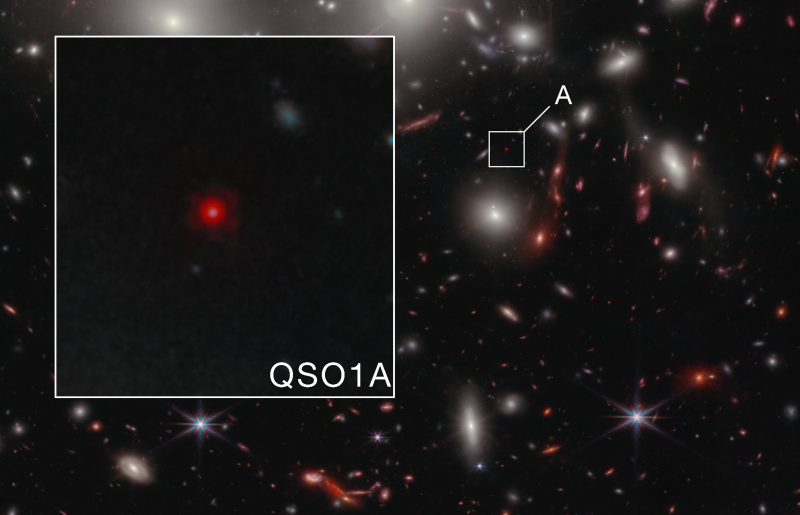
- QSO1 is a tiny galaxy from the early universe. It contains a supermassive black hole in its center. Which came first, the galaxy or the black hole?
- A new study says that the black hole came first, contrary to expectations.
- Galaxies like these are probably quite common, the researchers say.
Black hole or galaxy: Which came 1st?
When we look out into the universe, we see countless distant galaxies with supermassive black holes at their centers. Astronomers believe most galaxies have supermassive black holes. There’s one in our own Milky Way! But which came first: the black hole or the galaxy? A new study has found that, at least in one case, it was the black hole.
Astronomers long assumed that galaxies formed first. In that scenario, a huge cloud of gas would give rise to the galaxy’s stars. When the largest of these stars run out of fuel, they would collapse and form black holes. These black holes would grow by feeding on stars, gas and merging with other black holes, until they eventually form a supermassive black hole.
But researchers led by the University of Cambridge in the U.K., said on May 27, 2026, that the giant black hole in the center of the tiny galaxy Abell2744-QSO1 predates its galaxy. This galactic black hole was huge right from the beginning.
The evidence for a black hole preceding its galaxy is a gamechanger. Co-author Roberto Maiolino at the University of Cambridge said:
This is a remarkable finding. It’s a paradigm shift, a total revisiting of the classical scenarios of how black holes form and grow.
Two new peer-reviewed papers were published: in Nature on May 27, 2026, and Monthly Notices of the Royal Astronomical Society on April 6, 2026.
QSO1 is an ancient, young galaxy
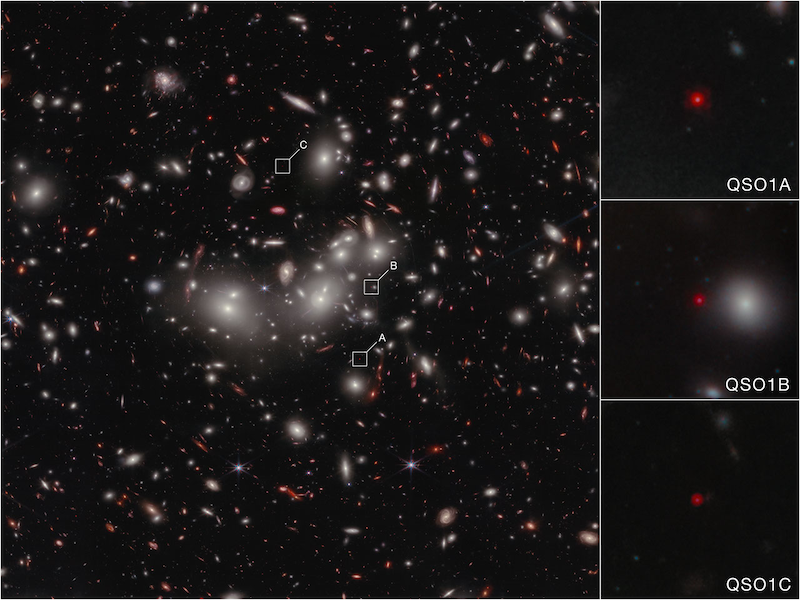
The galaxy Abell2744-QSO1 is what astronomers call a Little Red Dot. Little Red Dots are tiny, reddish objects, as seen by telescopes. They appear to be early forms of galaxies in the young universe. Scientists estimate that QSO1 formed only 700 million years after the Big Bang.
QSO1 is small for a galaxy, at only 1,300 light-years across. And like other Little Red Dots, it is incredibly far away and difficult to observe. But thankfully, QSO1 is gravitationally lensed by the galaxy cluster Abell 2744 (Pandora’s Cluster). The gravity of the cluster bends the light of QSO1, which magnifies it. This also causes the galaxy to be “mirrored,” so it appears in three different places in the sky.
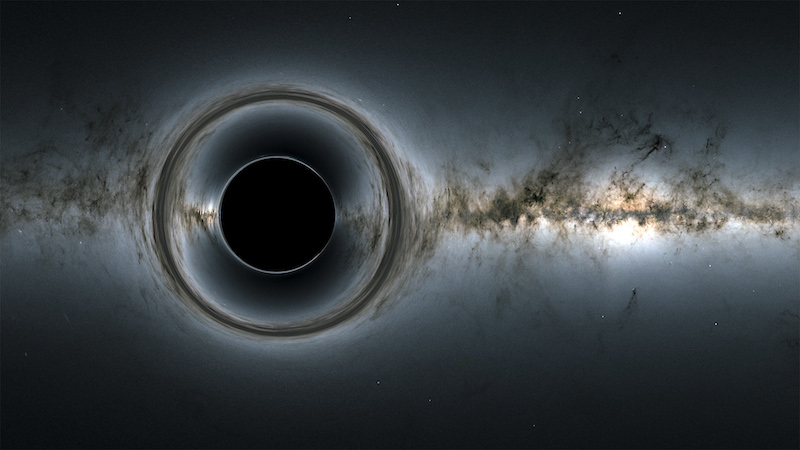
And QSO1 probably isn’t a galaxy in the way we usually think. Instead of a nice spiral with arms and a glowing center, it’s likely little more than a hydrogen and helium gas cloud around a black hole. Scientists estimate the supermassive black hole in its center is 50 million times the mass of our sun.
The observations of QSO1 are more detailed than for previous Little Red Dots. Co-author Francesco D’Eugenio at the University of Cambridge said:
Before now, all of the mass measurements of black holes in the early universe have been indirect, based on assumptions from what we know about them in the local universe. We didn’t know if those assumptions really apply to the distant universe.
A paper in Nature reports a direct measurement of a black hole mass in a distant object known as a little red dot, found in a galaxy dating back to when the Universe was just 700 million years old. go.nature.com/4nWSjKD ??
— Nature Portfolio (@natureportfolio.nature.com) 2026-05-27T22:13:01.316Z
Most of QSO1’s mass comes from its black hole
So how massive is the black hole in QSO1? To find out, the researchers used Webb’s NIRSpec (Near Infrared Spectrograph). It can trace the effects of the black hole’s gravity and also map the distribution of gas in QSO1.
The team found that the gas has Keplerian motion. That is, it orbits a single central point, similar to how our solar system’s planets orbit the sun. This also shows that most of the mass of QSO1 is taken up by the black hole. Ignas Juodžbalis, lead author of the Nature paper at the University of Cambridge, said:
This is important because it tells us that most of the mass of QSO1 is concentrated in the black hole at the center. If the mass were more distributed, as it would be if there were a lot of stars, the gas would not have this perfect Keplerian rotation.
By measuring the velocity of the gases in QSO1, the researchers could also determine the mass of the black hole. As it turned out, it is immense: 50 million times the mass of our sun. That means the black hole accounts for 2/3 of QSO1’s overall mass. That’s thousands of times more than we see in developed galaxies.
QSO1 is a pristine galaxy
The gases in the tiny galaxy are almost completely hydrogen and helium. Its metallicity – the proportion of elements that are heavier than hydrogen and helium – is over 200 times less than that of our sun. This makes it one of cleanest and “pristine” galactic environments that scientists have ever seen.
This matters because the birth and death of stars produces heavier elements, such as oxygen and carbon. The lack of these heavier elements suggests that this is not a galaxy rich in stars and stellar debris.

How did the black hole form?
So if the black hole came first, how did it form? Since it is so massive, the researchers don’t think it formed from smaller black holes merging together. This would have taken far longer and required a large stellar population. Instead, it might be a primordial black hole. These are hypothetical black holes that might have formed fractions of a second after the Big Bang. As Juodžbalis noted:
It seems that we have found a black hole that does not have a substantial host galaxy and that has predated stellar processes. This is very exciting because it is evidence for primordial black holes or direct collapse black holes, which have been theorized but not confirmed.
This means it was born large. It could have formed from a “heavy seed” within one second of the Big Bang or later when a giant cloud of gas collapsed.
Bottom line: QSO1 is an ancient Little Red Dot galaxy from the early universe. It contains a supermassive black hole. Which came 1st, the black hole or galaxy?
Source: A direct black-hole mass measurement in a little red dot at high redshift
Source: A black hole in a near pristine galaxy 700 Myr after the big bang
Read more: Little Red Dots might indicate ancient, growing black holes
Read more: Built not born: Huge black holes form in mergers, study says
Like what you read?
Subscribe and receive daily news delivered to your inbox.
More from
Paul Scott Anderson


Did formaldehyde on ancient Mars help kickstart life?

Black holes could have planets, new simulations suggest
Is this an alien radio signal from a super-Earth exoplanet?
Life on Enceladus? 2 new studies boost chances