



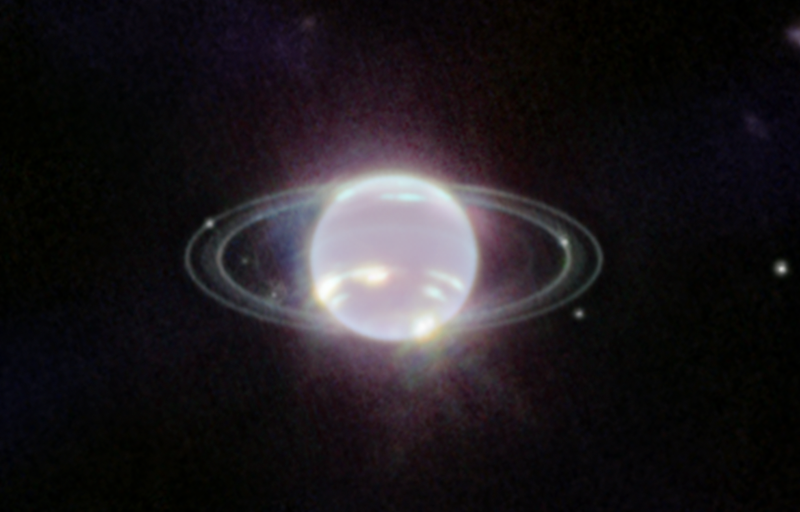
- How did Neptune’s inner moons form? Scientists have considered various possibilities.
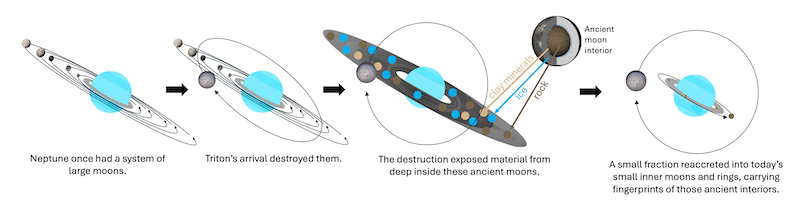
- A new hypothesis suggests that they formed from the remnants of a previous family of moons. Those moons would have been mostly obliterated when Neptune’s gravity captured Triton, the planet’s largest moon.
- Two of the studied moons, surprisingly, have rich clay deposits. But the third moon has none. Why?
Neptune’s inner moons
Neptune has 16 known moons. NASA’s James Webb Space Telescope recently took a closer look at three of the innermost small moons – Larissa, Galatea and Proteus – and found something interesting; they have a unique composition among all the bodies in the solar system.
Having looked into this surprising finding, a team of researchers said on July 29, 2026, that these moons likely formed from the remnants of a former system of moons around Neptune. They believe these moons were destroyed when the planet’s current largest moon, Triton, was captured by Neptune billions of years ago.
Ryleigh Davis, a former Caltech graduate student, now at UC San Diego, is the lead author of a new paper about these moons. She said:
If Neptune once had a system of moons that looked something like what we see at Uranus today [a stable family of multiple moons of different sizes orbiting the planet], we expect it would’ve been completely destroyed by the process of Triton getting captured. This is exciting new evidence that something catastrophic happened at Neptune that completely destroyed its original satellites, and we’re getting to see the fingerprints left behind by that process.
Those former icy moons are all gone now, except maybe for Nereid. Scientists think it might be the sole survivor of that catastrophe.
Davis and her colleagues published their peer-reviewed findings in Science Advances on July 29, 2026.
Clays on Larissa and Galatea, and in the rings
The researchers wanted to study Neptune’s inner moons to learn more about the planet’s history. There is still much that scientists don’t know about these small, distant worlds.
Astronomers had only recently obtained spectroscopy data for the moons, which tells scientists what kinds of molecules are present.
Surprisingly, they found phyllosilicates, or clays, on the moons and in Neptune’s rings. It was an unexpected discovery, as Davis noted:
Phyllosilicates had never been detected anywhere in the outer solar system beyond Jupiter, so that was not on our list of things to look for. We were shocked to find the observed clays, which had to come from objects that were much, much bigger than Neptune’s small inner ring moons.
Webb found the signatures of magnesium-rich phyllosilicates (clays). Why was this surprising?
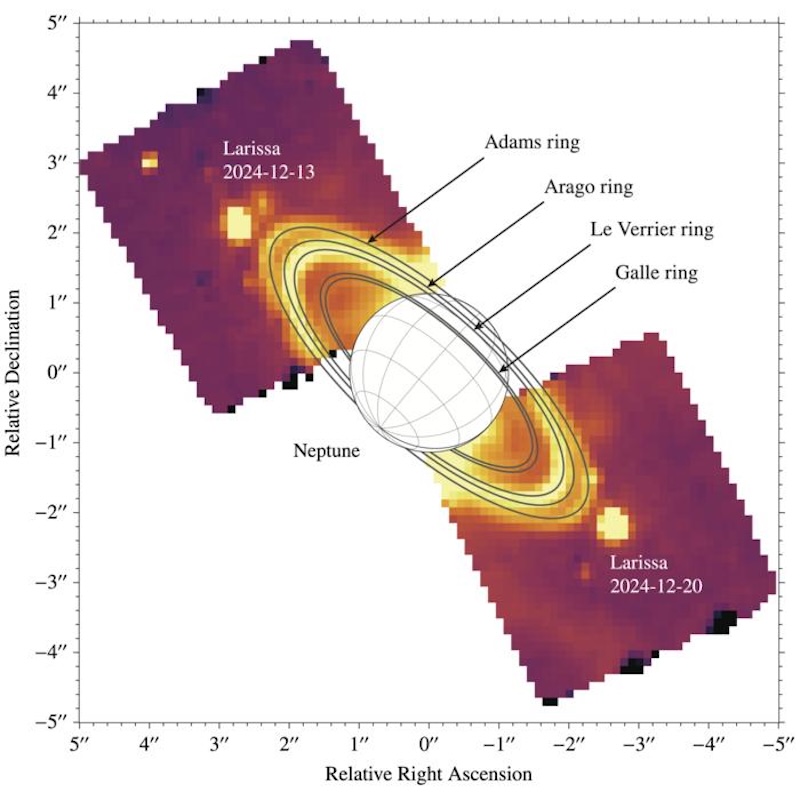
Where did the clays come from?
Clays require water to form. But no water ice was found on any of the moons or in the rings. And it’s way too cold for liquid water. So the moons and rings must have originated from some body or bodies that did have ice. Davis explained:
That’s really surprising because everything out in this part of the solar system is really icy. So, we’re fairly confident that they had to come from deep inside something that was big enough to generate enough heat that it melted its water ice. We think the most likely place would be an original system of icy moons, although it’s a bit of a mystery where the ice may have gone.
Scientist Mike Brown at Caltech added:
It took diligent detective work from Ryleigh before we understood what we were seeing. Sometimes in science you are trying to find evidence to evaluate a specific hypothesis, and, sometimes, something that you had not been thinking about just hits you in the face.
No clays for Proteus and an unknown mineral
There’s another twist, though. Proteus is the largest of the three small moons. And it doesn’t have the clays on it. Why? It might simply have originated from a part of the former debris where clays were absent. Or, perhaps there were clays originally, but heat destroyed them.
Plus, Webb identified a hydrated mineral that is on all three moons. But scientists don’t know what it is yet. It hasn’t even been seen elsewhere in the solar system. Davis said:
We see something that doesn’t really look like anything else we’ve identified in the solar system; it doesn’t match anything we have in our spectral libraries. We assume it’s some form of hydrated rock from the moons as well, but there’s still a lot of mystery.
This is reminiscent of another recent discovery. Scientists found a mineral that is present on the surfaces of both Pluto and Saturn’s moon Titan. But again, that mineral has never been seen before anywhere else …

A destroyed Kuiper Belt object?
The researchers consider the system of ancient moons to be the most likely scenario to explain the current inner moons of Neptune. But there is another possibility. A larger, single object from the Kuiper Belt beyond Neptune, about the size of Pluto, might have passed too close to Neptune. Neptune’s immense gravity would then have shredded the object. Davis said:
Either way, what we’re seeing on these moons had to come from deep inside something much larger. That material is normally permanently buried; we can only infer what’s there. Here, a catastrophic event essentially turned these ancient moons inside out, and we get to see what was hidden inside.
But if Triton did play a role, then it would have had a big effect on how the current moons formed and their behavior. Davis noted:
If you bring Triton in, and you smash up your large moons, we think only 1 percent or so of that material stayed around in the system. But the actual behavior of that material might be really different if Triton is still there shaking things up for a long time. So, looking forward, understanding how that process actually proceeds would be interesting. From there, the question is: ‘Can we learn anything about how big the initial moons had to be to have formed and provided this material?’
Bottom line: A new study suggests that Neptune’s inner moons formed when Neptune captured its largest moon Triton and a family of original small icy moons was destroyed.
Source: Neptune’s inner moons and rings are exposed icy body interiors
Read more: Are Uranus and Neptune rock giants and not ice giants?
Like what you read?
Subscribe and receive daily news delivered to your inbox.
More from
Paul Scott Anderson


Is this an alien radio signal from a super-Earth exoplanet?

Life on Enceladus? 2 new studies boost chances
Water systems on early Mars were complex and hot
Weather on exoplanets: Decoding the atmosphere of SIMP 0136



