- Over the past decade, astronomers have detected many black holes that seem too massive to have formed from the collapse of a single star. So how did they form?
- Researchers have just found new evidence that these black holes form from chaotic collisions between multiple smaller black holes.
- The finding comes from studying ripples in the fabric of spacetime that these black holes send out into the universe.
Huge black holes form from mergers
A new study has provided fresh evidence that some of the largest stellar-mass black holes didn’t form directly from the collapse of massive stars. Instead, the research suggests, they were built from chaotic collisions and repeated mergers between multiple smaller black holes.
Stellar-mass black holes are black holes ranging from a few times the mass of our sun to tens of solar masses. And on May 7, 2026, the researchers said they’ve identified two distinct populations of these black holes.
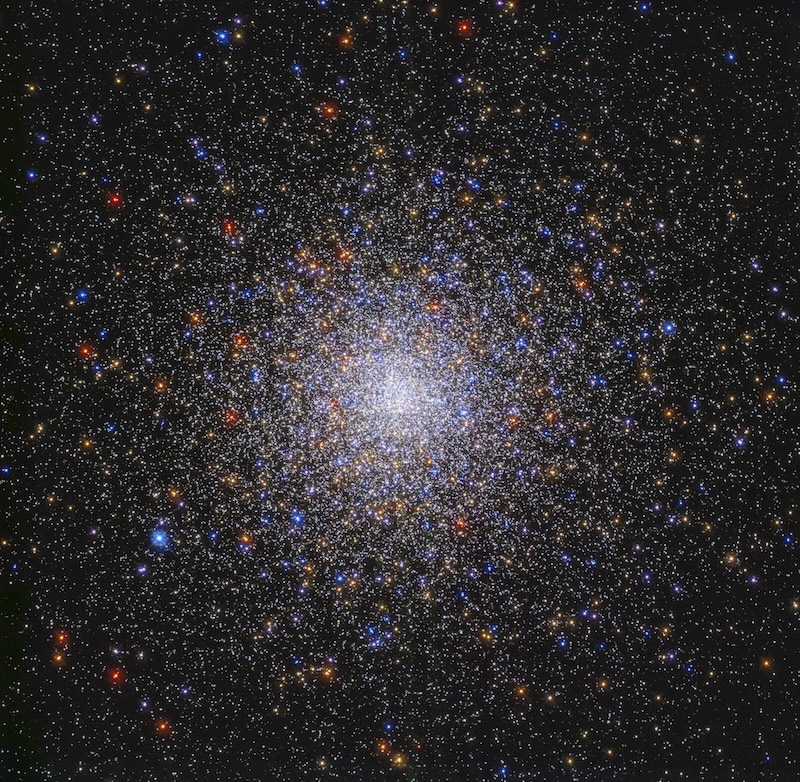
The first population, those less than 45 times the mass of our sun, formed as we’d typically expect: from stars collapsing at the end of their lives. But the second population – those over 45 solar masses – is more mysterious. Astronomers have long suspected that these are too massive to have formed from the collapse of single stars. And the new research helps explain how they’ve come to exist.
The scientists noticed that these larger black holes are spinning faster and in much more varied directions than the smaller ones. They say this is evidence that the larger black holes are the product of black hole collisions in the maelstrom of dense star clusters.
They performed this study using new data from gravitational waves observations. The research team analyzed data from a catalog of observations, called the LIGO–Virgo–KAGRA Gravitational-Wave Transient Catalog version 4 (GWTC4). In it, they found 153 detections of black hole mergers.
Fabio Antonini is the first author of this study. He said, in a statement:
Gravitational wave astronomy is now doing more than counting black hole mergers. It is starting to reveal how black holes grow, where they grow, and what that tells us about the lives and deaths of massive stars. This is exciting because we can use the information to test our understanding of how stars and [star] clusters evolve in the universe.
The team published its findings in the peer-reviewed journal Nature Astronomy on May 7, 2026.
Detecting ripples in spacetime
A black hole first forms when a massive star runs out of fuel for nuclear fusion. As a result, it collapses under its own gravity. The star’s mass becomes so compact that nothing can escape its powerful gravitational force … not even light.
In dense star clusters, two black holes often get close enough to start orbiting each other. As the two objects rotate, they generate a unique pattern of gravitational waves, or ripples in the fabric of the universe. The wave characteristics depend on the mass of each object, as well as their distance and orbit orientation from Earth.
This computer simulation shows the merger of 2 black holes. As the black holes spiral toward each other, collide and merge, they create gravitational waves. Scientists made this simulation using equations from Albert Einstein’s theory of general relativity and data from the Laser Interferometer Gravitational-wave Observatory (LIGO). Video via the Simulating eXtreme Spacetimes (SXS) project.
Gravitational waves are ripples in the four-dimensional realm where space and time are woven together. They can be detected on Earth by very sensitive instruments called gravitational wave laser interferometers.
The orbiting black hole pair radiates gravitational waves, resulting in some loss of orbital energy. As a result, the black holes get closer. That causes them to orbit each other faster, which radiates even stronger gravitational waves, which makes them get closer, and so on. The final outcome is a violent merger of the two objects.
Gravitational wave laser interferometers are able to detect the final orbits of the black holes just before the merger, which occurs over a timeframe of seconds.
Two populations of black holes
The scientists analyzed 153 black hole mergers in the LIGO–Virgo–KAGRA’s Gravitational-Wave Transient Catalog version 4. This catalog is a compilation of all gravitational wave detections from May 2023 to January 2024.
They noticed two distinct populations of stellar black holes. Isobel Romero-Shaw, also of Cardiff University, said:
What surprised us most was how clearly the high mass black holes [over 45 solar masses] stand out as a separate population.
Unlike the lower mass systems we analyzed, which were generally slowly-spinning, the higher mass systems are consistent with having more rapid spins, oriented in seemingly random directions. This is the exact signature you would expect if black holes were repeatedly merging in dense star clusters.
The pair-instability mass gap
There’s a theory in stellar evolution called the pair-instability mass gap. It states that stars above a certain mass limit will violently explode, rather than becoming a black hole. In their study, the team established that this limit was 45 solar masses. Therefore, any star over that value would explode at the end of its lifetime.
According to this theory, a collapsing star wouldn’t be able to form a black hole over 45 solar masses. However, gravitational wave detections have shown that stellar-mass black holes over this threshold do indeed exist.
Antonini said:
In our study we find evidence for the long-predicted pair-instability mass gap — a range of masses where stars are not expected to leave behind black holes at all. Gravitational wave detectors have successfully found black holes that appear to sit in or near that gap, which we identify at around 45 solar masses.
So how did these huge black holes form? The answer, Antonini says, lies in their spin:
The biggest black holes in the current sample seem to be telling us about [star] cluster dynamics, not just stellar evolution. Above about 45 solar masses the [black hole] spin distribution changes in a way that is hard to explain with normal stellar binaries alone but is naturally explained if these black holes have already been through earlier mergers in dense [star] clusters.
So the smaller black holes have similar spins, having formed from a population of similar stars. But when the black holes cross this 45-solar-mass line, they start to show a wide range of different spin speeds and orientations. The researchers think this erratic spinning is a sign that the large black holes have been through a series of violent collisions and mergers.
How gravitational wave laser interferometers work
If you threw two stones into a pond, each stone creates concentric ripples. The sections where the ripples intersect are called interference patterns. Gravitational wave laser interferometers look for laser beam interference patterns caused by gravitational waves.
A gravitational wave observatory has two long, perpendicular arms. For instance, at the LIGO observatories in Washington and Louisiana, each arm is 2.5 miles (4 km) long. A laser beam is split to shine along each arm. At the end of the arm, a mirror reflects the beam back and the two beams meet to form an interference pattern.
When gravitational waves pass through, spacetime itself oscillates. As a result, each wave stretches one arm and compresses the other. Therefore, the lasers move through slightly different lengths. The resulting interference patterns reveal information about the objects that generated the gravitational waves. This instrument is so sensitive that it can detect an arm length difference that’s 1/10,000th the width of a proton.
A brief animation showing the basic operation of the LIGO interferometer. Video via LIGO/ Einstein’s Messengers/ NSF.
Besides LIGO, there are two other gravitational wave observatories: the Virgo interferometer in Italy and the Kamioka Gravitational Wave Detector (KAGRA) in Japan. Ideally, all three observatories should detect a gravitational wave event to confirm it.
Bottom line: A new study suggests the largest stellar-mass black holes form not from single stars collapsing, but from collisions and mergers between smaller black holes.
Read more: Gravitational waves discoveries surge in new catalog
Like what you read?
Subscribe and receive daily news delivered to your inbox.
More from
Shireen Gonzaga


Alpha Cephei, or Alderamin, is a fast-spinning star

Delta Cephei helps measure cosmic distances