



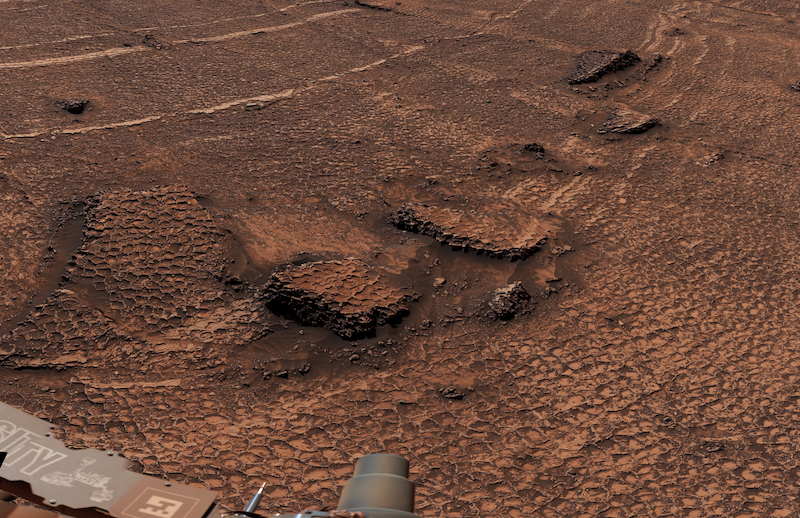
- NASA’s Curiosity rover has found the largest fields of honeycombs on Mars yet. These strange fractures in the ground are found in a region called Valle Grande on Mount Sharp.
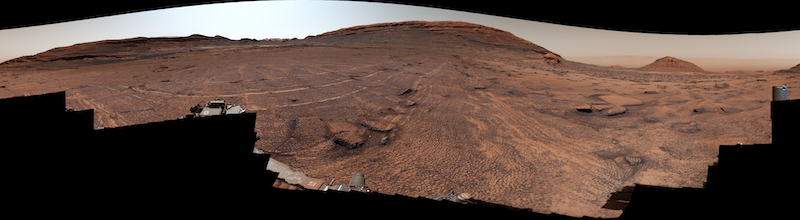
- Curiosity took a new panorama image of the terrain, with honeycombs extending as far as can be seen.
- How they formed isn’t precisely known yet, but scientists say they are likely mud cracks, like you might find on Earth.
Martian honeycombs in Valle Grande
Earlier this year, NASA’s Curiosity rover took a close look at some odd-looking features called “dragon scales” or “honeycombs.” Scientists aren’t sure exactly how they formed, but suspect water was involved. Now, the rover has come across more of the honeycombs, but on a much larger scale than the smaller patches seen before.
NASA said on July 29, 2026, that Curiosity found the honeycombs in a valley called Valle Grande on Mount Sharp. This field of honeycombs was vast, extending in all directions from the rover. Curiosity took a new panorama image of the honeycombs stretching across the landscape.
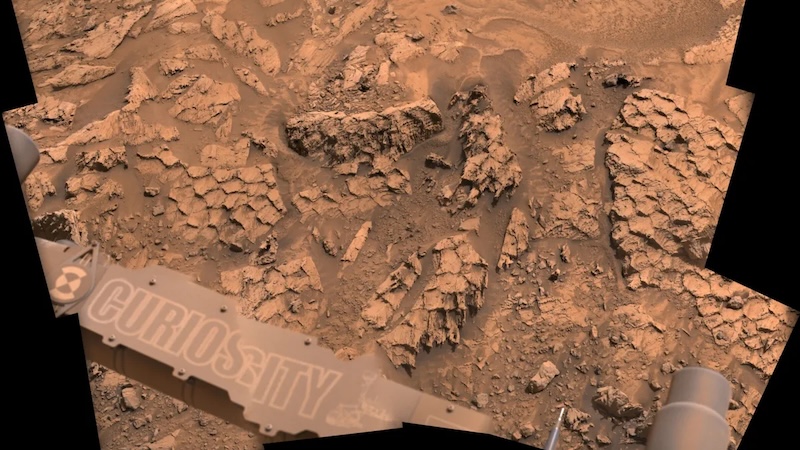
The honeycombs are polygons (shapes made of straight lines) fractured into the ground. Each polygon, or honeycomb, is about 1.5 to 3 inches (4 to 8 cm) across. The patterned landscape is something not seen on Mars before. The fractures look like desiccation cracks, where water has dried up, leaving dried-out mud behind. Such features are common on Earth simply as mud cracks. So finding them on Mars can provide scientists with valuable clues about how and when water was present on Mars before it disappeared.
‘Took our breath away’
Curiosity took a 360-degree panoramic image of the landscape, showing the honeycombs spreading out in all directions for as far as the rover could see. Curiosity obtained the images for the panorama on June 19 and 20, 2026. Those were the 4,930th and 4,931st Martian days, called sols, of the mission. Ashwin Vasavada at NASA’s Jet Propulsion Laboratory in Southern California is the project scientist of the mission. He said:
We’ve seen a lot of fascinating landscapes through Curiosity’s eyes, but this sea of polygons took our breath away. We measured their shapes and chemistry carefully and are hopeful there are clues in the data as to how these features formed.
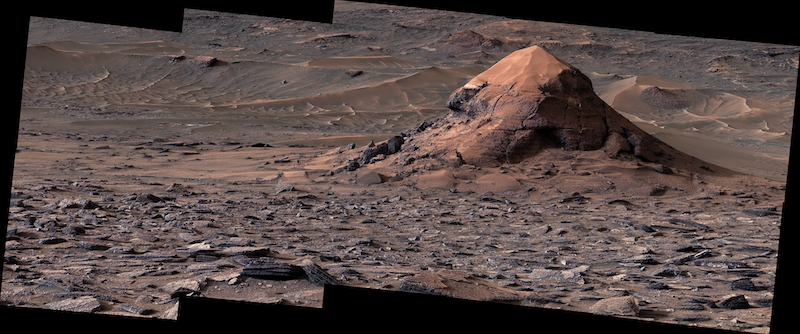
In one spot, the honeycombs wrap around a butte called Miraflores, which is 20 feet (6 meters) tall. It has a thick cap of sand on top. It stands like a little island among all the honeycombs around it.
How did the honeycombs form?
The new fields of honeycombs appear to be similar to the smaller patches that Curiosity saw previously. But how did they form? Scientists are still working on exactly how they came to be. But they think that they are similar to ones on Earth. Those honeycomb patterns form from water that has dried out or evaporated. You’ve probably seen them fairly often as mud cracks. As the wet mud dries out, it fractures into the honeycomb or polygonal shapes.
The previous largest number of these features seen by Curiosity was near Antofagasta, a relatively young, 33-foot (10-meter) wide impact crater located on the slopes of Mount Sharp.
Former lake in Gale crater
And indeed, Gale crater, where Curiosity is still exploring on Mount Sharp, was once a lake or series of lakes billions of years ago. And the rover has found plenty of other evidence for past water in this region. So finding mud cracks perhaps shouldn’t be too surprising.
Curiosity also investigated larger versions of similar fractures, called “spiderwebs” or boxwork. They also likely formed when salty mineral-ridge water evaporated and left the ridges behind when softer rock around them eroded away.
Bottom line: NASA’s Curiosity rover has found vast new fields of Martian honeycombs on Mount Sharp in Gale crater. They likely formed from drying mud, just like on Earth.
Read more: Mars rover Curiosity heads for intriguing ‘spiderwebs’
Read more: NASA orbiter spots Curiosity rover making tracks on Mars
Like what you read?
Subscribe and receive daily news delivered to your inbox.
More from
Paul Scott Anderson


Habitable worlds: Better than Earth? Scientists wonder

Pentagon UAP files part 7: Silent black triangles
Lucy mission to Trojan asteroids: 5 years of discoveries
Surprising colors of white dwarf stars revealed for 1st time



