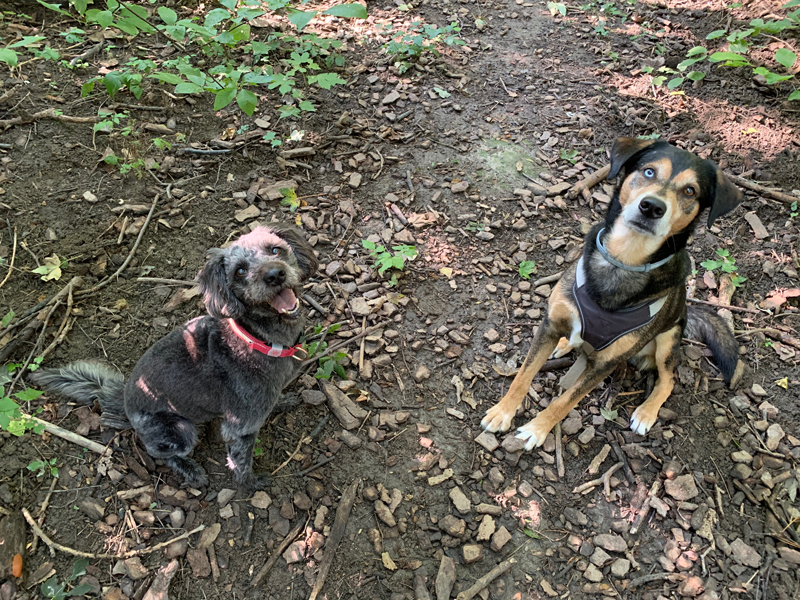
- Many people think their dogs are good judges of a person’s character. But this is not backed by science.
- In experiments, dogs showed no clear preference for people who offered them food over those who didn’t.
- The new study highlights the complexity of dog behavior and the need for more research with different dog populations.
Can dogs form opinions of people through interactions or observations?
Many people think their dogs are good judges of character. For instance, if your dog reacts favorably to a person, you’re inclined to do the same. But if your dog seems fearful of someone, you’re more likely to have a negative first impression of that person. But are we reading too much into how dogs react to people? A team of scientists from Japan and Austria wanted to know if a person could, from a dog’s perspective, have a reputation. Therefore, they conducted behavioral experiments with dogs and people. And their study suggests that there is no evidence that dogs form opinions of people.
Hoi-Lam Jim, at Kyoto University in Japan, is the lead author of the paper on this research. She said, in a statement:
It’s clear that reputation formation may be more complex than previously thought, even for animals like dogs that closely cooperate with humans.
The researchers published their findings in the peer-reviewed journal Animal Cognition on June 28, 2025.
Pet dog and human behavioral experiments
After observing their actions, Jim and her colleagues wanted to know how dogs judge people. In addition, they wanted to see if a dog’s age was a factor since older dogs have more experience with people.
They recruited 40 pet dogs, over a range of ages, for two sets of experiments.
In the first set, 20 dogs were tasked, one at a time, with observing two people interacting with another dog. One person was generous and fed the dog, while the other was selfish and withheld food from the dog. Meanwhile, the other 20 dogs were used as controls in the experiment; they watched the two people interact with an imaginary dog.
Following these activities, the 40 dogs individually interacted with these two people. Were the dogs drawn to a particular person, for instance, the person who fed them? The scientists looked for behaviors such as who the dogs approached first, how close they remained to either of the two people, and whether they jumped up at them.
In the second set of experiments, the 40 dogs were brought in with their owners, one at a time, to interact directly with two people, a generous one that offered food and a selfish person that withheld food. Following that, each dog was tested: when both people held up food, which person did the dog choose to go to for a snack?
Who did the dogs favor?
The scientists thought that the dogs would prefer the generous person over the selfish one. They also assumed that the more experienced older dogs would perform better than the younger ones in gravitating towards the generous person.
However, the dogs, regardless of age, collectively did not show a preference for the generous person. The odds of going to that person was about 50%.
These results are similar to those from previous research, done at the Wolf Science Center in Austria, with pack-living dogs and wolves. There, behavioral experiments showed that the wolves and pack-living dogs did not form opinions of people after direct and indirect interactions. Scientists had wondered if this could be attributed to the wolves and pack-living dogs’ lack of exposure to humans. So that’s why they used pet dogs for this study.
Understanding the complexity of dog behavior
Dogs descended from wolves, a pack-oriented, highly social canine species. Scientists think that dogs were first domesticated about 23,000 years ago, likely in Siberia. Since then, they have been artificially selected for traits that have produced the wide variety of breeds we see today.
During domestication, dogs lived alongside people, relying on them for food and shelter. This included free-ranging packs, such as street dogs, that depend on humans or trash for food.

The study also underscored how difficult it is to evaluate how dogs perceive people. There is no doubt that dogs have developed a special relationship with humans, but that relationship is quite diverse, based on the type of human-dog interaction. For instance, free-ranging dogs have a very different relationship with people compared to that of pet dogs and working dogs. The scientists say that future research should methodically study dogs of all ages from these different population groups.
Bottom line: Many people think their dogs are good judges of a person’s character, but new research indicates there is no evidence that dogs form opinions of people.
Read more: New insight into how dogs see their world through smell
Like what you read?
Subscribe and receive daily news delivered to your inbox.
More from
Shireen Gonzaga


Alpha Cephei, or Alderamin, is a fast-spinning star

Delta Cephei helps measure cosmic distances