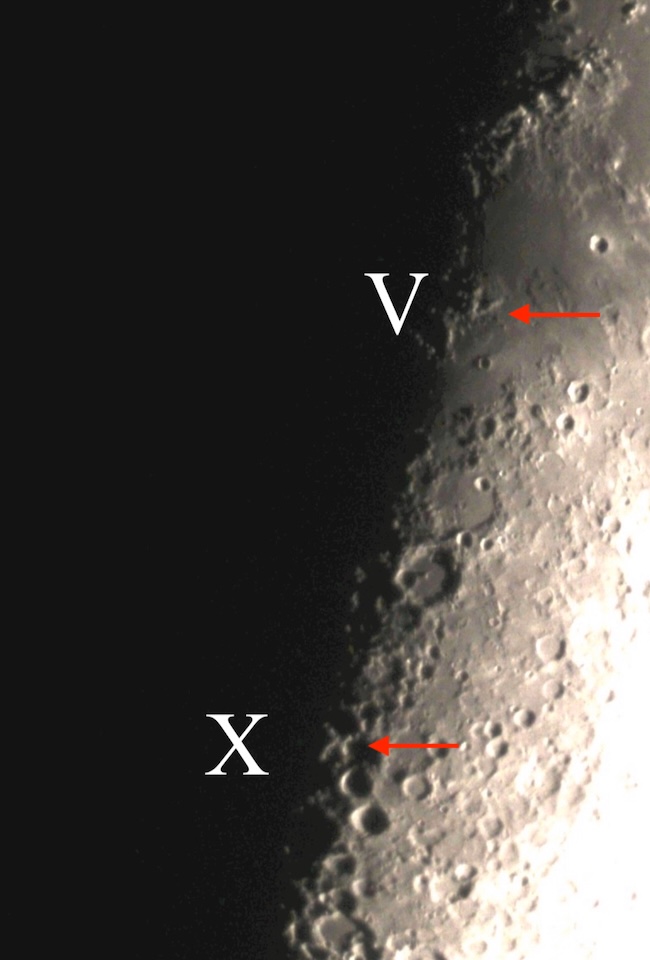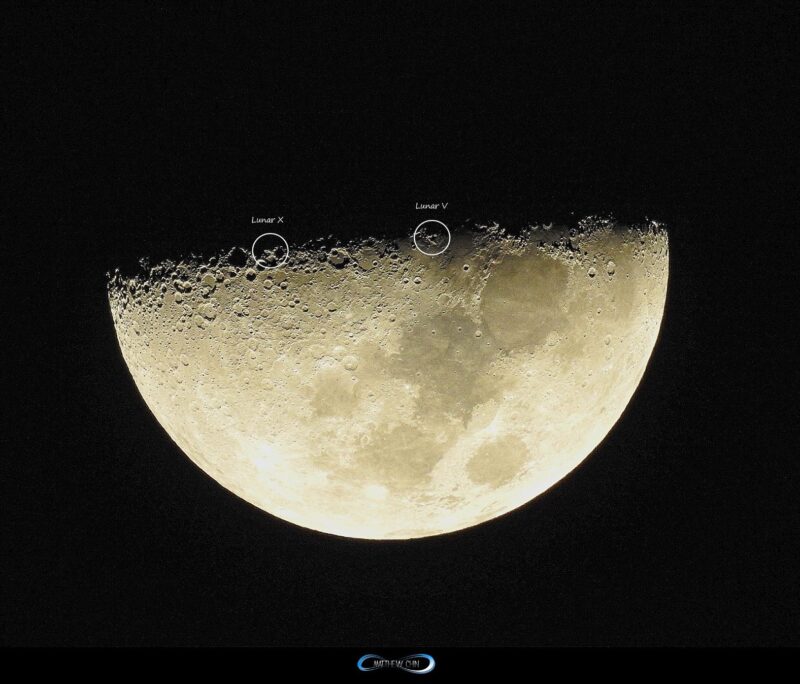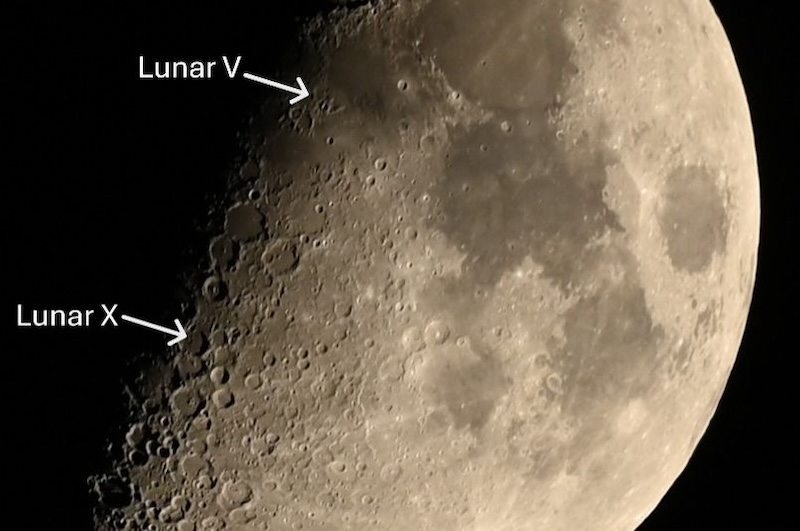
View at EarthSky Community Photos. | Frank Lu of Texas captured this image on February 5, 2025, and wrote: “Inspired by Deborah Byrd’s article in EarthSky’s Astronomy Essentials, I went out looking for the Lunar X and Lunar V on this 1st-quarter moon. I’m extremely pleased to find them.” Thank you, Frank!
Tonight’s 1st quarter moon is a perfect time to look for the Lunar X and V. It occurs overnight tonight at 2:32 UTC on April 24.
Lunar X and Lunar V
Have you heard of Lunar X and Lunar V? They are famous optical features on the moon, visible through telescopes. So, when the moon’s terminator – or line between light and dark on the moon – is located in just the right place, you can see a letter X and a letter V on the moon’s surface. Are they a sign of an alien visitation? No. Rather, Lunar X is a great example of how lighting and topography can combine on a planet or moon to produce a pattern that seems familiar to the human eye.
In reality, the illusion of Lunar X is created by sunlight falling on the rims/ridges between the craters La Caille, Bianchini and Purbach. The V is caused by light illuminating crater Ukert, along with several smaller craters.
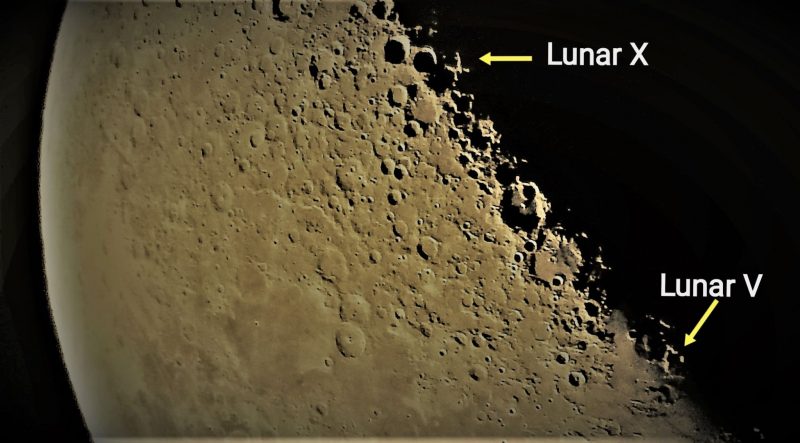
View at EarthSky Community Photos. | Kannan A in Singapore wrote on April 19, 2021: “Upon a close look at the moon tonight, I realized that the Lunar X and Lunar V were clearly visible. These are transient lunar features visible on the lunar surface for about 4 hours once a month. They are most striking when they are visible on the shadow side of the terminator. But they will remain visible against the lunar surface even after the terminator has moved because they are brighter than the surrounding area.” Thank you, Kannan!
When are they visible?
Basically, people see Lunar X and Lunar V at each cycle of the moon, but only for a short time. In fact, they’re observable for about four hours around the 1st quarter moon phase.
View at EarthSky Community Photo. | Greg Redfern captured this image from Virginia on July 2, 2025, and wrote: “The lunar X & V showed up last night in great splendor … what a treat to see and image.” Thank you, Greg!View at EarthSky Community Photos. | Matthew Chin from Hong Kong, China, shared this image of the moon, where Lunar X and Lunar V are visible, on January 18, 2024. Thank you, Matthew!
Bottom line: Lunar X and Lunar V are optical features on the moon. They are visible through a telescope for several hours around the time of the 1st quarter moon.
Our Editor-in-Chief Deborah Byrd works to keep all the astronomy balls in the air between EarthSky's website, YouTube page and social media platforms. She's the primary editor of our popular daily newsletter and a frequent host of EarthSky livestreams. Deborah created the EarthSky radio series in 1991 and founded EarthSky.org in 1994. Prior to that, she had worked for the University of Texas McDonald Observatory since 1976, and created and produced their Star Date radio series. She has won a galaxy of awards from the broadcasting and science communities, including having an asteroid named 3505 Byrd in her honor. In 2020, she won the Education Prize from the American Astronomical Society, the largest organization of professional astronomers in North America. A science communicator and educator since 1976, Byrd believes in science as a force for good in the world and a vital tool for the 21st century. "Being an EarthSky editor is like hosting a big global party for cool nature-lovers," she says.
Like what you read? Subscribe and receive daily news delivered to your inbox.
Thank you! Your submission has been received!
Oops! Something went wrong while submitting the form.