



Sun news May 31: Solar wind surges, brings aurora to high latitudes
Earth’s magnetic field stirred to active levels overnight. A stream of fast solar wind from a coronal hole poured in. The activity fell just short of G1 (minor) geomagnetic storm thresholds. But aurora watchers in Anchorage, Reykjavik, and northern Scandinavia might have caught faint displays during dark windows. Forecasters see a chance for isolated G1 storm periods today. The coronal hole stream persists. And possible glancing coronal mass ejection (CME) influences from earlier this week might arrive. That keeps conditions mildly unsettled into early June. Share your aurora photos with us!
Past 24 hours of sun news
(11 UTC May 30 – 11 UTC May 31)
Flare activity
Over the past day, solar activity held at low levels. In total, the sun fired 12 C-class flares.
- Strongest flare: C4.8 from AR4446 (S17W16), peaking at 11:45 UTC on May 30. As a C-class event, it produced no radio blackout. A faint, narrow CME was observed in association but should have a negligible Earth impact.
- Lead flare producer: AR4446 topped the list. It fired 5 of the 12 flares, including both events above C3.0. Meanwhile, AR4452 and AR4449 each contributed 2 flares. And AR4455 and AR4453 each added one.
Sunspot regions: key players
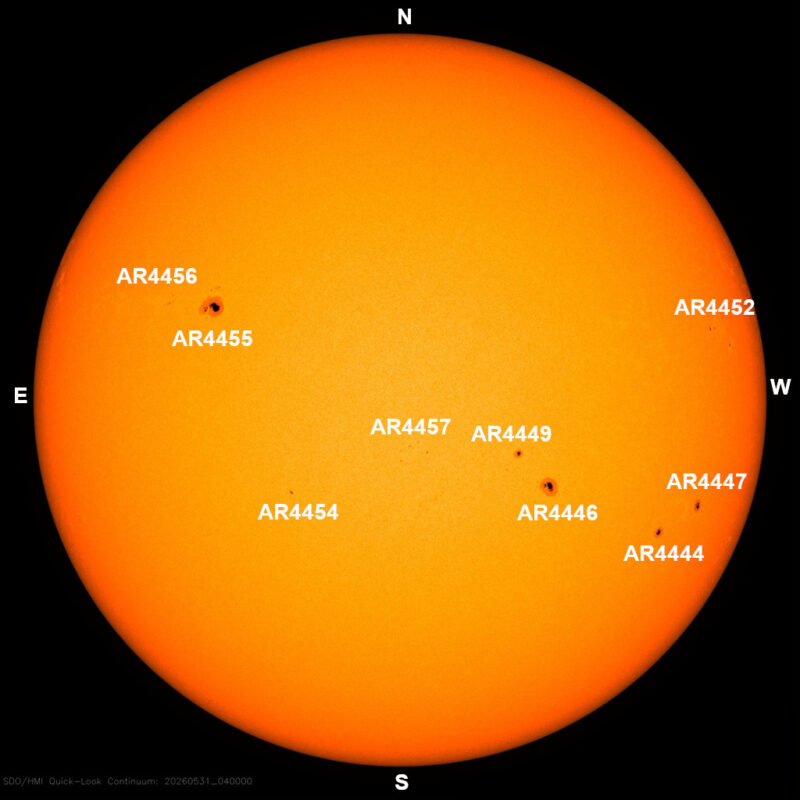
The Earth-facing solar disk showed 9 numbered active regions. Most were magnetically simple and relatively stable.
Blasts from the sun?
A halo coronal mass ejection (CME) appeared in GOES CCOR-1 imagery at approximately 9:15 UTC on May 30. It lifted off from the north limb at a projected speed of roughly 550 km/s. But forecasters assessed it as originating from the far side. No Earth impact is expected from this event. No significant Earth-directed CMEs were identified during the period.
Past 24 hours in space weather
Solar wind
Solar wind speeds surged during the past day, with coronal hole high-speed stream driving the increase. Speeds climbed from just below 400 km/s early in the period to near 550 km/s by the end. They peaked at 576 km/s after 18 UTC on May 30. That pushed the Kp index to 4. Meanwhile, Earth’s magnetic field also strengthened, with the total interplanetary magnetic field (IMF) increasing to 10–11 nT (moderate levels).
Bz and magnetic coupling
The Bz component underwent several sustained southward dips. It reached -7 to -10 nT early in the period and again later. Each southward plunge opened the door for geomagnetic coupling and auroral activity. As always, a southward Bz favors aurora displays at high latitudes.
Earth’s magnetic field
Over the past day, Earth’s magnetic field ranged from quiet to active levels. The Kp index sat at 1–3 for most of the period. But it reached Kp 4 (active) during the 18:00–0:00 UTC window spanning May 30–31. Conditions stayed just below G1 (minor) geomagnetic storm thresholds. Close, but not quite.
What’s ahead? Sun–Earth forecast
Flare activity forecast
Forecasters expect low to moderate levels through June 2. C-class flares are very likely. And a chance (40%) exists for isolated M-class (R1–R2) flares. AR4452, with its beta-gamma configuration, remains the most likely source before it rotates beyond the west limb.
AR4455 and the newly emerged AR4457 also bear watching as they evolve. X-class flares are unlikely (5%) given the current magnetic setups on the disk.
Geomagnetic activity forecast
- May 31: Expect unsettled-to-active conditions (Kp 3–4) as the negative-polarity coronal hole stream continues. A chance for isolated G1 (minor) geomagnetic storm periods exists. That chance increases if glancing influences from the slow CMEs of May 27–28 arrive. Aurora may reach Anchorage, Reykjavik, and northern Scandinavia. But limited hours of darkness in the Northern Hemisphere at this time of year will reduce visibility.
- June 1: Expect quiet-to-active conditions as the coronal hole stream wanes. Possible glancing CME influences could sustain isolated unsettled-to-active periods (Kp 3–4) early in the day. Conditions should trend quieter through the second half.
- June 2: Expect mostly quiet conditions (Kp 1–2) as ambient solar wind returns. No significant geomagnetic activity is anticipated.
Sun news May 30: Blast from sun might brush past Earth today

Our star hurled several blobs of stuff – solar plasma and magnetic fields – into space this week. It launched these coronal mass ejections (CMEs) on May 26 and 27. The blobs might reach Earth later today and tomorrow. If they deliver a glancing blow, they could disturb Earth’s magnetic field. What does that mean for aurora watchers? Forecasters expect unsettled-to-active conditions with the Kp index reaching 4. But a G1 (minor) geomagnetic storm level of Kp 5 is not ruled out. Auroral displays are possible tonight and tomorrow at high latitudes. Clear skies! And please share your aurora photos with us!
Past 24 hours of sun news
(11 UTC May 29 – 11 UTC May 30)
Flare activity
Solar activity dropped back to low levels over the past day. The long-awaited newcomer AR4455 lost its gamma configuration. It keeps flaring, but only faint C-class events. In total, it fired 7 C-class (common) flares.
- Strongest flare: C4.0 from AR4449 in the southwest, peaking at 7:47 UTC on May 30.
- Lead flare producer: AR4455 keeps flaring. Once again, it topped the list. It fired 4 of the 7 flares. Meanwhile, AR4449 contributed 2 C-class flares. The remaining flare came from elsewhere on the disk.
Sunspot regions
Currently, the Earth-facing solar disk shows 7 numbered active regions. Notably, only one sunspot region retains its beta-gamma configuration: AR4452. Both AR4455 (now beta) and AR4446 (now beta) lost their gamma components. The remaining 4 regions carry simpler alpha or beta configurations. They appear stable or in decay.
Blasts from the sun?
Several faint eruptions were observed in the southeast earlier this week. At least two were strong enough for SOHO LASCO C2 and GOES SUVI to register. The first occurred at 23:00 UTC on May 27. A second followed at 9:38 UTC on May 28. Modeling and analysis of these events continue. The CMEs from May 26 and 27 might deliver a glancing blow later today or tomorrow. No other Earth-directed CMEs appeared during the period.
Past 24 hours in space weather
Solar wind
Solar wind speeds held at moderate to moderate-high levels during the period. The coronal hole high-speed stream continued driving the elevated speeds. But by 11 UTC on May 30, speeds dropped back to moderate levels. Meanwhile, the total interplanetary magnetic field (IMF) showed a slight increase to moderate levels.
Bz and magnetic coupling
The Bz component pointed strongly southward from late May 29 through early this morning. That opened the door for geomagnetic coupling. But at 3 UTC on May 30, the Bz shifted northward. At the time of this writing, it still points north. As always, south is the orientation most favorable for auroral displays.
Earth’s magnetic field
Over the past day, Earth’s magnetic field has held at unsettled-to-active levels. Solar wind from the coronal hole continued reaching us and producing enhancements. Specifically, the Kp 4 threshold was reached at 19:49 UTC on May 29. Currently, Kp sits at level 3.
Sun news May 29: BAM! M flare from newcomer AR4455


The long-awaited newcomer has delivered! AR4455, the fiery region we have been watching approach from the northeast, fired an M1.2 flare at 7:04 UTC on May 29. The blast triggered an R1 (minor) radio blackout that affected an area over India. It’s a promising start for this sunspot group, which had already become the leading flare producer on the solar disk while still rotating into view yesterday. Now fully visible, AR4455 has revealed itself to have a promising beta-gamma magnetic complexity. That makes it one of three beta-gamma regions currently on the disk, alongside AR4446 and AR4452. Three beta-gamma regions at once is noteworthy. The more magnetic complexity on the disk, the greater the chances for stronger flares. Let’s see what else these regions have in store!
Past 24 hours of sun news
(11 UTC May 28 – 11 UTC May 29)
Flare activity
Over the past day, solar activity jumped to moderate levels with an isolated M-class flare. In total, the sun fired 7 flares: 1 M-class (moderate) and 6 C-class (common).
- Strongest flare: M1.2 from AR4455 in the northeast, peaking at 7:04 UTC on May 29. It triggered an R1 (minor) radio blackout over India.
- Lead flare producer: AR4455 once again topped the list. It fired 5 of the 7 flares, including the M1.2. The remaining 2 flares came from other regions on the disk.
Sunspot regions
The Earth-facing solar disk shows 8 numbered active regions. Notably, three sunspot regions carry beta-gamma configurations. AR4455 (beta-gamma) is the newcomer to watch. Now fully in view, it is already the top flare producer. And its beta-gamma complexity gives it the potential for M-class or even stronger flares. AR4446 (beta-gamma) continues holding its complexity. It remains a candidate for stronger activity. AR4452 (beta-gamma) rounds out the trio of complex regions. The remaining 5 regions carry simpler alpha or beta configurations. They appear stable or in decay.
Blasts from the sun?
Several faint eruptions were observed in the southeast. At least two were strong enough for SOHO LASCO C2 and GOES SUVI to observe. The first occurred at 23:00 UTC on May 27. A second followed at 9:38 UTC on May 28. Modeling and analysis of these events is ongoing. No other Earth-directed coronal mass ejections (CMEs) appeared during the period.
Past 24 hours in space weather
Solar wind
Solar wind speeds climbed to moderate-high levels late on May 28. The increase was driven by coronal hole high-speed stream influence. But this morning, speeds dropped back to moderate levels. Meanwhile, the total interplanetary magnetic field (IMF) stayed weak, with only a slight increase.
Bz and magnetic coupling
The Bz component pointed strongly southward through most of the period. Only a few northward peaks occurred. At the time of this writing, it still points south. That is the orientation most favorable for auroral displays.
Earth’s magnetic field
Over the past day, Earth’s magnetic field has jumped to unsettled-to-active levels, reaching just below Kp level 4. Currently, it sits at Kp level 3.
Sun news May 28: Exciting sunspot region finally arrives
A long-awaited sunspot region has finally come into view on the northeast solar horizon. Now officially numbered AR4455, all signs indicate this is the sunspot region that’s been erupting powerfully from the far side in recent days. It seems pretty large, but we still need to wait until it rotates farther into view to analyze it properly from Earth. It’s been producing jets and prominences all day, and has already fired more flares than any other region over the past 24 hours. Let’s see what else AR4455 has in store!
Past 24 hours of sun news
(11 UTC May 27 – 11 UTC May 28)
Flare activity
Solar activity has been low, with only faint C-class and B-class flares over the past 24 hours. We saw a total of 6 Cs and 1 B flare.
- Strongest flare: C3.4 from AR4451 in the southeast at 12:16 UTC on May 27.
- Lead flare producer: Active region AR4455 in the northeast was at the top of list. It fired 5 of the 7 flares.
Sunspot regions
The Earth-facing solar disk shows 11 numbered active regions. Three newcomer sunspot regions received an official number: AR4453 near the northwest horizon, AR4454 in the southeast and AR4455 in the northeast. AR4455 seems to be the one that’s been flaring from the far side. It seems pretty large, but we still need to wait for it to rotate more into view for a better analysis. For now, it shows a beta configuration. AR4446 keeps its beta-gamma configuration, the most complex on the solar disk currently. The rest of the sunspot region on the Earth-viewed solar disk show either alpha or beta configurations.
Blasts from the sun?
A partial halo CME registered by LASCO C2 at 22:30 UTC on May 26 may give us at Earth a glancing blow on May 31. No other Earth-directed CMEs appeared during the period.
Past 24 hours in space weather
Solar wind
Solar wind speeds averaged at moderate levels throughout the period. Meanwhile, the total interplanetary magnetic field (IMF) stayed weak with a slight increase.
Bz and magnetic coupling
The Bz component kept shifting between north and south through the period. At the time of this writing, it points southward. Southward is the orientation most favorable for auroral displays.
Earth’s magnetic field
Over the past day, Earth’s magnetic field jumped to unsettled with some quiet periods (Kp 1-3). Currently, Earth’s magnetic field sits at Kp level 2.
Sun news May 27: Almost-M flare from promising sunspot region

A C9.7 flare from sunspot region AR4446 brought activity tantalizingly close to moderate levels yesterday. The almost-M flare was fired at 12:38 UTC on May 26. And its producer, AR446, is evolving. It gained a gamma component over the past day, bringing it up to a beta-gamma magnetic complexity. That makes it the most complex sunspot region on the Earth-viewed disk right now. And the more complex a region is, the greater its potential for stronger flares. Let’s see what AR4446 has in store!
Past 24 hours of sun news
(11 UTC May 26 – 11 UTC May 27)
Flare activity
Over the past day, solar activity held at low levels. But the C9.7 from AR4446 nearly pushed conditions to moderate. In total, the sun sparked 7 C-class flares.
- Strongest flare: C9.7 from AR4446 in the southeast at 12:38 UTC on May 26. Just a whisker below M-class territory.
- Lead flare producer: The incoming northeast newcomer, still unnumbered, once again topped the list. It fired 5 of the 7 flares. Meanwhile, AR4446 contributed the remaining 2 C-class flares. Notably, those two were the strongest of the period.
Sunspot regions
Currently, the Earth-facing solar disk shows 10 numbered active regions. And a region that emerged from seemingly nowhere in the northwest quadrant received an official number: AR4452. AR4446 (beta-gamma) is the star of the show. It developed a gamma component during this period. It now carries the strongest magnetic complexity on the disk. As a result, it tops the watch list for stronger flare production.
Blasts from the sun?
Forecasters analyzed the C9.7 event. They determined that any coronal mass ejection (CME) produced during the flare was too narrow or faint to track. No Earth-directed CMEs appeared during the period.
Past 24 hours in space weather
Solar wind
Solar wind speeds sat at moderate levels by the end of the period. A momentary jump to moderate-high levels occurred at 19 UTC on May 26. Meanwhile, the total interplanetary magnetic field (IMF) stayed weak.
Bz and magnetic coupling
The Bz component kept shifting between north and south through the period. At the time of this writing, it points northward. That orientation is not favorable for auroral displays. But that could change as the coronal hole stream arrives.
Earth’s magnetic field
Over the past day, Earth’s magnetic field ranged from unsettled to quiet (Kp 1–3). No geomagnetic storm conditions occurred. Currently, Earth’s magnetic field sits at Kp level 1.
Sun news May 26: Far-side eruption hints at incoming action
Though the Earth-facing sun is currently quiet, action is on the way! A dramatic eruption over the solar horizon around 22 UTC last night suggests that volatile sunspot regions are on the sun’s far side. The eruption launched a coronal mass ejection (CME) into space, but this burst of sun-stuff is heading far to the north of Earth. Meanwhile, an active region just rotating into view in the east fired 6 of the past day’s 12 C (common) flares. The volume of activity from this sunspot group hints at a potent region, with some of its magnetic complexity likely still hidden from view. Experts expect some active far-side regions to start rotating into view from the east in the coming days. Stay tuned!
Past 24 hours of sun news
(11 UTC May 25 – 11 UTC May 26)
Flare activity
Over the past day, solar activity continued at low levels. In total, the sun sparked 12 C-class flares.
- Strongest flare: C4.6 from an as-yet-unnumbered incoming region in the northeast at 22:42 UTC on May 25.
- Lead flare producer: The incoming northeast newcomer topped the list. It fired 6 of the 12 flares, including the C4.6 peak event. Meanwhile, AR4451 contributed 3 C-class flares.
Sunspot regions: key players
The Earth-facing solar disk shows 9 numbered active regions. Notably, four newcomers received official numbers during the period: AR4448, AR4449, AR4450 and AR4451.
AR4447 (beta) underwent notable growth. It consolidated both its leading and trailing poles. As a result, it remains the region of greatest interest on the disk.
AR4446 (alpha) was resolved into two distinct groups as it rotated further into view. The second component received the new designation AR4449 (beta).
AR4451 (beta) received its official number this period. Despite its small size and simple setup, it fired 3 C-class flares.
Sunspot regions: supporting cast
AR4448 (beta) and AR4445 (beta) both showed some growth during the period. The remaining regions appear stable or in decay. All sunspot regions carry simple alpha or beta configurations. No delta structures are present on the disk.
Blasts from the sun?
No Earth-directed coronal mass ejections (CMEs) appeared during the period.
A partial halo CME showed up in SOHO LASCO C3 imagery in the northwest at 22:12 UTC on May 25. Forecasters confirmed it is not heading toward Earth. It aimed far to the north. And a second CME lifted off from the northeast limb at 7:12 UTC on May 25. It is also not expected to reach us.
Past 24 hours in space weather
Solar wind
Solar wind speeds increased to moderate levels throughout the period. Meanwhile, the total interplanetary magnetic field stayed weak.
Bz and auroras
The Bz component pointed mostly southward late on May 25, with sustained intervals. As a result, conditions briefly favored auroral displays late that evening. But at 0:00 UTC on May 26, the Bz shifted northward. It stayed there through the rest of the period.
Earth’s magnetic field
Over the past day, Earth’s magnetic field ranged from unsettled to quiet (Kp 1–3). No geomagnetic storm conditions occurred. Currently, Earth’s magnetic field sits at Kp level 1.
Sun news May 25: Coronal hole’s fast winds could disturb the peace
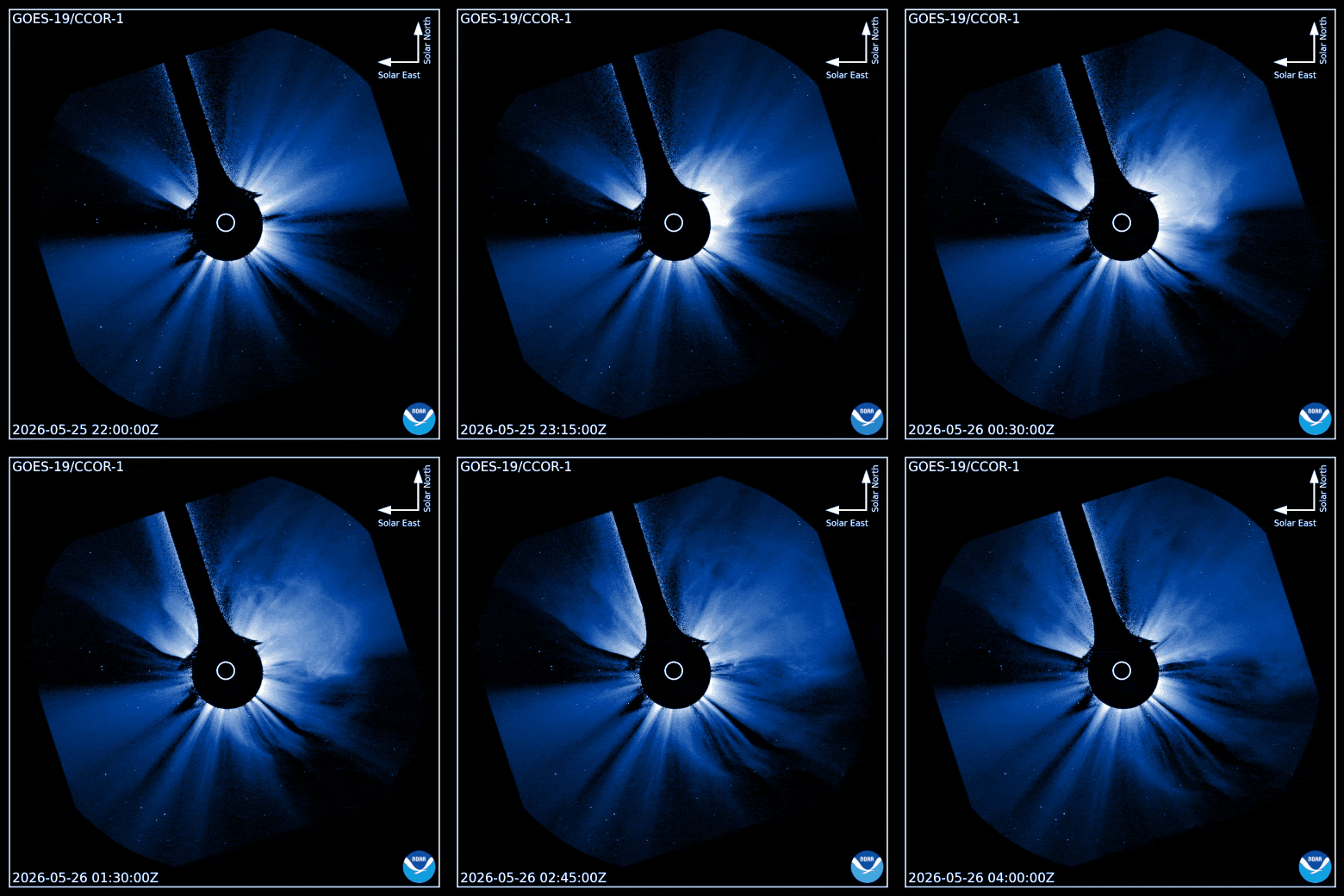

After an impressive burst of 18 flares in the previous day, the sun has calmed over the past 24 hours. We observed just 6 C-flares (common), while solar wind speeds remained sluggish. But change is on the way. A stream of high-speed solar wind from a coronal hole should arrive late on May 26 into May 27, potentially unsettling our magnetic field to G1 (minor) geomagnetic storm levels. Stay tuned!
Past 24 hours of sun news
(11 UTC May 24 – 11 UTC May 25)
Flare activity
Over the past day, solar activity held at low to moderate levels. In total, the sun fired 6 C-class flares.
- Strongest flare: C3.7 from AR4447 at 0:51 UTC on May 25.
- Lead flare producer: AR4447 topped the list. It fired 4 of the 6 flares, including the C3.7 peak event. Meanwhile, AR4441 contributed the remaining 2 C-class flares.
Sunspot regions
The Earth-facing solar disk currently shows 9 numbered active regions.
Blasts from the sun?
No Earth-directed coronal mass ejections (CMEs) appeared during the period.
Past 24 hours in space weather
Solar wind
Solar wind conditions stayed slow and near background levels throughout the period. Meanwhile, the total interplanetary magnetic field was weak.
Bz and magnetic coupling
The Bz component fluctuated mildly north and south. No sustained southward intervals developed. As a result, conditions were unfavorable for auroras.
Earth’s magnetic field
Over the past day, Earth’s magnetic field stayed quiet (Kp 0–2). No geomagnetic storm conditions occurred.
Sun news May 24: New region arrives, fires 16 flares!

Newcomer AR4446 announced its arrival on the sun’s east limb with a bang. This freshly numbered region fired off 16 C-class flares in just 24 hours! The strongest was a C5.6 at 21:57 UTC on May 23. None of these flares triggered radio blackouts. But the sheer volume of activity hints at a complex region still partially hidden behind the solar limb. And, veteran AR4441 made some noise too. Now approaching the west limb, it launched a long-duration C2.8 flare at 19:54 UTC on May 23. That blast produced a Type II radio burst with an estimated shock speed of 932 km/s. That speed signals a coronal mass ejection (CME) was likely produced. But with the source on the western limb, no Earth-directed CMEs were identified. On the space weather front, the solar wind remained sleepy. Speeds averaged near 330 km/s under background conditions. Earth’s magnetic field stayed quiet. Looking ahead, the arrival of AR4446 on the visible disk could bring a step-up in activity. Forecasters see a chance for isolated M-class flares over the coming days. Also, active regions behind the east limb fired C-class flares, suggesting more activity may emerge soon. Stay tuned!
Past 24 hours of sun news
(11 UTC May 23 – 11 UTC May 24)
Flare activity
Over the past day, solar activity held at low to moderate levels. In total, the sun fired 18 C-class flares. No M-class or X-class events occurred.
- Strongest flare: C5.6 from AR4446 (S08E89) at 21:57 UTC on May 23. Other notable events included a C4.8 at 23:43 UTC, a C3.7 at 2:33 UTC, and a C3.5 at 0:48 UTC, all from AR4446. In addition, AR4441 fired a long-duration C2.8 at 19:54 UTC on May 23, accompanied by a Type II radio burst (shock speed ~932 km/s).
- Lead flare producer: AR4446 dominated the period. It fired 16 of the 18 flares, including the C5.6 peak event. Meanwhile, AR4441 contributed the remaining 2 flares.
Sunspot regions
The Earth-facing solar disk showed a modest number of active regions. Two stand out.
AR4446 (beta) received its official number this period. It emerged from behind the east limb and immediately became the most active region on the disk with 16 C-class flares. Its position near the limb suggests more complexity may be revealed as it rotates further into view.
AR4441 is nearing the west limb. It continued producing occasional C-class flares, including the long-duration C2.8 event with the Type II radio burst. However, its geoeffective potential is fading as it rotates toward the far side.
Blasts from the sun?
No Earth-directed coronal mass ejections (CMEs) appeared during the period. Several CMEs showed up in coronagraph imagery. But the analysis pointed to source locations on the solar limb or the far side. The Type II radio burst from AR4441’s C2.8 flare (shock speed ~932 km/s) suggests a CME was produced. Even so, with the source at W71 on the western limb, any ejecta would be aimed well away from Earth.
Past 24 hours in space weather
Solar wind
Solar wind conditions reflected a quiet, near-background regime. Speeds averaged roughly 330 km/s with no notable increases. Meanwhile, the total interplanetary magnetic field (IMF) held steady near 3 nT, quite weak.
Bz and magnetic coupling
The Bz component fluctuated gently between roughly -4 and +4 nT. No sustained southward orientation developed. As a result, these calm conditions offered no fuel for geomagnetic disturbances or aurora enhancement.
Earth’s magnetic field
Over the past day, Earth’s magnetic field stayed quiet (Kp 1–2). No geomagnetic storm conditions occurred. Conditions settled quickly after a brief period of unsettled weather just before our reporting window.
Sun news May 23: BAM! M flare from the far side
AR4436 did it again. This prolific active region, now located just behind the sun’s northwest limb, or edge, blasted out an M2.4 flare at 10:29 UTC on May 22. The spark triggered an R1 (minor) radio blackout here on Earth, affecting an area over Morocco. Before departing for the far side, specialists observed AR4436 powering up again in magnetic complexity. Its position near the limb made that complexity difficult to define fully. But chances are, it has recovered a stronger magnetic configuration and will continue to flare from behind the solar horizon. Meanwhile, on the southeast side of our star, an incoming region is making noise, too. Over the past day, this as-yet-unnumbered active region took the lead as top flare producer, firing 8 C-class flares. The Earth-facing disk is about to get more interesting. Stay with us for more sun news!
Past 24 hours of sun news
(11 UTC May 22 – 11 UTC May 23)
Flare activity
Over the past day, solar activity reached moderate levels thanks to the M flare from AR4436. In total, the sun fired 13 flares: 1 M-class (moderate) and 12 C-class (common).
- Strongest flare: M2.4 from AR4436 behind the northwest limb, peaking at 10:29 UTC on May 22. This single flare lifted the period’s activity to moderate levels.
- Lead flare producer: An incoming region in the southeast, not yet numbered, took the lead. It fired 8 flares during the period, all C-class. Meanwhile, AR4436 and AR4441 each contributed 2 flares. The remaining flare came from elsewhere on the disk.
Sunspot regions
Currently, the sun shows 4 numbered active regions on its Earth-facing side. AR4441, nearing the northwest limb, retains its beta-gamma complexity. However, it remained a low flare producer during the past day. The remaining sunspot regions carry simpler alpha or beta configurations. As always, the more magnetic complexity a region carries, the greater its potential for flares.
Blasts from the sun?
The M 2.4 flare from AR4436 created a beautiful eruption off the sun’s northwest limb (edge). But this coronal mass ejection (CME) is traveling well away from Earth’s path. No geomagnetic effects are expected from this blast. And modeling and analysis showed no other Earth-directed CMEs during the past day.
Past 24 hours in space weather
Solar wind
Solar wind speeds stayed at moderate-low levels during the past day. No notable increase occurred. Meanwhile, the interplanetary magnetic field (IMF) remained weak.
Bz and magnetic coupling
The Bz component shifted between northward and southward through the period. However, the stronger peaks pointed mostly south. This morning, at the end of our observation period, the Bz continued south-oriented. As always, a sustained southward Bz favors auroras. Consequently, the door stayed open for auroral displays at high latitudes.
Earth’s magnetic field
Over the past 24 hours, Earth’s magnetic field continued at quiet-to-unsettled levels (Kp 1–3). Currently, at 11 UTC on May 23, the Kp index sits at level 1.
What’s ahead? Sun–Earth forecast
Flare activity forecast
Forecasters expect low levels of flare activity to continue. A chance exists for an isolated M-class flare. Specifically, chances for M-class (moderate) flares hold at 25% today. X-class (strong) flare chances remain low at 5%.
Two drivers shape the forecast. First, AR4441 carries a beta-gamma configuration and is the main candidate for stronger activity. However, it is nearing the northwest limb and will soon depart. Second, the incoming region in the southeast shows promising credentials. It already leads in flare production. Its position near the limb makes a full magnetic assessment difficult for now. Even so, it appears to carry good size. Once it rotates further into view, it could boost flare potential on the Earth-facing disk.
Geomagnetic activity forecast
- May 23 (Friday): Expect unsettled periods for the rest of the day. A chance for isolated active enhancements remains possible from fast solar wind from a coronal hole.
- May 24–25 (Saturday–Sunday): Expect mostly quiet levels as influences from the coronal hole fast wind wane. No significant geomagnetic drivers are in play. However, any surprises from the incoming southeast region could shift the forecast.


Sun news May 22: A sun-diving comet goes … poof!
Sun-diving – or sungrazing – comets are ancient icy leftovers from the birth of our solar system. We see them as they make one final incandescent dive into the star they’ve orbited for billions of years. Some come within only a few thousand miles of the sun’s visible surface. There, they face intense heat, fierce radiation, violent outgassing and enormous tidal forces from the sun’s gravity. Few survive. Looks like the one caught by the LASCO 2 imager yesterday didn’t make it!
Past 24 hours of sun news
(11 UTC May 21 – 11 UTC May 22)
Flare activity
After a few days of low to very-low flare activity – with few and faint C-class (common) and B-class (weak) flares – over the past day departing active region produced a list of stronger sparks, including a powerful C9.5 flare. Now, AR4436 is gone; it’s located behind the solar horizon on the northwest. So this strong flare surely was stronger that it look (the body of the sun blocked part of the blast). So, overall, we noted an increase in flare activity over the past day from very low to low, with 15 flares in total. The sun produced 12 C-class (common) flares plus another 3 B-class flares, compared to yesterday’s 5 B flares only.
- Strongest flare: C9.5 from AR4436 in the northwest, peaking at 18:25 UTC on May 21. Thanks to this one flare, sun activity is now considered moderate.
- Lead flare producer: Active region AR4436 once again is lead flare producer, now located on the far side of our sun. Besides this C9.5 flare, this active region also produced another two strong C flares: a C5.6 at 13:21 UTC and a C8.3 at 18:14UTC all on May 21. It produced 12 flares in total: 10 Cs plus 2 B flares.
Sunspot regions
The sun continued showing 4 numbered active regions on its Earth-facing side. Active region AR4441 developed a gamma complexity and now shows a beta-gamma configuration. The rest of the sunspot regions carry simpler alpha or beta configurations. The more magnetic complexity, the greater the potential for flares.
Blasts from the sun?
No blob of solar stuff was observed in the three strong Cs from AR4436. All there were considered rapid impulsive. But modeling and analysis are ongoing, in an effort to detect any component sent to us at Earth. We note that AR4463’s location – just behind the sun’s northwest limb – is a prime position for Earth-directed coronal mass ejections (CMEs). Any blob of sun-stuff leaving the sun from this area might travel a direct highway to Earth, known as the Parker Spiral.
Past 24 hours in space weather
Solar wind
Solar wind speeds did not increase and stayed at moderate levels through the entire period. The interplanetary magnetic field (IMF) continued weak.
Bz and magnetic coupling
The Bz component mostly south-oriented through the entire period. As of 11 UTC on May 22, the Bz continued south-oriented. As always, a sustained southward Bz favors auroras. So the door was open for auroral displays! But nothing much was coming in.
Earth’s magnetic field
Earth’s magnetic field stayed at quiet levels over the past 24 hours (Kp 1–2). Currently, at 11 UTC on May 22, Earth’s magnetic field sits slightly above Kp level 1.



Sun news May 21: Mars rover sees far-side active regions
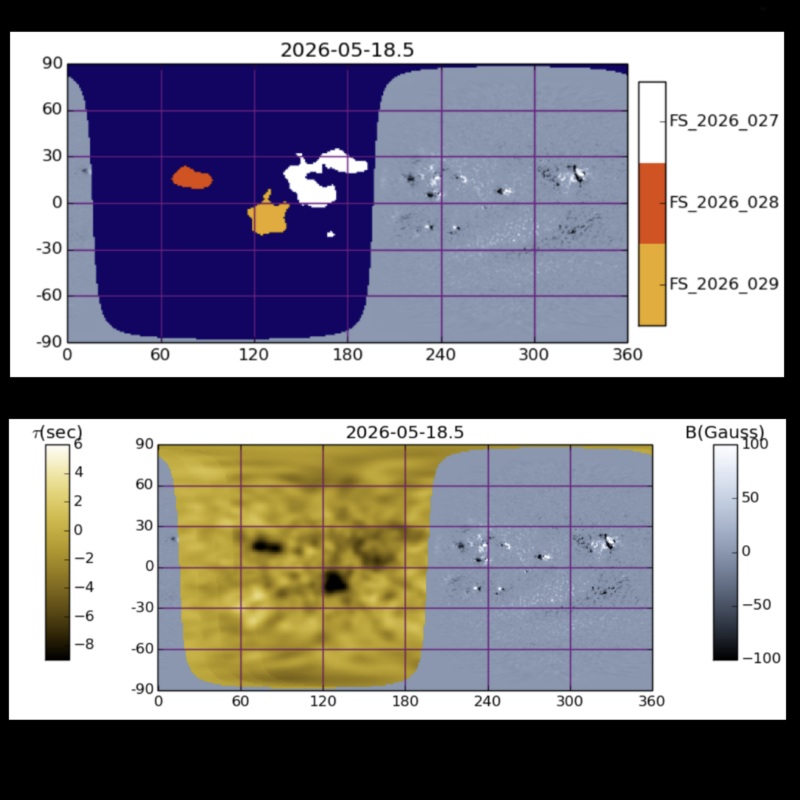
The Earth-facing side of the sun is currently quiet, but its far side tells a different story. Large, fiery sunspot regions are lurking out of view. How do we know? Firstly, NASA’s Perseverance rover has used its vantage point on Mars to image this activity. See the cool image below! Plus, specialists have been able to monitor these hidden regions using helioseismic echoes from the far side. Excitingly, these sunspot regions are approaching the eastern horizon of the sun from our perspective on Earth, and should soon rotate into our view. Stay tuned to see what these fiery regions bring to the table.
Past 24 hours of sun news
(11 UTC May 20 – 11 UTC May 21)
Flare activity
Over the past day, solar activity dropped from low to very low levels. The sun produced only B-class (weak) flares. In total, it fired just 5 B-class flares, down from yesterday’s 8.
- Strongest flare: B9.2 from AR4443 in the southeast, peaking at 16:11 UTC on May 20.
- Lead flare producer: A tie at the top once more; AR4441 and AR4443 each fired 2 B-class flares.
Sunspot regions
This morning, the sun shows 4 numbered active regions on its Earth-facing side. All four carry simple alpha or beta configurations. All four appear stable or in decay.
AR4436, the prolific flare producer of recent days, now sits at the very edge of the northwest horizon. Solar rotation is about to carry it to the far side. From this position, any strong flare or coronal mass ejection (CME) it produces could funnel directly toward Earth along the Parker Spiral. However, expectations are not high, as this region has reduced to a simpler beta configuration.
Blasts from the sun?
Available coronagraph imagery showed no Earth-directed coronal mass ejections (CMEs) over the past day.
Past 24 hours in space weather
Solar wind
Solar wind speeds averaged moderate levels through the entire period. Meanwhile, the interplanetary magnetic field (IMF) stayed weak throughout.
Bz and magnetic coupling
The Bz component kept shifting between north and south through the past day. However, it pointed mostly northward on most occasions. As of 11 UTC on May 21, the Bz has turned south-oriented. As always, a sustained southward Bz favors auroral displays.
Earth’s magnetic field
After yesterday’s Kp 4 disturbance, Earth’s magnetic field eased to quiet-to-unsettled levels over the past 24 hours (Kp 1–3). Currently, at 11 UTC on May 21, Earth’s magnetic field sits slightly above Kp level 2.
Sun news May 20: Solar material glances Earth, sun erupts again
The sun-stuff glancing blow we had been waiting for finally arrived last night. The coronal mass ejection (CME) from May 16 swept past Earth and pushed geomagnetic activity to Kp 4 (active) levels, falling just short of the G1 (minor) geomagnetic storm threshold. This disturbance is now starting to wane. Meanwhile on the sun, a beautiful eruption hurled another blob of solar stuff into space at 10:26 UTC yesterday. But after modeling and analysis, forecasters determined that no component of this CME is headed our way at Earth.
Past 24 hours of sun news
(11 UTC May 19 – 11 UTC May 20)
Flare activity
Over the past day, solar activity continued at low levels. In total, the sun sparked 12 flares: 8 C-class (common) and 4 B-class (weak).
- Strongest flare: C2.1 from AR4436 in the northwest, peaking at 20:00 UTC on May 19.
- Lead flare producer: AR4436 once again topped the list. It fired 10 of the 12 flares, including 7 C-class and 3 B-class events. The remaining 2 flares came from other regions on the disk.
Sunspot regions
Currently, 5 numbered active regions populate the Earth-facing side of the solar disk. Notably, all five sunspot regions now carry simple alpha configurations. All five appear stable or in decay. As a result, the risk of strong flares stays low from the currently numbered regions.
Blasts from the sun?
Available coronagraph imagery showed no Earth-directed coronal mass ejections (CMEs) over the past day. The eruption tied to the B8.2 flare from AR4440 launched material into space. However, forecasters confirmed that none is heading toward Earth.
Past 24 hours in space weather
Solar wind
Solar wind speeds decreased from moderate-high levels through the period. By 11 UTC on May 20, speeds have dropped to moderate-low levels. The glancing blow from the May 16 CME has started to wane. The interplanetary magnetic field (IMF) stayed weak throughout the past day.
Bz and magnetic coupling
The Bz component pointed mostly southward through the past day. Only a couple of weak northward peaks occurred. As of 11 UTC on May 20, the Bz remains south-oriented. As always, a sustained southward Bz favors auroral displays.
Earth’s magnetic field
Over the past day, Earth’s magnetic field reached active levels (Kp 3–4). The anticipated geomagnetic disturbance from the passing CME material arrived as a Kp 4 disturbance. It lasted for four consecutive three-hour periods. However, it did not cross the G1 storm threshold. Since then, Earth’s magnetic field has eased back to Kp 3.

Sun news May 19: Is recent sun-stuff grazing Earth?
The glancing blow from a blast of sun-stuff we’ve been waiting for – a traveling coronal mass ejection, or CME – might be here. Solar wind speeds started climbing to moderate-high levels at 5:30 UTC this morning. Meanwhile, the interplanetary magnetic field (IMF) also showed a slight increase around 6:30 UTC. These signatures suggest the CME’s glancing effects. This sun blast – consisting of solar materials and magnetic fields – left the sun on May 16. Forecasters expect unsettled-to-active conditions today. An isolated G1 (minor) geomagnetic storm is possible as the CME material sweeps past.
Past 24 hours of sun news
(11 UTC May 18 – 11 UTC May 19)
Flare activity
On the solar front, over the past day, activity returned to low levels. The sun fired only 2 C (common) flares and 6 B (weak) flares. AR4436 once again dominated, producing 7 of the 8 events. Even so, the region still packs energy.
- Strongest flare: C2.1 from AR4436, peaking at 7:40 UTC on May 19.
- Lead flare producer: AR4436 once again topped the list. It fired 7 of the 8 events.
Sunspot regions
Currently, 5 numbered active regions populate the Earth-facing side of the solar disk. All five sunspot regions stayed stable during this period. They carry simple alpha or beta configurations. As a result, the risk of strong flares remains low from the currently numbered regions.
Blasts from the sun?
Available coronagraph imagery showed no Earth-directed coronal mass ejections (CMEs) over the past day.
Past 24 hours in space weather
Solar wind
Solar wind speeds averaged moderate levels through most of the period. However, starting at 5:30 UTC this morning on May 19, speeds began climbing to moderate-high levels. This increase may signal the glancing arrival of the CME that left the sun on May 16.
Bz and magnetic coupling
The Bz component pointed mostly southward through the past day. A couple of northward peaks occurred. But the dominant story was the sustained southward orientation. In particular, a sustained southward dip began at 1 UTC on May 19 and continued through the morning. A sustained southward Bz favors auroral displays.
Earth’s magnetic field
Over the past day, Earth’s magnetic field ranged from quiet to unsettled (Kp 2–3). Currently, the Kp index sits at level 3. But with the CME material potentially arriving, that number could climb.
Sun news May 18: Sun-stuff racing toward Earth, aurora possible



A knotty blob of sun-stuff launched from the sun on Saturday is now racing through interplanetary space. Analysts currently think this coronal mass ejection (CME) could give Earth a glancing blow as early as overnight tonight. The impact could spark G1 (minor) to G2 (moderate) geomagnetic storms. And that could mean auroras visible from northern latitudes, including northern Scotland and Scandinavia. Share your aurora photos with us!
Past 24 hours of sun news
(11 UTC May 17 – 11 UTC May 18)
Flare activity
Over the past day, solar activity held at moderate. In total, the sun fired 9 flares: 4 C-class (common) and several B-class (weak) events.
- Strongest flare: C9.7 from AR4436, peaking at 20:42 UTC on May 17. This event was accompanied by a notably strong 370-solar-flux-unit radio burst.
- Lead flare producer: AR4436 topped the list. It fired at least 6 of the 9 tracked events, including the C9.7 and multiple B-class flares.
Sunspot regions
The Earth-facing solar disk currently shows 7 numbered active regions.
Blasts from the sun?
The major CME story centers on the complex eruption on May 16, which is now en route to Earth. A wide, fast CME appeared in SOHO LASCO C2 and C3 imagery at 16:36 UTC on May 16. It was tied to the M1.9 flare from AR4436. Coronal dimming and a Type IV radio sweep accompanied the eruption. The bulk of the ejecta soared out to the northwest. However, modeling indicates some will give Earth a glancing blow around 0:00 UTC on May 19. Kp estimates range from 3 to 5, depending on the CME’s magnetic orientation upon arrival. That points to potential G1 (minor) storm conditions, with a chance of borderline G2 (moderate).
Past 24 hours in space weather
Solar wind
Solar wind speeds gradually decreased through the period. That’s as the coronal hole’s high-speed solar wind stream continued its slow fadeout. Meanwhile, the total interplanetary magnetic field stayed relatively weak.
Bz and magnetic coupling
The Bz component remained near neutral. No sustained southward dips occurred. That explains why geomagnetic conditions stayed quiet despite the elevated solar wind speeds. Without a sustained southward Bz, Earth’s magnetic shield stays effectively closed.
Earth’s magnetic field
Over the past day, Earth’s magnetic field stayed at quiet levels (Kp 1–2).
Sun news May 17: M2 flare erupts, G2 storm rocks Earth

The sun stayed active over the past day. AR4435 and AR4436 both fired M-class flares. The headline event was an M2.0 from AR4435. It triggered a minor radio blackout. In total, 4 M-class and 8 C-class flares were recorded. Looking ahead, a complex coronal mass ejection (CME) erupted in association with the M1.9 flare from AR4436. Early modeling suggests a glancing blow could reach Earth around May 19. Meanwhile, Earth’s magnetic field rumbled with geomagnetic storm activity over the past 24 hours. And the incoming material suggests that aurora-watchers shuld stay on alert into early next week! Share your aurora photos with us!
Past 24 hours of sun news
(11 UTC May 16 – 11 UTC May 17)
Flare activity
Over the past day, solar activity reached moderate to high levels. In total, the sun fired 13 flares: 4 M-class and 8 C-class.
- Strongest flare: M2.0 from AR4435, peaking at 17:39 UTC on May 16. It triggered an R1 (minor) radio blackout, briefly affecting HF communications over the sunlit United States.
- Other M-class flares: M1.9 from AR4436 at 15:50 UTC on May 16 (R1 blackout). This one triggered a complex CME and filament eruption, accompanied by a Type IV radio sweep. An M1.3 from AR4436 followed at 16:22 UTC (R1 blackout). Then, an M1.4 from AR4435 fired at 3:29 UTC on May 17 (R1 blackout affecting East Asia and the Pacific Ocean).
- Lead flare producer: AR4435 dominated the period. It fired 9 of the 13 flares, including the M2.0 and M1.4. Meanwhile, AR4436 contributed its M1.9 and M1.3 pair plus a C1.2. In addition, newcomer AR4439 produced two minor C-class flares, marking its first observed activity.
Sunspot regions
The Earth-facing solar disk showed 5 numbered active regions. Notably, three newcomers received official numbers during this period.
Blasts from the sun?
Multiple coronal mass ejections (CMEs) were observed. One carries potential Earth-directed components.
The main event on the sun: The M1.9 flare from AR4436 at 15:50 UTC on May 16 triggered a filament eruption and a complex, multi-front CME. It first appeared in SOHO LASCO C2 imagery at 16:36 UTC. A second front became visible near 17:00 UTC. Initial WSA-ENLIL modeling suggests a glancing blow arriving around 0:00 UTC on May 19. Kp estimates range from 3 to 5, depending on the CME’s magnetic field orientation upon arrival. That indicates potential for G1 (minor) to borderline G2 (moderate) storm conditions. However, the bulk of the material may pass north of Earth.
Past 24 hours in space weather
Solar wind
Solar wind conditions reflected an ongoing influence of the coronal hole high-speed stream. Speeds remained strong throughout the period. They peaked at approximately 823 km/s (very high) at 3:36 UTC on May 16. Then they erratically declined to around 630 km/s by the end of the period. Meanwhile, the total interplanetary magnetic field (IMF) decreased from moderate levels of 7–8 nT to weaker 4–5 nT.
Bz and magnetic coupling
Meanwhile, the Bz component swung southward repeatedly over the past day. Each dip opened the door for charged particles to pour into Earth’s upper atmosphere, energizing it. Those dips opened the door for enhanced geomagnetic activity and aurora. But, by the end of the period, the Bz settled closer to neutral.
Earth’s magnetic field
Over the past day, Earth’s magnetic field reached G2 (moderate) geomagnetic storm levels. And a fast-flowing stream of solar wind from a large coronal hole kept conditions unsettled. Kp values climbed as high as 6, reaching G2 (moderate) storm territory during the early hours of the past day. Auroras danced across high-latitude skies. Displays were potentially visible from Edinburgh, northern England, and similar geomagnetic latitudes in the Southern Hemisphere.
What’s ahead? Sun–Earth forecast
Flare activity forecast
Forecasters expect low levels to continue through May 19. A chance (40%) exists for isolated M-class (R1–R2) flares. AR4435 is rotating beyond the western limb and becoming less geoeffective. AR4436 shows signs of decay.
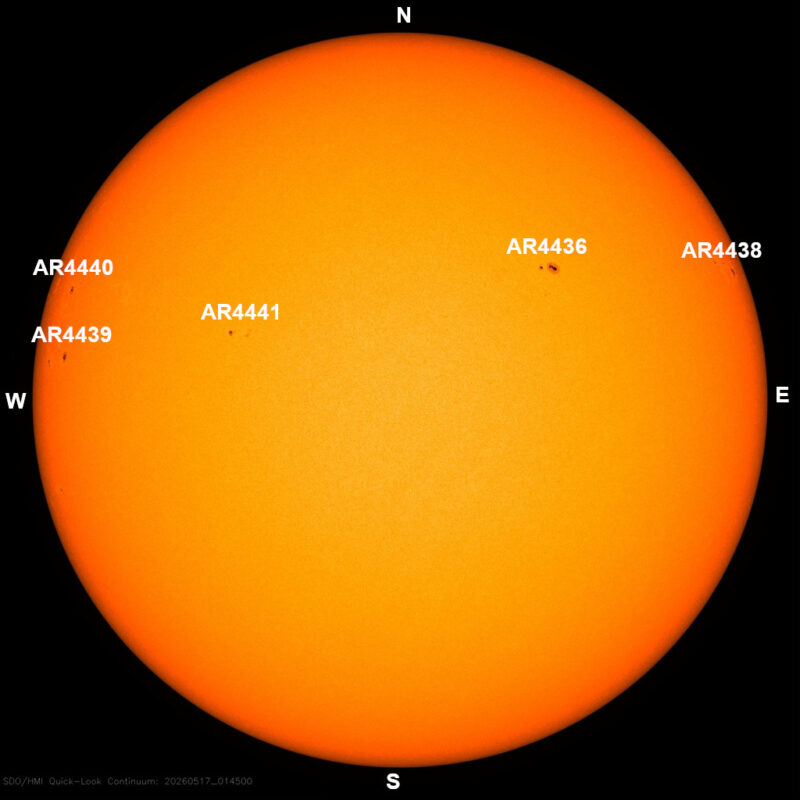
However, the newly numbered eastern-limb regions (AR4439, AR4440, AR4441) bear watching as they rotate into more Earth-facing positions. None currently show high complexity. X-class flares remain unlikely (5%) given the current setups on the disk.
Geomagnetic activity forecast
- May 17 (Saturday): Expect G1 (minor) geomagnetic storming early in the day as the coronal hole high-speed stream continues. Conditions should gradually ease to unsettled-to-active levels (Kp 3–4) through the rest of the day. Aurora may remain visible from high-latitude locations such as northern Scotland, southern Alaska, and similar geomagnetic latitudes.
- May 18 (Sunday): G1 (minor) storming is likely. A chance of G2 (moderate) levels exists as well. Specifically, the glancing CME from the May 16 M1.9 event may arrive mid-day. Forecasters expect the bulk of the material to pass north of the sun-Earth line. However, even a glancing encounter could reinvigorate geomagnetic activity atop the waning high-speed stream. If Kp reaches 5–6, aurora could reach Seattle, Minneapolis, Edinburgh, and possibly Toronto and Chicago.
- May 19 (Monday): A chance for G1 (minor) storm intervals persists as residual CME effects and lingering high-speed stream influence taper off. Conditions should gradually return toward quiet-to-unsettled levels (Kp 2–3).
Sun news May 16: Solar wind arrived and arrived strong last night
The anticipated fast solar wind arrived, and it arrived strong. It kept Earth’s magnetic field busy over the past day with enhancements that reached G2 (moderate) geomagnetic storm levels. Meanwhile, solar wind speeds climbed to high levels over the past day. The interplanetary magnetic field (IMF) also strengthened to strong levels. These conditions of geomagnetic storming might extend through the weekend. More G1 (minor) and even G2 (moderate) storming might continue through Sunday, as lingering effects of the high-speed solar winds persist. Aurora-watchers, please share your photos with EarthSky.
Past 24 hours of sun news
(11 UTC May 15 – 11 UTC May 16)
Flare activity
Over the past day, activity on the sun itself stayed low . The sun produced only C (common) and B (weak) flares, 10 total: five C flares plus five B flares.
- Strongest flare: The strongest flare of the period was a C9.5, almost an M flare. Active region AR4435 in the sun’s northwest fired it off. It peaked at 16:14 UTC on May 15.
- Lead flare producer: Active region AR4435 topped the list as lead flare producer. It sparked seven flares over the past day: five C and two B flares, the largest of the period included.
Sunspot regions
Today the sun shows just three numbered active regions on its side we see from Earth. All three sunspot regions carry beta magnetic configurations. Chances for strong flares remain low.
Blasts from the sun?
Experts did not observe any coronal mass ejections (CMEs) in available coronagraph imagery over the past 24 hours.
Past 24 hours in space weather
Solar wind
Solar wind speeds increased to high over the past day. That increase signals the approaching coronal hole high-speed stream. Meanwhile, the total interplanetary magnetic field (IMF) started strong late yesterday. But, at around 22 UTC on May 15, it started to decrease and ended at a weak level this morning.
Bz and magnetic coupling
The Bz component showed strong peaks in both south and north orientation. It kept shifting southward-northward throughout the past day. At the time of this writing, it shows a strong northward orientation. Southward Bz keeps Earth’s magnetic shield open and favors auroral activity.
Earth’s magnetic field
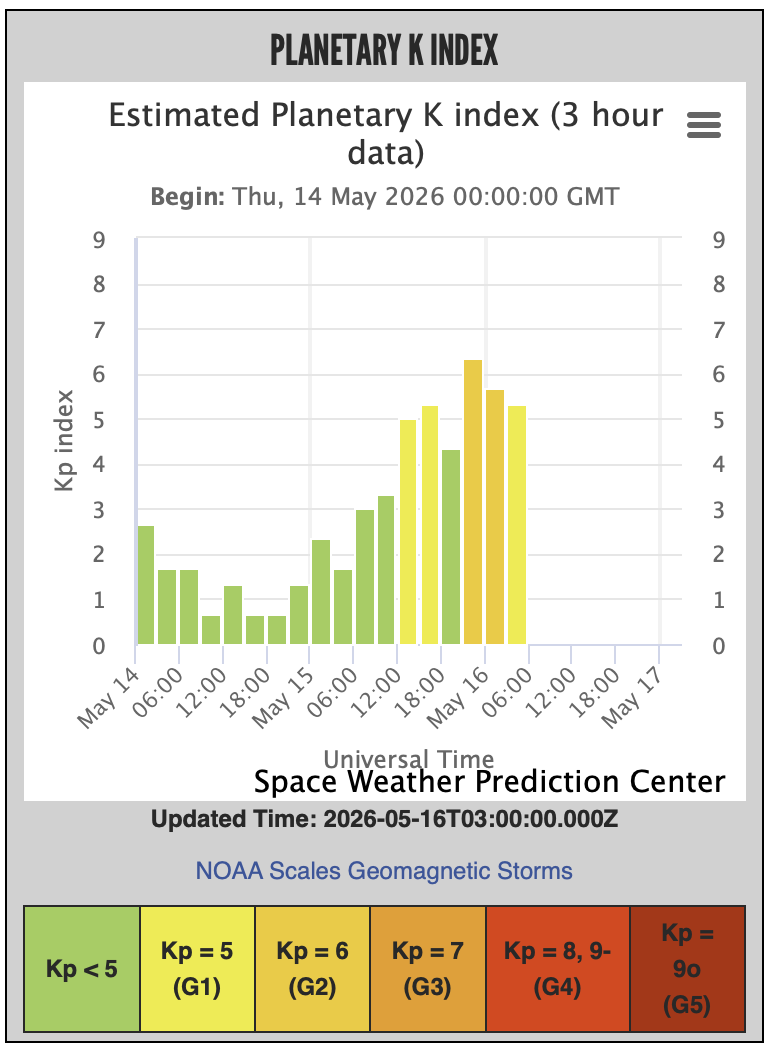
Over the past day, Earth’s magnetic field increased to active and storming levels (Kp 4–6). The planetary Kp index kept busy the whole period, starting at around 12 UTC on May 15 when it reached a G1 (minor) or Kp 5 geomagnetic storm level. Then it increased to G2 (moderate) or Kp 6 levels. In short, the Kp index kept at level 5 for three three-hour synoptic periods and reached Kp 6 levels for two three-hour synoptic periods. It was a busy day for Earth’s magnetic field, as anticipated! Currently, the Kp index continues at level 5, indicating a G1 (minor) geomagnetic storm.
What’s ahead? Sun–Earth forecast
Flare activity forecast
Forecasters continue to anticipate low levels of flare activity in the coming days. Chances for M-class (moderate) flares hold at 40%. Meanwhile, chances for an isolated X-class (strong) flare stay at 5%. Three remaining numbered sunspot regions on the sun’s disk appear either stable or in decay.
Geomagnetic activity forecast
- May 16 (Saturday): Active-to-storming conditions may continue during the day today. Fast solar wind from the large coronal hole – combined with a co-rotating interaction region (CIR) – should drive the activity. More G1 (minor) geomagnetic storm levels are anticipated, with chances for a G2 (moderate) storming disturbance. All this is happening as the trans-equatorial coronal hole stream keeps providing enhancements. There are good chances for aurora watchers at high latitudes to capture beautiful auroral displays!
- May 17 (Sunday): G1 (minor) geomagnetic storming might continue through the day as the high-speed stream persists. Auroral displays might continue through the weekend. Aurora-chasers, stay alert. Clear skies!
- May 18 (Monday): We expect unsettled-to-active conditions, as lingering effects of the high-speed solar wind start to decrease.
Sun news May 15: Waiting on the solar wind

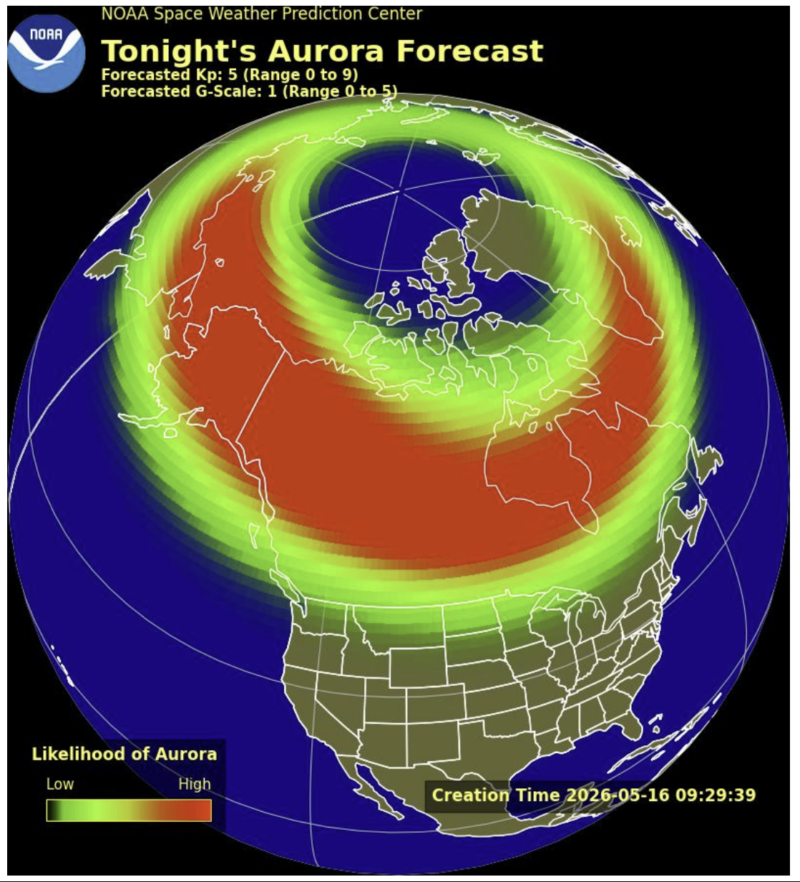
We’re waiting for Earth’s reaction to the solar wind. Will it bring us a geomagnetic storm and auroras? Solar wind speeds climbed to moderate-high levels over the past day. The interplanetary magnetic field (IMF) also strengthened to strong levels. Forecasters expect G2 (moderate) geomagnetic storm conditions later today. And G1 (minor) storming might continue through Saturday and Sunday as lingering effects of the high-speed solar wind persist. Aurora watchers, this is your weekend! Displays are possible (likely?) at high latitudes. Get your cameras ready! And please share your aurora photos with EarthSky.
Past 24 hours of sun news
(11 UTC May 14 – 11 UTC May 15)
Flare activity
Over the past day, solar activity continued at low levels. But flare production increased notably. In total, the sun fired 18 flares: 14 C-class (common) and 4 B-class (weak). That’s up from 13 flares during the previous day.
- Strongest flare: C5.1 from AR4436 in the sun’s northeast, peaking at 18:40 UTC on May 14.
- Lead flare producer: There was a tie at the top again today. AR4438 and AR4435 produced six flares each. In addition, AR4432 contributed three flares from behind the solar horizon. It was still firing even after rotating out of view.
Sunspot regions
Currently, the Earth-facing side of our sun shows just three numbered active regions. All three sunspot regions carry beta magnetic configurations. So the risk of strong flares remains low.
Blasts from the sun?
Available coronagraph imagery showed no significant Earth-directed coronal mass ejections (CMEs) over the past 24 hours. We did see two filament eruptions, throwing billions of tons of sun-stuff into space. See the images below. This sun-stuff isn’t headed our way.
Past 24 hours in space weather
Solar wind
Solar wind speeds initially decreased to moderate-low levels, early in the past day. But, starting around 20 UTC on May 14, they started climbing and climbed to moderate-high levels. That increase signals the approaching coronal hole high-speed stream. Meanwhile, the total interplanetary magnetic field (IMF) started weakly. Then, around 22 UTC on May 14, it jumped to strong levels.
Bz and magnetic coupling
The Bz component pointed mostly northward through the period. Only a couple of weak southward peaks occurred. At the time of this writing, it shows a strong northward orientation. As always, a northward Bz keeps Earth’s magnetic shield closed and limits auroral activity. However, that could change quickly as the coronal hole stream fully arrives.
Earth’s magnetic field
Over the past day, Earth’s magnetic field held at very quiet to unsettled levels (Kp 0–3). Currently, the Kp index sits just below level 3. But that’s about to change as the coronal hole high-speed stream ramps up.
Sun news May 14: Auroras on the way this weekend?



Auroras are possible from tomorrow through the weekend! That’s because a large coronal hole – an area of lower density in the sun’s outer atmosphere – is now facing straight at Earth. And this is no ordinary coronal hole. It stretches from the sun’s northern to southern hemisphere, crossing the solar equator. That makes it a transequatorial coronal hole, one of the more potent drivers of geomagnetic activity at Earth. The fast solar wind streaming out of it should start hitting our planet’s magnetic field tomorrow. Experts are now forecasting G2 (moderate) geomagnetic storms, which could bring auroras to high latitudes. Don’t forget to share your aurora photos with us!
Past 24 hours of sun news
(11 UTC May 13 – 11 UTC May 14)
Flare activity
Over the past day, solar activity held at low levels. The sun produced only C-class (common) flares. In total, it fired 13 C-class flares.
- Strongest flare: C5.5 from AR4435 in the northwest, peaking at 6:42 UTC on May 14.
- Lead flare producer: A tie at the top once again! AR4432, now lost over the northwest horizon, is still flaring from behind the limb. It fired 6 C-class flares, as did AR4435.
Sunspot regions
Currently, the Earth-facing side of our sun shows 4 numbered active regions. Two newcomers received official numbers during the period: AR4437, which rapidly decayed to plage, and AR4438 in the northwest. All sunspot regions carry either beta or alpha configurations. As a result, the risk of strong flares stays low.
Blasts from the sun?
Available coronagraph imagery showed no coronal mass ejections (CMEs) over the past 24 hours.
Past 24 hours in space weather
Solar wind
Solar wind speeds slightly increased to moderate-high levels starting around 12 UTC on May 13. However, they dropped back to moderate levels by the end of the period. Meanwhile, the total interplanetary magnetic field (IMF) stayed weak.
Bz and magnetic coupling
The Bz component kept shifting between north and south through the period. However, at 3 UTC this morning, it turned northward. It has stayed there through the time of this writing. As always, a northward Bz keeps Earth’s magnetic shield closed and limits auroral activity.
Earth’s magnetic field
Over the past day, Earth’s magnetic field ranged from quiet to unsettled levels (Kp 1–3). Currently, the Kp index sits just below level 2.


Sun news May 13: A huge coronal hole is now facing Earth
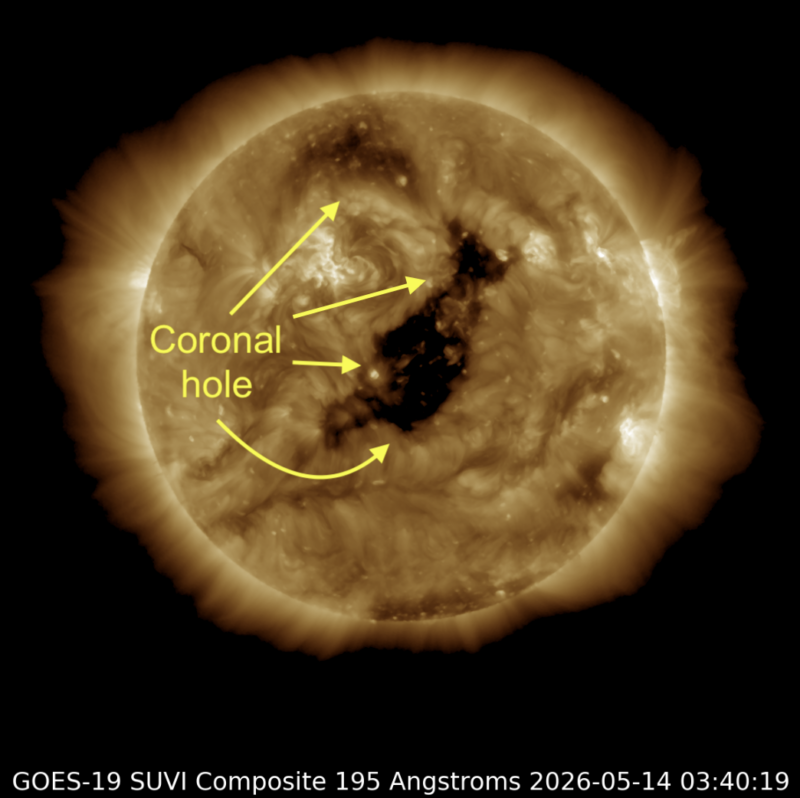
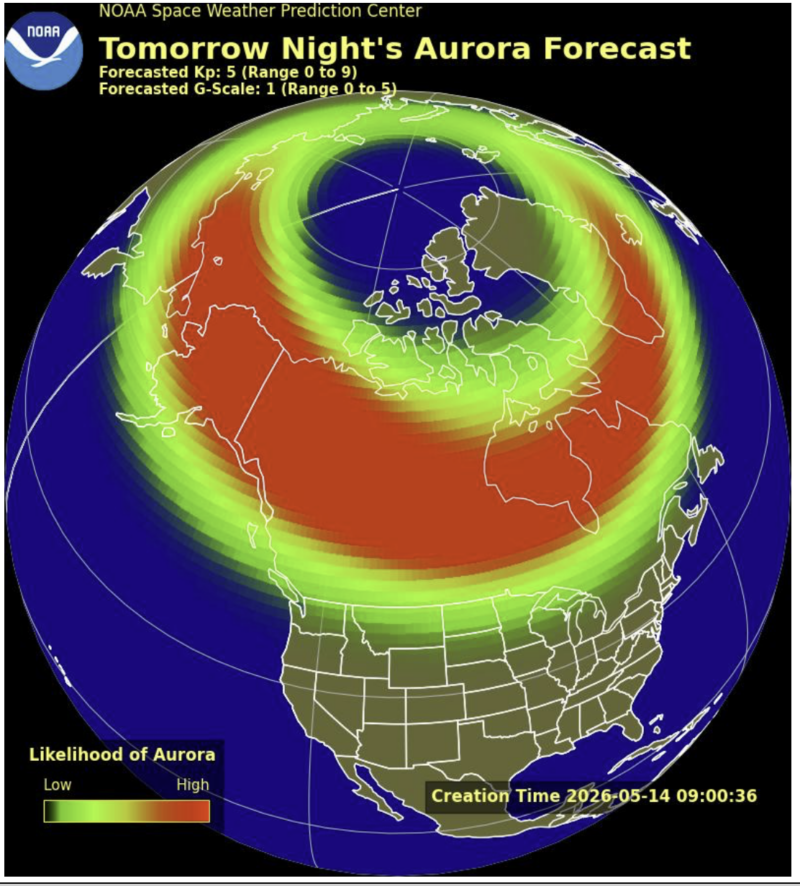
A large coronal hole – an area of lower density in the sun’s outer atmosphere – is now facing straight at Earth. The fast solar wind streaming from this hole should start reaching us on Friday, likely triggering G1 (minor) or even G2 (moderate) geomagnetic storms. And that means possible auroras at high latitudes!
Past 24 hours of sun news
(11 UTC May 12 – 11 UTC May 13)
Flare activity
Solar activity continued at low levels over the past day with the production of only C-class (common) and B-class (weak) flares. An increase in flare production was noted, though, with the sun firing 14 flares: 10 C-class and 4 B-class.
As sunspot region AR4432 departs it keeps producing gorgeous jets. An incoming active region on the northeast responded with its own powerful jets. Take a look at the imagery below.
- Strongest flare: C2.3 from AR4436 in the northeast, peaking at 6:40 UTC on May 13.
- Lead flare producer: Once again AR4432 is at the top of the list. It blasted out 9 flares: 5 Cs plus all 4 B-class flares of the period.
Sunspot regions
Currently the Earth-facing side of our star shows 4 numbered active regions. AR4432 keeps its beta-gamma configuration and it is now at the very edge of the solar northwest horizon, prompt to depart to the far side. AR4436 shows a beta magnetic configuration, and is now the largest sunspot region on the solar face we see from Earth. The rest of the sunspot regions show either a beta or alpha configuration.
Blasts from the sun?
We observed no coronal mass ejections (CMEs) in available coronagraph imagery during the past day. But forecasters still await the coronal mass ejection (CME) produced during the M5.8 event from AR4436 on May 10. It may provide a glancing blow late today. Conditions for a G1 (minor) geomagnetic storm are not ruled out.
Past 24 hours in space weather
Solar wind
Solar wind speeds averaged moderate-low-to-moderate levels during the period. The total interplanetary magnetic field (IMF) increased to strong levels.
Bz and magnetic coupling
The Bz component kept shifting between north and south orientations throughout the past day, ending south at the time of this writing.
Earth’s magnetic field
Earth’s magnetic field remained at very quiet levels (Kp 0–1). At the time of this writing, Earth’s magnetic field sits slightly above level 1 on the Kp index scale.


Sun news May 12: A pair of fiery simultaneous eruptions
The sun treated us to a pair of gorgeous, fiery eruptions over the northwest and southeast horizons around 17 UTC yesterday evening. These beautifully synchronized blasts sent chunks of sun-stuff into space, but neither are heading Earthward. However, we’re still awaiting a possible impact of sun-stuff fired out in Sunday’s M5.8 (moderate) flare. This might reach our magnetic field late today or tomorrow. Stay tuned!
Past 24 hours of sun news
(11 UTC May 11 – 11 UTC May 12)
Flare activity
Over the past day, solar activity returned to low levels with the production of only C-class (common) and B-class (weak) flares. In total, the sun fired 9 flares: 6 C-class and 3 B-class.
- Strongest flare: C1.9 from AR4432, peaking at 14:15 UTC on May 11.
- Lead flare producer: AR4432 blasted out all 9 flares of the period.
Sunspot regions
Today the Earth-facing side of our sun is populated with 4 numbered active regions. AR4432 keeps its beta-gamma configuration and AR4436 lost the gamma complexity shown yesterday.
Blasts from the sun?
At around 4:16 UTC on May 11, a filament in the south hemisphere erupted, hurling a blob of solar stuff into space. The event is under modeling and analysis to determine if a component of this coronal mass ejection (CME) is coming our way at Earth. The coronal mass ejection (CME) produced during the M5.8 event from AR4436 on May 10, may provide a possible glancing blow late today or tomorrow. This might trigger a G1 (minor) geomagnetic storm … or it might deliver only a weak disturbance or miss entirely!
Past 24 hours in space weather
Solar wind
Solar wind speeds averaged moderate-low levels during this period. The total interplanetary magnetic field (IMF) stayed weak.
Bz and magnetic coupling
The Bz component shifted between north and south orientations throughout the past day.
Earth’s magnetic field
Over the past day, Earth’s magnetic field remained at quiet levels (Kp 1–2). At the time of this writing, Earth’s magnetic field sits at level 1 on the Kp index scale.
Sun news May 11: M5 flare erupts, sun-stuff may glance Earth


The sun just fired its strongest flare in days! The M5.8 (moderate) flare erupted from sunspot region AR4436 in the northeast around 13 UTC yesterday. The blast sent a fast chunk of sun-stuff – a coronal mass ejection (CME) – racing into space. Scientists have detected a fast, powerful pressure wave racing ahead of this CME. The bulk of the ejecta is heading away from Earth, but our planet could receive a glancing blow early on May 13. If so, this could trigger G1 (minor) auroras. Stay tuned, aurora hunters!
Past 24 hours of sun news
(11 UTC May 10 – 11 UTC May 11)
Flare activity
Over the past day, solar activity reached high levels. In total, the sun fired 10 flares: 1 M-class, 8 C-class (common) and 1 B-class (weak).
- Strongest flare: M5.8 from AR4436, peaking at 13:19 UTC on May 10. It triggered an R2 (moderate) radio blackout, disrupting high frequency communications across eastern Africa.
- Lead flare producer: AR4432 generated the vast majority of the remaining activity. It fired 8 C-class flares and 1 B-class event.
Sunspot regions
The Earth-facing solar disk showed 5 numbered active regions.
Blasts from the sun?
A significant partial halo CME accompanied the M5.8 flare from AR4436. It first appeared at 13:48 UTC on May 10, erupting off the east limb in the SOHO spacecraft’s LASCO C2 imagery. The bulk of the ejecta was aimed well east of Earth. However, initial WSA-ENLIL modeling points to a possible glancing blow arriving at Earth early UTC on May 13. If the Earth-directed component is confirmed, Kp could reach 5, indicating G1 (minor) storm potential. However, significant uncertainty remains. The CME may deliver only a weak disturbance or miss entirely.
Past 24 hours in space weather
Solar wind
Solar wind conditions reflected the waning influence of a positive-polarity coronal hole high-speed stream. Speeds declined from slightly elevated to normal by its end. The total interplanetary magnetic field (IMF) stayed weak.
Bz and magnetic coupling
The Bz component remained near neutral and variable. The slight swings from north to south were too weak to drive any significant geomagnetic response. Consequently, Earth’s magnetic shield stayed firmly closed.
Earth’s magnetic field
Over the past day, Earth’s magnetic field stayed quiet (Kp 0–2). No geomagnetic storm conditions occurred. The weak and variable IMF kept conditions calm throughout. No sustained southward Bz developed.
Sun news May 10: Quiet sun as coronal hole winds fade
The sun took a breather over the past day. Activity held at low to moderate levels as AR4432 peppered the X-ray monitors with a steady stream of C-class (common) flares, 18 in all, without mustering anything stronger. The strongest was a C3.8 at 09:32 UTC on May 10. Earth’s magnetic field stayed calm. Our planet remained under the waning influence of a coronal hole high-speed stream. Solar wind speeds gradually eased to moderate levels. A faint coronal mass ejection (CME) from May 6 might deliver a glancing blow today. But confidence is low. Any aurora-producing effects would likely be minor.
Past 24 hours of sun news
(11 UTC May 9 – 11 UTC May 10)
Flare activity
Over the past day, solar activity held at low levels. In total, the sun fired 18 C-class flares. No M-class or X-class flares occurred.
- Strongest flare: C3.8 from sunspot region AR4432, peaking at 9:32 UTC on May 10. As a C-class event, it triggered no radio blackout.
- Lead flare producer: AR4432 dominated almost entirely. It fired 17 of the 18 flares, all C flares. Meanwhile, newcomer AR4436 contributed the remaining C1.4 at 6:32 UTC on May 10.
Sunspot regions
The Earth-facing solar disk showed 5 numbered active regions. AR4432 (beta-gamma) continued as the most active region on the disk. It developed additional middle spots and continued to grow. Notably, it maintains some mixed magnetic structure. As a result, it remains the region most likely to produce an M-class event. AR4436 (beta) received its official number during the period. This returning region sits near the northeast limb. The remaining three numbered regions carry simpler alpha or beta configurations. They were mostly stable or in decline. None produced notable flaring.
Blasts from the sun?
Available coronagraph imagery showed no Earth-directed coronal mass ejections (CMEs) during the past day. But the faint CME from May 6 might deliver a glancing blow today, with emphasis on the might. Any effects would likely be limited to isolated unsettled intervals.
Past 24 hours in space weather
Solar wind
Solar wind speeds gradually declined through the period. The coronal hole high-speed stream that we’ve been experiencing – and which normally contributes to aurora possibilities (but not this time; see Bz below) – continued to weaken. Speeds ranged from roughly 450–550 km/s, with a clear downward trend. By the end of the period, conditions approached near-normal levels. The total interplanetary magnetic field (IMF) stayed weak overall.
Bz and magnetic coupling
The Bz component pointed mostly neutral to northward throughout the period. Only brief southward dips occurred. A northward Bz effectively shields Earth from solar wind energy. That explains why geomagnetic conditions stayed quiet – and auroras prospects stayed relatively low – despite the elevated wind speeds. Consequently, no auroral displays were reported.
Earth’s magnetic field
Over the past day, Earth’s magnetic field stayed quiet (Kp 0–2). No geomagnetic storm conditions occurred. The northward Bz and declining solar wind speeds kept conditions calm throughout.
What’s ahead? Sun–Earth forecast
Flare activity forecast
Forecasters expect low levels to continue through May 12. C-class flaring from AR4432 should persist. A chance (40%) exists for isolated M-class (R1–R2) flares, primarily from AR4432 given its beta-gamma complexity and continued growth.
In addition, AR4436 bears watching. It previously produced M-class activity from behind the limb. As it rotates further onto the disk, forecasters can better assess its true complexity. A slight chance (5%) for an X-class event also remains.
Geomagnetic activity forecast
- May 10 (Saturday): Expect quiet-to-unsettled conditions (Kp 0–3) as the positive-polarity coronal hole stream continues to wane. A slight chance of active to G1 (minor) geomagnetic storm intervals (Kp 4–5) exists if the faint CME from May 6 makes contact. But confidence is low. If G1 conditions briefly appear, aurora could reach Anchorage, Reykjavik, and Tromsø.
- May 11 (Sunday): Expect quiet-to-unsettled conditions (Kp 0–3) as the coronal hole influence fades and solar wind returns toward background levels. No significant geomagnetic drivers are at play.
- May 12 (Monday): Expect quiet-to-unsettled conditions (Kp 0–3) to continue. A small mid-latitude coronal hole may produce a mild solar wind boost. But the stream should largely miss Earth.
Join EarthSky’s Deborah Byrd and space weather forecaster Shawn Dahl of NOAA’s Spaceweather Prediction Center in Boulder, Colorado, as they revisit the biggest solar storm in 2 decades. The May 10-11, 2024, event brought auroras to skies around the world. What did we learn from that storm? How did our technology — and especially our power grids— hold up? And are we ready for the next big solar storm? Plus … Shawn also explains how space weather forecasting could play a key role as humans head back to the moon and to Mars. Watch in the player above or on YouTube.
Sun news May 9: Returning powerhouse shows its nose
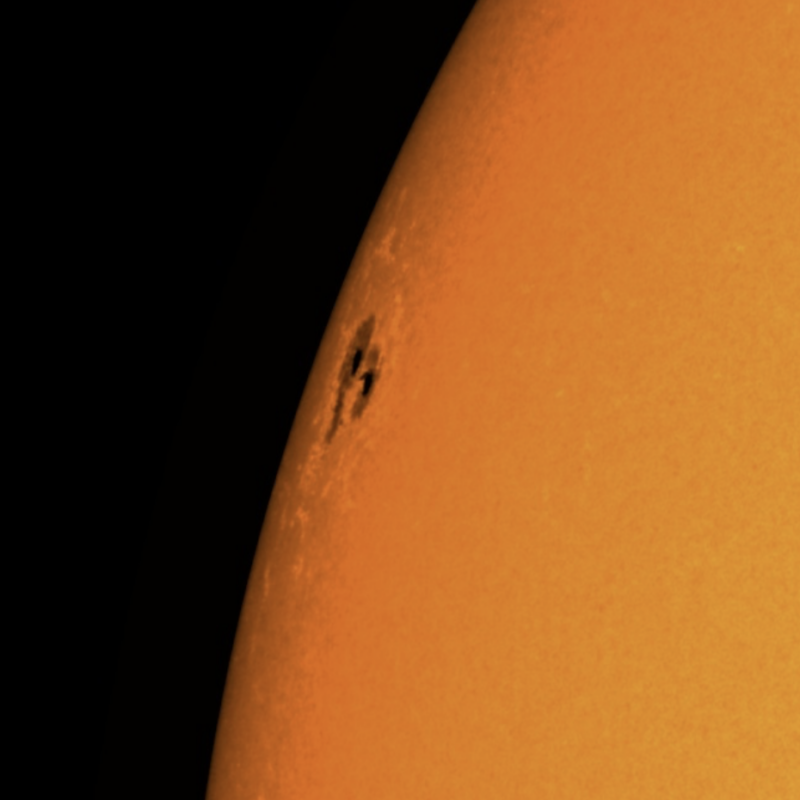
Sun-watchers’ eyes are turning to the northeast solar horizon. The sunspot region formerly known as AR4419 – continuously carried westward by the sun’s rotation – has finished its journey on the sun’s far side and has started coming back into view. And this former powerhouse looks impressive already. Even the small portion now visible appears larger in extent than all the other sunspot regions on the sun’s visible disk now. Yesterday, this as-yet-unnumbered region fired an M flare from the far side! But, over the past day, it remained dormant, with no flares. Did it keep its complex magnetic setup, the same setup that let it fire two X flares on a single day when we last saw it cross the sun’s visible face? We don’t know yet. Soon we’ll see. Stay with us!
Past 24 hours of sun news
(11 UTC May 8 – 11 UTC May 9)
Flare activity
Over the past day, solar activity held at low levels. Only C-class and B-class flares occurred. But overall flare production increased notably. In total, the sun fired 17 flares: 16 C-class (common) and 1 B-class (weak).
- Strongest flare: C2.7 from AR4432 in the northwest, peaking at 20:21 UTC on May 8.
- Lead flare producer: AR4432 was not just the lead producer. It was the only producer. This single sunspot region fired all 18 flares of the period: 17 C-class and 1 B-class.
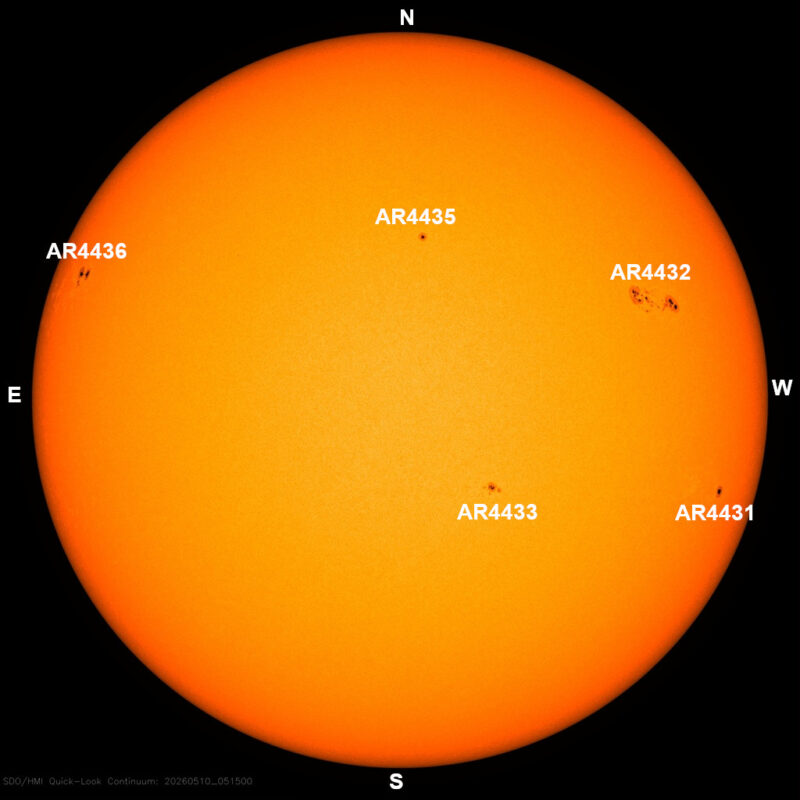
Sunspot regions
Currently, the sun shows 5 numbered active regions on its visible side. Notably, AR4432 continued to grow over the past day. It gained a gamma component and now shows a beta-gamma magnetic complexity. That upgrade boosts its potential for stronger flares. The remaining regions on the visible disk carry beta or simpler configurations.
Blasts from the sun?
Available coronagraph imagery showed coronal mass ejections (CMEs) tied to the M flare from yesterday’s update. But the CMEs weren’t directed toward Earth. No new Earth-directed CMEs appeared over the past day, either.
Past 24 hours in space weather
Solar wind
Solar wind speeds continued at moderate-high levels throughout the period. Fast solar wind from a coronal hole combined with a co-rotating interaction region (CIR) drove the elevated speeds. But effects then started to wane. Meanwhile, the total interplanetary magnetic field (IMF) dropped from strong to weak levels.
Bz and magnetic coupling
The Bz component stayed weak during the past day. It shifted between south and north. Those conditions were not ideal for auroral displays. Currently, at the time of this writing, the Bz has turned slightly northward, sitting just above the zero level. Tough luck, aurora-watchers!
Earth’s magnetic field
Over the past day, Earth’s magnetic field ranged from unsettled-to-quiet levels (Kp 1–3). Specifically, the CIR and fast solar wind kept the Kp index at level 3 for three consecutive three-hour synoptic periods. Since then, conditions have eased. Currently, the Kp index sits slightly above level 1.
Sun news May 8: Bam! M flare fires from far side

Bam! The sun surprised us with an M flare from its far side! The fiery northeast horizon we’ve been watching in recent days delivered the M2.6 flare at 15:14 UTC on May 7. The eruption clearly originated from the sun’s far side, just around the corner in the northeast. So the real strength was surely larger than the registered M2.6. The resulting blob of solar stuff isn’t heading toward Earth, given its far-side location. But gorgeous prominences danced during the blast. Is this a preview of the return of powerhouse sunspot region AR4419? We’ll see. Stay with us!
Past 24 hours of sun news
(11 UTC May 7 – 11 UTC May 8)
Flare activity
Over the past day, solar activity jumped to moderate levels with the production of an isolated M-class flare. In total, the sun produced 7 flares: 1 M-class (moderate), 5 C-class (common), and 1 B-class (weak).
- Strongest flare: M2.6 from an incoming region on the northeast, not yet numbered. It peaked at 15:14 UTC on May 7. The blast triggered an R1 (minor) radio blackout over the mid-Atlantic.
- Lead flare producer: The incoming, unnamed newcomer topped the list. It fired 5 of the period’s 7 flares. These included 4 C-class events and the M-class blast.
Sunspot regions
Currently, the sun shows 4 numbered active regions on its Earth-facing side. AR4432 showed slight growth during the period. But all regions on the visible disk carry beta or simpler magnetic configurations. In other words, the currently numbered regions hold simple magnetic setups for now. The real action is coming from the unnumbered newcomer in the northeast. We’ll be able to see its magnetic configuration when the sun’s rotation carries it into better view.
Blasts from the sun?
Available coronagraph imagery showed non-Earth-directed coronal mass ejections (CMEs) during the period, from the M flare.
Past 24 hours in space weather
Solar wind
Solar wind speeds climbed to moderate-high levels throughout the period. Fast solar wind from a coronal hole arrived and combined with a co-rotating interaction region (CIR). Together, they drove a noticeable increase in space weather activity. Meanwhile, the total interplanetary magnetic field (IMF) jumped to strong levels.
Bz and magnetic coupling
The Bz component pointed almost entirely northward through the period. Only slight, weak southward peaks occurred. Consequently, that shut the door on any auroral displays. But, at the time of this writing, the Bz has turned strongly southward. That could open the door for geomagnetic coupling and potential aurora activity in the hours ahead.
Earth’s magnetic field
Over the past day, Earth’s magnetic field jumped from very quiet to unsettled levels (Kp 0–3). The arrival of the CIR and fast solar wind drove the change. Currently, the Kp index sits slightly above level 2.
Sun news May 7: Strong activity continued on the northeast


The fiery activity we’ve been observing in the northeast continued throughout the past day. Filament eruptions and prominences danced along the entire northeast horizon. Experts say this activity heralds the return of powerful sunspot region AR4419, which has been traveling around the far side of our star. When it was last on the Earth-facing sun, this region fired a barrage of powerful flares, including 2 X-class flares on April 24. We’ve not seen an X flare since then. Will AR4419 have the same potency this time around? We should be able to start assessing its potential when it moves into view around May 8. Stay tuned to see what this returning hero has in store!
Past 24 hours of sun news
(11 UTC May 6 – 11 UTC May 7)
Flare activity
Over the past day, solar activity remained at low levels. The sun continued producing only C-class (common) and B-class (weak) flares. In total, the sun fired 8 flares: 2 C-class and 6 B-class.
- Strongest flare: C4.5 from a newcomer in the northeast, not yet numbered. It peaked at 2:15 UTC on May 7.
- Lead flare producer: Once again, a tie at the top! This time AR4428 and AR4432 each fired 2 B-class flares.
Sunspot regions
Currently, the sun shows 5 numbered active regions on its Earth-facing side. Notably, AR4429 lost its gamma component. It now carries a simpler beta magnetic complexity. The remaining sunspot regions hold beta or simpler configurations. As a result, all regions on the visible disk carry simple setups for now.
Blasts from the sun?
Available coronagraph imagery showed no Earth-directed coronal mass ejections (CMEs) during the period.
Past 24 hours in space weather
Solar wind
Solar wind speeds averaged moderate-low levels throughout the period. The coronal hole high-speed stream effects continued to wane. Meanwhile, the total interplanetary magnetic field (IMF) stayed at weak levels.
Bz and magnetic coupling
The Bz component pointed completely northward through the entire period. Consequently, that shut the door on any auroral displays.
Earth’s magnetic field
Over the past day, Earth’s magnetic field stayed at very quiet levels (Kp 0–1). Currently, the Kp index sits slightly above level 0. It does not get much quieter than this.

Sun news May 6: Fiery activity coming from the northeast

While activity on the Earth-facing solar disk remains low, the northeast solar horizon told a very different story over the past day. Lifting filament eruptions and prominences danced along the entire northeast limb (edge). Forecasters think this activity might come from the former active region AR4419, which fired multiple X flares when it was last on the Earth-facing side of our star. Having passed round the sun’s far side, this region could start to reappear in the northeast around May 8. Stay tuned!
Past 24 hours of sun news
(11 UTC May 5 – 11 UTC May 6)
Flare activity
Over the past day, solar activity held at low levels. Only C-class (common) and B-class (weak) flares occurred. In total, the sun fired 9 flares: 8 C-class and 1 B-class.
- Strongest flare: C1.8 from AR4425, peaking at 14:12 UTC on May 5.
- Lead flare producer: A tie at the top! AR4431 and AR4425 each fired 3 C-class flares.
Sunspot regions
The sun continued to show 8 numbered active regions on its Earth-facing side today. Notably, AR4429 developed a gamma component. It now shows a beta-gamma magnetic complexity. That upgrade opens up chances for stronger flares. The remaining sunspot regions hold beta or simpler configurations.
Blasts from the sun?
Available coronagraph imagery showed no Earth-directed coronal mass ejections (CMEs) during the period.
Past 24 hours in space weather
Solar wind
Solar wind speeds continued at moderate-low levels. The coronal hole high-speed stream effects started to wane. Meanwhile, the total interplanetary magnetic field (IMF) dropped from strong to weak levels.
Bz and magnetic coupling
The Bz component pointed completely northward through the entire period. That shut the door on any auroral displays.
Earth’s magnetic field
Over the past day, Earth’s magnetic field stayed at quiet levels (Kp 0–2). Currently, the Kp index sits slightly above level 0.
Sun news May 5: Surprise G2 storm hits overnight
Surprise! A G2 (moderate) geomagnetic storm arrived around 20:32 UTC yesterday. We noted yesterday a slight chance of G1 (minor) storming, but the disturbance was much stronger than expected. The reason? Scientists aren’t sure! It might have been due to the arrival of a blob of solar stuff hurled into space by the sun last week. Combined with fast solar wind from a coronal hole, the ingredients lined up for a stronger punch than forecasters anticipated. More G1 conditions may occur throughout the rest of today and into tomorrow, so auroral displays are possible at high latitudes. Share your aurora photos with us!
Past 24 hours of sun news
(11 UTC May 4 – 11 UTC May 5)
Flare activity
Over the past day, solar activity returned to low levels, with only C-class (common) flares. However, flare production picked up slightly. In total, the sun fired 11 C-class flares, compared to yesterday’s 3.
- Strongest flare: C6.0 from AR4424, peaking at 5:27 UTC on May 5.
- Lead flare producer: A three-way tie! AR4432, AR4424 and AR4425 each fired 3 C-class flares.
Sunspot regions
The sun shows 8 numbered active regions on its Earth-facing side today. Notably, all 8 sunspot regions hold beta or simpler configurations. As a result, the risk of strong flares remains low for now.
Blasts from the sun?
Available coronagraph imagery showed no Earth-directed coronal mass ejections (CMEs) during the period.
Past 24 hours in space weather
Solar wind
Solar wind speeds averaged at moderate-low levels. The coronal hole high-speed stream continued to influence conditions around Earth. Meanwhile, the total interplanetary magnetic field peaked at strong levels. That elevated field strength played a key role in driving the geomagnetic storm.
Bz and magnetic coupling
The Bz component pointed mostly southward during this period. Crucially, those southward dips were sustained from 15 UTC on May 4 through 6 UTC this morning. That is a long stretch with Earth’s magnetic shield held open. As a result, solar wind energy poured in and fueled the G2 storm. At the time of this writing, the Bz component has shifted slightly northward.
Earth’s magnetic field
Over the past day, Earth’s magnetic field ranged from unsettled to geomagnetic storming levels (Kp 3–6). Specifically, the G2 (moderate) storm threshold of Kp 6 was reached at 20:32 UTC on May 4. It held for one three-hour period. Then conditions eased to G1 (minor) at Kp 5 starting at 0 UTC on May 5. Auroras were likely visible at high latitudes during these storm intervals.

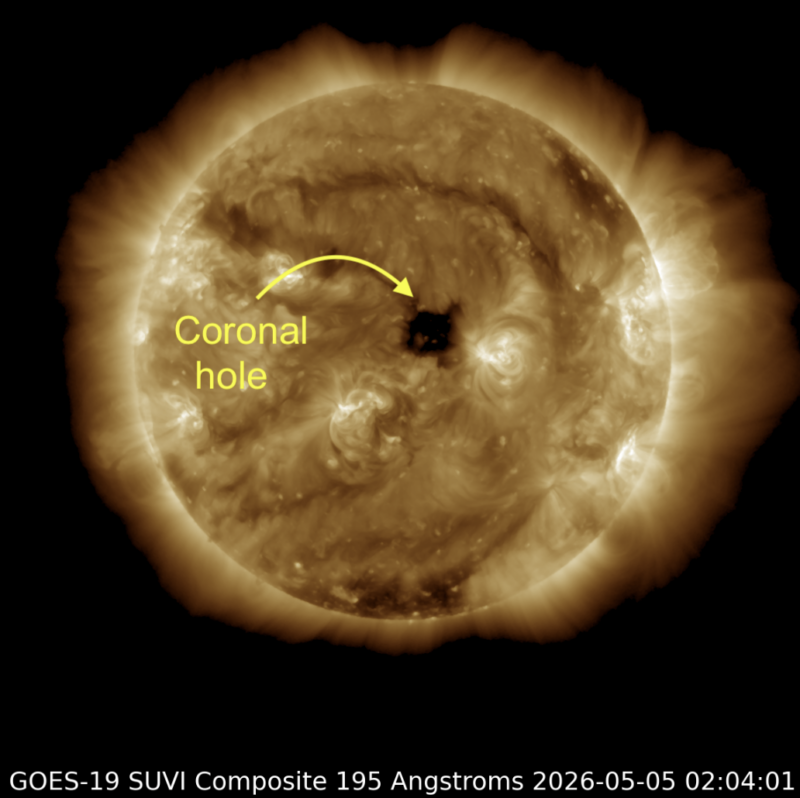

Sun news May 4: M1.8 flare ends the quiet spell
The sun broke out of its activity lull overnight! AR4424 fired an M1.8 flare (moderate) at 1:13 UTC on May 4, ending a several-day run of only C (common) flares. The blast triggered an R1 (minor) radio blackout that briefly disrupted high-frequency communications over the Pacific and eastern Asia.
Past 24 hours of sun news
(11 UTC May 3 – 11 UTC May 4)
Flare activity
Over the past day, solar activity rose to moderate levels thanks to the M1.8 from AR4424. However, overall output was light. In total, the sun fired just 3 flares: 1 M-class and 2 C-class.
- Strongest flare: M1.8 from AR4424, peaking at 1:13 UTC on May 4. Given its position near the western limb, any ejecta would have aimed largely away from Earth.
- Lead flare producer: AR4424 fired 2 of the 3 flares, including the only M-class event. In addition, AR4430 chipped in a C1.3 at 18:51 UTC on May 3.
Sunspot regions
The Earth-facing solar disk showed 10 numbered active regions. Notably, none carried complex magnetic setups. All ten hold beta or simpler configurations.
Blasts from the sun?
No Earth-directed coronal mass ejections (CMEs) appeared in coronagraph imagery during the period.
Past 24 hours in space weather
Solar wind
Solar wind speeds continued to ease to background levels as the coronal hole high-speed stream slowly waned. The total interplanetary magnetic field stayed weak overall.
Bz and magnetic coupling
The Bz component was weak and variable, bouncing between northward and southward. Those southward dips were not sustained enough to drive significant auroral activity.
Earth’s magnetic field
Over the past day, Earth’s magnetic field ranged from quiet to unsettled (Kp 1–3). Auroras stayed confined to the highest latitudes: Alaska, northern Canada, Iceland and northern Scandinavia.

Sun news May 3: Quiet sun, but coronal hole keeps Earth stirring
Earth’s magnetic field remained restless overnight. But the cause wasn’t a dramatic solar explosion. Instead, a persistent stream of fast-moving particles – flowing from a dark gap in the sun’s atmosphere, called a coronal hole – did the work. The hole is releasing a high-speed stream of solar particles that’s washing over our planet. Over the past day, it kept solar wind speeds elevated between roughly 400–475 km/s. As a result, geomagnetic activity nudged up to quiet-to-unsettled levels (Kp 1–3). Looking ahead, forecasters expect the coronal hole influence to push activity to active levels (Kp 4) today, with more to come, possibly, by May 4-5. Aurora watchers at high latitudes should stay alert!
Past 24 hours of sun news
(11 UTC May 2 – 11 UTC May 3)
Flare activity
Over the past day, the sun took a breather on flare production. Flaring stayed at low levels. But multiple active regions contributed to a steady drumbeat of modest activity.The sun fired 16 C-class flares but nothing reached M-class. The strongest event was a C8.7 from AR4420. That region is now rounding the northwest limb and heading out of Earth’s view.
- Strongest flare: C8.7 from AR4420 (N16W88), peaking at 18:30 UTC on May 2. This impulsive event came from a region now beyond the northwest limb. As a C-class flare, it triggered no radio blackout.
- Lead flare producer: AR4429 topped the list by count. It fired 5 C-class flares. Meanwhile, AR4428 contributed 3 flares in quick succession. In addition, AR4424 added 3 C-class events, and AR4420 chipped in 2 before departing.
Sunspot regions
Though flaring has been low, our star remained restless over the past day. Several moderately sized sunspot groups showed minor growth, hinting at potential. But magnetic setups remained relatively simple across the board. Notably, no regions carried delta configurations. In the past day, the Earth-facing solar disk showed 10 numbered active regions.
Blasts from the sun?
No significant Earth-directed coronal mass ejections (CMEs) appeared in coronagraph imagery over the past 24 hours.
However, two faint, slow CMEs from April 30 remain of interest. They were observed in SOHO LASCO C2 around 12:30 and 18:30 UTC on April 30. They traveled at only about 250 km/s. If they arrive at all, they may produce only a low-confidence glancing blow late on May 4 or into May 5. Any impact would likely be minor.
Past 24 hours in space weather
Solar wind
Solar wind speeds stayed elevated under the influence of the coronal hole high-speed stream. Speeds ranged between roughly 400–475 km/s. The total interplanetary magnetic field (IMF) peaked at 6 nT, relatively weak.
Bz and magnetic coupling
The Bz component fluctuated between -5 and +5 nT. It briefly dipped to -4 nT. However, those southward intervals were only modest. As a result, they provided only limited windows favorable for aurora production. The solar wind is now transitioning from a fast to a slow regime. Even so, the coronal hole that crossed the central meridian on May 2 may sustain elevated conditions through May 5.
Earth’s magnetic field
Over the past day, Earth’s magnetic field ranged from quiet to unsettled (Kp 1–3). The ongoing coronal hole stream drove the activity. No G-scale geomagnetic storm levels were reached. Aurora stayed confined to high latitudes: northern Scandinavia, Iceland, and northern Canada.
What’s ahead? Sun–Earth forecast
Flare activity forecast
Forecasters expect low levels to continue through May 5. A 45% chance exists for M-class flares (R1–R2). The most likely sources are AR4429 (near disk center, well-aimed at Earth), AR4428, and AR4431. All three showed minor growth. An X-class event remains unlikely at 5%, given the current simple setups. However, it cannot be entirely ruled out if rapid changes occur.
Geomagnetic activity forecast
- May 3 (Saturday): Expect active conditions (Kp up to 4) as the negative-polarity coronal hole stream persists. A chance exists for isolated G1 (minor) geomagnetic storm intervals. Aurora may reach Reykjavik, Tromsø, Anchorage, and northern Canada. If Kp reaches 4, Calgary, Edmonton, and Oslo could also catch a glimpse.
- May 4 (Sunday): Expect quiet-to-unsettled conditions (Kp 1–3) as coronal hole effects slowly wane. However, a slight chance of active to minor storm conditions (Kp 4–5) exists later in the day. Specifically, the low-confidence CMEs from April 30 may deliver a glancing blow. If a CME impact occurs, aurora could reach Seattle, Edinburgh, and Minneapolis.
- May 5 (Monday): Expect quiet-to-unsettled conditions (Kp 1–3) as both coronal hole and any residual CME influences fade. A slight chance of active intervals remains early in the day if CME arrival is delayed. Conditions should return toward background levels by day’s end.
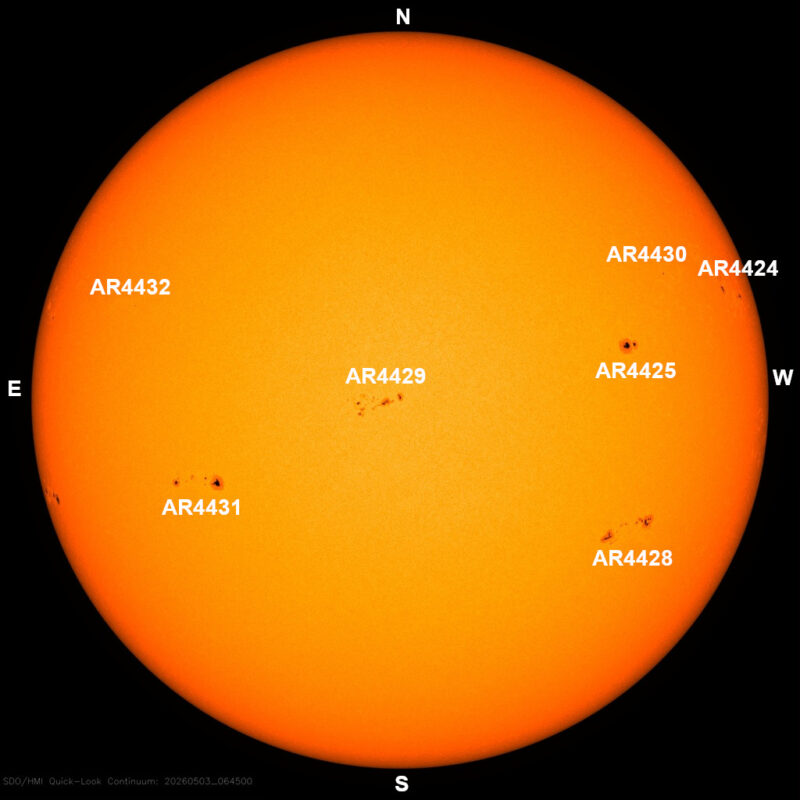
Sun news May 2: Fiery filament action, but quiet sun overall
Overall, sun activity was low over the past day, with only C-class (common) flares. But the side of the sun we see from Earth wasn’t entirely calm. Take a look to our top image. A long trans-equatorial filament in the sun’s northeast quadrant offers an eye-catching display (filaments are ropes of solar material and magnetic fields, arcing up from the sun’s visible surface). And a lifting filament in the sun’s southwest erupted in a long-lasting prominence (prominences are the same thing as filaments, but seen extending off one side of the sun). Sunspot region AR4431 in the sun’s southeast quadrant wasn’t flaring, but it also showed fiery filament action. So, all in all, it seems we’ll see a quiet sun this weekend. But a close look at our star offers interest! Stay tuned.
Past 24 hours of sun news
(11 UTC May 1 – 11 UTC May 2)
- Strongest flare: Sunspot region AR4420 blasted a C7.4 at 15:29 UTC on May 1.
- Lead flare producer: Sunspot region AR4420 blasted out 6 C flares in all.
Sunspot regions: key players
Today 9 numbered active regions populate the Earth-viewed solar disk. Three newcomers were numbered during the period. They are AR4430, AR4431 and AR4432.
AR4420 has been this week’s hero during its transit of the side of the sun we see from Earth. This sunspot region is now at the very edge of the solar west horizon. It lost its gamma-delta magnetic configuration as seen from Earth and now has a beta configuration. Specialists can’t see it well anymore; it’s now getting lost behind the solar horizon. Farewell, AR4420!
AR4424 lost its gamma magnetic configuration, but retains its beta. Meanwhile, AR4428 gained a gamma and now shows a beta-gamma magnetic setup.
Blasts from the sun?
Experts did not observe any coronal mass ejections (CMEs) in available coronagraph imagery over the past day.
Past 24 hours in space weather
Solar wind
Solar wind speeds averaged low-to-moderate levels during the past day. We’re seeing waning effects of that fast solar wind from a coronal hole. The total interplanetary magnetic field (IMF) showed weak levels this morning (May 2).
Bz and magnetic coupling
The Bz component kept shifting intermittently from north- to south-oriented over the past couple of days. Its strongest peaks were at around 21 UTC on April 30, reaching levels of -12nT. This morning (May 2), the Bz component showed southward. A southward Bz is favorable for auroras.
Earth’s magnetic field
Earth’s magnetic field was quiet to unsettled during the past day (Kp 1–3). At the time of this writing, the Kp index sits at level 1.

Sun news May 1: Solar wind brings a minor geomagnetic storm
The geomagnetic disturbance we were awaiting arrived in the form of an isolated G1 (minor) geomagnetic storming. It sparked auroras at northerly latitudes. The large coronal hole – a cooler, less dense region in the sun’s outer atmosphere – is now in the southwest solar quadrant. It sent us its fast solar wind, just as predicted, to provoke mild disturbances in Earth’s magnetic field. We reached a higher level of activity (Kp 5) at 23:59 UTC on April 30. But we also had a slightly lower level (Kp 4) for three three-hour synoptic periods last night. Did you see the auroras last night? Share your beautiful photos with us here. Stay tuned.
Past 24 hours of sun news
(11 UTC April 30 – 11 UTC May 1)
Flare activity
Solar activity continued at low levels with the production of only C-class (common) flares over the past day. This time flare production dropped as well. The sun fired only 8 C flares compare to yesterday’s 15 Cs.
- Strongest flare: Two C1.9 flares from active region AR4420 in the solar northwest top the list. The first C1.9 blasted at 4:19 UTC. The second C1.9 flare was produced at 9:33 UTC. Both flares were fired on May 1.
- Lead flare producer: An incoming active region in the southeast, as-yet-unnumbered, shares the top flare producer position with AR4420.The two active regions produced three C flares each.
Sunspot regions: key players
Today the sun shows 6 numbered active regions on its Earth-viewed side. Two continue to dominate. AR4429 was new during this period. And there is another newcomer blasting C flares. But it is not numbered yet.
AR4420 (beta-gamma-delta) will soon depart for the far side of our sun. This sunspot region is now at the very edge of the solar west horizon. It keeps its strong complexity.
AR4424 (beta-gamma) gained a gamma configuration. This sunspot is today’s second main player due to its configuration.
Blasts from the sun?
A coronal mass ejection (CME) occurred in the solar southeast and is now under modeling and analysis. The LASCO C2 instrument registered the event at 13:26 UTC on April 30.
Past 24 hours in space weather
Solar wind
Solar wind speeds increased from low to moderate-high levels during our observation period. This was due to the arrival of fast solar wind from a coronal hole. The total interplanetary magnetic field (IMF) was strong late on April 30 and returned to weak levels this morning.
Bz and magnetic coupling
The Bz component kept mostly south-oriented over the past day. Its strongest peaks were at around 21 UTC on April 30, reaching levels of -12nT. This morning, the Bz component is still southward. A southward Bz is favorable for auroras.
Earth’s magnetic field
Earth’s magnetic field registered from quiet to active storming levels over the past day (Kp 1–5), as mentioned above. At the time of this writing, the Kp index sits at level 3.

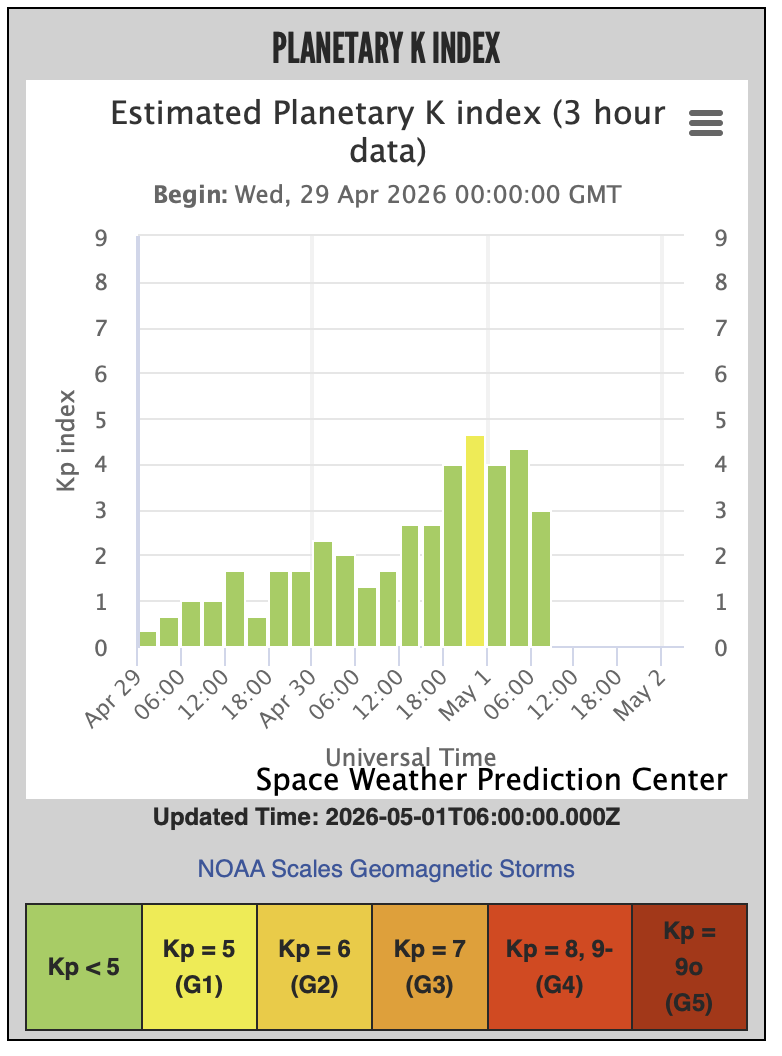

Like what you read?
Subscribe and receive daily news delivered to your inbox.
More from
C. Alex Young


Sun news: Solar wind disturbs our magnetic field

Yes, there’s an aurora season, and it’s here
Sun activity archive for September 2026
Sun activity archive for August 2026



