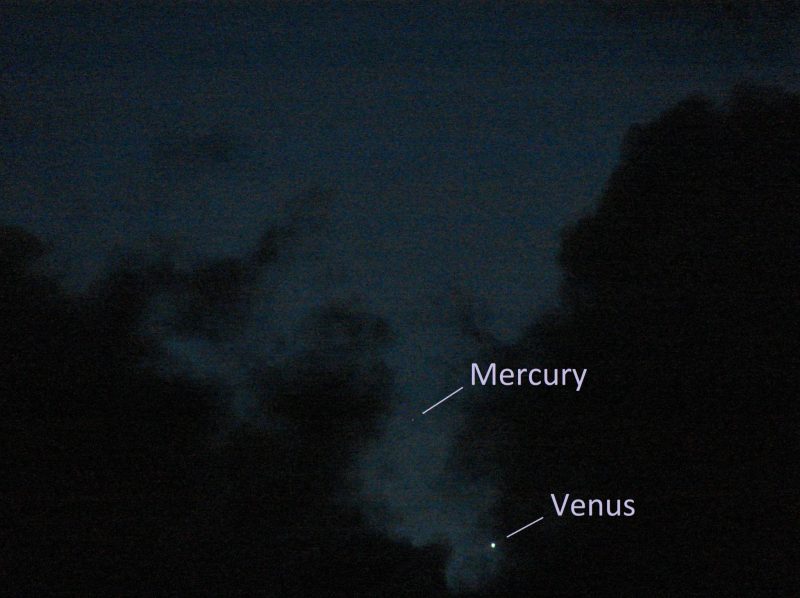
View at EarthSky Community Photos. | Kit-fun Ho in Shatin, Hong Kong caught the pair on May 28, 2021. He wrote: “It is fortunate for me to have captured in my photo Venus and Mercury conjunction in the west of NW direction of the cloudy city sky. While taking the picture, I can only see Venus which is very much brighter than Mercury. Afterwards, I look up SkySafari software set, which shows that Mercury is approximately at 11 o’clock direction from Venus. And SkySafari software also shows the brightness of Mercury at magnitude-2.1 and Venus at magnitude-3.9. So my photo of this conjunction seems to match SkySafari data.” Thank you, Kit-fun Ho!
Closest Mercury-Venus conjunction until 2033
It hasn’t been easy, but members of the EarthSky community have caught photos of the close Mercury-Venus conjunction going on now in the west after sunset. It’s the closest Mercury-Venus conjunction until November 5, 2033. Venus is bright and easy to see. It’s a few hundred times brighter than Mercury, which is hard to catch in the glow of evening twilight. Watch for them both shortly after sunset. Binoculars will come in handy.
Thanks to all who submitted photos! If you have a photo you’d like to share, please submit it here.
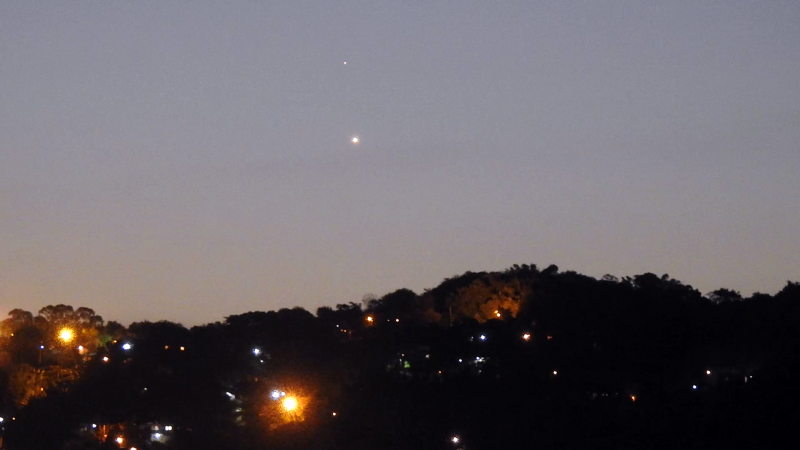
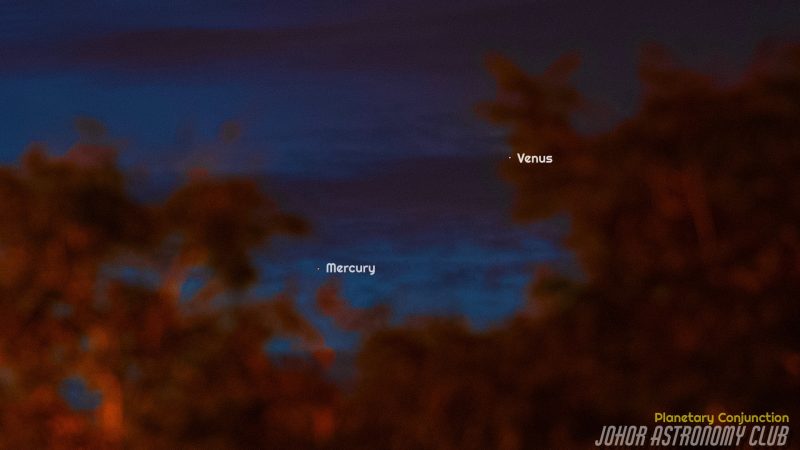
View at EarthSky Community Photos. | Helio C. Vital in Rio de Janeiro, Brazil, caught the pair on May 28, 2021. He wrote: “The image shows Venus and Mercury a few minutes before setting. They were only 0.5 degrees apart and 17 degrees from the sun. Venus was over 200 times brighter than Mercury.” Thank you, Helio!View at EarthSky Community Photos. | Mohd Nazam Anuar of the Johor Astronomy Club in Johor Bahru, Malaysia, caught Mercury and Venus on May 29, 2021. He wrote: “A rare and beautiful conjunction of the 2 inner planets.” Thank you, Mohd!View at EarthSky Community Photos. | Vermont Coronel Jr. in Quezon City, Philippines captured the pair on May 29, 2021. He wrote: “The closest Venus-Mercury conjunction until 2033, as observed from our rooftop at about 33 minutes after sunset.” Thank you, Vermont!
Bottom line: Photos of the Mercury-Venus conjunction.
Deborah Byrd (asteroid 3505 Byrd) helps edit EarthSky.org and is a frequent host of EarthSky videos. Deborah created the EarthSky radio series in 1991 and founded EarthSky.org in 1994. Prior to that, she had worked for the University of Texas McDonald Observatory since 1976, and created and produced their Star Date radio series. She has won a galaxy of awards from the broadcasting and science communities, including having an asteroid named in her honor in 1990, a Public Service Award from the National Science Board in 2003, and the Education Prize from the American Astronomical Society in 2020. A science communicator and educator since 1976, Byrd believes in science as a force for good in the world and a vital tool for the 21st century. "Being an EarthSky editor is like hosting a big global party for cool nature-lovers," she says.
Like what you read? Subscribe and receive daily news delivered to your inbox.
Thank you! Your submission has been received!
Oops! Something went wrong while submitting the form.