Moon Phases

What is a full moon? All you need to know

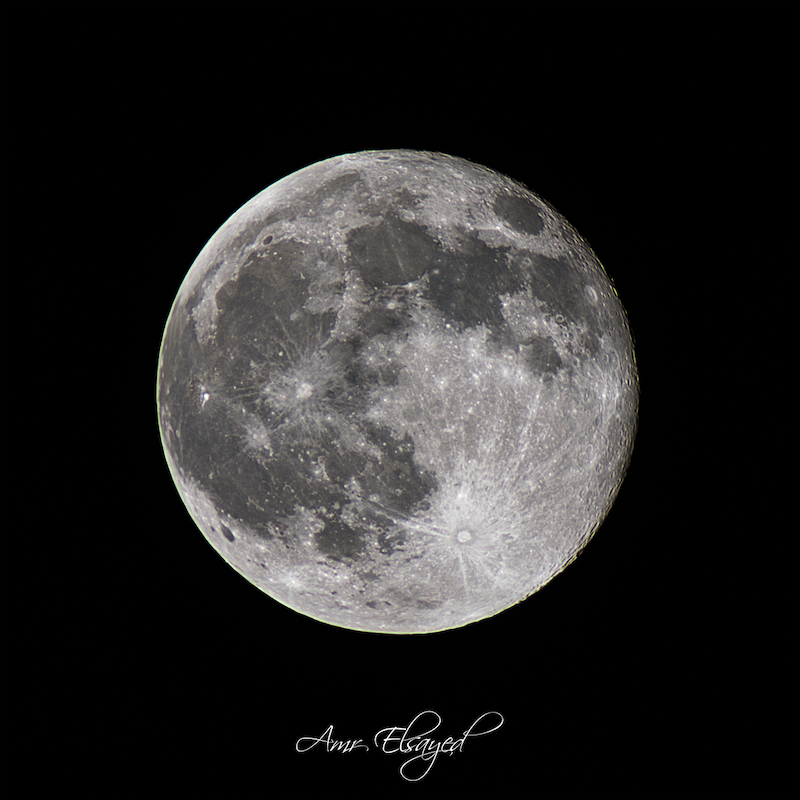
Full moon: Close-up of the Super Harvest Moon on October 7, 2025.
View at EarthSky Community Photos. | Amr Elsayed captured this on October 7, 2025, from Egypt, and wrote: “A bright full supermoon glowing vividly against the night sky.” Thank you, Amr! Read more about the full moon below.

Full moon always opposite the sun

A full moon is opposite the sun in its orbit around Earth. Its sunlit side is entirely visible from Earth. The moon appears full to the eye for two to three nights. However, astronomers regard the moon as full at a precisely defined instant, when the moon is exactly 180 degrees opposite the sun in ecliptic longitude.
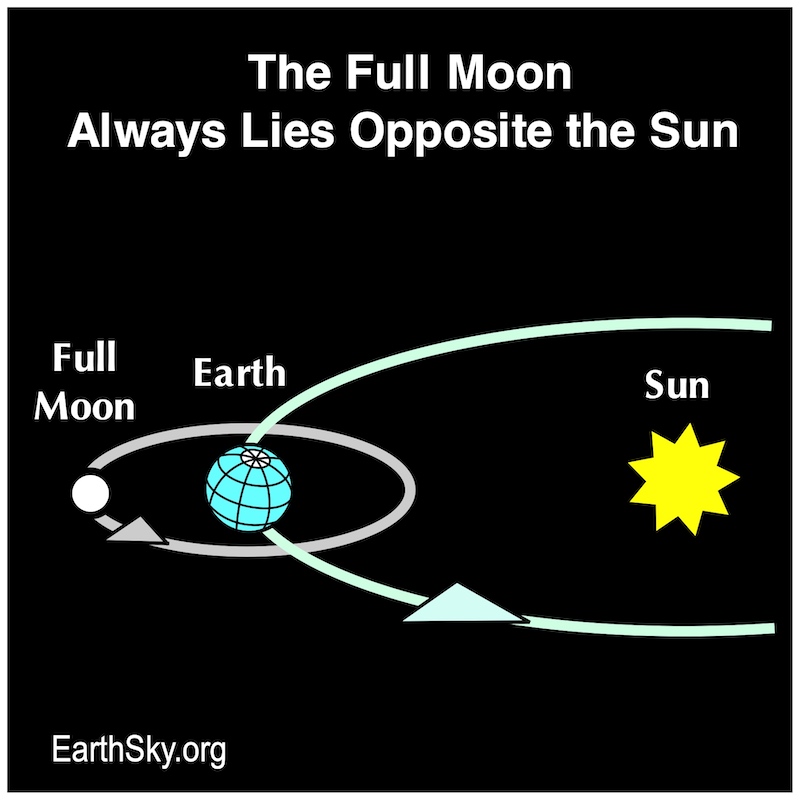
The moon, the Earth and the sun are aligned. Earth surrounds the sun in a big circle. The moon surrounds the Earth in a smaller circle.
At full moon, the sun, Earth, and moon are aligned in space, with Earth in the middle. The moon’s day side – its fully lighted hemisphere – directly faces us. Chart via EarthSky.

It’s that feature of a full moon – the fact that it’s opposite the sun as viewed from Earth – that causes a full moon to look full and round.
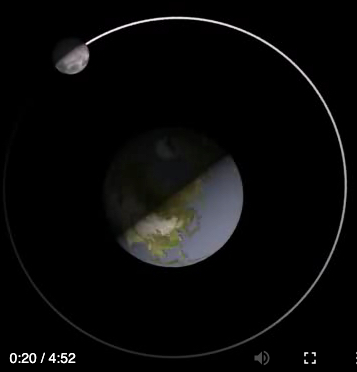
Earth in space with moon, viewed from directiy above north pole.
In the linked animation you can see the moon revolving around Earth. Note that the full moon is on the opposite side of the Earth from the sun. Not to scale. Image via Wikipedia Commons. Click here to see animation.

Some EarthSky Community photos of the full moon
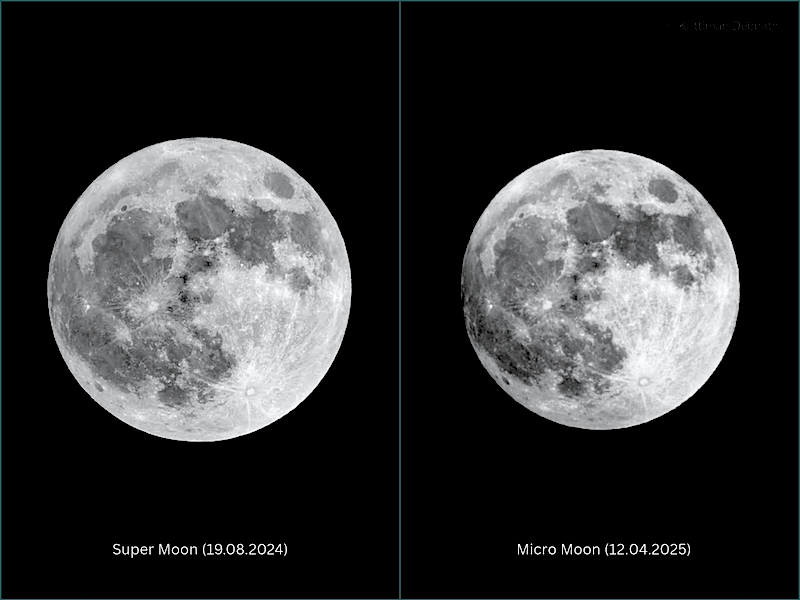
Comparison shot to show size difference of the August 2024 supermoon and the April 12 2025 micromoon.
View at EarthSky Community Photos. | Krittiman Debnath of India submitted this composite image and wrote: “Here’s a side-by-side comparison of the supermoon on August 19, 2024, and the micromoon on April 12, 2025. They were both captured using my Celestron PowerSeeker 60AZ. Both images were taken with the same setup.” Thank you, Krittiman. You can easily see the size difference of a supermoon and a micromoon. However, most people won’t notice a size difference to the eye, but supermoons do look brighter.
4 pale moons close together. One bluish, other purplish, other yellowish and other grayish.
View at EarthSky Community Photos. | Steven Sweet from Ontario, Canada, shared this composite image of the full moon on February 1, 2026, and wrote: “Captured using the camera’s multiple exposure feature. White balance was changed for each shot, manually captured as the moon set.” Thank you, Steven!
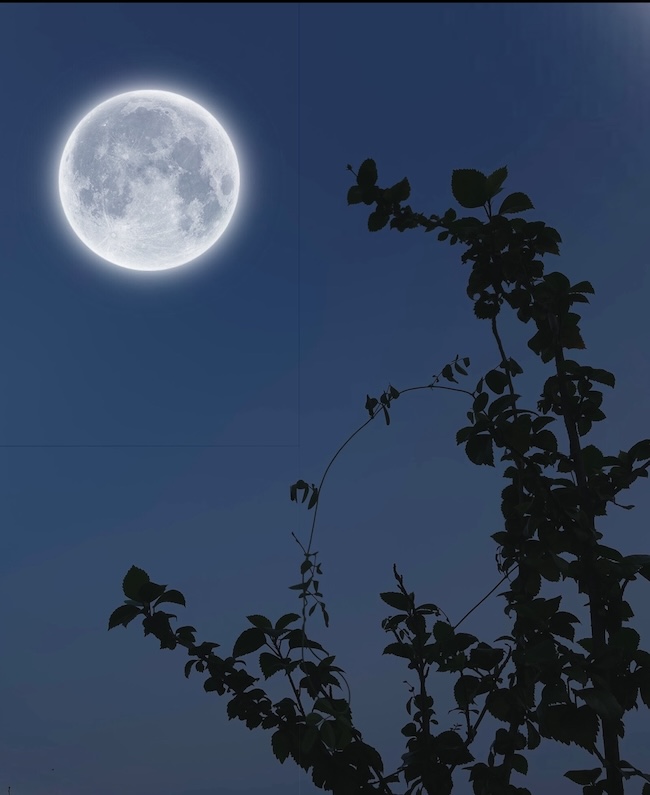
Full moon shining brightly in a dark blue sky with some tree branches in the foreground.
View at EarthSky Community Photos. | Sreerup Saha of India submitted this photo and said: “The Buck Moon is the name given to the full moon that occurs in July. This name originates from Native American traditions and refers to the time of year when the new antlers of buck deer begin to grow from their foreheads, covered in velvety fur. The Buck Moon is one of the traditional names for full moons, each of which has a unique name tied to natural events or agricultural activities corresponding to the time of year they occur. Other names for the July full moon include the Thunder Moon and the Hay Moon.” Thank you, Sreerup!

About the full moon

Why does a full moon look full? Remember that half the moon is always illuminated by the sun. That lighted half is the moon’s day side. In order to appear full to us on Earth, we have to see the entire day side of the moon. That happens only when the moon is opposite the sun in our sky. So a full moon looks full because it’s opposite the sun.

That’s also why every full moon rises in the east around sunset – climbs highest up for the night midway between sunset and sunrise (around midnight) – and sets around sunrise. Stand outside tonight around sunset and look for the moon. Is the sun going down while the moon is coming up? Then that’s a full moon, or close to one.

Just be aware that the moon will look full for at least a couple of nights around the instant of full moon.
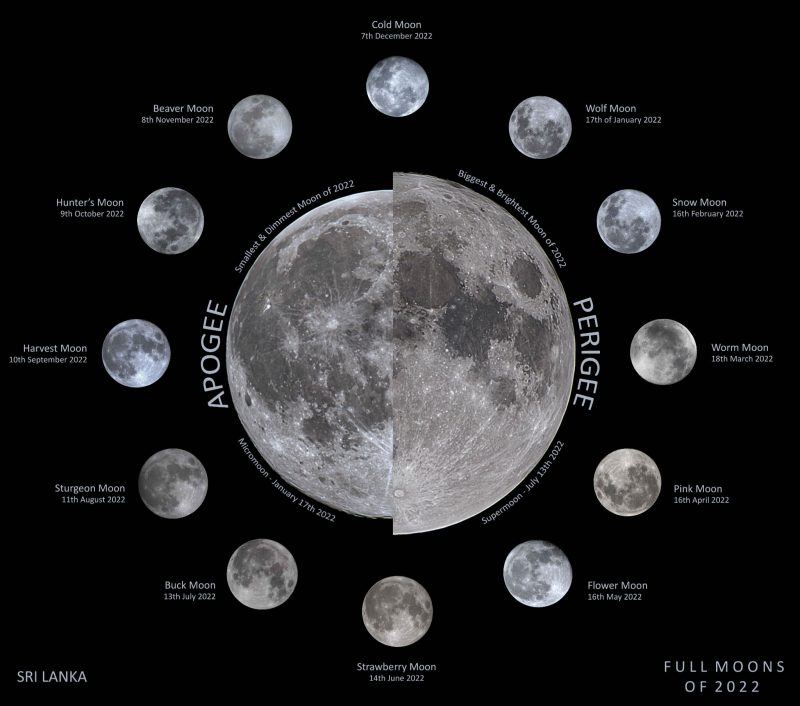
Collage of full moons. Center has smallest and largest moon comparing size surrounded by full moons.
View at EarthSky Community Photos. | Niveth Kumar created this cool composite image and wrote: “Here’s a comparison of the size of our moon’s closest and farthest throughout the year, represented along the 12 full moons of 2022.” Thank you, Niveth.

When is the moon full?

Want to know the instant of full moon in your part of the world, as well as the moonrise and moonset times? Visit Sunrise Sunset Calendars, remembering to check the moon phases plus moonrise and moonset boxes.

Read more: What are the full moon names?

Often, you’ll find two different dates on calendars for the date of full moon. That’s because some calendars list moon phases in Coordinated Universal Time, also called Universal Time Coordinated (UTC). And other calendars list moon phases in local time, the clock time of a specific place, usually the place that made and distributed the calendars. Translate UTC to your local time.

Why no lunar eclipse every full moon?

If a full moon is opposite the sun, why doesn’t Earth’s shadow fall on the moon at every full moon? The reason is that the moon’s orbit is tilted by 5.1 degrees with respect to Earth’s orbit around the sun. At every full moon, Earth’s shadow sweeps near the moon. But, in most months, there’s no eclipse.

Why there’s no lunar eclipse every full moon
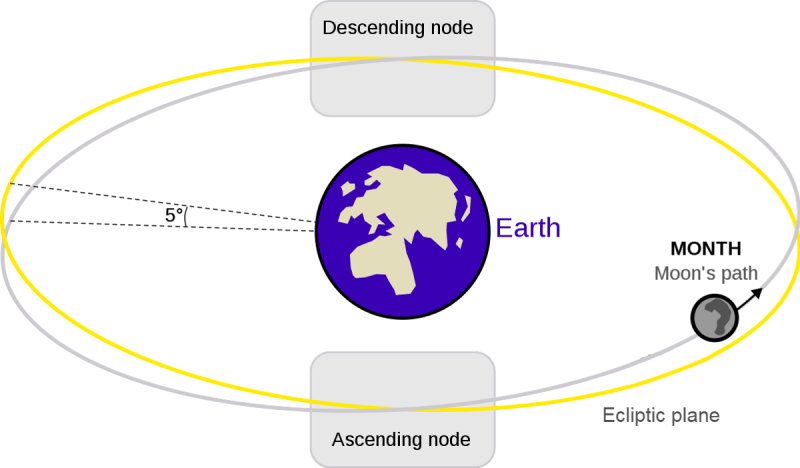
Earth at center with moon's orbit crossing the ecliptic line twice.
The moon’s orbit tips 5 degrees relative to Earth’s. Eclipses only occur when the moon crosses the ecliptic during a full or new moon. Image via Wikimedia Commons (CC BY-SA 4.0).

Read more about the moon’s phases

As the moon orbits Earth, it changes phase in an orderly way. Follow these links to understand the various phases of the moon.

New moon
Waxing crescent moon
First quarter moon
Waxing gibbous moon
Full moon
Waning gibbous moon
Last quarter moon
Waning crescent moon

Bottom line: A full moon looks full because it’s opposite the sun. Its lighted face is turned entirely in Earth’s direction.

Read more: Top 4 keys to understanding moon phases

Posted 
January 1, 2026
 in 
Moon Phases

Like what you read?
Subscribe and receive daily news delivered to your inbox.

Your email address will only be used for EarthSky content. Privacy Policy
Thank you! Your submission has been received!
Oops! Something went wrong while submitting the form.

More from 

Deborah Byrd

View All