A star named Mimosa
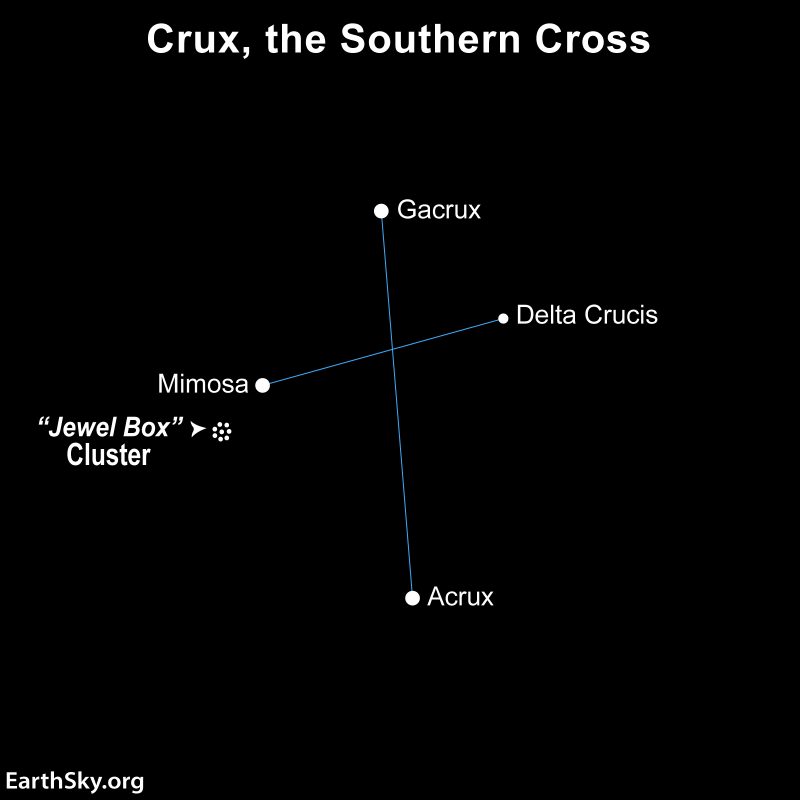
The constellation of the Southern Cross is called Crux. Its brightest star is called Alpha Crucis or Acrux. And its 2nd-brightest star, Beta Crucis, is sometimes called Becrux … but more often called Mimosa.
Blue-white Mimosa is the 20th brightest star in all the heavens.
And the origin of its name is somewhat mysterious. Unlike many bright stars, Beta Crucis is so far south that it wasn’t well known to most ancient Mediterranean skywatchers. So it never received one of the old Arabic or Greek traditional names that many northern stars have. The name Mimosa seems to have become popular later, possibly in the modern era of southern-sky astronomy.
Also, it’s said, the name might have been inspired by flowering mimosa herbs and shrubs. But most of those flowers are pink, red or yellow. And Mimosa is a blue-white star.
Its blue-white glow helps create the jewel-like appearance of the Southern Cross.
A midnight culmination happens when a star is highest in your sky at your local midnight. It happens for everyone on Earth around the same dates, on or about April 2 each year. Stars rise four minutes earlier each day. So, by May, Mimosa is highest in your sky in mid-evening. And, by June, it’s highest in early evening.
So April, May and June are great months for seeing Mimosa, no matter where you are on Earth.
Mimosa from the Southern Hemisphere
Southern Hemisphere observers know and love Mimosa. It’s circumpolar – up all night – for latitudes of about 30 degrees south and higher.
Mimosa’s declination (the sky equivalent of latitude) is about -60 degrees. So – when highest in the sky as seen from a very high southern latitide, say, about 45° south – Mimosa reaches an altitude of about 75° above the southern horizon. That’s the view from New Zealand’s South Island.
Meanwhile, from a latitude of 30 degrees S., Mimosa would appear only about 60 degrees up in the south, at its highest. That’s the view from Porto Alegre, Brazil – La Serena, Chile – and Springbok, South Africa. From Brisbane, Australia (27.5° south), Mimosa reaches nearly 58° above the horizon, at its highest.
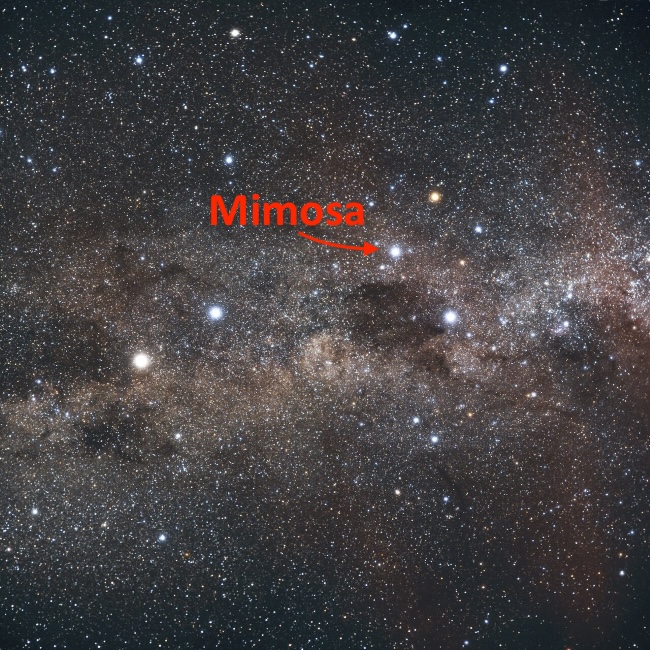
Because it’s so high up in the sky, Mimosa offers great deep-sky views of objects such as the Jewel-Box Cluster and the Coal Sack Nebula.
Want an exact location for Mimosa from your latitude and time of night? Try Stellarium.
Mimosa from the Northern Hemisphere
You won’t see Mimosa north of 30 degrees north latitude. Some cities near 30 degrees north latitude are Austin, Texas; Cairo, Egypt; and New Delhi, India.
From Northern Hemisphere locations such as Honolulu Hawaii (21 degrees N), Mimosa can be seen more easily.
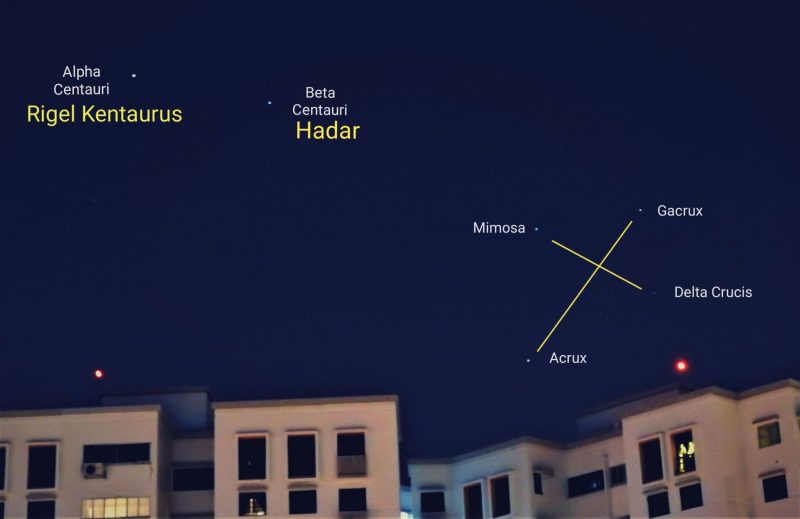
But, for observers in the Northern Hemisphere, Mimosa is in view for only a short time each year (or each night, when it is visible). For example, observers around Miami, Florida (26 degrees N latitude), can just glimpse the Southern Cross and Mimosa on May evenings. From there, it rises about 5 degrees above the southern horizon and stays up more than four hours.
The nearer the observer is to the northern observation limit (30 degrees N), the lower the arc of Mimosa across the southern sky, and the shorter the time it will be visible. For example, from Austin, the star barely skirts the horizon for about a half hour at most. Often, it can’t be seen at all due to the dimming affects of Earth’s atmosphere.
So it’s a challenge!
History and mythology of Mimosa
Because of its southerly location, Crux and Mimosa were essentially unknown in classical western mythology. But these stars were well known to Australian Aboriginal peoples, as well as to the islanders of Polynesia and the people of southern Africa.
One Aboriginal story is that the stars of the Southern Cross are a reminder of the time and place where death first came to mankind. Two of the stars in Crux are said to represent the glowing eyes of the spirit of death. And the other two are said to be the eyes of the first man to die.
The main stars of Crux, including Mimosa, appear on the flags of both Australia and New Zealand. Mimosa appears as the left side of the crossbar, and Acrux as the bottom of the Cross.
See flags featuring the stars of the Southern Cross

The science of Beta Crucis
Mimosa lies about 280 light-years from Earth. It has a visual magnitude of 1.25.
Mimosa is a giant (or subgiant) blue star, more than 3,000 times brighter than our sun in visible light.
So Mimosa is blue and very hot. It has a radius about eight times that of the sun, with a mass 14 times greater. But all of these figures are uncertain. And the reason is a small stellar companion for Mimosa about which we know little. Mimosa also is a complex variable star.
Directly south of Mimosa is the Coalsack, a distinctive dark nebula in the Milky Way.
The famous Jewel Box Cluster lies to Mimosa’s east.
Position of Mimosa (Beta Crucis) is RA: 12h 47m 44s, dec: -59° 41′ 19″.
Bottom line: Mimosa is the 2nd-brightest star in Crux, the Southern Cross. It’s circumpolar – up all night – from much of the Southern Hemisphere.
Acrux is brightest star in Southern Cross
Like what you read?
Subscribe and receive daily news delivered to your inbox.
More from
Larry Sessions


Why can’t I find the Big Dipper in September?

Fomalhaut is the Loneliest Star once again
Summer Triangle star: Altair is variable and spins fast!
Summer Triangle star Deneb is distant and luminous