EarthSky // Tonight // Brightest Stars By Larry Sessions Jan 21, 2012

Capella is two golden stars

We see Capella as the brightest star in the constellation Auriga the Charioteer. It is really two stars, each with a golden color similar to our sun.

DownloadEmbed
close

Copy the following code to embed this player

Capella is the brightest star we see at night of the same spectral type, or color, as our daytime star, the sun. Like our sun, Capella is a yellow or golden star. It is the brightest yellow star visible in our sky – much bigger and brighter than our sun in absolute terms, but of course much farther away, about 42 light-years in contrast to the sun’s 8 light-minutes.

Like so many stars that appear single to the eye, Capella actually consists of two stars. Capella A and Capella B, as they’re called, are similar to each other, both roughly 10 times the sun’s diameter. They emit about 80 and 50 times more overall light than the sun, respectively. Another component to this system, a binary of small red stars, orbits about a light-year away.

Double star system Capella. Image Credit: Atlas of the Universe

Capella A and B are both yellow giant stars at the end of their normal lifetimes. Each being more than two and a half times more massive than the sun, the two components of Capella likely are also younger. This is because more massive stars have higher internal pressures, which causes them to burn their nuclear fuel faster and to have shorter lifespans. The stars of Capella are in a transitional period from the smaller, hotter stars they once were, to the cooler and larger red giants they must ultimately become in their final phase. However, for now, their surface temperatures are similar to that of the sun, and so they share its spectral type of G.

The two stars we see as Capella mark the 6th brightest star in our sky. Astronomers measure the combined magnitude of this system as 0.08.

How to see it

From mid-latitudes of the U.S. and Europe, Capella is far enough to the north to be seen at some time of the night all year round. For us in the Northern Hemisphere, it’s best in winter, when you’ll find golden Capella high overhead before bedtime.

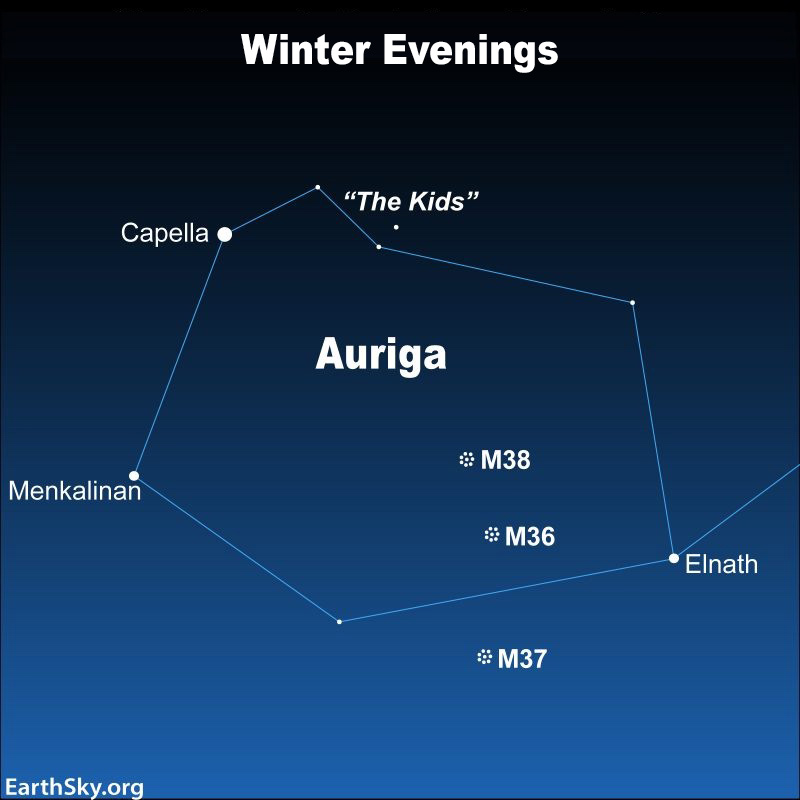
Capella is the brightest star in a five-sided star pattern, which we know as the constellation Auriga the Charioteer. Capella is the Latin word for ‘nanny goat,’ and this lovely star is often called the Goat Star.

Here is the key to knowing you’ve found Capella. Near it, you’ll find a tiny asterism – a noticeable pattern on the sky’s dome – consisting of three fainter stars. This little triangle of stars is approriately called the Kids, and it makes Capella instantly recognizable.

The star El Nath originally was part of the constellation Auriga, too. Now El Nath marks the tip of one of horns of the constellation Taurus the Bull. Still, including El Nath, you can see a large misshapen pentagon of stars in Capella’s part of the sky. The shape is difficult to reconcile with the idea of a man driving a chariot, but it is a noticeable pattern and easy to find.

Some people use the Big Dipper to locate Capella. The two bowl stars – Megrez and Dubhe – more or less point toward Capella. It’s a long hop, though, in the direction opposite of the Big Dipper handle.

History and myth

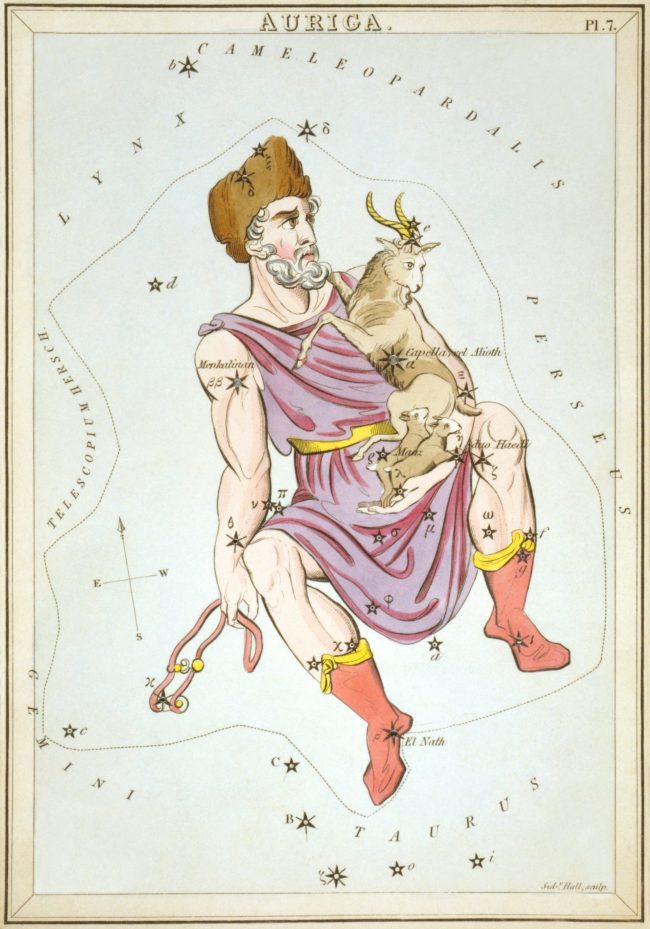
For such a large constellation with such a bright star, the mythology of Auriga and Capella is sparse. The constellation has been associated with the Greek sea god Posideon (the Roman god Neptune). Other stories say Auriga represents Erichthonius, the ancient lame king of Athens who invented the horse-drawn chariot.

Constellation Auriga as depicted in a set of constellation cards published in London c.1825. Image Credit: Wikimedia Commons

Auriga seems to have been associated with shepherds and flocks, so the title of nanny goat — or ‘she goat’ — for Capella is reasonable. However, neither Capella nor its constellation Auriga figures prominently in any major mythological stories from Greek or Roman culture.

Richard Hinkley Allen, in his famed Star Names, says that the ancient Arabs called the star Capella by a name that meant ‘The Driver’ and implies that this star was seen as a shepherd driving a flock across the sky. The flock might have been the nearby star cluster Pleiades, although – instead of sheep or goats – early Arabian stargazers saw this pattern composed of camels. Capella was also apparently important in ancient Egypt. It appears on the Denderah Zodiac as a mummified cat.

Interestingly, in China, Capella and four other stars of Auriga were known as the Five Chariots. The other four stars are Beta, Theta, Kappa and Gamma (El Nath, which is now Beta Tauri).

Capella’s position is RA: 5h 16m 41.4s, dec: +45° 59′ 53″.

Share your comments on Facebook

32 Responses to Capella is two golden stars

  1. Roz McKevitt says:

    We recently came to Kihei, Maui, Hawaii, from NYC, where some of the night sky is unfamiliar. There is a beautiful bright star visible in the lower southern sky in the evening, that twinkles in colors! We’re guessing it’s Capella. Can you verify? Mahalo & Aloha

  2. Larry Sessions says:

    Wow, let me regain my composure and overcome my envy just a little. I’m in Denver but I have spent plenty of time in the City and have been to Kihei as well. What a transition! I love them both but I am so jealous of your situation. Wow.

    OK, OK, I’ve had a little brandy and I am better now. As it turns out, the sky as seen from Kihei and what you would see from the City (during clear skies in a blackout), really isn’t all that different. By what you are describing, the star is not Capella, but Sirius in Canis Major. Sirius twinkles like the “spuyten duyvil”, if you get my reference. Sirius will be due South at about 10 p.m. right now. You are correct in that Capella is in th sky, too, at that time, but not as bright and considerably farther to the North. In fact Capella is past the zenith and actually in the Northern half of the sky, whereas Sirius (the brightest star in the sky) is definitely to the South.

    Kihei…. wow. Have you been to Molokini yet? My wife and I were there nearly 20 years ago and both of us got seasick due to the bobbing of the Zodiac (rubber inflated boat). But it was more than worth it. Kihei. Wow!

    Don’t hesitate to ask more questions. My peronal email address is starman@usa.net. If there is antyhing approaching the pleasure of living in Hawaii, for me it is answering questions about astronomy!

  3. daniel says:

    Hello there i was wondering if i am looking at capella right now (23.42 14/08/10 united kingdom) im looking down my scope and i see a what it looks like two stars almost over lapping each other, its in the north sky where i am. It is now (23.57 15/08/10 united kingdom) and what i was looking at last night is now completly diferent. it looks like one of the stars or a orbiting planet/satilite has moved infront of the star and is causing a STAR ECLIPSE. could you please get back to me asap thanks.

    Daniel

  4. the andersons says:

    Hello, we saw this star in the North tonight. It was “strobing” colors-green, red, white(kind of)-. It had like a stipe that would moved to the left everytime we looked at it. But the stripe was just like a blank line in it. The star moved kind of fast upwards. We think it is Capella. It is basiclly by itself. One of the lowest stars. We would like to know what it is called and why it is like that. It seems to be the only star that is “strobing”. Please reply. Thanks.

    date:10/08/10 10:35 P.M.
    place:Wichita, Kansas.

  5. Sounds like Capella, but your remarks about a “stripe” are confusing. Capella has no stripe. If you were looking through a telescope or binoculars, they may not have been fully focused.

  6. Melissa says:

    Wondering if we viewed Capella? Can you help two new stargazers out. My 10 year old son and I are just now exploring and stargazing… We think we may have viewed Capella. We live in the San Francisco bay area and last night around 7:00 my son noticed above the horizon (looking north/ east) what appeared to be an airplane but it never moved. I located the star through the telescope and we saw the most beautiful sight … It was strobing colors of green, blue, yellow and red. According to a star map we think it was Capella but didn’t look to see if the “kids” were next to it… Could it have been?
    Thanks Melissa

  7. Melissa, yep, most likely that was Capella. Although we describe it as yellow or golden, when it is fairly low in the sky as it was at 7 p.m. last night, effects of Earth’s own atmosphere will make it appear to flicker in various colors. The same is true for all bright stars, especially even brighter Sirius, which would have also been visible last night, but later, around midnight, in the southeast.

    • Melissa says:

      thank you Larry…my son and i are having the most wonderful time exploring the night sky…thank you for explaining why it gave off the unusual colors… we cant wait till may when we will be able to view Saturn… but Jupiter will do just fine…my son has been keeping track of the 4 visible moons and how they change every night. I appreciate your response….
      thank you,
      Melissa

  8. Melissa, you are welcome. That’s what we are here for, so don’t hesitate to ask further questions.

  9. Robin says:

    I was wondering if you could tell me what I saw at 5:53 A.M. in the eastern sky. We live in DeLand, FL just west of Daytona Beach. I went out to let my cat outside and saw this bright light in the sky. At first I thought it was a helicopter hovering with a search light on, but as I watched I realized it wasn’t moving at all. It was like no star I’ve ever seen. It was so bright and seemed so close. I looked at it through my binoculars and could take a picture of it with my camera, when I tried to take a picture of the other stars my camera didn’t even see them. Will be going out tomorrow morning and see if I can see it again. The sky was crystal clear just wondering if you could shed some light on this for me.
    Thank you,Robin

  10. Larry Sessions says:

    Hi, Robin. What you saw was Venus. It is near its brightest, and can look truly amazing, and is sometimes even reported as a UFO. Weather permitting, it will be there again tomorrow morning. In fact you will be able to see it in the morning sky until next summer. Enjoy!
    Larry Sessions

    • Robin says:

      Larry,
      Thank You, I will be sure to check it out again. I really did think UFO at first. Glad to know I’m not alone. Thanks for clearing that up.
      Robin

  11. Kriste says:

    I live in Scottsdale , Arizona, and I’ve recently noticed this star/planet, too. I’ve also been wondering what it is. After reading all the comments here, I’m surprised that no one really knows what it is for sure; some think its Siruis, others think its Capella, and some claim its Venus. There isn’t any confusion with other stars, like the North Star, or planets, like Mars, so why is this star/planet such a mystery?

  12. Kriste,
    I would attempt to respond if I knew what you are referring to, but unfortunately I don’t. Can you give more specifics? Are you saying Capella is a mystery? If so, what’s the mystery?

  13. Kriste says:

    Hi Larry,

    Thanks for responding! I thought I was referring to the same question that Roz (and others) posted; maybe not. Anyway, below the Big Dipper handle, and a little to the left, there is a very bright star/planet/satellite. It almost looks like there are two overlapping stars, and they flicker with colors of blue, green and yellow. When I look at a constellation map, it can’t be Capella because Capella is too far west of the Big Dipper (almost directly horizontal of it). Maybe it’s the North Star, but it, too, seems a little more west than the star/planet/satellite that I am looking at. It’s a mystery to me because I haven’t noticed it until recently, and I assumed everyone was describing the same thing.

    Thanks for your help!

  14. Kriste says:

    Now I don’t think it’s the North Star becasue it doesn’t remain fixed – the object that I am looking rotates with the other stars and stays in teh same alignment with the Big Dipper.

  15. Kriste, I’m glad you wrote back. The stars appear to be constantly moving due mostly to the rotation of the Earth. Something that might be “horizontal” to the Big Dipper at one date and time, might be “vertical” to it at some other date and time. In order for me to be able to say much about what you saw, I need to know where you are (city is good enough), and when you observed this. That way I can simulate the sky at that time and place to get a better idea of what you are describing. Also, “below the Big Dipper handle, and a little to the left” is really too vague, simply because words such as “a little” mean different things. To some it might mean the width of the Full Moon, while to someone else it could be the length of the Big Dipper itself. Can you compare it to the size of the Dipper or some other common celestial sight? If you can give me that, plus the date and location, I might be able to better tell what you are seeing.

  16. The North Star is not very bright, either. I’ve checked and I can’ think of anything very close to the Big Dipper that would be very bright or appear as you describe — certainly nothing that looks anything like Venus. On the other hand, very bright Jupiter — which can be confused for Venus — is in the southwest to western sky, setting sometime before about 10 p.m., but this is no where near the Big Dipper.

    I don’t know how experienced you are in observing the sky, but are you sure you are looking at the Big Dipper?

  17. Kriste says:

    Larry,

    Thanks for being so helpful! I am pretty sure that I am looking at the Big Dipper. I will look at the sky again tonight and write back with a better description.

    Kriste

  18. Valos says:

    Hi there, when I went out early this morning, I saw a beautiful star in the sky, strobing between red, blue and green/white. After a bit of research, I believe it is Capella, but I was hoping I could get some verification. I’m in Denton, TX, 33 09′ 47″ N, 97 04′ 45″ W. The star was in the north-northeastern sky at approx. 5:30am, roughly 20 degrees above the horizon. Any help would be appreciated. Thank you.

    –Valos

  19. Yes, I think it was Capella. Venus would have been quite a bit lower and to the right, whereas Jupiter would have been higher and further to the right.

  20. Valos, BTW, check out the Sky Theater at UNT sometime if you haven’t already, and say high to the guys over there, including Ron DiIulio!

  21. Tanya says:

    I have been seeing this star from my front porch the last few weeks my husband insisting its a airplane so in researching I found this sight can anyone tell me why it flashes so much I’m sure I could find it on here just thought I would ask… Also I have noticed that jupiter makes a very bright star as well quite amazing!

  22. Bright stars flash or sparkle (also called twinkling or scintillation) because of the turbulent nature of the Earth’s atmosphere. It is a bit like looking at the shimmering image of a heat mirage on a hot day. This most often occurs with bright stars when they are low in the sky. I would guess that you are looking at a bright star such as Capella, but I cannot tell you which one. I would need to know the time, your general location, and the directlion you are looking.

  23. Cynthia Parrish says:

    I’ve really enjoyed looking at the stars lately here in SC. My children and I had the chance to watch the meteor shower and see capella and sirius (Because they were up too late!) They loved the “airplane” stars and learning about the our atmosphere and binary stars. the joys of homeschooling!

  24. Jennifer says:

    Hi Larry,
    I live in Berkeley, CA, US. I’ve been seeing this bright star that appears around 5.30 – 6 p.m. it’s so bright that it’s visible that early. I wonder what’s the name of that star?
    Thanks :D

  25. Jennifer, it kind of depends on which direction you are looking. However, I am pretty convinced that you likely are referring to the planet Venus, not a star.

  26. [...] from mid-northern latitudes. At nightfall and early evening, look high overhead for the bright star Capella. This star marks the top (or more properly, the northern terminus) of the Winter [...]

Share your comments on EarthSky

Your email address will not be published. Required fields are marked *

*

You may use these HTML tags and attributes: <a href="" title=""> <abbr title=""> <acronym title=""> <b> <blockquote cite=""> <cite> <code> <del datetime=""> <em> <i> <q cite=""> <strike> <strong>