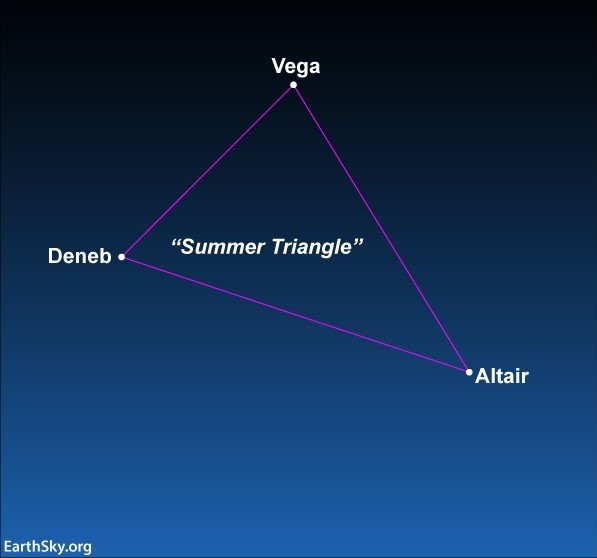
Summer Triangle: Watch before dawn
Before sunup on March mornings, look for the Summer Triangle. Although it’s not summer at our northern latitudes, the Summer Triangle’s three bright stars – Vega, Deneb and Altair – are visible now in the east before sunrise. They’re all 1st-magnitude stars and the brightest stars in their constellations. The three stars are: Vega in Lyra the Harp, Deneb in Cygnus the Swan and Altair in Aquila the Eagle.
The Summer Triangle isn’t one of the officially recognized 88 constellations. Like the Big Dipper, it’s what’s called an asterism, a pattern of stars that’s easy to pick out. And it’s called the Summer Triangle because it dominates the northern summer sky, even though it is visible at other times of the year. For much of the Northern Hemisphere, the Summer Triangle stars are up for at least part of the night every night of the year.
In the Southern Hemisphere, the triangle can be seen low in the northern sky before dawn from late February through April, with the stars rising higher above the horizon as the season progresses. Vega and Altair are the easiest to spot, while Deneb can be lost in the glow of sunrise. Southern viewers will have the best chances under a dark sky, ideally during the pre-dawn hours, when the stars are highest above the horizon.
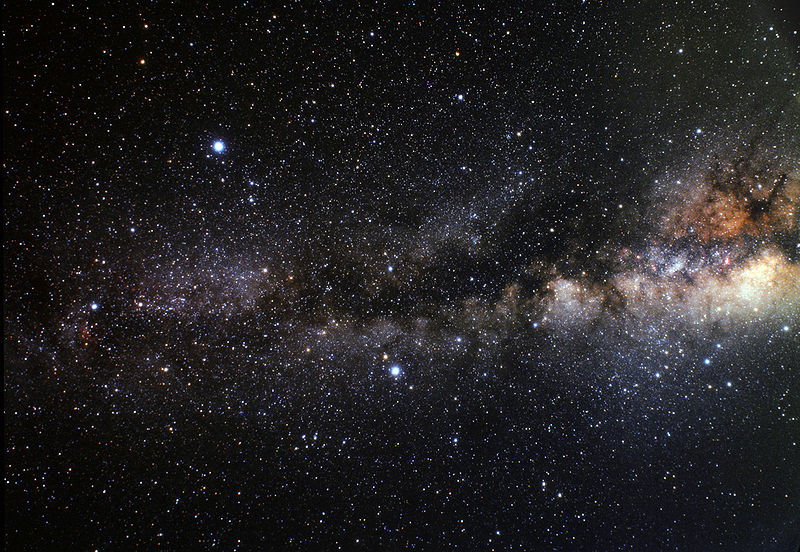
Prominent after sunset around the northern summer solstice
Like all the stars, the stars of the Summer Triangle rise four minutes earlier with each passing day. That also means, the stars rise two hours earlier with each passing month. Why is this happening? It’s because Earth is orbiting the sun, and our night sky is pointing outward toward an ever-changing panorama of stars.
Around May 1, the Summer Triangle will climb over the eastern horizon around local midnight (1 a.m. daylight saving time).
When middle to late June comes rolling along, you’ll see the Summer Triangle sparkling in the east at evening dusk. Watch for it around the time of the June solstice. It’s a sure sign of summer’s return to the Northern Hemisphere.
To gauge the size of the Summer Triangle, hold a one-foot (30 cm) ruler at arm’s length from your eye. The ruler pretty much fills the gap between Vega and Altair, the Summer Triangle’s 1st- and 2nd-brightest stars, respectively.

Bottom line: Watch for the three bright stars of the Summer Triangle – Vega, Deneb and Altair – before dawn in March, before midnight in May and at dusk near the June solstice.
EarthSky astronomy kits are perfect for beginners. Order today from the EarthSky store
Like what you read?
Subscribe and receive daily news delivered to your inbox.
More from
Bruce McClure


Find the Andromeda Galaxy using Cassiopeia

What are star trails, and how do I photograph them?
Meet Shaula and Lesath, the Scorpion’s Stinger stars
M6 and M7: Open star clusters in the Scorpion’s Tail