Today's Image

Watch a sungrazing comet’s final death leap

Sungrazing comet: Animation showing the sun and a comet entering the scene from the lower left.
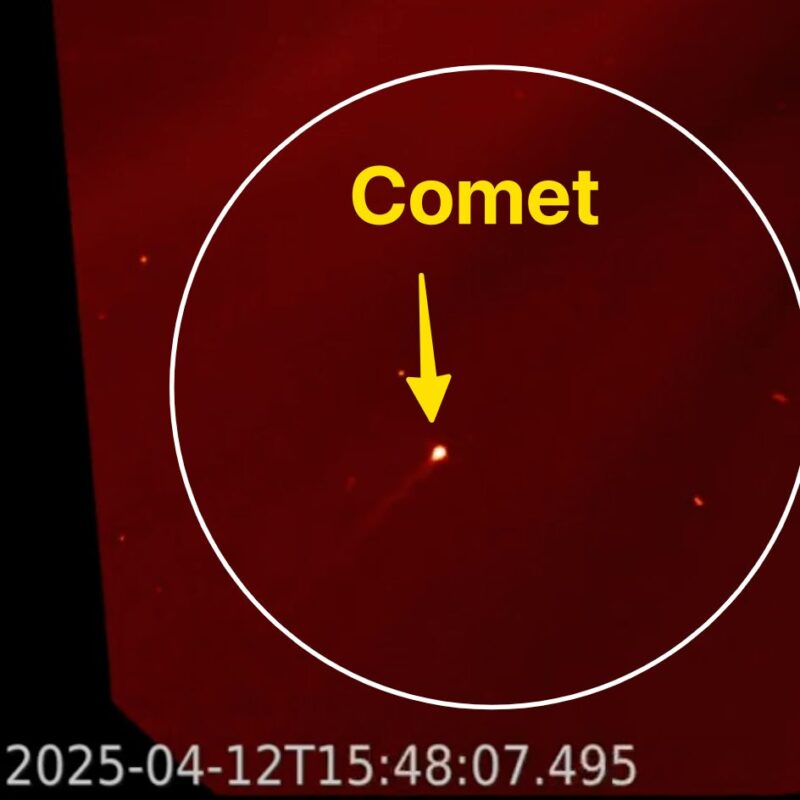
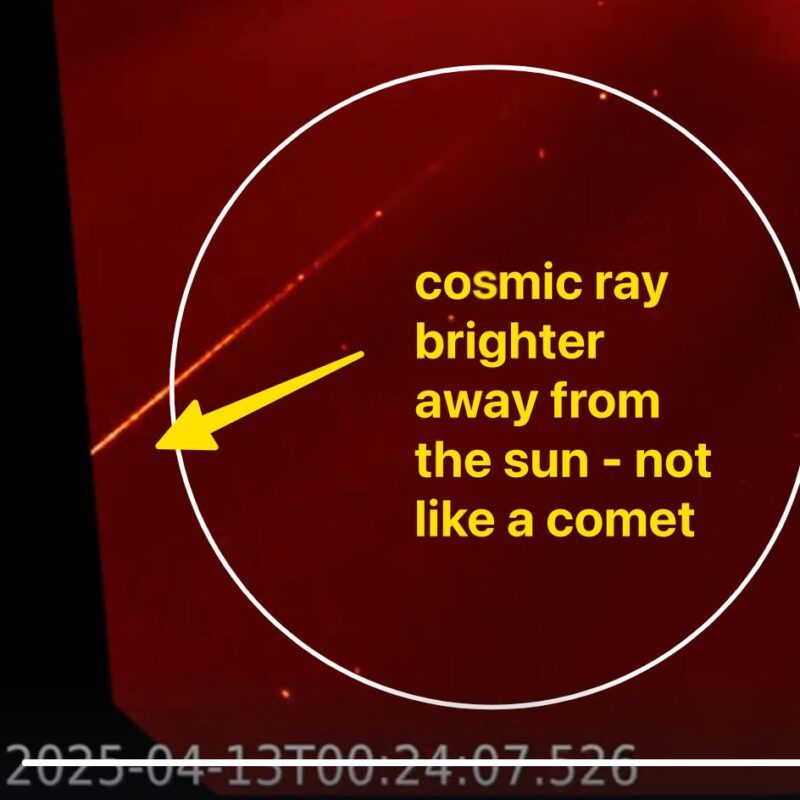
Check out the sungrazing comet that dove into our sun on April 12-13, 2025. Look in the bottom left of this image, inside the circle. The comet appears as a relatively bright and slow-moving dot, heading toward the sun, then suddenly fading away just before it enters the sun’s inner corona. Shortly afterwards, you’ll see a streak. That’s an energetic particle, probably a cosmic ray. See closeups of the comet and cosmic ray, below. Recent data suggest that over 5,000 sungrazing comets have been discovered, with most belonging to the Kreutz group, thought to be fragments from a larger comet that broke up long ago. Image via SDO and SOHO.

EarthSky isn’t powered by billionaires. We’re powered by you.
Support EarthSky’s 2025 Donation Campaign and help keep science accessible.

A dot inside a circle, labeled as "comet."
Closeup of the sungrazing comet, spied shortly before it appeared to disintegrate as it hit the sun’s inner corona. Note the head (the comet’s core) and the tail pointing away from the sun. Image via SDO and SOHO.
A streak inside a circle and text that reads
Probably a cosmic ray. Not the comet! Note that the comet appears in multiple frames of the animation above, more than just 1 or 2. Cosmic rays appear brighter when they are farther away from the sun. They only appear in 1 or at most 2 frames of these sorts of images from SOHO. Their short-lived appearance is how scientists tell the difference between cosmic rays and sungrazing comets. Having multiple images is important! Image via SDO and SOHO.

Bottom line: The sungrazing comet appears as a relatively bright and slow-moving dot, heading toward the sun, then suddenly fading away.

Read the sun news

Comets are icy balls of gas, dust and rock

Posted 
April 15, 2025
 in 
Today's Image

Like what you read?
Subscribe and receive daily news delivered to your inbox.

Your email address will only be used for EarthSky content. Privacy Policy
Thank you! Your submission has been received!
Oops! Something went wrong while submitting the form.

More from 

Editors of EarthSky

View All