



On Earth, nothing could feel as familiar as the passing of our seasons. And our days are steady, too – 24 hours, over and over, all our lives. But not so on Mars. Different world, just one step outward from Earth. Same laws of nature … but alien all the same. In this livestream, EarthSky’s Deborah Byrd explores the seasons on the red planet, and how even small differences in time and orbit can reshape our perception of a world. Watch in the player above or on YouTube.
Summer solstice in Mars’ southern hemisphere
Earth’s next solstice will fall at 8:25 UTC on June 21, 2026. It’ll be a summer solstice for the Northern Hemisphere (and a winter solstice for the Southern Hemisphere). It’ll happen when Earth’s south pole is tilted most toward the sun.
Like Earth, Mars tilts on its axis with respect to its orbit around the sun. It tilts by about 25 degrees, in contrast to Earth’s 23.5 degrees. So Mars has equinoxes and solstices as well. And Mars’ summer solstice for its southern hemisphere arrives on April 25, 2026.
Like Earth, Mars has 4 seasons
Mars takes 687 Earth-days to orbit the sun once. That’s almost two Earth-years. So each season on Mars – winter, spring, summer, fall – lasts roughly twice as long as a season on Earth.
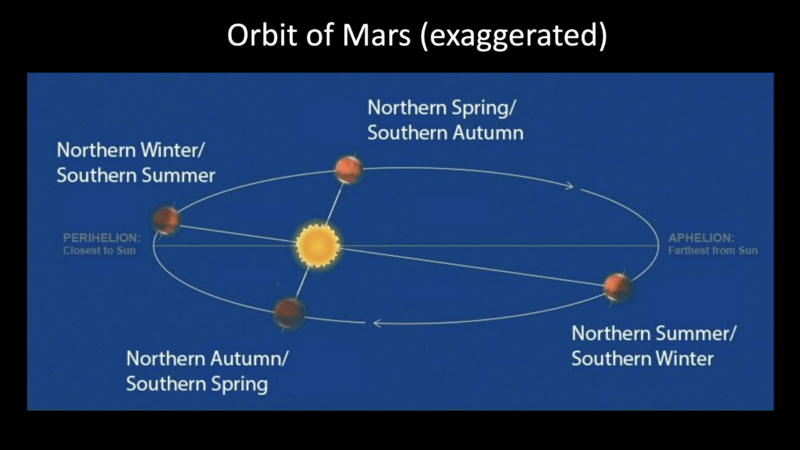
And, meanwhile, although the image below is exaggerated, it shows that the orbit of Mars is more squashed than that of Earth. Astronomers say it’s more elliptical. Mars is farther from the sun during southern winter … and closer during southern summer. So the Mars southern hemisphere has shorter, hotter, more extreme seasons.
So – now, in April 2026, as Mars’ northern hemisphere of is tipping into the deepest part of winter – its southern hemisphere is celebrating summer. Of course, nothing is blooming. To date, scientists haven’t confirmed life on Mars, today or in the past. But there’s still seasonal change, just as there is in the most Mars-like places on Earth … Antarctica, for example.
The season of dust
Because Mars’ orbit is so squashed, relative to Earth’s, its closest and farthest points to the sun are more extreme than Earth’s. And Mars’ closest point to the sun – its perihelion – always happens near the Mars southern summer. In 2026, perihelion for Mars happened on March 26.
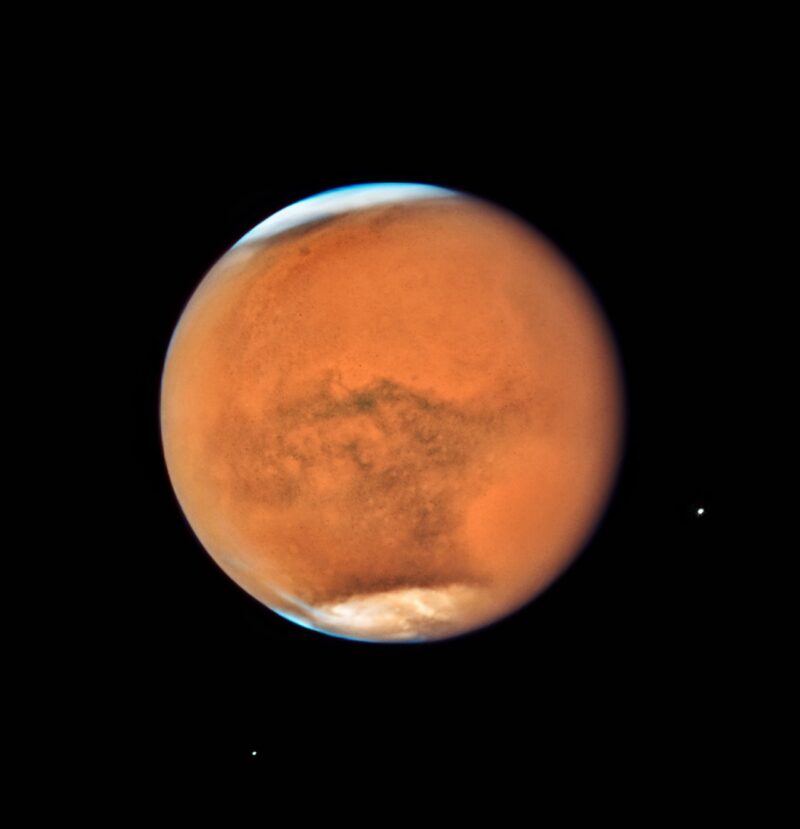
So Mars is relatively closest to the sun around now. It’s moving fastest in orbit. And that’s why Martian southern summers are shorter, hotter, and more volatile than in the north. During the Martian southern summertime, dust storms can kick up, sometimes growing large enough to wrap around the entire planet. In the image below from the Hubble Space Telescope in 2018, you can see what the last global dust storm on Mars looked like. No surface features were visible because – for some months in 2018, centered on the Martian southern summer – Mars was shrouded in dust.
What’s happening on Mars now?
As of April 2026, atmospheric conditions on the red planet are relatively clear.
Current Martian weather stats – formed from recent data from the Perseverance and Curiosity rovers (the only two rovers active on Mars now) indicate “very dusty conditions” locally at certain craters. But these are localized events. And Mars is now entering a season where localized dust activity typically increases.
On average, global storms happen once every three to four Mars years. That’s about every 5 1/2 to eight Earth years. We haven’t had a a truly huge, global Mars dust storm since 2018.
So the “watch” is officially on for Mars dust in 2026.
And the current Martian season – summer in the southern hemisphere, officially starting on April 25, 2026 – is the primary reason for the anticipation.
Bottom line: The summer solstice in Mars’ southern hemisphere happens on April 25, 2026. At that time, the south pole of Mars is pointed most directly toward the sun. Summertime in the Martian southern hemisphere typically kicks off dust season on the red planet.
Like what you read?
Subscribe and receive daily news delivered to your inbox.
More from
Deborah Byrd


Visible planets and night sky guide late September and October

The September full Moon is the Harvest Moon near Saturn
Curiosity rover insights after 5000+ sols on Mars
Great Square of Pegasus gallops into the autumn sky



