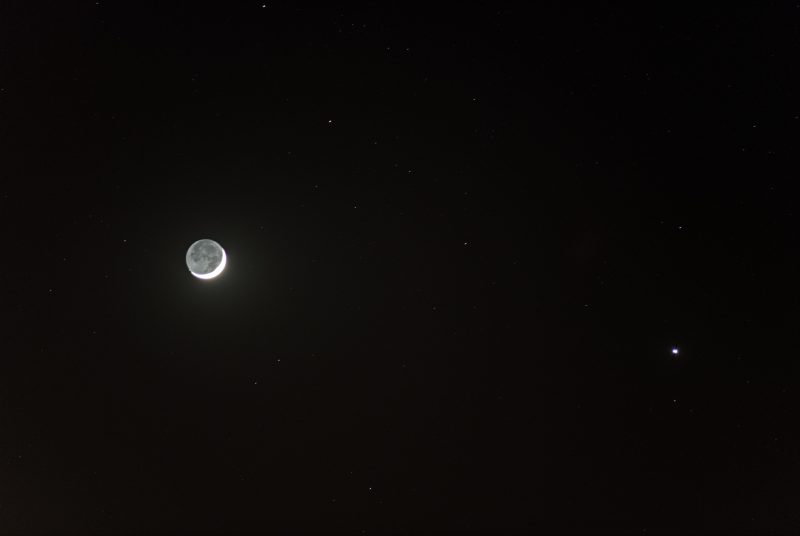
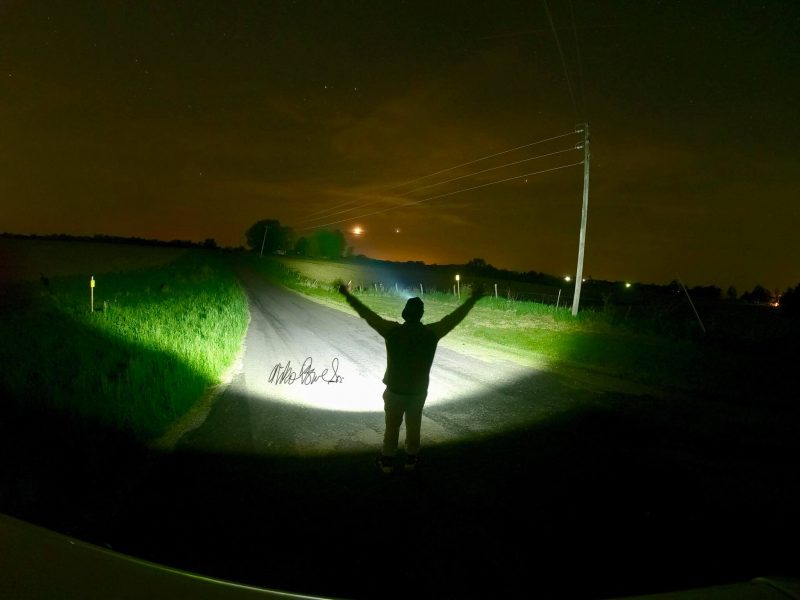
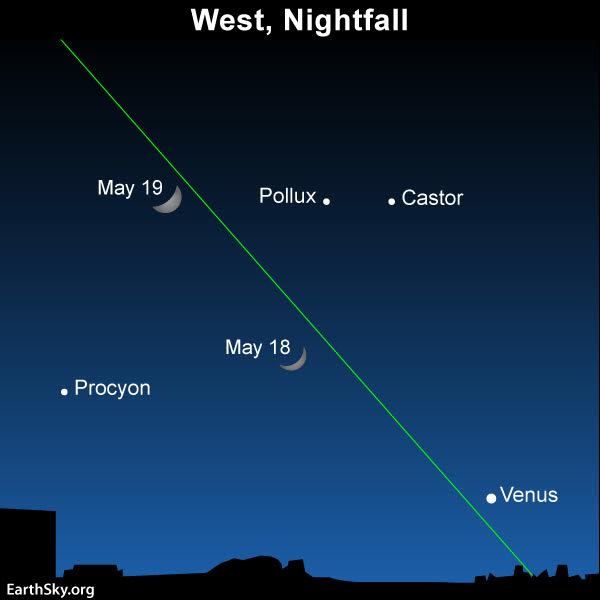
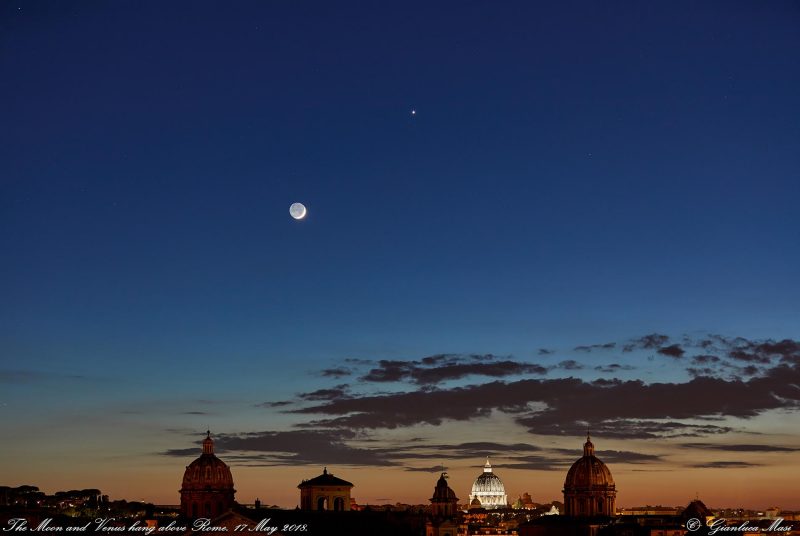
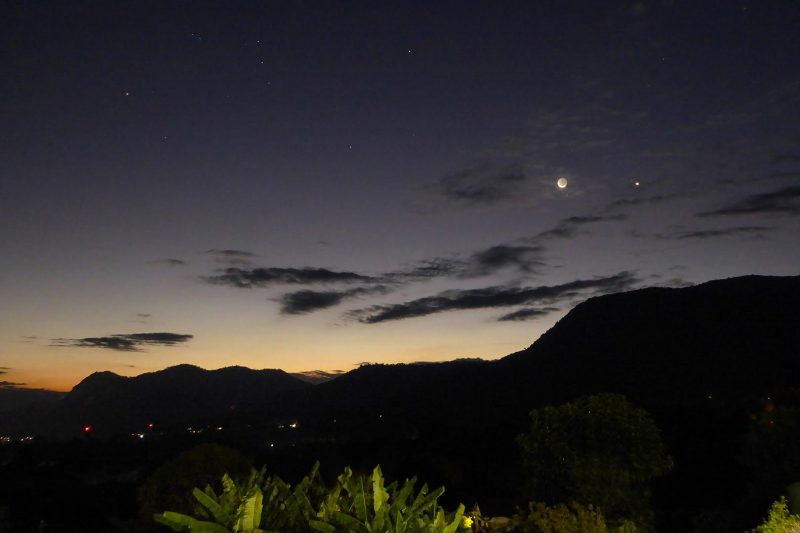
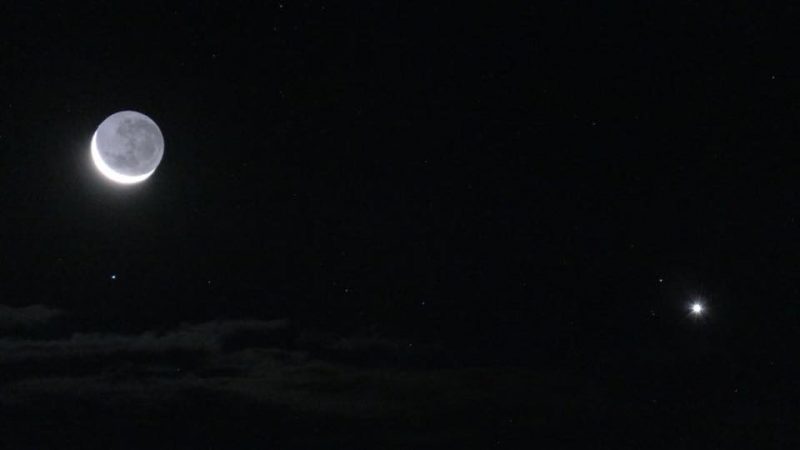
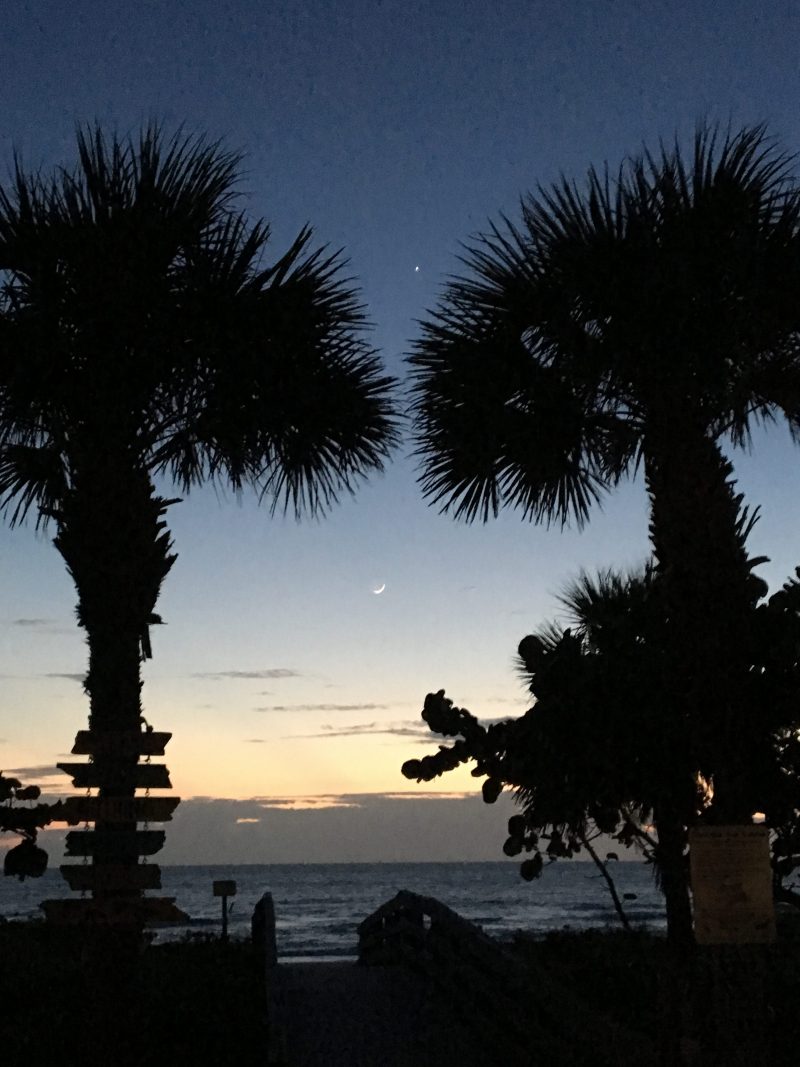
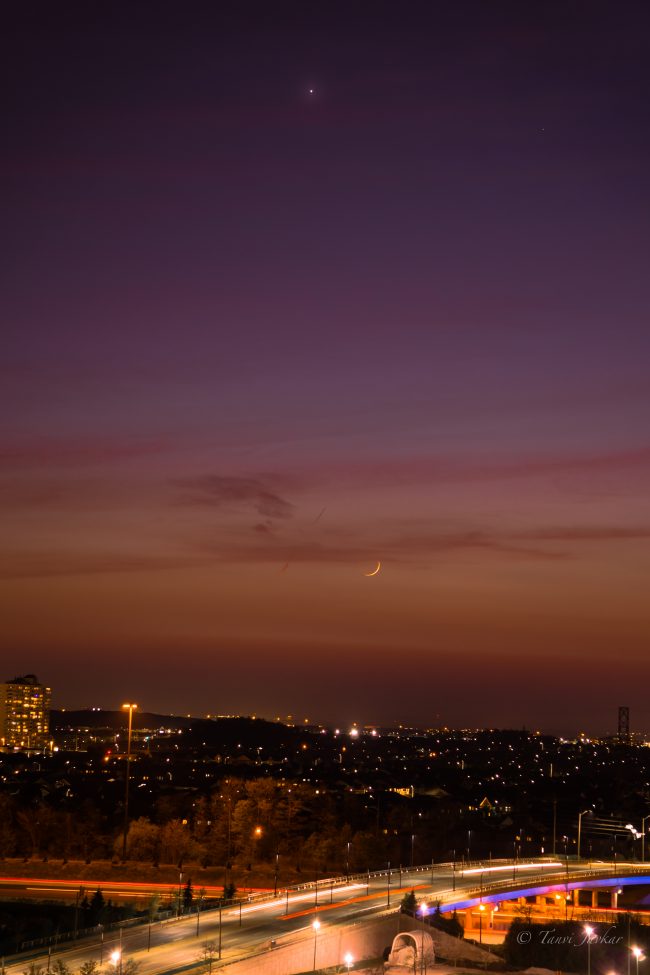
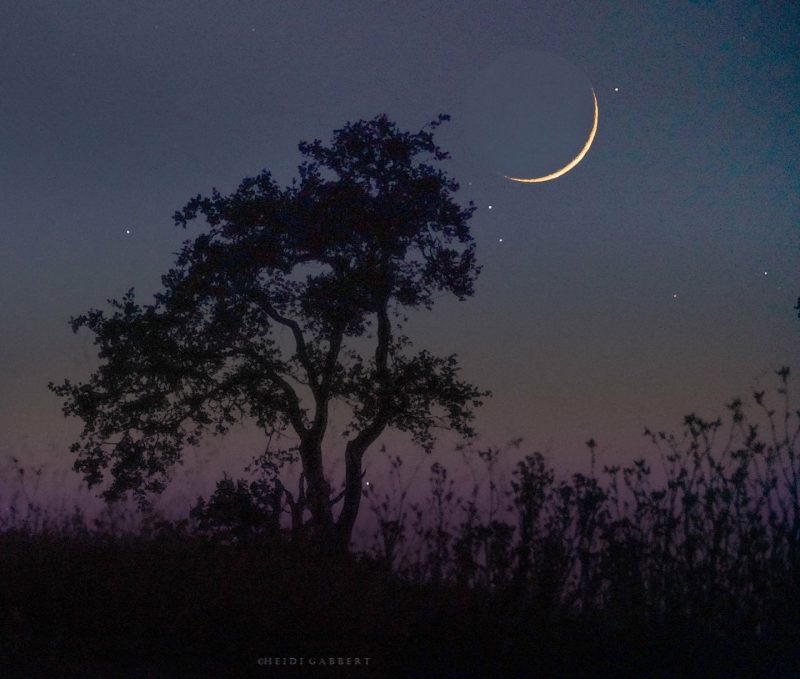
Mohamed Laaifat Photographies in France wrote on May 17, 2018: “Moon and Vénus tonight over my Normandy sky.”Eliot Herman in Tucson, Arizona, wrote: “… much better to see than a photo.” Camera Nikon D850, Nikon 180 mm lens, F2.8, ISO 4000. This is nine images stacked differing by 0.3 stops, deconvoluted and adjusted with Photoshop.Nico Powe wrote: “Checking out the young moon, Venus, Castor and Pollux [the 2 stars above the moon and Venus], the zodiacal light and more in Kewanee, Illinois!” See the chart below.If you keep watching Friday and Saturday evenings, you’ll see the moon move up toward the stars Castor and Pollux in the constellation Gemini. Look west shortly after the sun goes down.Gianluca Masi of the Virtual Telescope Project caught Venus and the moon from Rome, Italy, on May 17, 2018.Moon and Venus, May 17, 2018, from Peter Lowenstein in Mutare, Zimbabwe.Isi Grefen caught Venus and the moon on May 17 from Gilling East, North Yorkshire, U.K.Abdulmajeed Alshatti captured this crescent moon – which marked the start of the Islamic holy month of Ramadan – from Kuwait City on May 17.Michael Coonan caught Venus and the moon on May 17 from Wodonga, Australia.Nikki Ellis caught Venus and the moon on May 17 from South Africa.Moon and Venus on May 17, 2018, from Jean Baptiste Feldmann – aka Astro Jb – in France.Chris Young in Indian Rocks Beach, Florida, shot Venus and the moon with an iPhone on May 16, 2018.Tanvi Javkar in Mississauga, Ontario, Canada, caught Venus and the moon on May 16.Heidi Gabbert wrote on May 16, 2018: “Here’s a little sliver of last night’s new moon setting during blue hour with a few bright stars shining through.”
Bottom line: Photos of the moon and Venus on May 16 and 17, 2018, from the EarthSky community around the world.
Deborah Byrd (asteroid 3505 Byrd) helps edit EarthSky.org and is a frequent host of EarthSky videos. Deborah created the EarthSky radio series in 1991 and founded EarthSky.org in 1994. Prior to that, she had worked for the University of Texas McDonald Observatory since 1976, and created and produced their Star Date radio series. She has won a galaxy of awards from the broadcasting and science communities, including having an asteroid named in her honor in 1990, a Public Service Award from the National Science Board in 2003, and the Education Prize from the American Astronomical Society in 2020. A science communicator and educator since 1976, Byrd believes in science as a force for good in the world and a vital tool for the 21st century. "Being an EarthSky editor is like hosting a big global party for cool nature-lovers," she says.
Like what you read? Subscribe and receive daily news delivered to your inbox.
Thank you! Your submission has been received!
Oops! Something went wrong while submitting the form.