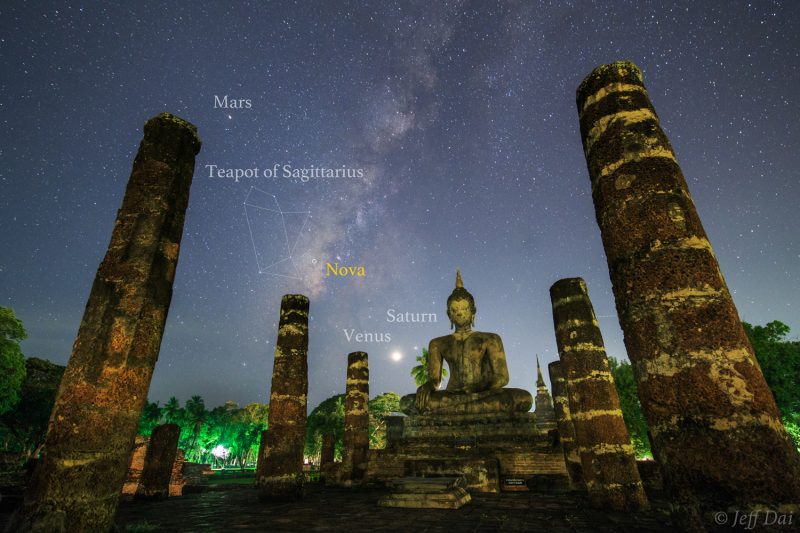
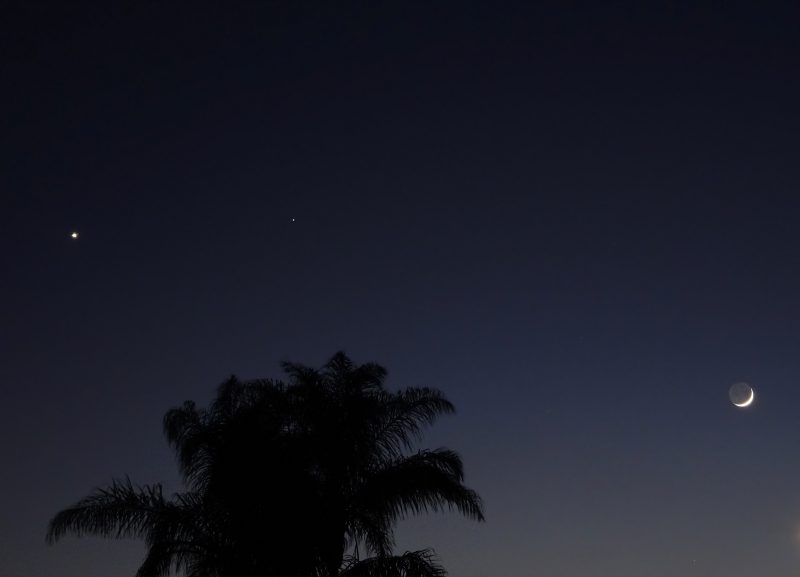
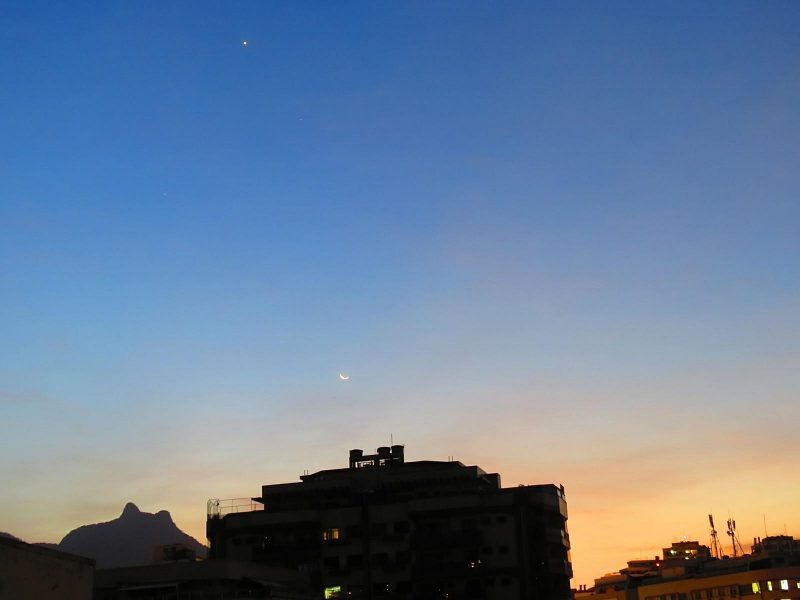
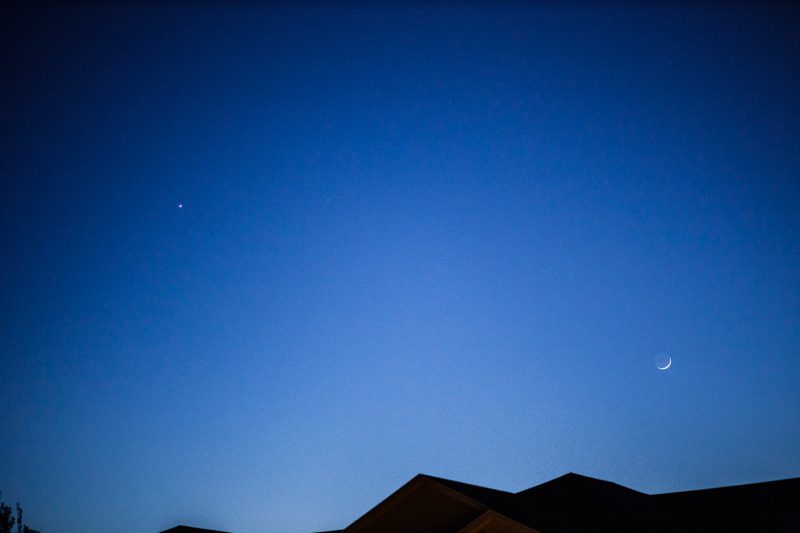
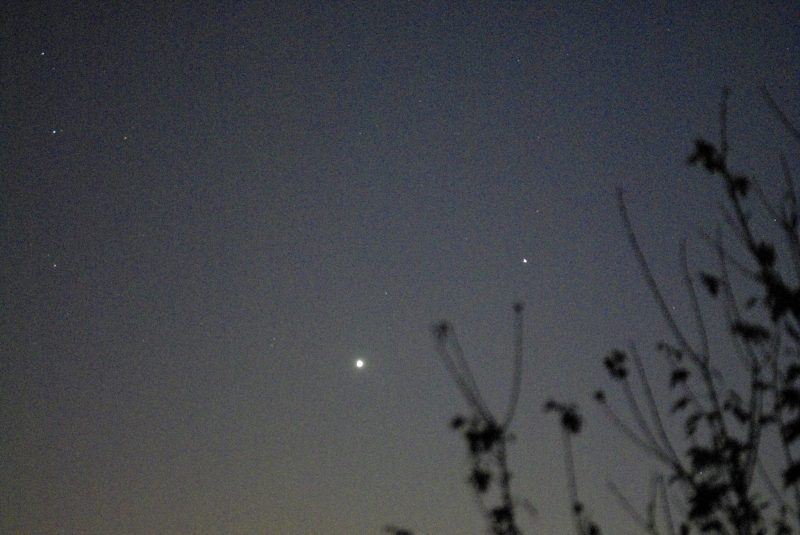
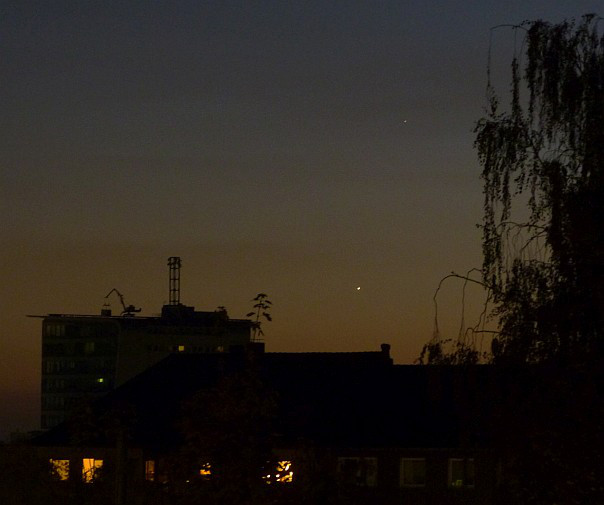
October 29 or 30 was the night of the Venus-Saturn conjunction. Jeff Dai caught the pair on October 30 from the world heritage site at Sukhothai, Thailand. He wrote: “A nova in Sagittarius, discovered a few nights ago by a Japanese amateur, has become bright enough to see in binoculars. The Milky Way in Sagittarius is sinking in the southwest right after dusk, affording only a short viewing window. Mars is also visible on the left.”Dan Wyman in Oceanside, California caught Venus, Saturn and the moon on November 1, 2016.The moon and Venus are the 2 brightest objects to appear after sunset in early November. This is November 1, in Rio de Janeiro, Brazil. See Saturn below Venus? Photo by Helio C. Vital.Linda Carlson caught Venus (far left), Saturn and the waxing crescent moon on November 1, 2016 from Orlando, Florida.
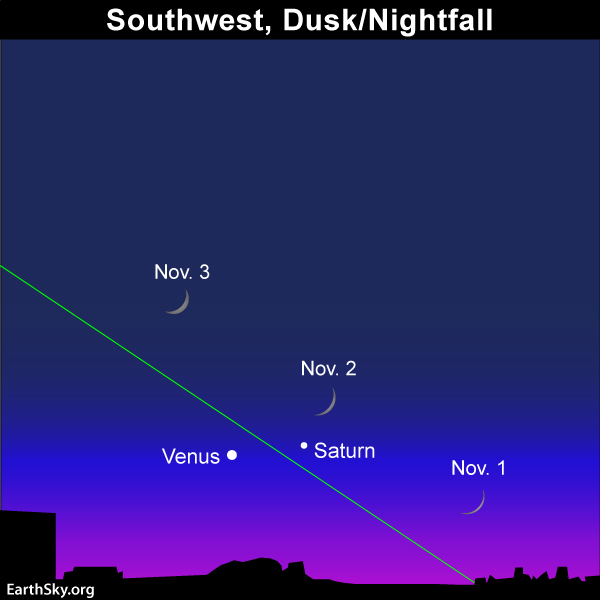
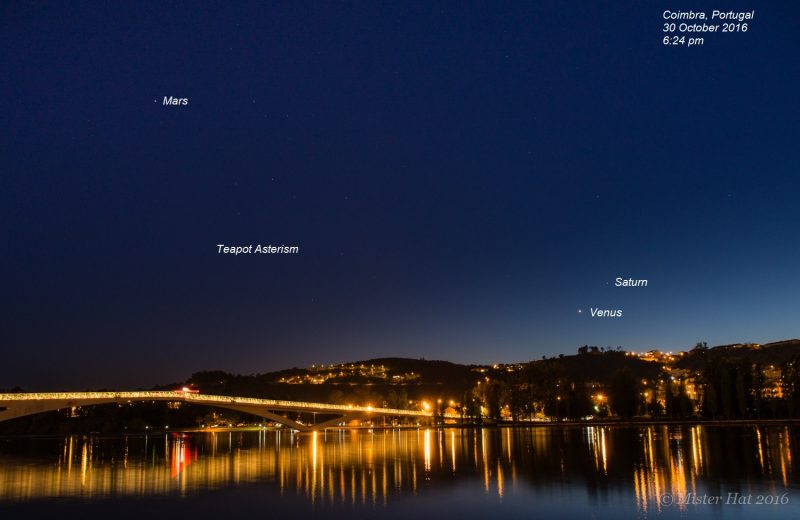
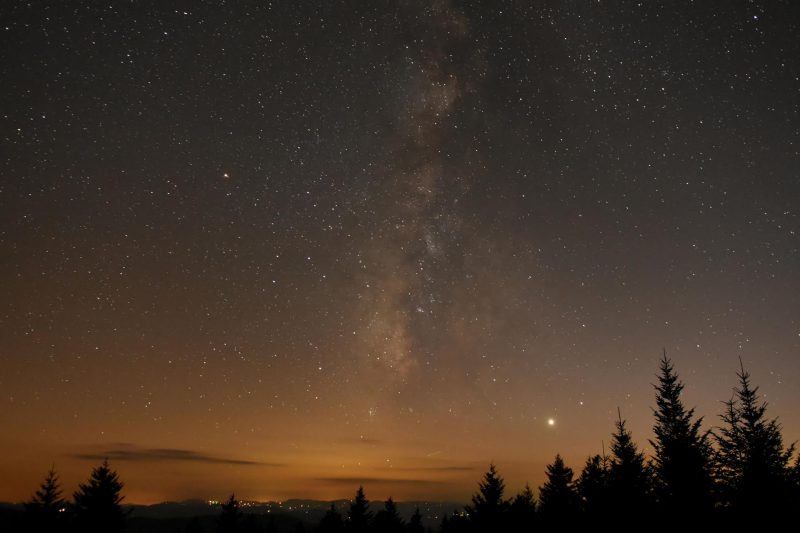
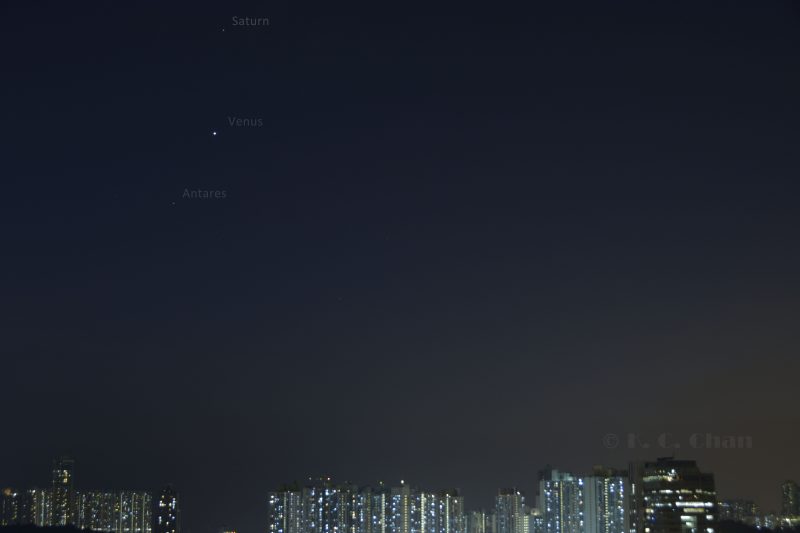
Don’t miss Venus and Saturn on the evenings of November 1, 2 and 3, when they’ll be near the waxing moon. Read more.Vince Babkirk wrote: “From our new home in Coimbra, Portugal, we had a very clear night on 30 October 2016. I was able to capture Venus, Saturn, the Teapot asterism, and Mars in this photo across the Rio Mondego. Taken about 50 minutes after sunset.”Bright Venus and fainter Saturn over Tennessee on Sunday evening – October 30 – by Lester Fandel.David Wilson of Weaverville, North Carolina caught the pair Sunday evening. Notice Venus is much brighter than Saturn. Mars is above and to the left. David wrote: “We drove up on the Blue Ridge Parkway tonight to get some shots of the Venus-Saturn conjunction. We stopped at the ‘highest point’ on the parkway…”Daniel Fischer (@cosmos4u on Twitter) caught the pair on Saturday evening, October 29, 2016.Kai Cheong Chan caught Saturn, Venus and the star Antares after sunset on October 27, 2016. Antares is sinking into the sunset by early November, increasingly difficult to see. Saturn will soon follow.
Bottom line: Photos of the brightest planet Venus – plus Saturn, Mars and the star Antares – in late October and early November 2016.
Deborah Byrd (asteroid 3505 Byrd) helps edit EarthSky.org and is a frequent host of EarthSky videos. Deborah created the EarthSky radio series in 1991 and founded EarthSky.org in 1994. Prior to that, she had worked for the University of Texas McDonald Observatory since 1976, and created and produced their Star Date radio series. She has won a galaxy of awards from the broadcasting and science communities, including having an asteroid named in her honor in 1990, a Public Service Award from the National Science Board in 2003, and the Education Prize from the American Astronomical Society in 2020. A science communicator and educator since 1976, Byrd believes in science as a force for good in the world and a vital tool for the 21st century. "Being an EarthSky editor is like hosting a big global party for cool nature-lovers," she says.
Like what you read? Subscribe and receive daily news delivered to your inbox.
Thank you! Your submission has been received!
Oops! Something went wrong while submitting the form.