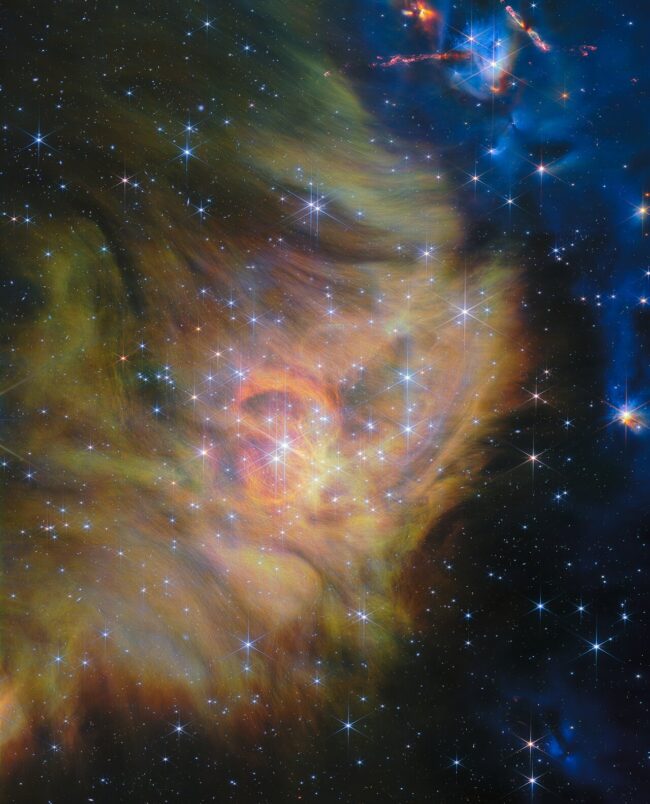
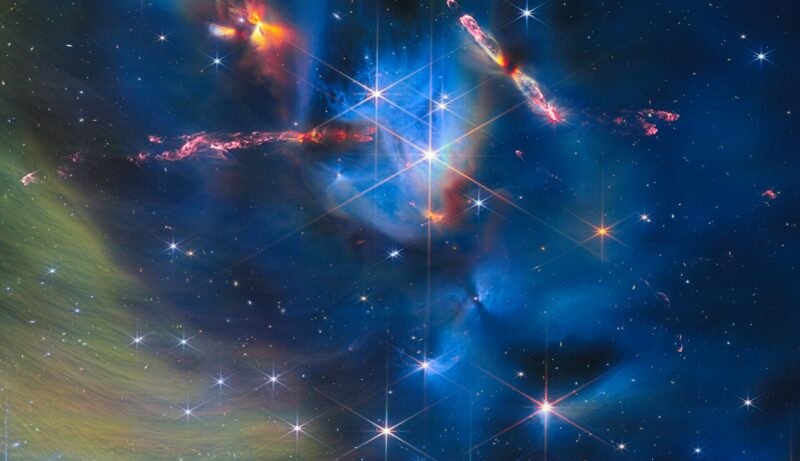
View larger. | This new Webb image is one of the largest released so far. It focuses on IC 348, a star-forming region in the constellation Perseus just 1,000 light-years away. Researchers were looking for brown dwarfs, also known as failed stars. But the image captures much more, including protostars, jets, spiral galaxies and a gravitational lens. Image via ESA/ Webb/ NASA/ CSA/ K. Luhman/ C. Alves De Oliveira/ M. Zamani (ESA/ Webb).
Huge new Webb image is chock-full of space delights
ESA has just released one of the largest James Webb Space Telescope images yet, and it’s spectacular.
The image reveals a nearby cloud of of gas and dust known as IC 348. Sitting about 1,000 light-years away in the constellation Perseus, IC 348 is a star-formation hotbed. Enjoy the array of dazzling young protostars in the images below, alongside a range of other beautiful objects.
The astronomers behind the observation were looking for elusive brown dwarfs. Brown dwarfs are known as failed stars because they never grew large enough to start nuclear fusion in their cores.
The researchers wanted to learn just how small a brown dwarf can be. They still don’t have a definitive answer, but they did find brown dwarfs that were only twice the mass of Jupiter, or 0.19% the mass of the sun. Another surprise was that one of the lightest newfound brown dwarfs might be growing planets or moons. It had signs of a disk around it.
But the new Webb image reveals much more, including protostars, jets, spiral galaxies and a gravitational lens. Enjoy the wonderful closeups below.
An image chock-full of space delights
So what else did Webb capture in its image of IC 348?
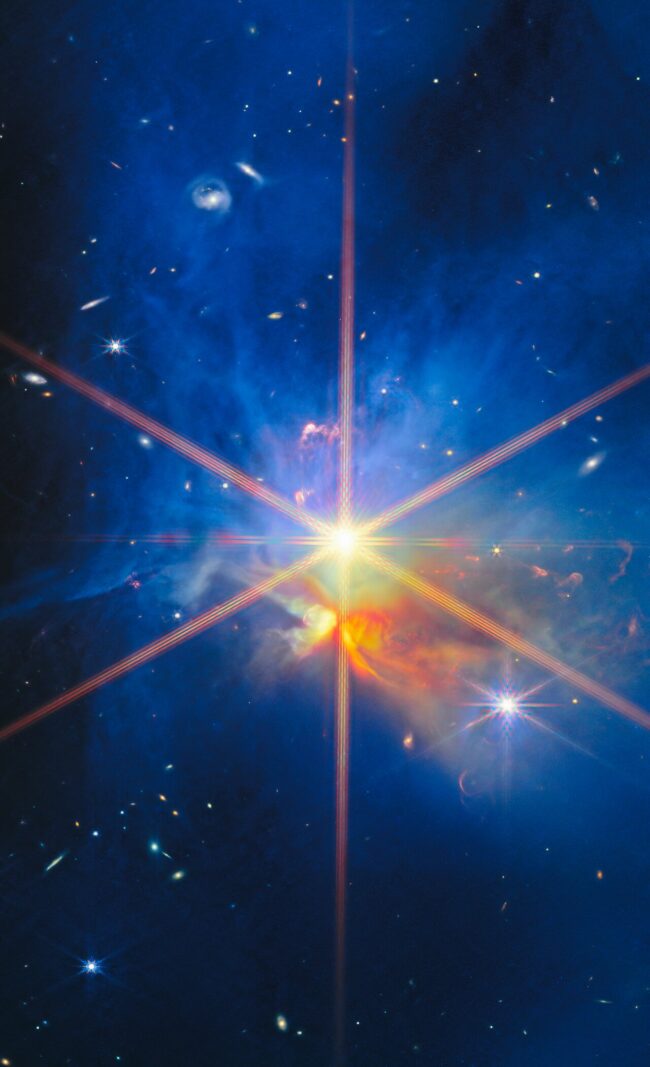
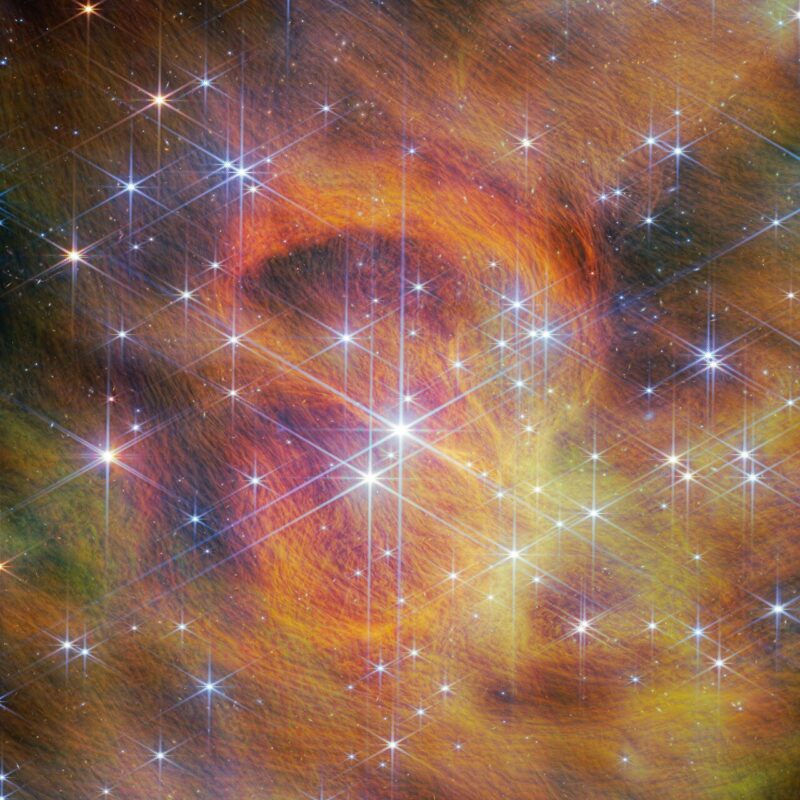
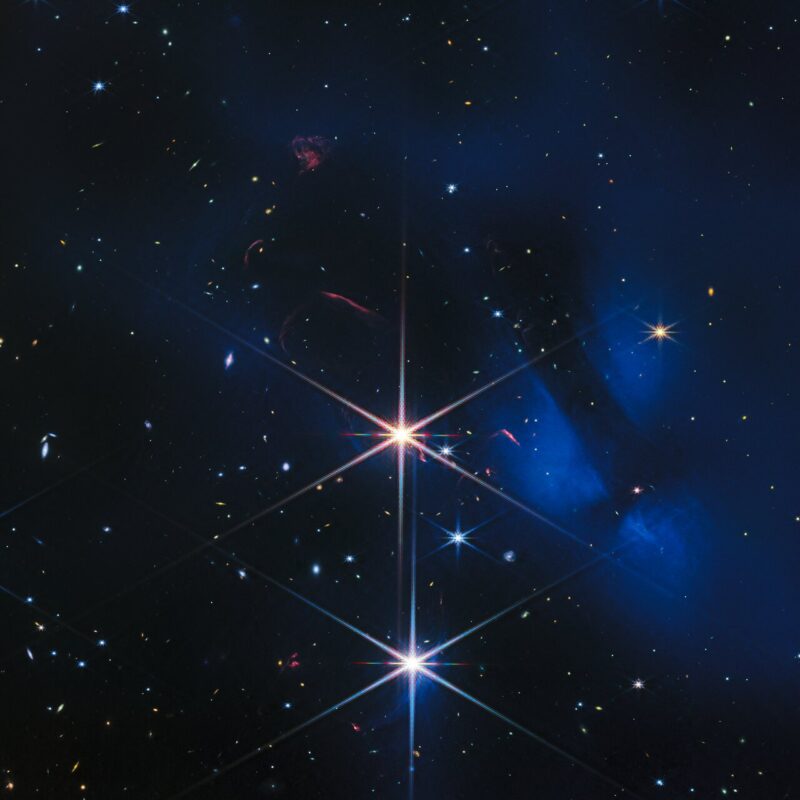
Here are 2 stars from the right middle edge of the top photo. The stars are embedded in a cloud of gas and dust. The central and brighter star is, surprisingly, more deeply wrapped in the cloud. The smaller star has a whiter-blue color because it is less shrouded, with shorter and longer infrared wavelengths making it through. Image via ESA/ Webb/ NASA/ CSA/ K. Luhman/ C. Alves De Oliveira/ M. Zamani (ESA/ Webb).A closer view of the central swirl of gas and dust. There’s a cluster of stars here, and their light reflects off the gas and dust. There are also carbon-containing molecules here, known as polycyclic aromatic hydrocarbons, or PAHs. Image via ESA/ Webb/ NASA/ CSA/ K. Luhman/ C. Alves De Oliveira/ M. Zamani (ESA/ Webb).View larger. | These 2 bright stars and dim nebula are in the bottom right corner of the top image. Again, the orange star is deeper in the clouds, with whiter light filtered out. If you look closely, you can see thin red arcs around the stars. These are shockwaves in gas from the young stars’ outbursts. Image via ESA/ Webb/ NASA/ CSA, K. Luhman/ C. Alves De Oliveira/ M. Zamani (ESA/ Webb).
More gems in the IC 348 image
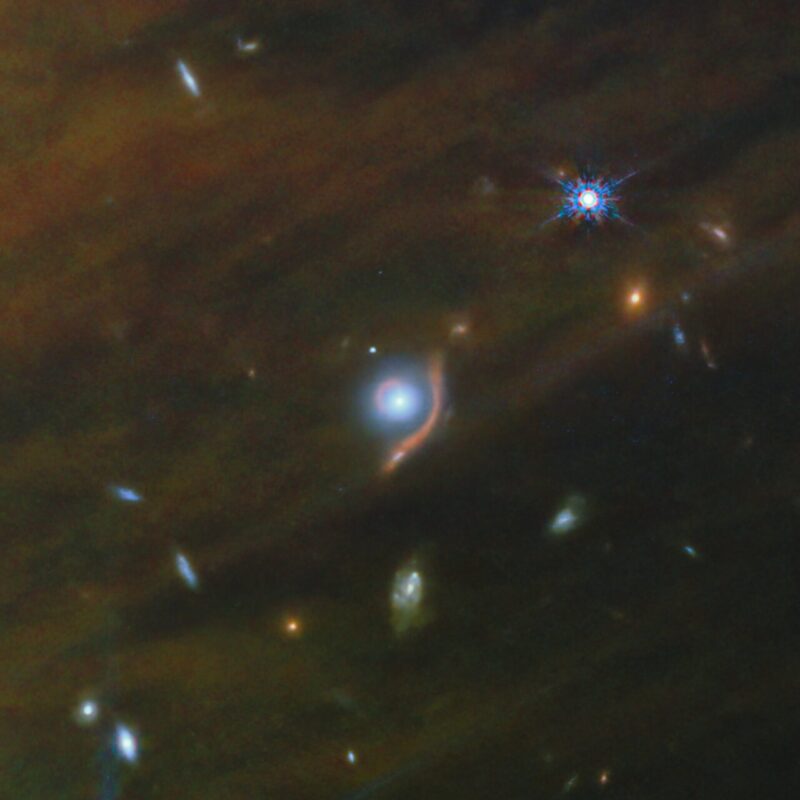
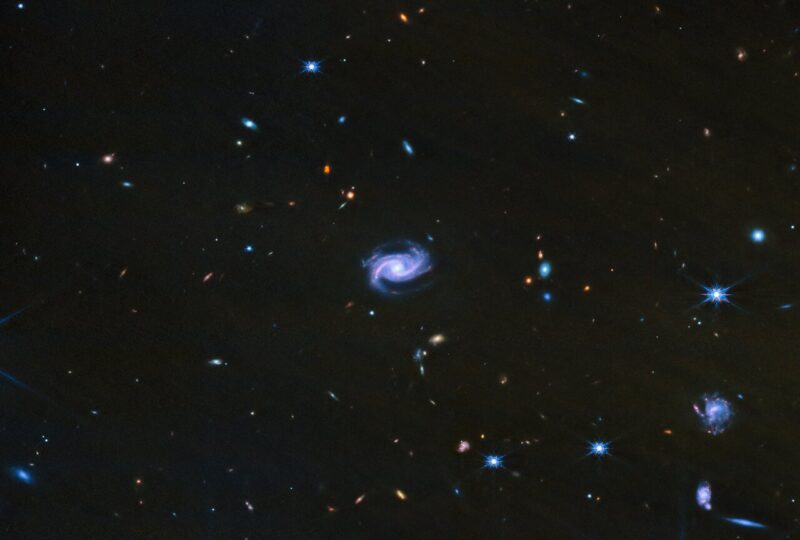
View larger. | This view focuses on protostars and jets in the upper right original image. The horizontal streak to the left is a Herbig-Haro object, HH 797. The objects are bright jets associated with newborn stars. In this case, it’s 2 protostars with nearly parallel outflows. The other Herbig-Haro object nearby is HH 211, which has another protostar. And yet 2 more protostars are in the orange area above HH 797. And there are even more protostars lurking here, in this colorful stellar factory. Image via ESA/ Webb, NASA/ CSA/ K. Luhman/ C. Alves De Oliveira M. Zamani (ESA/ Webb).View larger: | The IC 348 image also reveals background objects, including this bright, distant galaxy. Notice the orange arc and small loop touching it. Both are images of a more distant galaxy behind it. The gravity of the foreground galaxy creates a gravitational lens that allows us to see more distant objects behind it. Image via ESA/ Webb/ NASA/ CSA/ K. Luhman/ C. Alves De Oliveira/ M. Zamani (ESA/ Webb).View larger. | Finally, we spy some spiral galaxies twirling in the background of IC 348. The galaxies we see here are millions of light-years away. Even the dimmer, blobby dots are galaxies that are up to billions of light-years from Earth. Image via ESA/ Webb/ NASA/ CSA/ K. Luhman/ C. Alves De Oliveira/ M. Zamani (ESA/ Webb).
Bottom line: ESA has unveiled a spectacular new Webb space telescope image. This shot is one of the largest yet, and it features an array of protostars, jets, distant spiral galaxies and a gravitational lens.
Kelly Kizer Whitt writes and edits some of the most fascinating stories at EarthSky.org. She's been writing about science, with a focus on astronomy, for decades. She began her career at Astronomy Magazine and made regular contributions to other outlets, including AstronomyToday and the Sierra Club. She has nine published books, including a children's picture book, Solar System Forecast, and a young adult dystopian novel, A Different Sky.
Like what you read? Subscribe and receive daily news delivered to your inbox.
Thank you! Your submission has been received!
Oops! Something went wrong while submitting the form.