




Sun news May 31: Solar wind surges, brings aurora to high latitudes
Today’s top story: Earth’s magnetic field stirred to active levels overnight. A stream of fast solar wind from a coronal hole poured in. The activity fell just short of G1 (minor) geomagnetic storm thresholds. But aurora watchers in Anchorage, Reykjavik, and northern Scandinavia might have caught faint displays during dark windows. Forecasters see a chance for isolated G1 storm periods today. The coronal hole stream persists. And possible glancing coronal mass ejection (CME) influences from earlier this week might arrive. That keeps conditions mildly unsettled into early June. Share your aurora photos with us!
Past 24 hours of sun news
(11 UTC May 30 – 11 UTC May 31)
Flare activity
Over the past day, solar activity held at low levels. In total, the sun fired 12 C-class flares.
- Strongest flare: C4.8 from AR4446 (S17W16), peaking at 11:45 UTC on May 30. As a C-class event, it produced no radio blackout. A faint, narrow CME was observed in association but should have a negligible Earth impact.
- Lead flare producer: AR4446 topped the list. It fired 5 of the 12 flares, including both events above C3.0. Meanwhile, AR4452 and AR4449 each contributed 2 flares. And AR4455 and AR4453 each added one.
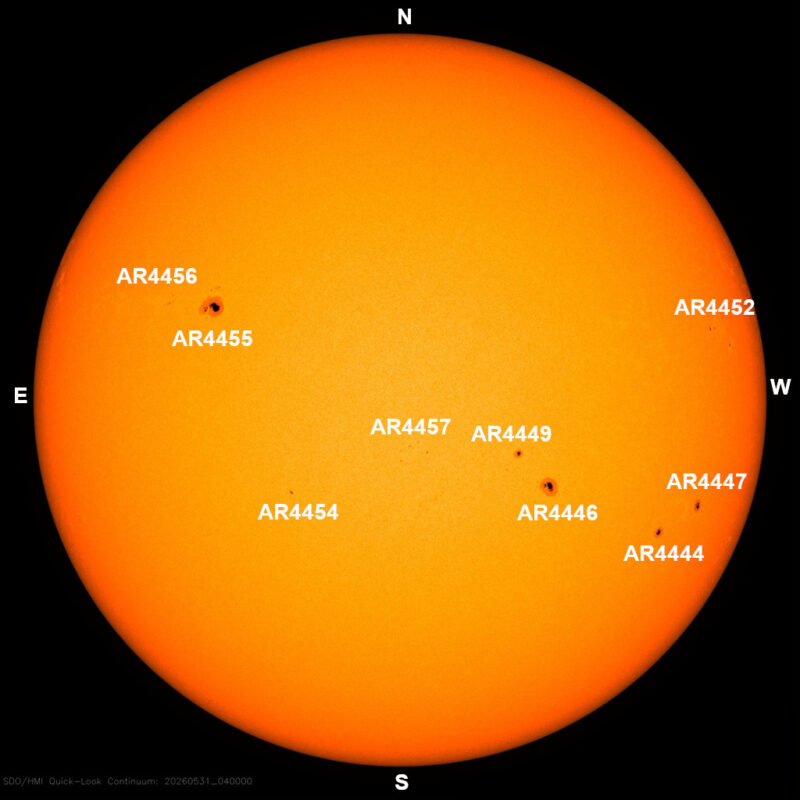
Sunspot regions: key players
The Earth-facing solar disk showed 9 numbered active regions. Most were magnetically simple and relatively stable.
Blasts from the sun?
A halo coronal mass ejection (CME) appeared in GOES CCOR-1 imagery at approximately 9:15 UTC on May 30. It lifted off from the north limb at a projected speed of roughly 550 km/s. But forecasters assessed it as originating from the far side. No Earth impact is expected from this event. No significant Earth-directed CMEs were identified during the period.
Past 24 hours in space weather
Solar wind
Solar wind speeds surged during the past day, with coronal hole high-speed stream driving the increase. Speeds climbed from just below 400 km/s early in the period to near 550 km/s by the end. They peaked at 576 km/s after 18 UTC on May 30. That pushed the Kp index to 4. Meanwhile, Earth’s magnetic field also strengthened, with the total interplanetary magnetic field (IMF) increasing to 10–11 nT (moderate levels).
Bz and magnetic coupling
The Bz component underwent several sustained southward dips. It reached -7 to -10 nT early in the period and again later. Each southward plunge opened the door for geomagnetic coupling and auroral activity. As always, a southward Bz favors aurora displays at high latitudes.
Earth’s magnetic field
Over the past day, Earth’s magnetic field ranged from quiet to active levels. The Kp index sat at 1–3 for most of the period. But it reached Kp 4 (active) during the 18:00–0:00 UTC window spanning May 30–31. Conditions stayed just below G1 (minor) geomagnetic storm thresholds. Close, but not quite.
What’s ahead? Sun–Earth forecast
Flare activity forecast
Forecasters expect low to moderate levels through June 2. C-class flares are very likely. And a chance (40%) exists for isolated M-class (R1–R2) flares. AR4452, with its beta-gamma configuration, remains the most likely source before it rotates beyond the west limb.
AR4455 and the newly emerged AR4457 also bear watching as they evolve. X-class flares are unlikely (5%) given the current magnetic setups on the disk.
Geomagnetic activity forecast
- May 31: Expect unsettled-to-active conditions (Kp 3–4) as the negative-polarity coronal hole stream continues. A chance for isolated G1 (minor) geomagnetic storm periods exists. That chance increases if glancing influences from the slow CMEs of May 27–28 arrive. Aurora may reach Anchorage, Reykjavik, and northern Scandinavia. But limited hours of darkness in the Northern Hemisphere at this time of year will reduce visibility.
- June 1: Expect quiet-to-active conditions as the coronal hole stream wanes. Possible glancing CME influences could sustain isolated unsettled-to-active periods (Kp 3–4) early in the day. Conditions should trend quieter through the second half.
- June 2: Expect mostly quiet conditions (Kp 1–2) as ambient solar wind returns. No significant geomagnetic activity is anticipated.
Sun news May 30: Blast from sun might brush past Earth today

Our star hurled several blobs of stuff – solar plasma and magnetic fields – into space this week. It launched these coronal mass ejections (CMEs) on May 26 and 27. The blobs might reach Earth later today and tomorrow. If they deliver a glancing blow, they could disturb Earth’s magnetic field. What does that mean for aurora watchers? Forecasters expect unsettled-to-active conditions with the Kp index reaching 4. But a G1 (minor) geomagnetic storm level of Kp 5 is not ruled out. Auroral displays are possible tonight and tomorrow at high latitudes. Clear skies! And please share your aurora photos with us!
Past 24 hours of sun news
(11 UTC May 29 – 11 UTC May 30)
Flare activity
Solar activity dropped back to low levels over the past day. The long-awaited newcomer AR4455 lost its gamma configuration. It keeps flaring, but only faint C-class events. In total, it fired 7 C-class (common) flares.
- Strongest flare: C4.0 from AR4449 in the southwest, peaking at 7:47 UTC on May 30.
- Lead flare producer: AR4455 keeps flaring. Once again, it topped the list. It fired 4 of the 7 flares. Meanwhile, AR4449 contributed 2 C-class flares. The remaining flare came from elsewhere on the disk.
Sunspot regions
Currently, the Earth-facing solar disk shows 7 numbered active regions. Notably, only one sunspot region retains its beta-gamma configuration: AR4452. Both AR4455 (now beta) and AR4446 (now beta) lost their gamma components. The remaining 4 regions carry simpler alpha or beta configurations. They appear stable or in decay.
Blasts from the sun?
Several faint eruptions were observed in the southeast earlier this week. At least two were strong enough for SOHO LASCO C2 and GOES SUVI to register. The first occurred at 23:00 UTC on May 27. A second followed at 9:38 UTC on May 28. Modeling and analysis of these events continue. The CMEs from May 26 and 27 might deliver a glancing blow later today or tomorrow. No other Earth-directed CMEs appeared during the period.
Past 24 hours in space weather
Solar wind
Solar wind speeds held at moderate to moderate-high levels during the period. The coronal hole high-speed stream continued driving the elevated speeds. But by 11 UTC on May 30, speeds dropped back to moderate levels. Meanwhile, the total interplanetary magnetic field (IMF) showed a slight increase to moderate levels.
Bz and magnetic coupling
The Bz component pointed strongly southward from late May 29 through early this morning. That opened the door for geomagnetic coupling. But at 3 UTC on May 30, the Bz shifted northward. At the time of this writing, it still points north. As always, south is the orientation most favorable for auroral displays.
Earth’s magnetic field
Over the past day, Earth’s magnetic field has held at unsettled-to-active levels. Solar wind from the coronal hole continued reaching us and producing enhancements. Specifically, the Kp 4 threshold was reached at 19:49 UTC on May 29. Currently, Kp sits at level 3.
Sun news May 29: BAM! M flare from newcomer AR4455

Today’s top story: The long-awaited newcomer has delivered! AR4455, the fiery region we have been watching approach from the northeast, fired an M1.2 flare at 7:04 UTC on May 29. The blast triggered an R1 (minor) radio blackout that affected an area over India. It’s a promising start for this sunspot group, which had already become the leading flare producer on the solar disk while still rotating into view yesterday. Now fully visible, AR4455 has revealed itself to have a promising beta-gamma magnetic complexity. That makes it one of three beta-gamma regions currently on the disk, alongside AR4446 and AR4452. Three beta-gamma regions at once is noteworthy. The more magnetic complexity on the disk, the greater the chances for stronger flares. Let’s see what else these regions have in store!
Past 24 hours of sun news
(11 UTC May 28 – 11 UTC May 29)
Flare activity
Over the past day, solar activity jumped to moderate levels with an isolated M-class flare. In total, the sun fired 7 flares: 1 M-class (moderate) and 6 C-class (common).
- Strongest flare: M1.2 from AR4455 in the northeast, peaking at 7:04 UTC on May 29. It triggered an R1 (minor) radio blackout over India.
- Lead flare producer: AR4455 once again topped the list. It fired 5 of the 7 flares, including the M1.2. The remaining 2 flares came from other regions on the disk.
Sunspot regions
The Earth-facing solar disk shows 8 numbered active regions. Notably, three sunspot regions carry beta-gamma configurations. AR4455 (beta-gamma) is the newcomer to watch. Now fully in view, it is already the top flare producer. And its beta-gamma complexity gives it the potential for M-class or even stronger flares. AR4446 (beta-gamma) continues holding its complexity. It remains a candidate for stronger activity. AR4452 (beta-gamma) rounds out the trio of complex regions. The remaining 5 regions carry simpler alpha or beta configurations. They appear stable or in decay.
Blasts from the sun?
Several faint eruptions were observed in the southeast. At least two were strong enough for SOHO LASCO C2 and GOES SUVI to observe. The first occurred at 23:00 UTC on May 27. A second followed at 9:38 UTC on May 28. Modeling and analysis of these events is ongoing. No other Earth-directed coronal mass ejections (CMEs) appeared during the period.
Past 24 hours in space weather
Solar wind
Solar wind speeds climbed to moderate-high levels late on May 28. The increase was driven by coronal hole high-speed stream influence. But this morning, speeds dropped back to moderate levels. Meanwhile, the total interplanetary magnetic field (IMF) stayed weak, with only a slight increase.
Bz and magnetic coupling
The Bz component pointed strongly southward through most of the period. Only a few northward peaks occurred. At the time of this writing, it still points south. That is the orientation most favorable for auroral displays.
Earth’s magnetic field
Over the past day, Earth’s magnetic field has jumped to unsettled-to-active levels, reaching just below Kp level 4. Currently, it sits at Kp level 3.
Sun news May 28: Exciting sunspot region finally arrives

A long-awaited sunspot region has finally come into view on the northeast solar horizon. Now officially numbered AR4455, all signs indicate this is the sunspot region that’s been erupting powerfully from the far side in recent days. It seems pretty large, but we still need to wait until it rotates farther into view to analyze it properly from Earth. It’s been producing jets and prominences all day, and has already fired more flares than any other region over the past 24 hours. Let’s see what else AR4455 has in store!
Past 24 hours of sun news
(11 UTC May 27 – 11 UTC May 28)
Flare activity
Solar activity has been low, with only faint C-class and B-class flares over the past 24 hours. We saw a total of 6 Cs and 1 B flare.
- Strongest flare: C3.4 from AR4451 in the southeast at 12:16 UTC on May 27.
- Lead flare producer: Active region AR4455 in the northeast was at the top of list. It fired 5 of the 7 flares.
Sunspot regions
The Earth-facing solar disk shows 11 numbered active regions. Three newcomer sunspot regions received an official number: AR4453 near the northwest horizon, AR4454 in the southeast and AR4455 in the northeast. AR4455 seems to be the one that’s been flaring from the far side. It seems pretty large, but we still need to wait for it to rotate more into view for a better analysis. For now, it shows a beta configuration. AR4446 keeps its beta-gamma configuration, the most complex on the solar disk currently. The rest of the sunspot region on the Earth-viewed solar disk show either alpha or beta configurations.
Blasts from the sun?
A partial halo CME registered by LASCO C2 at 22:30 UTC on May 26 may give us at Earth a glancing blow on May 31. No other Earth-directed CMEs appeared during the period.
Past 24 hours in space weather
Solar wind
Solar wind speeds averaged at moderate levels throughout the period. Meanwhile, the total interplanetary magnetic field (IMF) stayed weak with a slight increase.
Bz and magnetic coupling
The Bz component kept shifting between north and south through the period. At the time of this writing, it points southward. Southward is the orientation most favorable for auroral displays.
Earth’s magnetic field
Over the past day, Earth’s magnetic field jumped to unsettled with some quiet periods (Kp 1-3). Currently, Earth’s magnetic field sits at Kp level 2.
Sun news May 27: Almost-M flare from promising sunspot region

A C9.7 flare from sunspot region AR4446 brought activity tantalizingly close to moderate levels yesterday. The almost-M flare was fired at 12:38 UTC on May 26. And its producer, AR446, is evolving. It gained a gamma component over the past day, bringing it up to a beta-gamma magnetic complexity. That makes it the most complex sunspot region on the Earth-viewed disk right now. And the more complex a region is, the greater its potential for stronger flares. Let’s see what AR4446 has in store!
Past 24 hours of sun news
(11 UTC May 26 – 11 UTC May 27)
Flare activity
Over the past day, solar activity held at low levels. But the C9.7 from AR4446 nearly pushed conditions to moderate. In total, the sun sparked 7 C-class flares.
- Strongest flare: C9.7 from AR4446 in the southeast at 12:38 UTC on May 26. Just a whisker below M-class territory.
- Lead flare producer: The incoming northeast newcomer, still unnumbered, once again topped the list. It fired 5 of the 7 flares. Meanwhile, AR4446 contributed the remaining 2 C-class flares. Notably, those two were the strongest of the period.
Sunspot regions
Currently, the Earth-facing solar disk shows 10 numbered active regions. And a region that emerged from seemingly nowhere in the northwest quadrant received an official number: AR4452. AR4446 (beta-gamma) is the star of the show. It developed a gamma component during this period. It now carries the strongest magnetic complexity on the disk. As a result, it tops the watch list for stronger flare production.
Blasts from the sun?
Forecasters analyzed the C9.7 event. They determined that any coronal mass ejection (CME) produced during the flare was too narrow or faint to track. No Earth-directed CMEs appeared during the period.
Past 24 hours in space weather
Solar wind
Solar wind speeds sat at moderate levels by the end of the period. A momentary jump to moderate-high levels occurred at 19 UTC on May 26. Meanwhile, the total interplanetary magnetic field (IMF) stayed weak.
Bz and magnetic coupling
The Bz component kept shifting between north and south through the period. At the time of this writing, it points northward. That orientation is not favorable for auroral displays. But that could change as the coronal hole stream arrives.
Earth’s magnetic field
Over the past day, Earth’s magnetic field ranged from unsettled to quiet (Kp 1–3). No geomagnetic storm conditions occurred. Currently, Earth’s magnetic field sits at Kp level 1.
Sun news May 26: Far-side eruption hints at incoming action
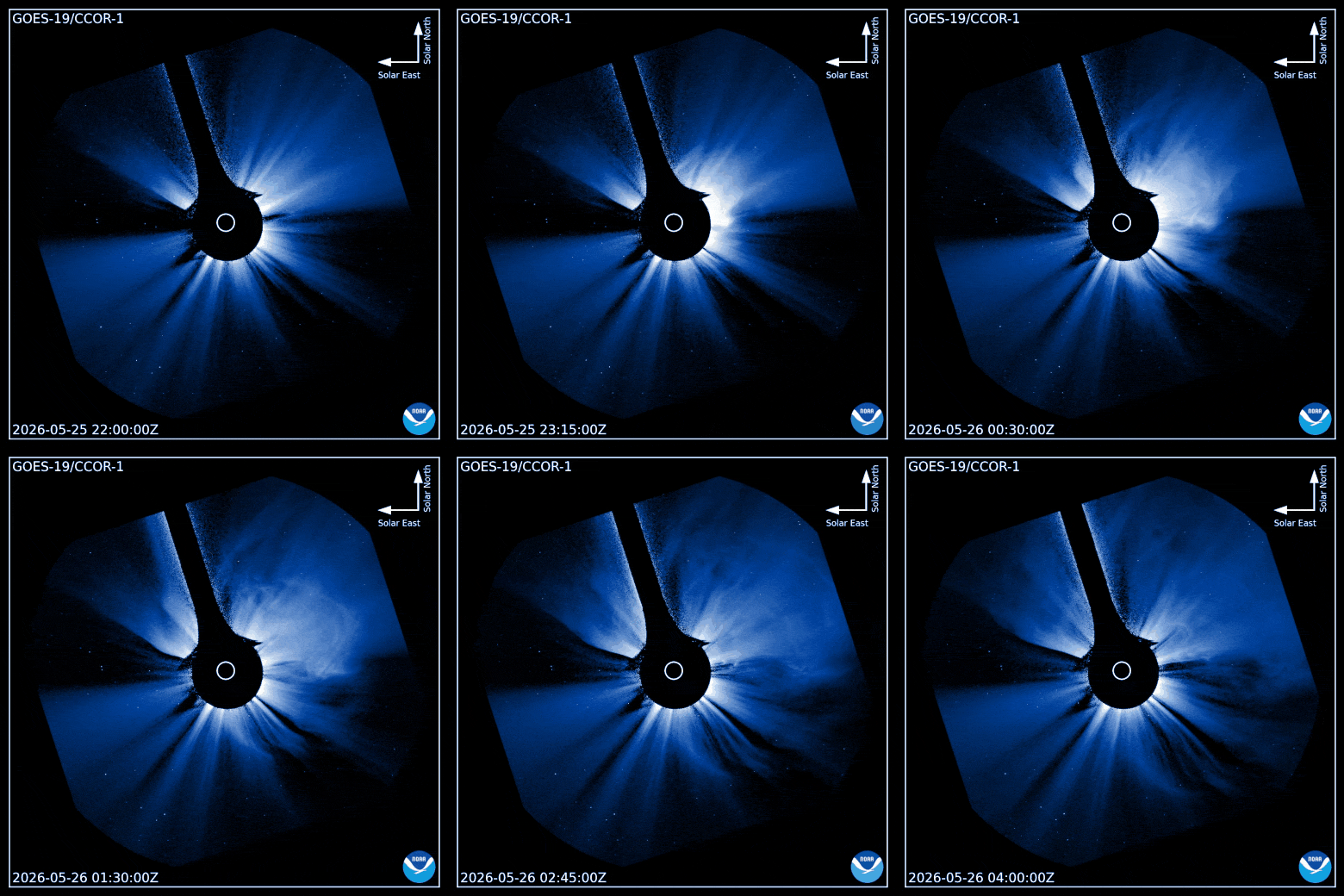
Though the Earth-facing sun is currently quiet, action is on the way! A dramatic eruption over the solar horizon around 22 UTC last night suggests that volatile sunspot regions are on the sun’s far side. The eruption launched a coronal mass ejection (CME) into space, but this burst of sun-stuff is heading far to the north of Earth. Meanwhile, an active region just rotating into view in the east fired 6 of the past day’s 12 C (common) flares. The volume of activity from this sunspot group hints at a potent region, with some of its magnetic complexity likely still hidden from view. Experts expect some active far-side regions to start rotating into view from the east in the coming days. Stay tuned!
Past 24 hours of sun news
(11 UTC May 25 – 11 UTC May 26)
Flare activity
Over the past day, solar activity continued at low levels. In total, the sun sparked 12 C-class flares.
- Strongest flare: C4.6 from an as-yet-unnumbered incoming region in the northeast at 22:42 UTC on May 25.
- Lead flare producer: The incoming northeast newcomer topped the list. It fired 6 of the 12 flares, including the C4.6 peak event. Meanwhile, AR4451 contributed 3 C-class flares.
Sunspot regions: key players
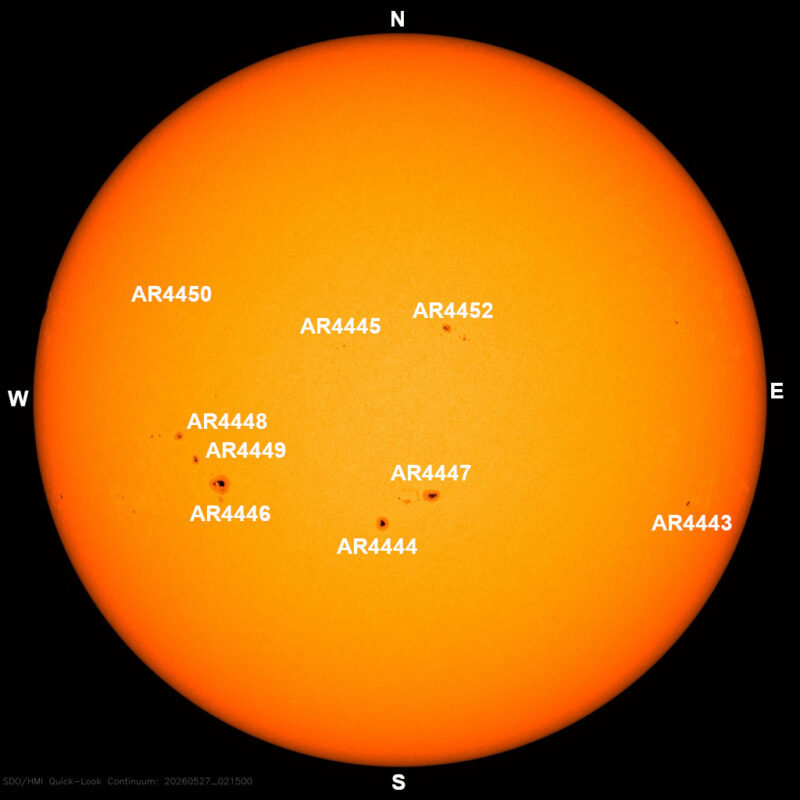
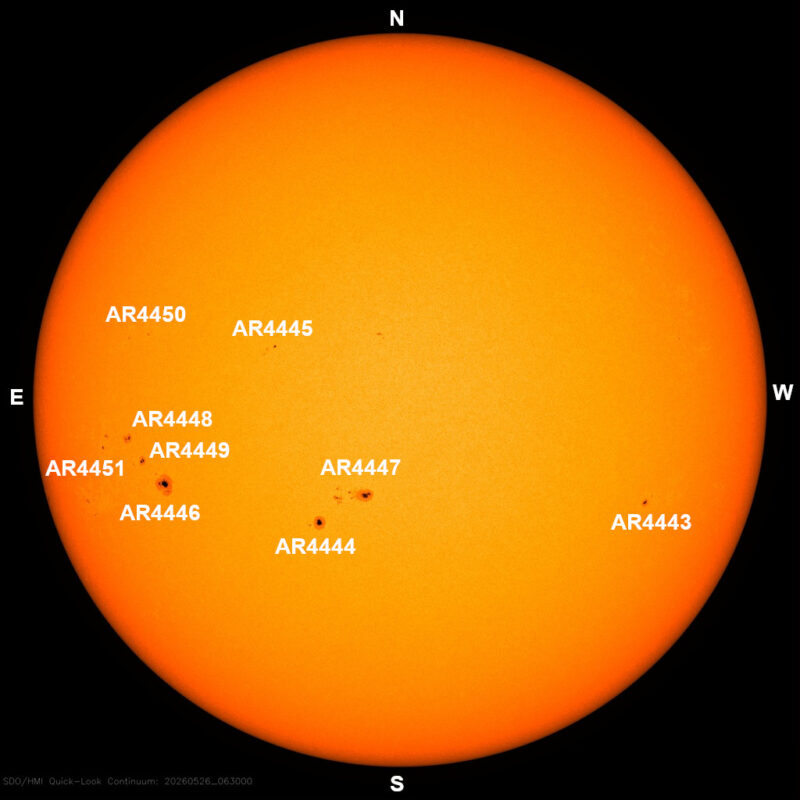
The Earth-facing solar disk shows 9 numbered active regions. Notably, four newcomers received official numbers during the period: AR4448, AR4449, AR4450 and AR4451.
AR4447 (beta) underwent notable growth. It consolidated both its leading and trailing poles. As a result, it remains the region of greatest interest on the disk.
AR4446 (alpha) was resolved into two distinct groups as it rotated further into view. The second component received the new designation AR4449 (beta).
AR4451 (beta) received its official number this period. Despite its small size and simple setup, it fired 3 C-class flares.
Sunspot regions: supporting cast
AR4448 (beta) and AR4445 (beta) both showed some growth during the period. The remaining regions appear stable or in decay. All sunspot regions carry simple alpha or beta configurations. No delta structures are present on the disk.
Blasts from the sun?
No Earth-directed coronal mass ejections (CMEs) appeared during the period.
A partial halo CME showed up in SOHO LASCO C3 imagery in the northwest at 22:12 UTC on May 25. Forecasters confirmed it is not heading toward Earth. It aimed far to the north. And a second CME lifted off from the northeast limb at 7:12 UTC on May 25. It is also not expected to reach us.
Past 24 hours in space weather
Solar wind
Solar wind speeds increased to moderate levels throughout the period. Meanwhile, the total interplanetary magnetic field stayed weak.
Bz and auroras
The Bz component pointed mostly southward late on May 25, with sustained intervals. As a result, conditions briefly favored auroral displays late that evening. But at 0:00 UTC on May 26, the Bz shifted northward. It stayed there through the rest of the period.
Earth’s magnetic field
Over the past day, Earth’s magnetic field ranged from unsettled to quiet (Kp 1–3). No geomagnetic storm conditions occurred. Currently, Earth’s magnetic field sits at Kp level 1.
Sun news May 25: Coronal hole’s fast winds could disturb the peace

After an impressive burst of 18 flares in the previous day, the sun has calmed over the past 24 hours. We observed just 6 C-flares (common), while solar wind speeds remained sluggish. But change is on the way. A stream of high-speed solar wind from a coronal hole should arrive late on May 26 into May 27, potentially unsettling our magnetic field to G1 (minor) geomagnetic storm levels. Stay tuned!
Past 24 hours of sun news
(11 UTC May 24 – 11 UTC May 25)
Flare activity
Over the past day, solar activity held at low to moderate levels. In total, the sun fired 6 C-class flares.
- Strongest flare: C3.7 from AR4447 at 0:51 UTC on May 25.
- Lead flare producer: AR4447 topped the list. It fired 4 of the 6 flares, including the C3.7 peak event. Meanwhile, AR4441 contributed the remaining 2 C-class flares.
Sunspot regions
The Earth-facing solar disk currently shows 9 numbered active regions.
Blasts from the sun?
No Earth-directed coronal mass ejections (CMEs) appeared during the period.
Past 24 hours in space weather
Solar wind
Solar wind conditions stayed slow and near background levels throughout the period. Meanwhile, the total interplanetary magnetic field was weak.
Bz and magnetic coupling
The Bz component fluctuated mildly north and south. No sustained southward intervals developed. As a result, conditions were unfavorable for auroras.
Earth’s magnetic field
Over the past day, Earth’s magnetic field stayed quiet (Kp 0–2). No geomagnetic storm conditions occurred.
Sun news May 24: New region arrives, fires 16 flares!

Newcomer AR4446 announced its arrival on the sun’s east limb with a bang. This freshly numbered region fired off 16 C-class flares in just 24 hours! The strongest was a C5.6 at 21:57 UTC on May 23. None of these flares triggered radio blackouts. But the sheer volume of activity hints at a complex region still partially hidden behind the solar limb. And, veteran AR4441 made some noise too. Now approaching the west limb, it launched a long-duration C2.8 flare at 19:54 UTC on May 23. That blast produced a Type II radio burst with an estimated shock speed of 932 km/s. That speed signals a coronal mass ejection (CME) was likely produced. But with the source on the western limb, no Earth-directed CMEs were identified. On the space weather front, the solar wind remained sleepy. Speeds averaged near 330 km/s under background conditions. Earth’s magnetic field stayed quiet. Looking ahead, the arrival of AR4446 on the visible disk could bring a step-up in activity. Forecasters see a chance for isolated M-class flares over the coming days. Also, active regions behind the east limb fired C-class flares, suggesting more activity may emerge soon. Stay tuned!
Past 24 hours of sun news
(11 UTC May 23 – 11 UTC May 24)
Flare activity
Over the past day, solar activity held at low to moderate levels. In total, the sun fired 18 C-class flares. No M-class or X-class events occurred.
- Strongest flare: C5.6 from AR4446 (S08E89) at 21:57 UTC on May 23. Other notable events included a C4.8 at 23:43 UTC, a C3.7 at 2:33 UTC, and a C3.5 at 0:48 UTC, all from AR4446. In addition, AR4441 fired a long-duration C2.8 at 19:54 UTC on May 23, accompanied by a Type II radio burst (shock speed ~932 km/s).
- Lead flare producer: AR4446 dominated the period. It fired 16 of the 18 flares, including the C5.6 peak event. Meanwhile, AR4441 contributed the remaining 2 flares.
Sunspot regions
The Earth-facing solar disk showed a modest number of active regions. Two stand out.
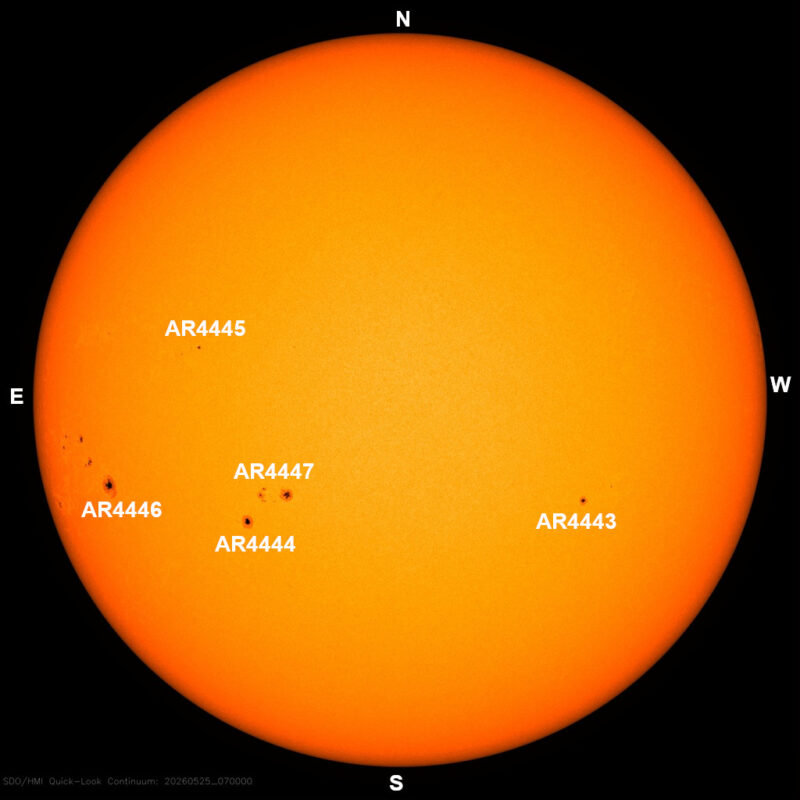
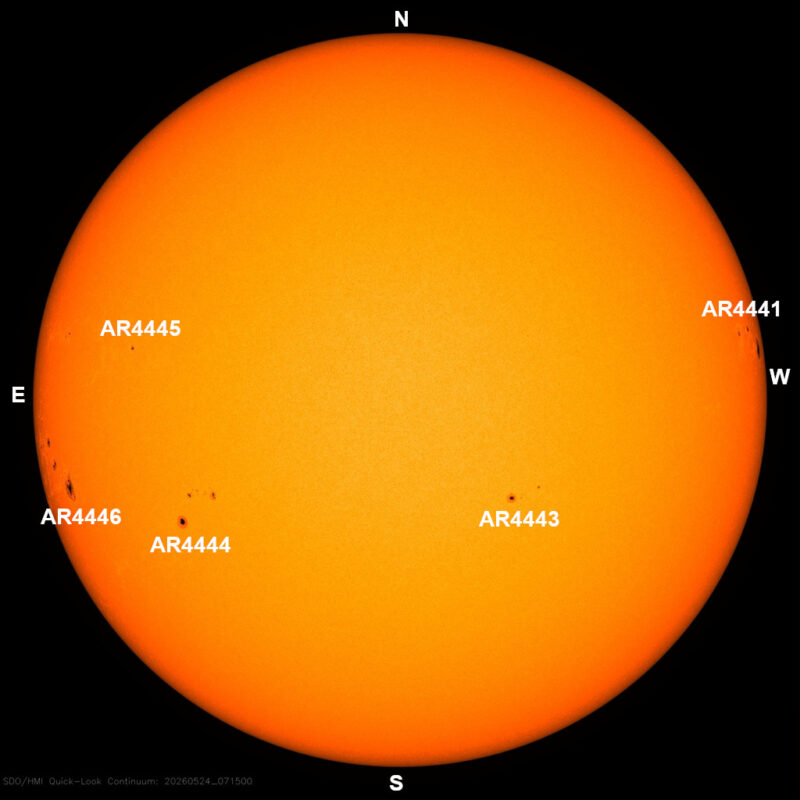
AR4446 (beta) received its official number this period. It emerged from behind the east limb and immediately became the most active region on the disk with 16 C-class flares. Its position near the limb suggests more complexity may be revealed as it rotates further into view.
AR4441 is nearing the west limb. It continued producing occasional C-class flares, including the long-duration C2.8 event with the Type II radio burst. However, its geoeffective potential is fading as it rotates toward the far side.
Blasts from the sun?
No Earth-directed coronal mass ejections (CMEs) appeared during the period. Several CMEs showed up in coronagraph imagery. But the analysis pointed to source locations on the solar limb or the far side. The Type II radio burst from AR4441’s C2.8 flare (shock speed ~932 km/s) suggests a CME was produced. Even so, with the source at W71 on the western limb, any ejecta would be aimed well away from Earth.
Past 24 hours in space weather
Solar wind
Solar wind conditions reflected a quiet, near-background regime. Speeds averaged roughly 330 km/s with no notable increases. Meanwhile, the total interplanetary magnetic field (IMF) held steady near 3 nT, quite weak.
Bz and magnetic coupling
The Bz component fluctuated gently between roughly -4 and +4 nT. No sustained southward orientation developed. As a result, these calm conditions offered no fuel for geomagnetic disturbances or aurora enhancement.
Earth’s magnetic field
Over the past day, Earth’s magnetic field stayed quiet (Kp 1–2). No geomagnetic storm conditions occurred. Conditions settled quickly after a brief period of unsettled weather just before our reporting window.
The sun in recent days
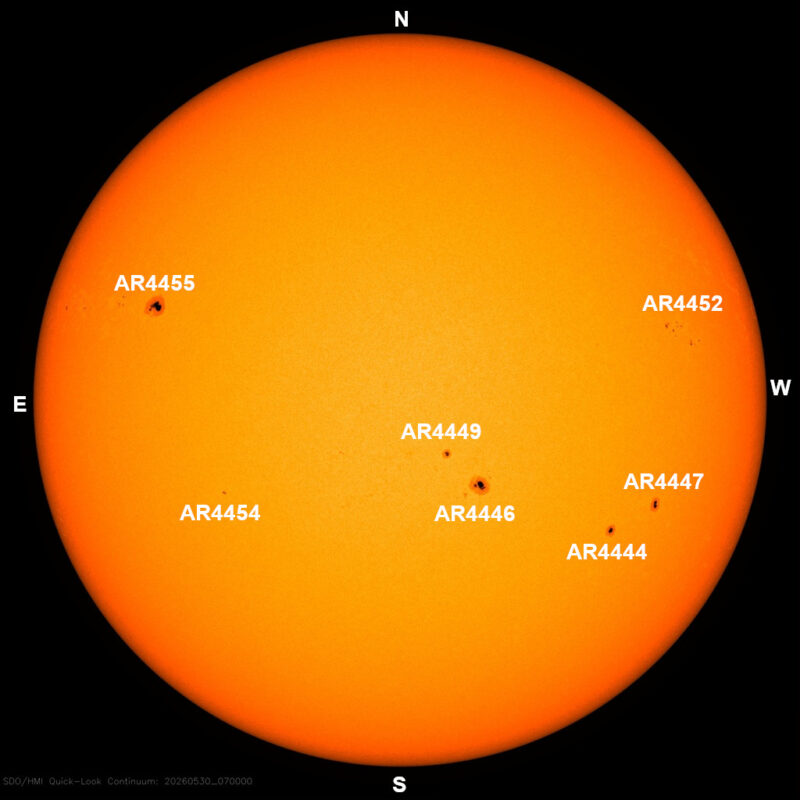
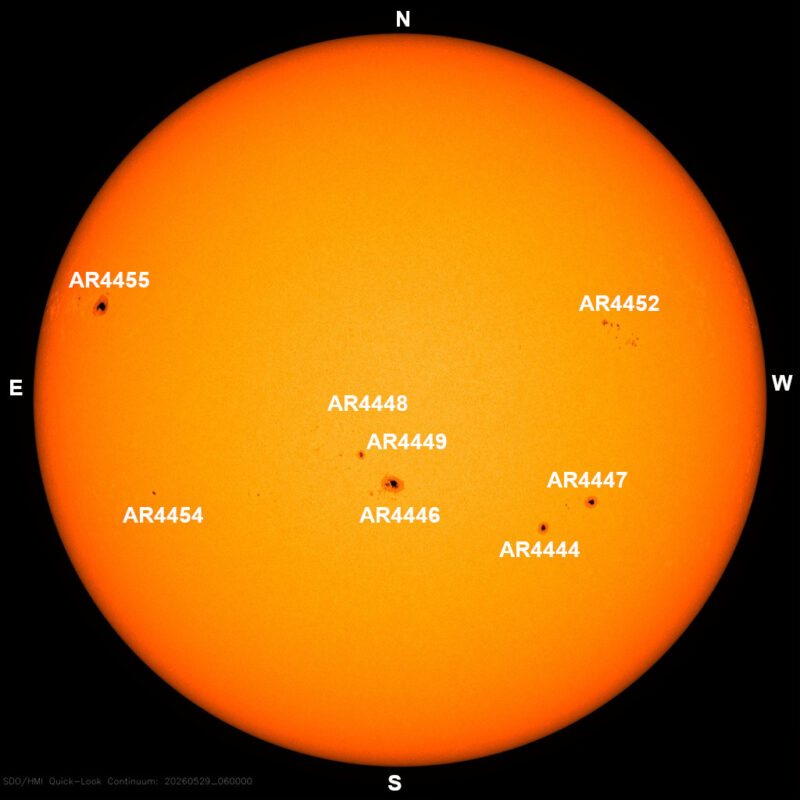
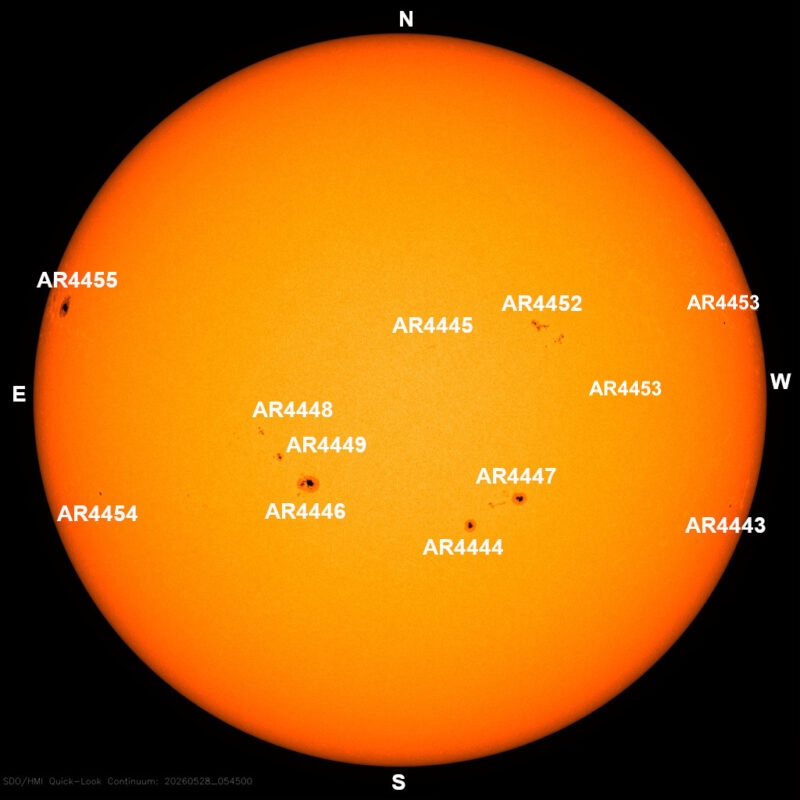
Earlier sun images
Sun images from our community
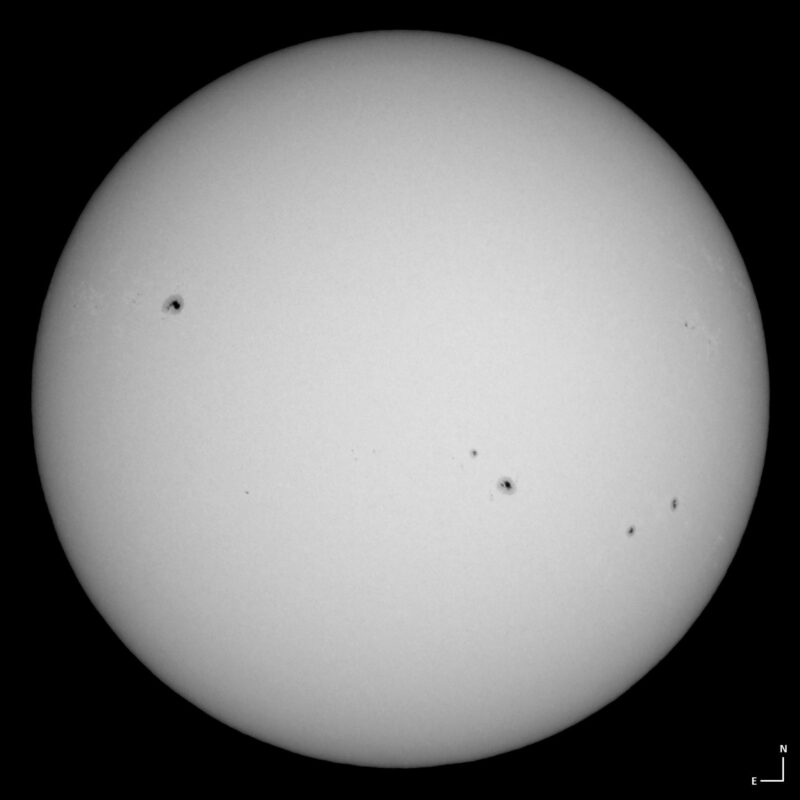
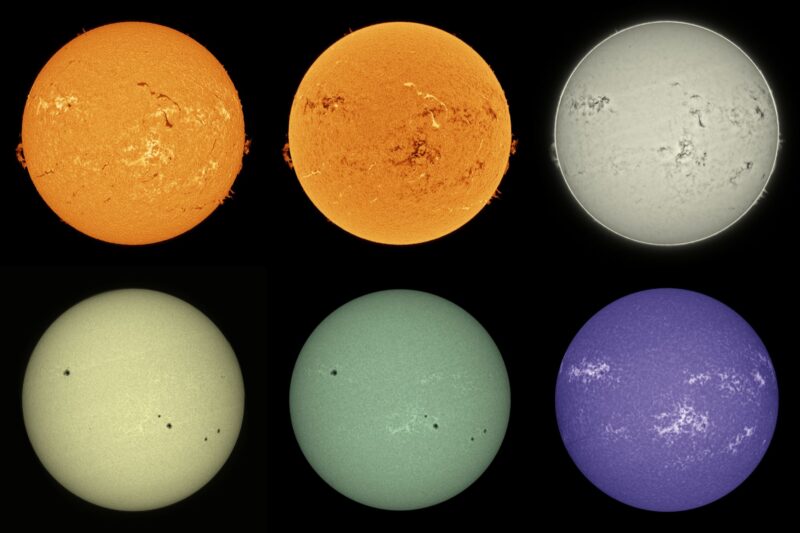
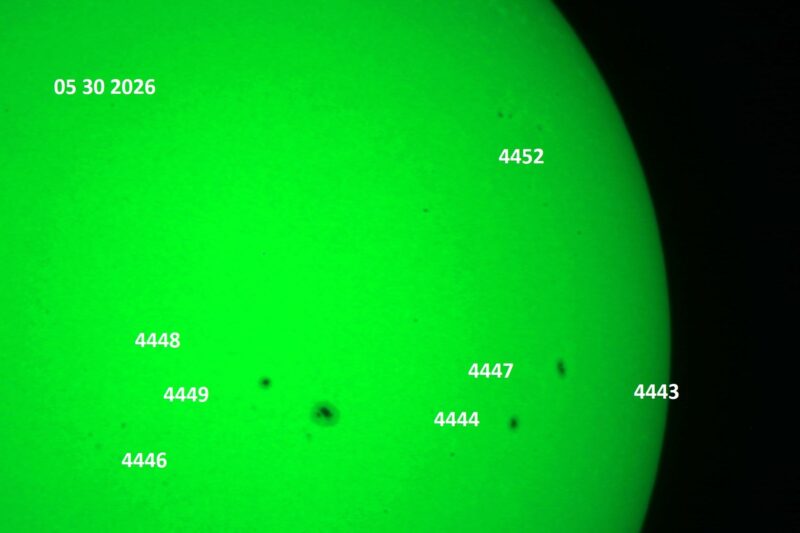
More sun images from our community
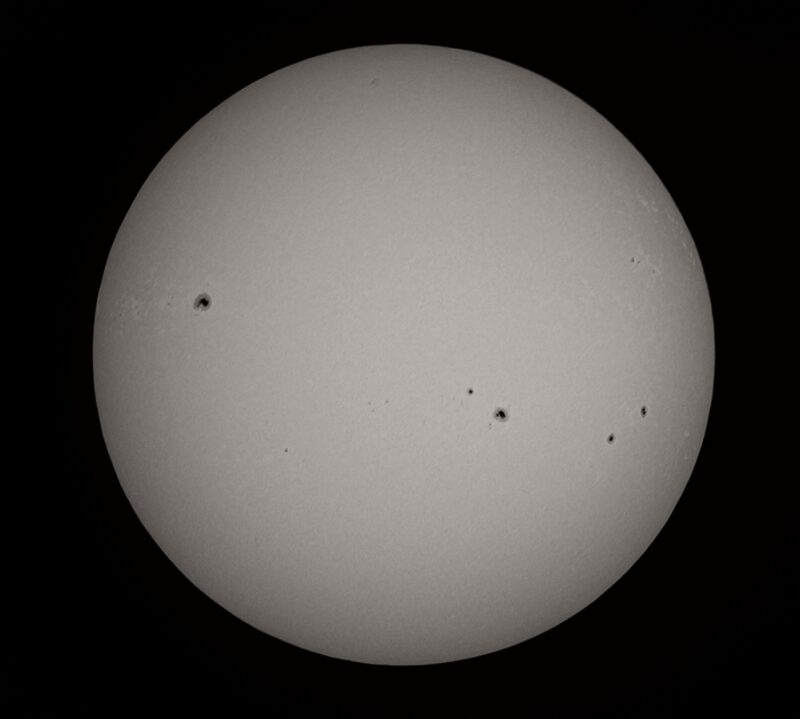
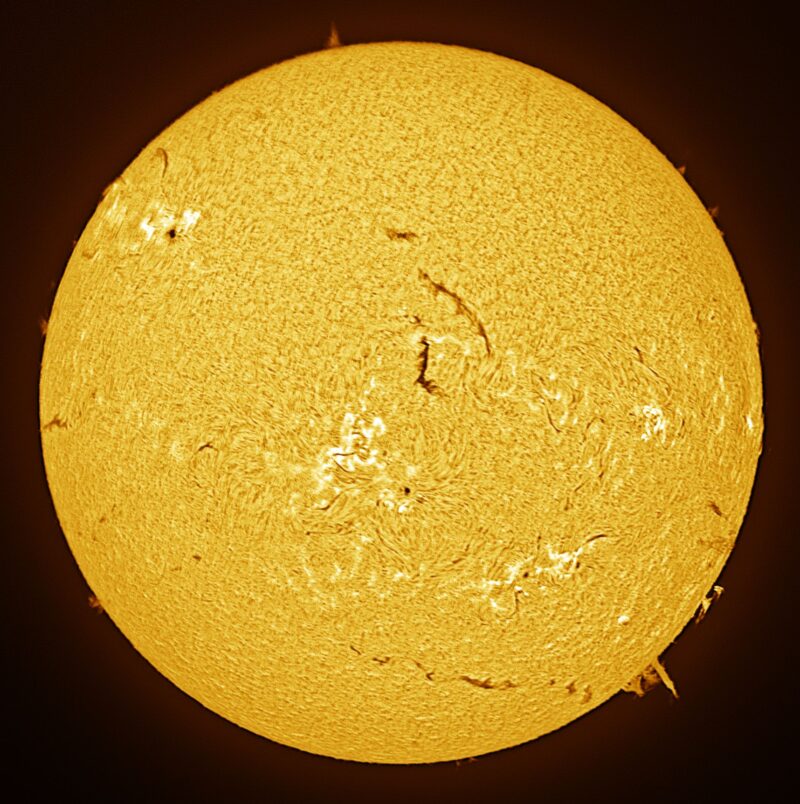
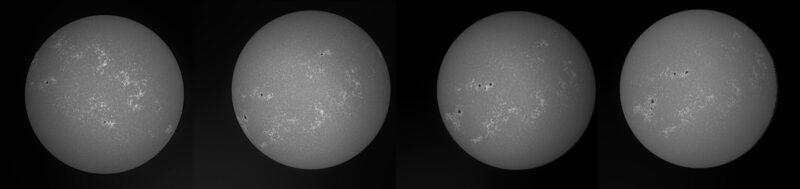
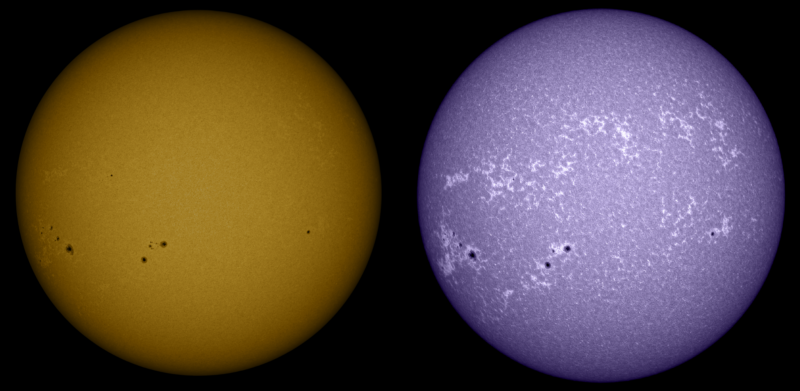
We sometimes feature sun images obtained using hydrogen-alpha filters. Read why.
Bottom line: Sun news for May 31, 2026: Solar wind surges past 550 km/s! Kp hits 4. G1 storm chance today. Glancing CMEs may add fuel. Aurora watchers, stay alert!
Like what you read?
Subscribe and receive daily news delivered to your inbox.
More from
C. Alex Young


Sun activity archive for April 2026

Sun activity archive for March 2026
Sun activity archive for February 2026


