Sun news July 12 (UTC): M1.2 flare as CME impacts for Earth loom
(11 UTC July 11 – 11 UTC July 12)

Today’s top story: The sun maintained low-to-moderate activity over the past day. Sunspot region AR4485 fired off an M1.2 flare at 7:17 UTC on July 12, as the region approached the sun’s western limb. In turn, the flare triggered a brief R1 (Minor) radio blackout over the sunlit Eastern Hemisphere. Meanwhile, Earth’s magnetic field held mostly quiet overnight. But the calm may not last long. Up to three coronal mass ejections (CMEs) are bearing down on our planet. The first should deliver a glancing blow later today (July 12). Two more could arrive in tandem late on July 13 or early July 14. Forecasters say the combined impacts could push geomagnetic conditions to G1 (Minor) storm levels today, with a chance of G2 (Moderate) intervals. As a result, aurora watchers across Scotland, Scandinavia, and similar magnetic latitudes could stay busy into mid-week (though short summer nights will limit viewing opportunities).
Flare activity: Solar activity was at moderate levels. Observers logged six flares during the period: one M-class and five C/B-class events. All significant activity came from AR4485. Notably, the region kept producing flares even as foreshortening near the western limb made magnetic analysis increasingly difficult.
- Strongest flare: An M1.2 from AR4485 (S08W76) at 07:17 UTC on July 12. It triggered an R1 (Minor) radio blackout. The blackout briefly affected HF communications across the sunlit portions of Europe, Africa, and the Indian Ocean.
- Other notable flares: AR4485 also produced a C6.0 flare at 00:28 UTC on July 12, plus C1.1 flares at 13:13 UTC and 20:02 UTC on July 11.
- Lead flare producer: AR4485 fired all six events, including the M1.2 and three C-class flares. Moreover, the region continued to exhibit new flux emergence even as it neared the western limb.
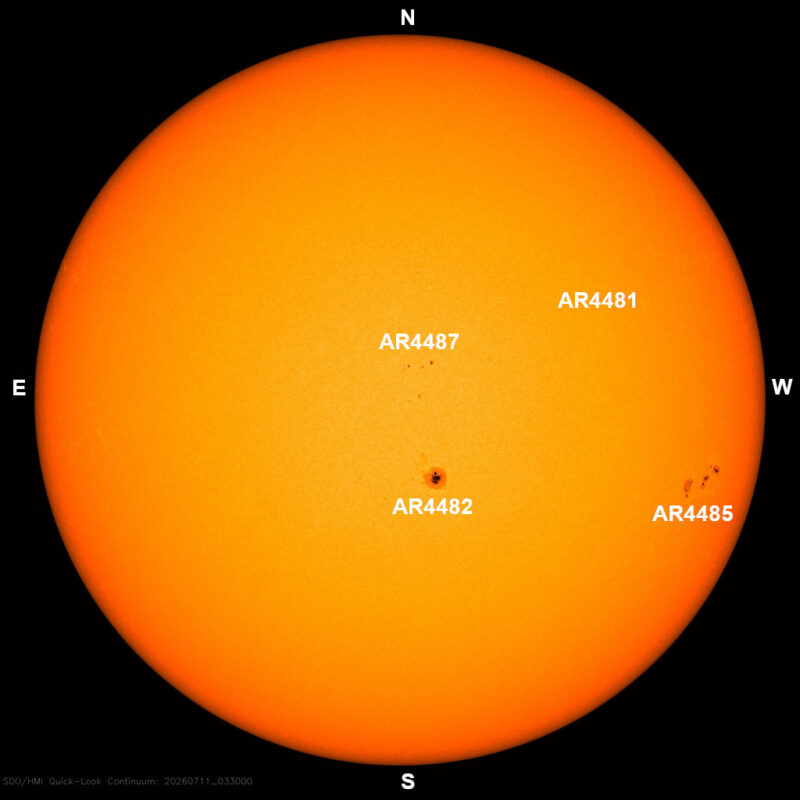
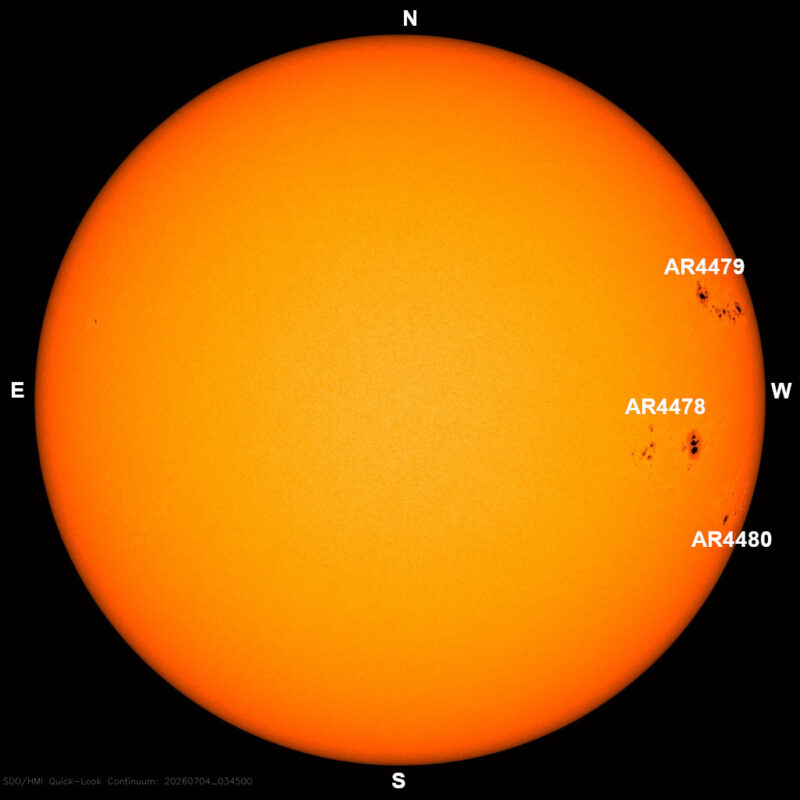
Sunspot regions: The Earth-facing solar disk displayed six numbered active regions. However, the most complex and productive of them is rapidly approaching the western limb.
- AR4485 (beta-gamma) remained the most magnetically complex region on the disk. It continued to show new flux emergence despite approaching the west limb. Foreshortening now inhibits accurate magnetic analysis, though. This region fired all the notable flares of the period, including the M1.2 event.
- AR4488 (beta) received its number during the period. So far, it has remained inactive.
- The remaining four numbered regions stayed stable or showed signs of decay. All carry simple magnetic configurations and produced no notable flaring activity.
Blasts from the sun? Observers spotted three CMEs during the period. Fortunately, none carry significant Earth-directed components. However, previously launched CMEs remain of interest for the forecast period.
- A CME first appeared at approximately 01:14 UTC on July 12. It erupted from S15W70 (AR4485). Leading Edge analysis measured a speed of about 480 km/s. Modeling predicts no Earth-directed component.
- A second CME appeared at approximately 18:53 UTC on July 11, with a Leading Edge speed of about 656 km/s. One model run found no Earth impact.
- Another CME appeared at approximately 16:09 UTC on July 11. Analysts examined it with both Leading Edge (about 591 km/s) and Shock Front (about 665 km/s) techniques. Neither analysis predicts Earth impact.
- In addition, a faint, northerly directed CME appeared in LASCO C2 and STEREO COR2 imagery starting around 23:24 UTC on July 10. Analysts assessed it as having no Earth-directed component, given its northerly trajectory and faint signature.

- Previously launched CMEs approaching Earth: Three earlier CMEs remain in the forecast window:
- July 9 CME (associated with a C2.7 flare from AR4485)
- July 10 CME (associated with a C6.0 flare from AR4485)
- Two CMEs from July 11 (from a filament eruption in the east and activity from AR4485) They could possibly merge into a single event. Model runs predict Earth arrival around 11:00–12:00 UTC on July 14. Kp estimates of 2–3 suggest only modest additional enhancement.
Solar wind: Solar wind speeds reflected the persistent yet waning influence of a negative-polarity coronal hole high-speed stream. Speeds decreased from about 585 km/s at the start of the period. They gradually eased to about 490 km/s by midday on July 11. Then they rose again to near 530 km/s by the period’s end.
Meanwhile, the interplanetary magnetic field (IMF) total strength averaged roughly 5 nT. The Bz component fluctuated between +7 nT and -4 nT, staying mostly northward. This limited geomagnetic coupling and kept conditions relatively calm. The phi angle remained predominantly in the negative (toward-sun) sector.
Earth’s magnetic field: The geomagnetic field ranged from quiet to unsettled levels (Kp 1–3) under the weakening influence of the coronal hole high-speed stream. Notably, no geomagnetic storm thresholds were crossed during the period. The predominantly northward Bz orientation limited energy transfer into Earth’s magnetosphere. As a result, conditions stayed subdued despite moderately elevated solar wind speeds.
What’s ahead? Sun–Earth forecast
Flare activity forecast: We expect solar activity to remain at low levels, with a chance (25%) for M-class (R1–R2) flares through July 13. The complexity and flare potential of AR4485 drives this outlook as the region transits the western limb. By July 14, AR4485 should have rotated far enough behind the limb to minimize its impact on Earth-side flare activity. The chance for an X-class event stays very low (5%).
Geomagnetic activity forecast:
- July 12: Expect quiet to unsettled conditions early, with diminishing coronal hole high-speed stream influence. By around midday, active conditions are anticipated. Isolated periods of G1 (Minor) storming are likely as the July 9 CME delivers a possible glancing blow. Confidence on timing and magnitude remains low. If the Bz turns southward, aurora may become visible from Seattle, Edinburgh, Oslo, and similar high-latitude locations. However, very short summer nights will severely limit Northern Hemisphere viewing.
- July 13: This is the main event of the forecast period. The July 10 CME shock front should arrive around 01:41 UTC. The main material follows around 02:15 UTC. Kp indices could reach 5–7, indicating G1–G2 (Minor–Moderate) geomagnetic storms. If conditions align favorably, aurora could appear over Toronto, Chicago, northern England, and southern New Zealand. Conditions should begin tapering late on July 13 as the CME completes its transit past Earth.
- July 14: Two additional CMEs from July 11 may arrive, possibly as a combined event, around 11:00–12:00 UTC. Kp estimates for these stay modest (2–3), suggesting quiet to unsettled conditions. As CME influences wane, the geomagnetic field should return to mostly quiet levels by late in the day and into July 15.
Sun news July 11: Sun still quiet, but auroras possible at Earth
(11 UTC July 10 – 11 UTC July 11)
Over the past day, sun activity saw a slight increase from very low to low levels thanks to a couple of C-class (common) flares. Meanwhile, a chunk of sun-stuff that left our star on July 9 might strike Earth’s magnetic field this weekend, with a glancing blow. That means G1 (minor) geomagnetic storm conditions are possible tonight and could extend through July 12.
Past 24 hours on the sun
Flare activity: In total, the sun fired 6 flares: 2 C-class and 4 B-class flares.
- Strongest flare: C6.0 from AR4485, peaking at 14:59 UTC on July 10.
- Lead flare producer: AR4485 once more topped the list with 6 flares during this period. In fact, this active region produced every flare of the period.
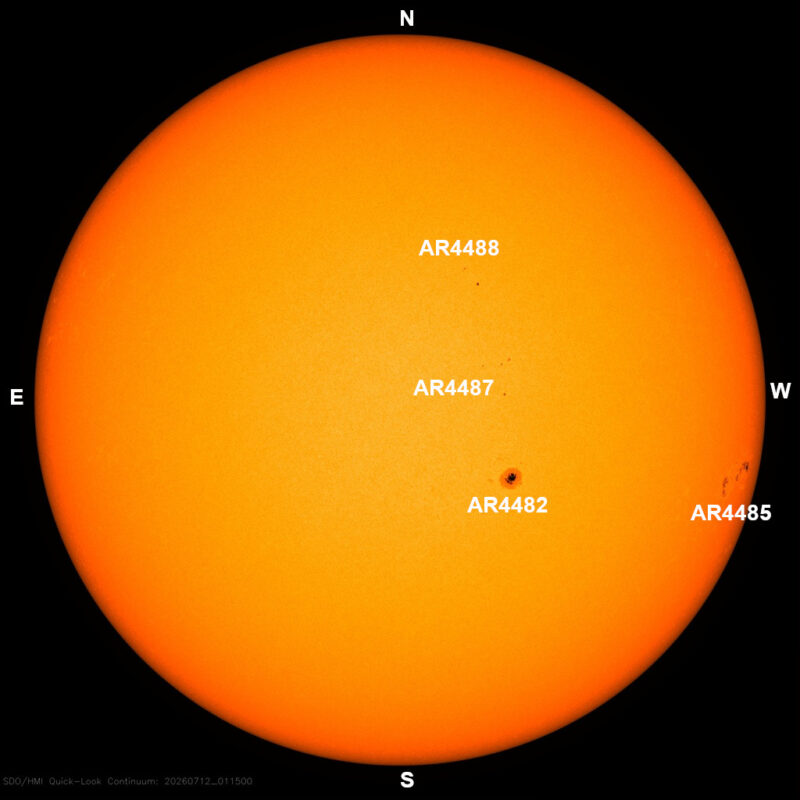
Sunspot regions: The sun is still quiet. The Earth-viewed solar disk today shows 4 numbered active regions.
- AR4485 (beta-gamma): This region keeps growing slightly. It has lost the “delta” in its magnetic configuration and today shows a simpler beta-gamma configuration. So, magnetically speaking, its potential for flaring has dropped. Even so, it remains a prolific flare producer. The sunspot region is now approaching the southwest solar horizon, ready to depart to the far side.
- AR4481 (alpha), AR4482 (beta) and AR4487 (alpha): The remaining sunspot regions stayed stable. All three showed signs of decay, with no flare activity over the past day.

Blasts from the sun? Observers spotted a coronal mass ejection (CME) associated with the C6.0 event from AR4485 at 14:59 UTC on July 10. Initial analysis suggests the bulk of this chunk of solar stuff will pass ahead of Earth. But modeling and analysis continue. In addition, a second event hurled plasma into space: a filament eruption at 13:10 UTC from the northeast. Take a look at our lower image. Modeling of this event is ongoing.
Past 24 hours in space weather
Solar wind: Solar wind speeds showed moderate-high levels during the first half of this period. Then, at around 22:45 UTC on July 10, speeds started to decrease. They reached moderate levels by the time of this writing. Meanwhile, the total interplanetary magnetic field (IMF) held at weak levels throughout the period. The Bz component intermittently shifted between northward and southward during the first half of the period. At around 22:45 UTC on July 10, it turned mostly southward. At the time of this writing, it has turned northward. As a result, magnetic coupling stayed open for aurora activity early this morning, with a slight chance of auroral displays at high latitudes.
Earth’s magnetic field: Over the past day, the geomagnetic field ranged from quiet-to-unsettled levels (Kp 1–3+). Conditions climbed slightly above Kp 3 at 11 UTC on July 10. At the time of this writing, the Kp index sits just above level 2.
Sun news July 10: Is the quiet sun awaiting a big blast?
(11 UTC July 9 – 11 UTC July 10)


Sun activity decreased to very low levels today, with only a few faint B-class flares. Notably, sunspot region AR4482 lost its magnetic complexity – a beta-gamma-delta complexity – which indicates a high potential for flaring. This region now shows a simpler beta configuration. But we’ve seen this before. Other sunspot regions have lost their gamma-delta complexity, then regained a lost delta, sparking stronger flares before departing to the far side. Shall we see the same behavior from AR4482? We will keep watching. Meanwhile, AR4485 continued to grow and developed a small delta in its complexity. It ranks as today’s lead flare producer. Still, only faint B-class flares have emerged from this active region. Stay with us.
Past 24 hours on the sun
Flare activity: Over the past day, solar activity dropped to a very low level with only B-class (weak) flares. In total, the sun fired 6 B-class flares.
- Strongest flare: B7.5 from AR4485, peaking at 5:16 UTC on July 10.
- Lead flare producer: AR4485 again topped the list with 4 flares during this period, all B-class. AR4482 followed closely behind, producing 2 B flares.
Sunspot regions: The Earth-viewed solar disk today shows 4 numbered active regions.
- AR4482 (beta): The region has lost its delta complexity. It now shows a simpler beta configuration. Even so, it remains the largest in extent and keeps its mixed polarity.
- AR4485 (beta-delta): This region continued its growth. In addition, it developed a small delta spot.
- AR4481 (alpha) and AR4487 (alpha): The remaining sunspot regions stayed stable, with no flare activity over the past day.
Blasts from the sun? Observers spotted no Earth-directed coronal mass ejections (CMEs) in available coronagraph imagery.
Past 24 hours in space weather
Solar wind: Solar wind speeds increased from moderate to moderate-high levels during the period. Fast solar wind from a coronal hole drove this rise. Meanwhile, the total interplanetary magnetic field (IMF) climbed to strong levels late on July 9. Then, at 22 UTC on July 9, it began easing back to moderate-to-strong levels. The Bz component predominantly pointed southward for most of the period, with only a few weak northward peaks. At the time of this writing, it continues to point south. As a result, magnetic coupling stayed open for aurora activity. There was a slight chance of auroral displays at high latitudes.
Earth’s magnetic field: Over the past day, the geomagnetic field ranged from quiet to active levels (Kp 1–4). Forecasters observed no geomagnetic storm levels during the period. However, conditions reached the active threshold (Kp 4) at 11:20 UTC on July 9. At the time of this writing, the Kp index sits at level 3.
Sun news July 9: Two M flares from promising sunspot region
(11 UTC July 8 – 11 UTC July 9)

Thanks to a couple of M-class flares, sun activity remained at moderate levels over the past day. Sunspot region AR4482 produced both M flares. This is the largest region on the solar disk currently, and has the maximum possible magnetic complexity: beta-gamma-delta. That means it has the potential to fire more M flares and even X flares. This region already fired an X flare when it first appeared on the northeast horizon, so let’s see if it has any more in store!
Past 24 hours on the sun
Flare activity: Over the past day, solar activity continued at moderate levels thanks to a couple of M-class (moderate) flares. In total, the sun fired 7 flares: 2 M-class (moderate), 2 C-class (common), and 3 B-class (weak).
- Strongest flare: M1.5 from AR4482, peaking at 17:56 UTC on July 8. It triggered an R1 (minor) radio blackout over the northeast coast of Mexico.
- Second M flare: An M1.2 from AR4482 at 2:27 UTC on July 9. This flare produced a corresponding R1 (minor) radio blackout over the Philippine Sea.
- Lead flare producer: AR4485 again topped the list with 5 flares during this period: 2 C-class and 3 B-class flares.
Sunspot regions: The Earth-viewed solar disk today shows 5 numbered active regions. Two newcomers were officially numbered during this period: AR4486 and AR4487.
- AR4482 (beta-gamma-delta): This region remained the most magnetically complex on the disk. It has the potential for more M-class flares, and even another X-class event.
- AR4485 (beta-gamma): This region grew somewhat and developed a gamma configuration during the period. For a second day running, it ranked as the most active region.
- AR4481 (beta), AR4486 (beta), and AR4487 (beta): All three remained stable, with no flare activity over the past day.
Blasts from the sun? Observers spotted no Earth-directed coronal mass ejections (CMEs) in available coronagraph imagery.
Past 24 hours in space weather
Solar wind: Solar wind speeds averaged at moderate levels during the period. Meanwhile, the total interplanetary magnetic field (IMF) strength remained at moderate-to-strong levels. The Bz component pointed strongly southward for most of the period, with only a few weak northward peaks. At the time of this writing, it continues to point south. As a result, magnetic coupling stayed open for aurora activity.
Earth’s magnetic field: Over the past day, the geomagnetic field stayed quiet (Kp 1–3). Forecasters observed no geomagnetic storm levels during the period. At the time of this writing, the Kp index sits at level 1.
Sun news July 8: Wham! Huge filament eruption in the northeast
(11 UTC July 7 – 11 UTC July 8)

A huge, fiery eruption lit up the solar northeast at 21 UTC last night. It came in the same area we were watching on Monday, when a fiery prominence erupted almost in sync with another in the opposite direction. But last night’s eruption was much bigger and stronger. Interestingly, no flare accompanied this powerful blast, and no sunspot region sits near the area. It was simply a lifting filament – a rope of solar material and magnetic fields – that violently erupted into space. It’s a spectacular reminder that the sun doesn’t need sunspots to put on a show!
Past 24 hours on the sun
Flare activity: Over the past day, solar activity increased to moderate with an isolated M-class (moderate) flare. In total, the sun fired 6 flares: 1 M-class (moderate), 4 C-class (common), and 1 B-class (weak).
- Strongest flare: M4.0 from AR4482, peaking at 14:19 UTC on July 7. It triggered an R1 (minor) radio blackout over the middle of the Atlantic Ocean.
- Lead flare producer: AR4485 topped the list with 3 flares during the period. And AR4482 closely followed with 2 flares, including the M4.0.
Sunspot regions: Currently, our sun shows 3 numbered active regions on its Earth-facing side.
- AR4482 (beta-gamma-delta): This region developed a delta component during the period. It now ranks as both the largest region in extent and the most magnetically complex on the disk. And it carries real potential for more M-class flares and even another X-class event like the one it already produced.
- AR4485 (beta) and AR4481 (beta): Both continue to show simple beta configurations. AR4485 was the most active region of the period. But AR4481 remained stable, with no flare activity over the past day.
- AR4478 (beta-gamma): This region has already departed to the far side.
Blasts from the sun? Ejecta was observed hurtling into space during the M4.0 flare. That event is under further analysis to determine if a component is heading our way to Earth. Meanwhile, the coronal mass ejections (CMEs) seen during the northeast filament eruption appear, on initial analysis, to be directed well away from Earth.
Past 24 hours in space weather
Solar wind: Solar wind speeds were at moderate levels early in the period. But around 18 UTC on July 7, they began to decrease to moderate-to-low levels. Meanwhile, the total interplanetary magnetic field (IMF) strength stayed moderate. And the Bz component pointed southward for the whole period. It held that strong southward direction through the time of this writing. As a result, magnetic coupling stayed open for aurora activity.
Earth’s magnetic field: Over the past day, the geomagnetic field stayed quiet (Kp 0–3). At the time of this writing, the Kp index sits just above level 3.
Sun news July 7: Monstrous sunspots depart with a fiery show
(11 UTC July 6 – 11 UTC July 7)


The monstrous sunspot regions that put on an impressive show over the past week have now fully departed to the far side of our star. As they crossed the western horizon, these active regions continued to show off their power, producing fiery jets and prominences. Now, with the big active regions on the far side, nearly all flare responsibility on the Earth-viewed side falls to active region AR4482. And with a beta-gamma complexity, this region is showing promising potential.
Past 24 hours on the sun
Flare activity: Solar activity dropped to low levels over the past day. Observers registered 5 flares, all C-class (common) events.
- Strongest flare: A C3.8 from active region AR4479 peaking at 18:40 UTC on July 6.
- Lead flare producer: AR4482 and AR4478 ended tied at the top. Each produced two C flares during this period.
Sunspot regions: Currently, 4 numbered active regions appear on the Earth-facing solar disk.
-
- AR4478 (beta-gamma): This region now sits at the very edge of the southwest horizon. It will soon depart to the far side.
- AR4482 (beta-gamma): This region ranks as the largest active region and has a promising beta-gamma magnetic complexity.
- AR4485 (beta) and AR4481 (beta): Both have a simple beta configuration and remained stable with no flare production over the past day.
Blasts from the sun? Observers spotted no Earth-directed coronal mass ejections (CMEs) in available coronagraph imagery.
Past 24 hours in space weather
Solar wind: Solar wind conditions gradually eased from moderate to moderate-low levels during this period.
Bz and magnetic coupling: Meanwhile, the interplanetary magnetic field total strength (Bt) remained relatively weak. The Bz component pointed southward during the first half of the period. Then, starting at around 0 UTC this morning, it shifted northward. It has held that direction until the time of this writing. As a result, aurora activity stayed subdued.
Earth’s magnetic field: The geomagnetic field showed very quiet levels throughout the period. This corresponds to Kp values of 0–2. At the time of this writing, the Kp index sits just below 2.
Sun news July 6: AR4479 exits the stage with a bang
(11 UTC July 5 – 11 UTC July 6)

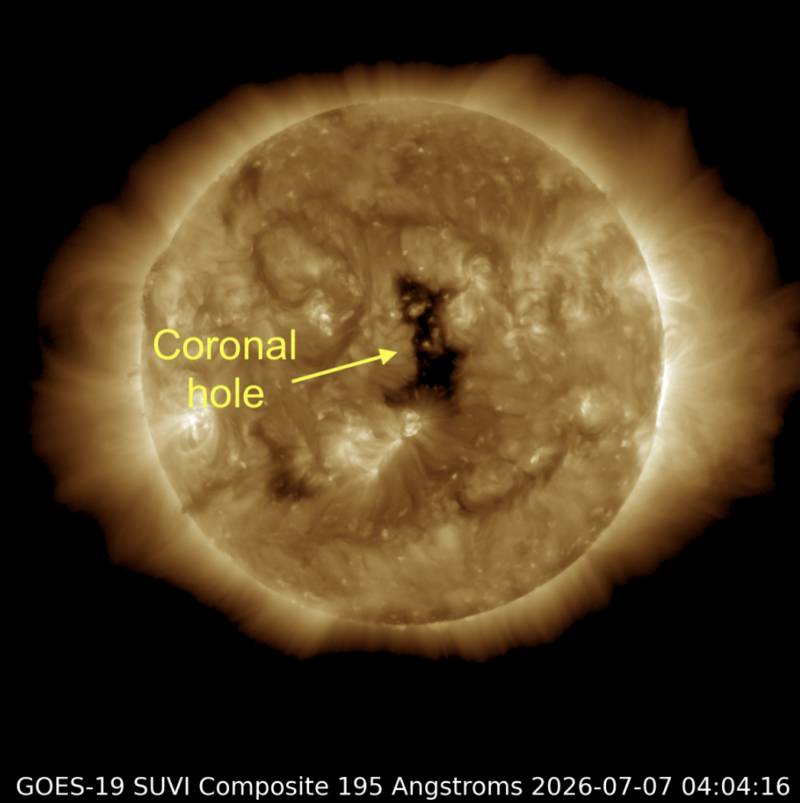
The sun fired off a barrage of flares over the past 24 hours. Forecasters logged 6 M-class (moderate) flares and 15 C-class (common) flares during the period, nearly all of which came from the prolific sunspot AR4479. The most powerful of these was an M5.3 from AR4479 at 17:51 UTC yesterday, which caused an R2 (moderate) radio blackout across the Americas. It was an impressive farewell from AR4479, with this prolific flare factory now having rotated almost fully out of view over the western horizon.
Past 24 hours on the sun
Flare activity: Solar activity remained high. Observers recorded 21 flares: 6 M-class and 15 C-class events.
- Strongest flare: An M5.3 from AR4479 peaking at 17:51 UTC on July 5. It triggered an R2 (moderate) radio blackout. The blackout temporarily degraded high-frequency radio communications across the sunlit Americas and eastern Pacific. This affected aviation and maritime operations.
- Other M-class flares: M1.4 at 16:41 UTC on July 5 from AR4479; M1.4 at 16:21 UTC on July 5 from AR4479; M1.4 at 18:56 UTC on July 5 from AR4479; M1.0 at 21:14 UTC on July 5 from AR4479. In addition, AR4478 fired an M1.4 at 11:00 UTC on July 5, that region’s sole notable contribution. All M-class events produced R1 (minor) radio blackouts.
- Lead flare producer: AR4479 produced the overwhelming majority of activity. It fired at least 18 of the 21 flares, including all six M-class events and most of the stronger C-class flares (C9.6, C9.5, C8.1, C7.3, C6.1, C5.9, C5.0 and others).
Sunspot regions: The Earth-facing solar disk displayed seven numbered active regions. Forecasters cataloged 2 new regions during the period.
-
- AR4479 (beta-gamma-delta) dominated flare production and now sits right on the western limb. The viewing angle now makes detailed magnetic analysis difficult. Even so, sustained high flare output strongly suggests at least one delta configuration persists. This region produced the vast majority of the period’s activity. We expect it to rotate out of view by July 7.
- AR4478 (beta-gamma) ranked as the second-most complex region on the disk. However, it stayed mostly quiet this period aside from a lone M1.4 flare. The trailing portion continued to decay.
The remaining regions hold either of alpha or beta complexity.
Blasts from the sun? Observers spotted several coronal mass ejections (CMEs) in LASCO coronagraph imagery during the period. However, the vast majority lacked an Earth-directed component.
Past 24 hours in space weather
Solar wind: Solar wind conditions gradually eased to near normal as the lingering influence of the June 30 CME faded.
Bz and magnetic coupling: Meanwhile, the interplanetary magnetic field total strength (Bt) remained relatively weak, keeping aurora activity subdued.
Earth’s magnetic field: The geomagnetic field held at a steady unsettled-to-active level throughout the period. This corresponds to Kp values of 2–3. After a round of geomagnetic storms and auroras over the weekend, no geomagnetic storm thresholds were reached over the past day.

The sun in recent days
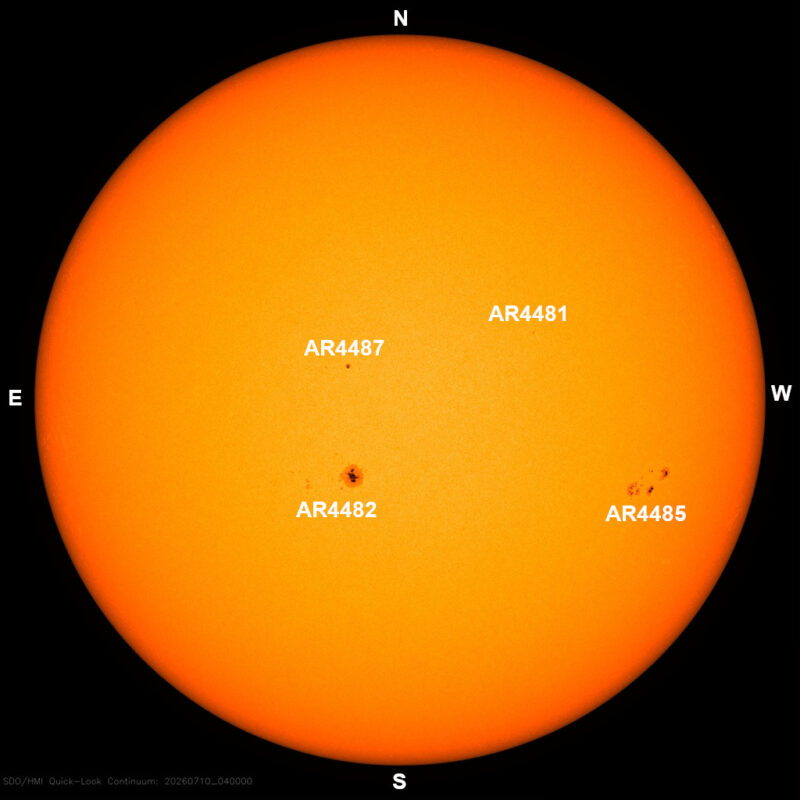
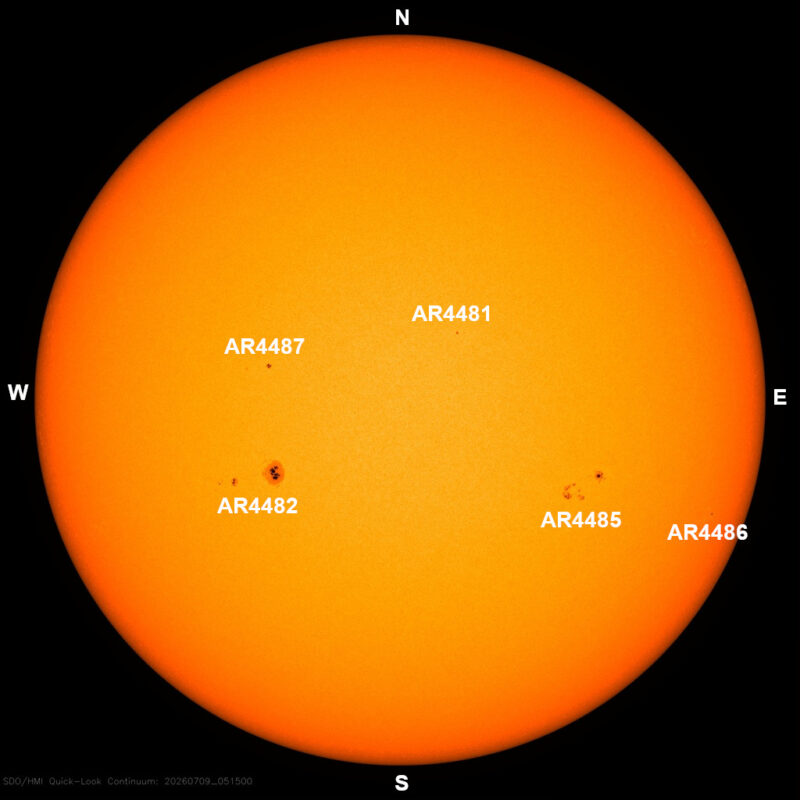
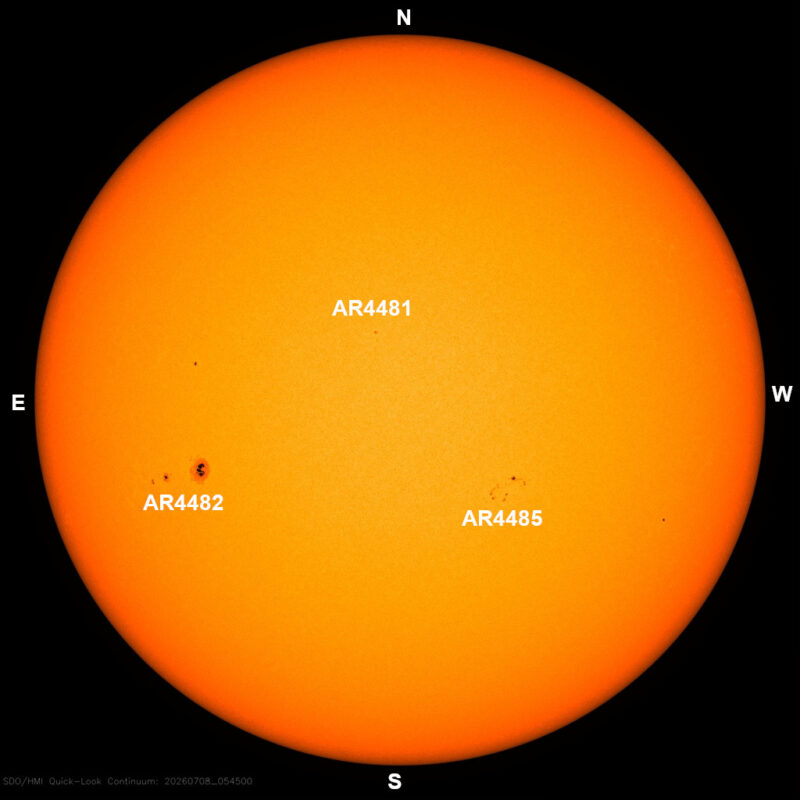
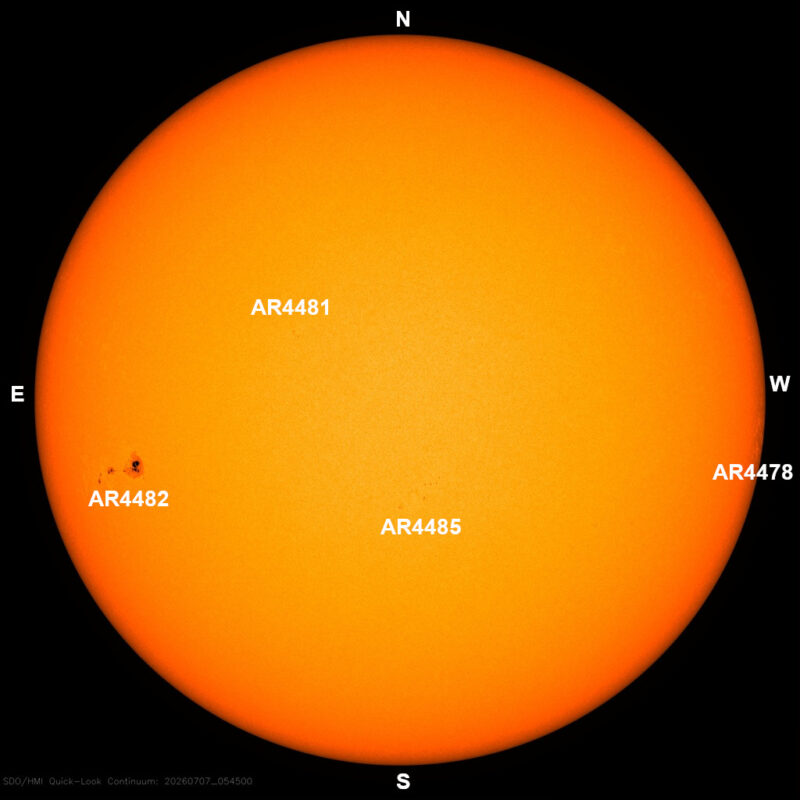
Earlier sun images
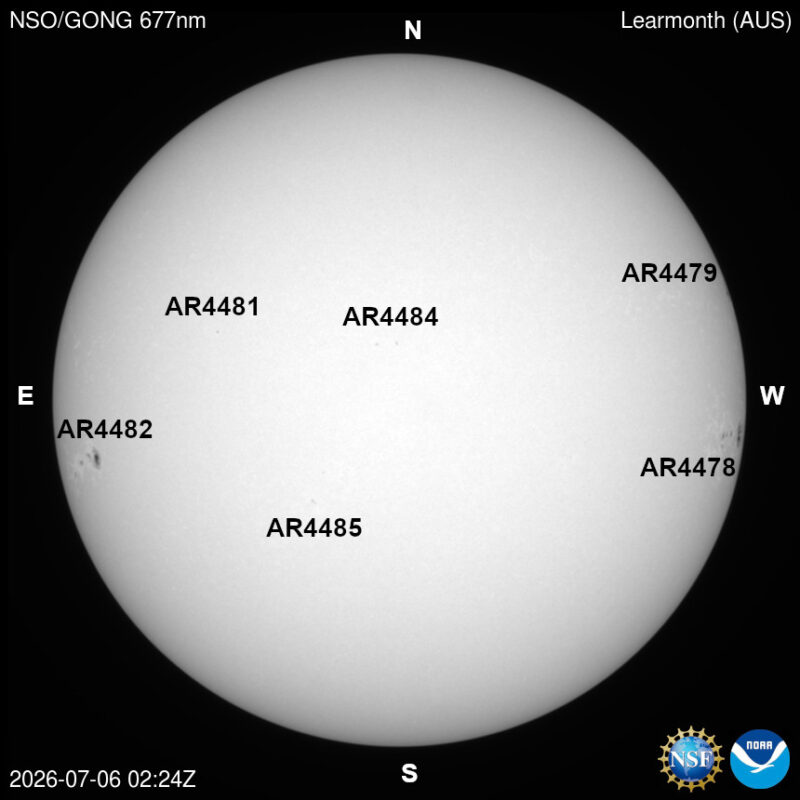
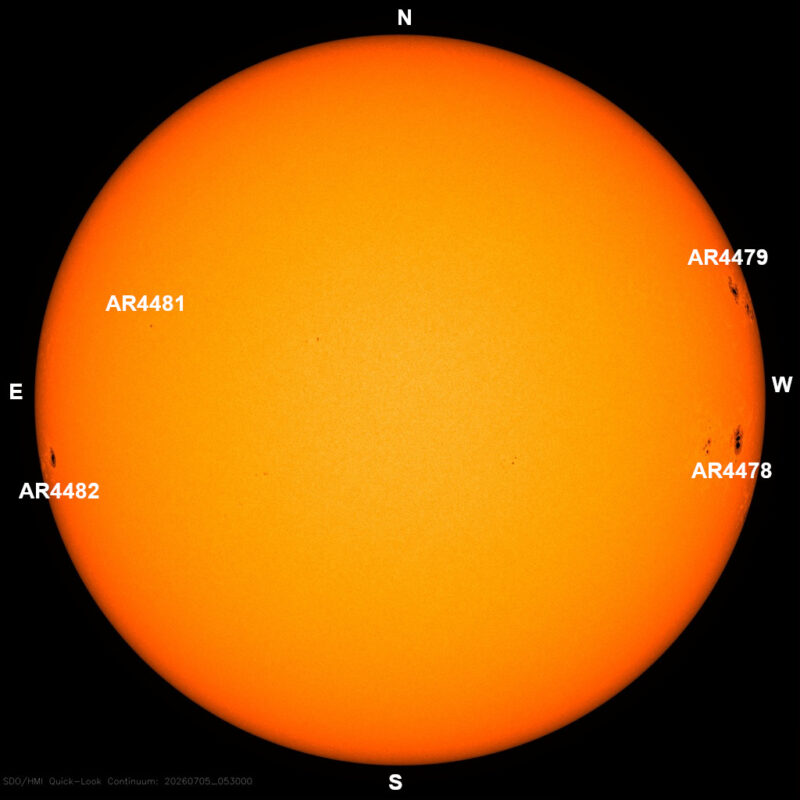
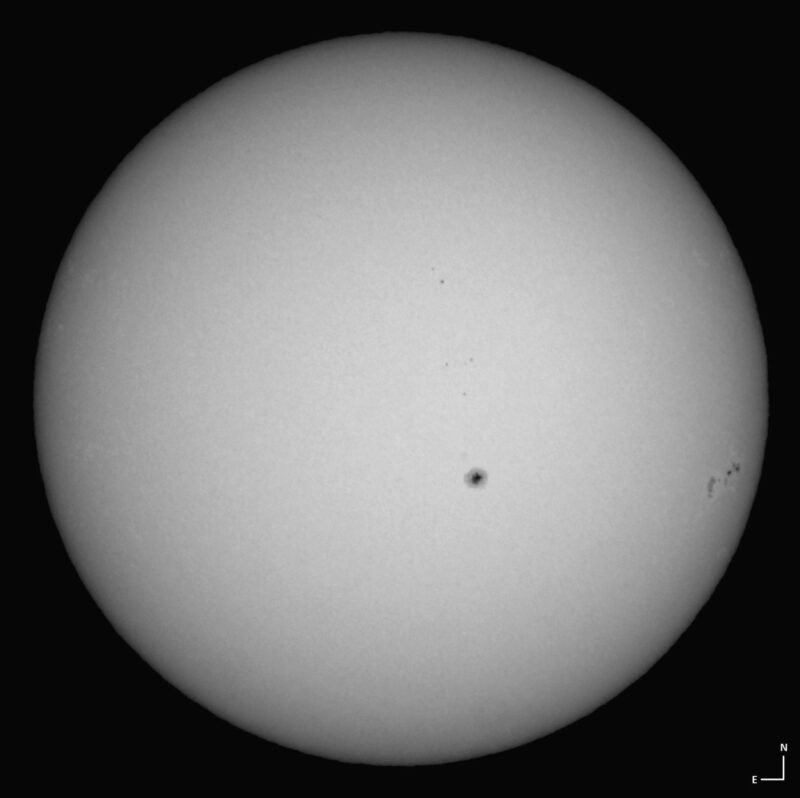
Sun images from our community
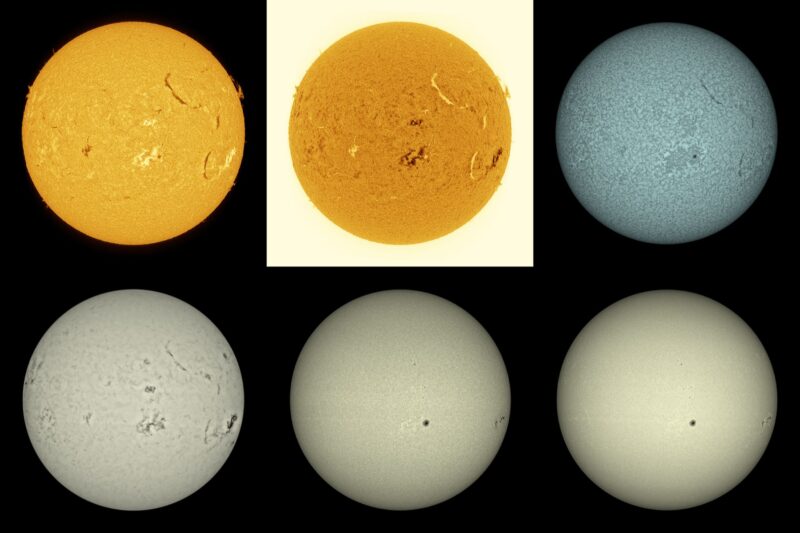
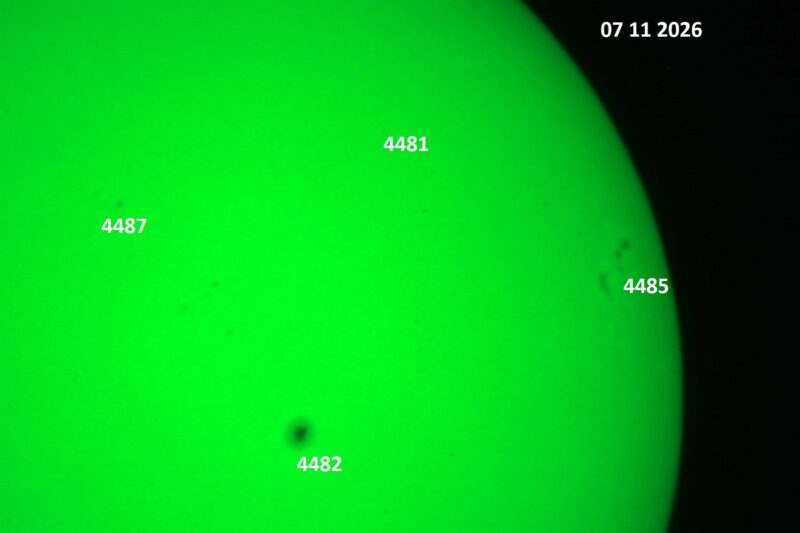
More sun images from our community
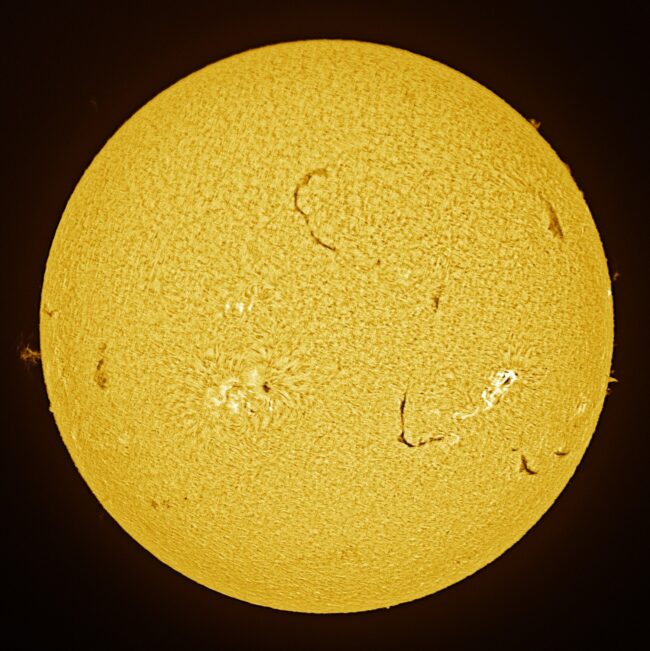
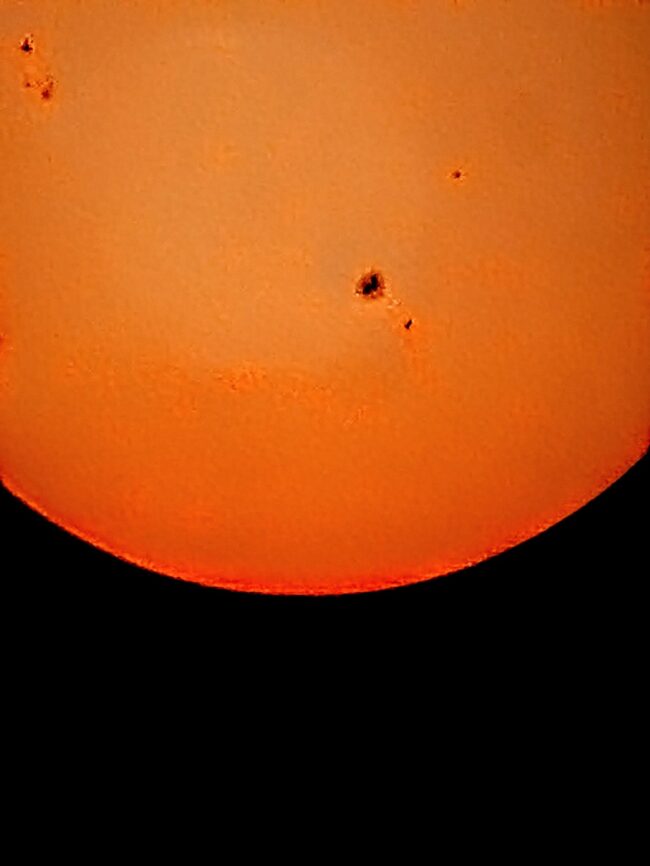
We sometimes feature sun images obtained using hydrogen-alpha filters. Read why.
Bottom line: Sun news July 12, 2026: Up to three CMEs are heading for Earth, with G1 to G2 storms possible into midweek. Meanwhile, AR4485 fired an M1.2 flare in farewell.
Like what you read?
Subscribe and receive daily news delivered to your inbox.
More from
C. Alex Young


Sun activity archive for June 2026

Sun activity archive for May 2026
Sun activity archive for April 2026