



Sun news October 18: Fast solar wind is headed Earth’s way



Today’s top story: A coronal hole — a place where the solar magnetic field opens directly into space rather than looping back down to the sun’s surface — is now crossing the central meridian of the sun’s visible disk. And that means charged particles from the sun are now flowing freely into space, from the hole. Forecasters expect this high-speed stream to reach Earth around October 20. That could push geomagnetic activity up to G1 (minor) geomagnetic storm levels and bring auroras into view at high latitudes across Earth.
Meanwhile, the previous high-speed stream keeps fading, and solar wind speeds are easing toward background. So today Earth’s magnetic field should stay mostly quiet, with isolated unsettled intervals. Stay tuned for the pickup late on October 19!
Past 24 hours on the sun
(11 UTC October 17 – 11 UTC October 18)
Flare activity: Solar activity stayed low. Observers counted 12 flares: 9 C-class and 3 B-class. No M-class or X-class events occurred.
- Strongest flare: A C3.7 from AR4551 (S15W35), peaking at 06:44 UTC on October 18.
- Other notable flares: A C3.4 from AR4556 peaked at 03:53 UTC on October 18. Both AR4551 and AR4556 also fired several C1-class flares through the period.
- Lead flare producer: AR4551 produced 7 of the 12 flares. AR4556 contributed the other 5.
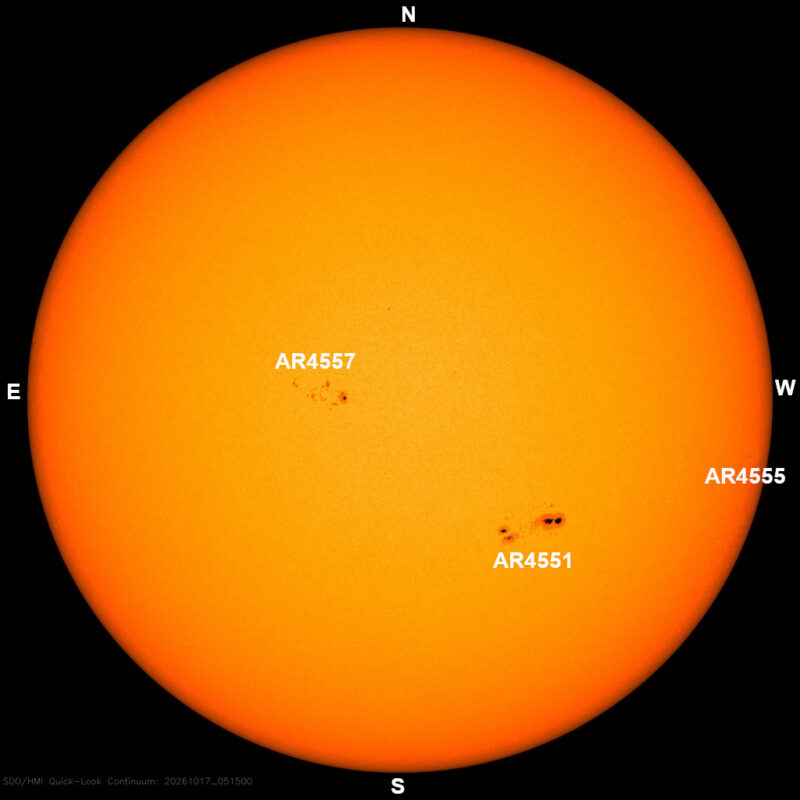
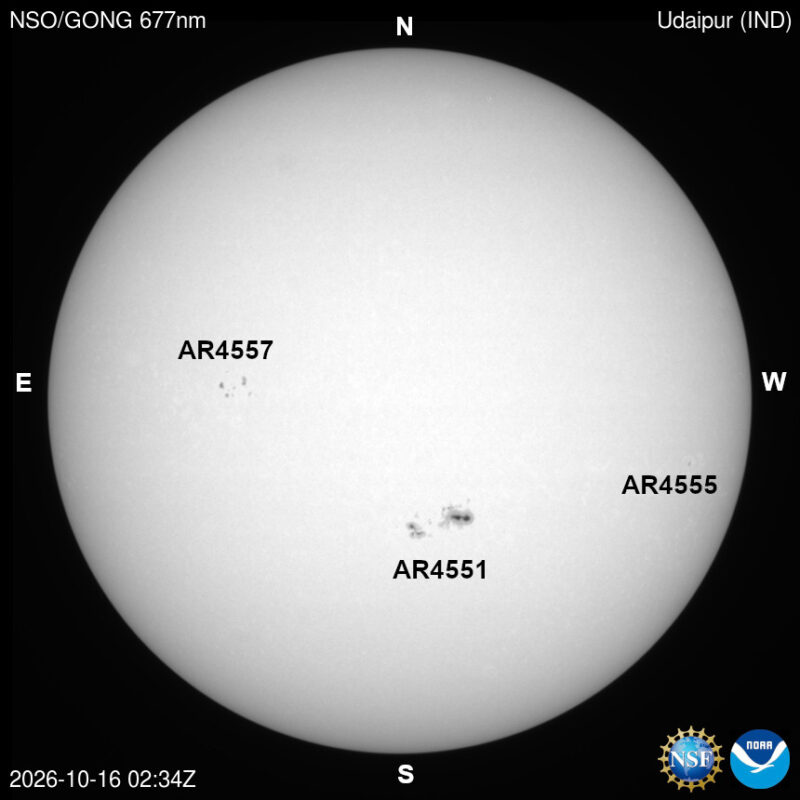
Sunspot regions: Three numbered sunspot regions sat on the disk.
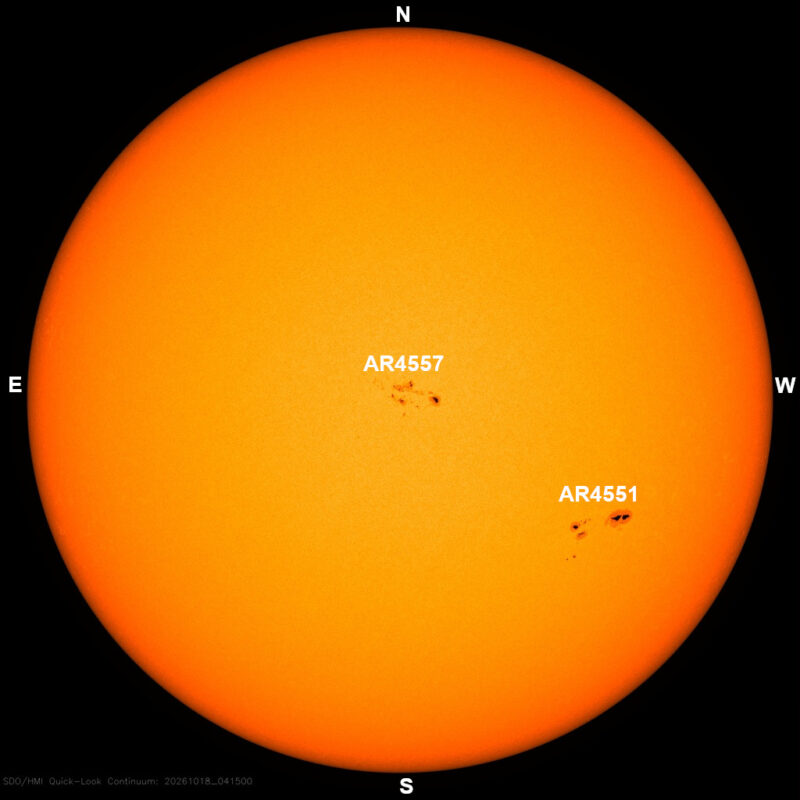
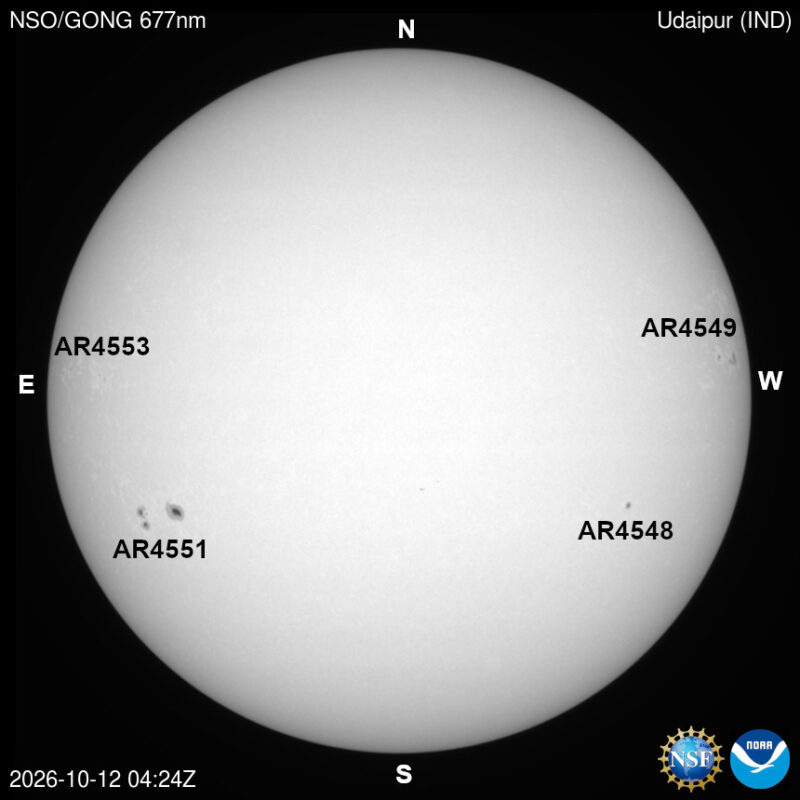
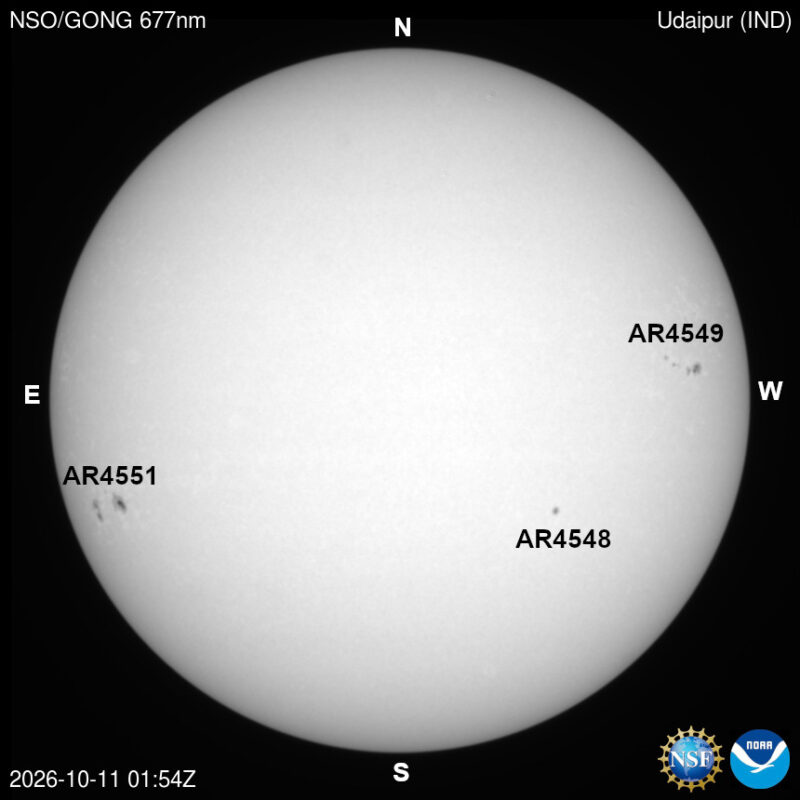
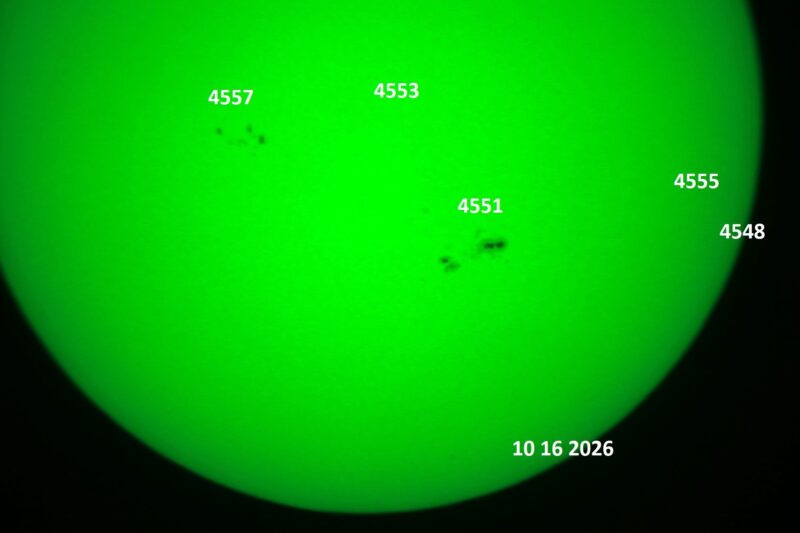
- AR4551 (beta-gamma): This region, at S15W32, remained the largest on the disk. However, it lost the delta it carried yesterday, and its smaller spots kept decaying. Even so, a strong, persistent leader spot keeps it capable of moderate flares. It produced the period’s strongest flare, the C3.7.
- AR4557 (beta): This region, at N17E01, kept developing, gaining area and more intermediate spots. In fact, the SIDC rates it beta-gamma, pointing to ongoing changes as some of its southern spots wax and wane.
- AR4556 (beta): This region stayed active, producing 5 flares, including the C3.4.
Blasts from the sun? Analysts tracked two faint coronal mass ejections (CMEs) during the period. Both were slow, at around 427 to 453 km/s, and neither should hit Earth.
Past 24 hours in space weather
Solar wind: Solar wind speeds ranged between about 400 and 514 km/s, reflecting the gradual decline of a negative-polarity coronal hole high-speed stream. Conditions trended toward background levels.
Bt, Bz and magnetic coupling: The total interplanetary magnetic field (Bt) held near 4 to 8 nT, with some moderate readings between 14:42 and 19:05 UTC on October 17. Meanwhile, the Bz component swung between north and south, dipping as far as minus 7 nT.
Earth’s magnetic field: The geomagnetic field stayed quiet to unsettled overall, with Kp ranging from 0 to 3. No geomagnetic storms occurred.
What’s ahead? Sun–Earth forecast
Flare activity forecast: Forecasters expect low activity to continue, with a chance of M-class (R1 to R2) flares. SWPC gives M-class flares a 20% probability, with a small chance of an X-class event. AR4551, AR4556, and AR4557 remain the key players.
Geomagnetic activity forecast:
- October 18: Expect mostly quiet conditions with isolated unsettled periods (Kp 1 to 3) as the waning high-speed stream fades. Aurora will stay limited to the highest latitudes.
- October 19: Quiet early, then rising to unsettled or active conditions (Kp 3 to 4) late in the day as the positive-polarity high-speed stream begins to arrive.
- October 20: Expect active conditions, rising to G1 (minor) storm levels (Kp 5) as the high-speed stream becomes fully geoeffective. A possible glancing CME could add to the mix. Aurora may then appear across high latitudes, perhaps reaching northern Scotland, southern Scandinavia, and southern New Zealand.
Sun news October 17: Huge sunspot still blasting out flares

Solar activity reached moderate levels over the past day, thanks to an impulsive M1.4 flare. The flare peaked at 15:42 UTC on October 16. And it was this week’s hero, active region AR4551, fired it. As we mentioned yesterday, this monster sunspot group — as wide as 2 to 3 Earths — has a complex magnetic configuration. So we’ll keep watching this guy to see what else it has in store. Details on the flare are below. Meanwhile, the large coronal hole we’ve been following now faces Earth directly, in a geoeffective position. Its fast solar wind should start arriving soon. When it does, it could stir Earth’s magnetic field and spark auroral displays. Stay tuned for the latest solar news!
Past 24 hours on the sun
(11 UTC October 16 – 11 UTC October 17)
Flare activity: Solar activity jumped to moderate in the past day. Our sun produced 20 flares over this period: one M-class (moderate), 15 C-class (common), and 4 B-class (weak).
- Strongest flare: An M1.4 from AR4551, peaking at 15:42 UTC on October 16. The event caused an R1 (minor) radio blackout on the sunlit side of Earth.
- Other notable flares: A C6.0 at 19:14 UTC on October 16, then a C2.8 at 4:10 UTC on October 17. AR4551 produced both.
- Lead flare producer: AR4551 topped the list again, with 13 flares this period, including the M flare. Meanwhile, AR4557 contributed five flares, and AR4553 sparked two.
Sunspot regions: Our sun still shows three numbered sunspot regions on the side we see from Earth. No new regions appeared. In fact, as the existing ones rotate west, they leave a large stretch of the eastern horizon free of numbered sunspots.
- AR4551 (beta-gamma-delta): This region keeps drawing all the attention. Its beta-gamma-delta complexity is the strongest there is. It has been a prolific C-flare producer, and now it’s an M-flare producer too.
- AR4555 (beta): This region now sits near the west horizon and will soon depart to the far side. It stayed stable and produced no flares during the period.
- AR4557 (beta): This region showed growth. Once again, it produced three flares.
Blasts from the sun? Observers spotted no Earth-bound coronal mass ejections (CMEs) in available coronagraph imagery during the past 24 hours.
Past 24 hours in space weather
Solar wind: Solar wind speeds averaged moderate levels during the period. Fast wind from a previous coronal hole kept waning, though it still produced a brief active spell. Meanwhile, a large coronal hole in the southeast quadrant is now geoeffective and Earth-facing. Its fast solar wind may start reaching Earth within the next couple of days.
Bt, Bz, and magnetic coupling: The total interplanetary magnetic field (Bt) averaged a weak strength. Meanwhile, the Bz component pointed south for about seven hours, from 13:30 to 20:30 UTC on October 16. Then it shifted northward for the rest of the period. At the time of this report, it still points north.
Earth’s magnetic field: The geomagnetic field ranged from quiet to active levels during the period (Kp 0-4). Conditions reached the Kp 4 threshold at 19:40 UTC on October 16, during that southward Bz stretch. At the time of this report, the Kp index sits just above level 0.
Sun news October 16: Meet monster sunspot region AR4551
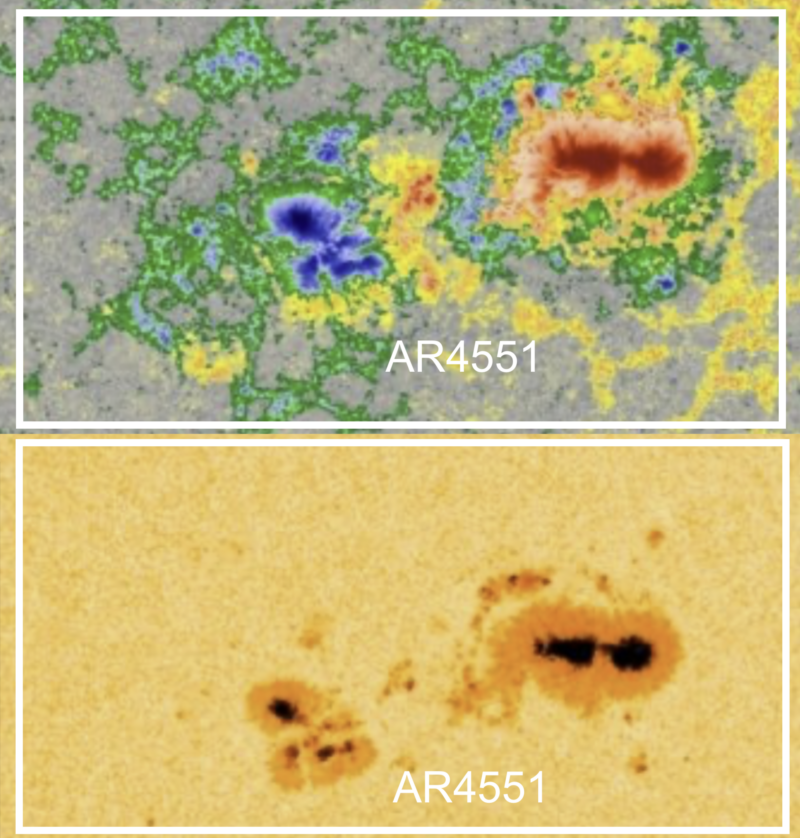
Today’s top story: Today’s sun is adorned by a monster sunspot region: AR4551. The active region first emerged on the Earth-viewed solar disk last Friday, and it’s grown rapidly since then, developing a beta-gamma-delta magnetic complexity. That’s the strongest magnetic configuration possible. And that means it has the potential to fire out some major M flares and even X flares. Stay tuned as we keep an eye on this monster sunspot group.
Past 24 hours on the sun
(11 UTC October 15 – 11 UTC October 16)
Flare activity: Solar activity stays at low levels. Our sun produced 17 flares during the period, all C-class (common).
- Strongest flare: A C4.9 flare from AR4551, peaking at 15:55 UTC on October 15.
- Other notable flares: On October 15: a C2.8 at 17:55 UTC. On October 16; a C3.1 at 0:19 UTC. All these flares were produced by active region AR4551.
- Lead flare producer: AR4551 topped the list with 14 flares produced during this period. The other three flares were produced by active region AR4557.
Sunspot regions: Today our sun is populated with three numbered sunspot regions on the side we see from Earth.
- AR4551 (beta-gamma-delta): This region kept its beta-gamma-delta complexity, the strongest there is.
- AR4455 (beta): This active region remained stable.
- AR4557 (beta): Showed growth and produced three C flares.
Blasts from the sun? No Earth-bound coronal mass ejections (CMEs) were observed in available coronagraph imagery during the past 24 hours.
Past 24 hours in space weather
Solar wind: Solar wind averaged at moderate-low levels during the period, as fast solar wind from a coronal hole continued waning. A large coronal hole in the southeast quadrant is moving into a geoeffective (Earth-facing) position in the coming days.
Bt, Bz and magnetic coupling: The total interplanetary magnetic field (Bt) averaged at weak strength. The Bz component kept shifting for short periods from north to south orientation through the entire period. This time the southward orientation was predominant. At the time of this report the Bz component orientation points towards north.
Earth’s magnetic field: The geomagnetic field showed low to unsettled levels during the period (Kp 2-3). At the time of this report the Kp index sits just below level 2.
What’s ahead? Sun–Earth forecast
Flare activity forecast: Specialists expect solar activity to continue at low levels. Chances for M-class (moderate) flares sit at 20% today. Chances for X-class (strong) flares remain at 5%. Active region AR4551 is the main driver with its beta-gamma-delta complexity.
Geomagnetic activity forecast:
- October 16: Unsettled conditions expected to persist. Influence from a coronal hole high-speed stream continues to wane. No G1 (minor) geomagnetic storm levels expected.
- October 17: Quiet conditions might return during the day.
- October 18: Quiet conditions might extend through the day.
Sun news October 15: Huge solar eruption yesterday



A huge filament — a rope of dense plasma suspended by magnetic fields — lifted from the sun yesterday and erupted, hurling plasma into space. The dramatic event occurred at around 10 UTC on October 14 over an area in the northeast solar quadrant. Take a look above, and note how the twisting plasma and magnetic fields make it look like a rubber band that eventually breaks, forming a whirling loop to finally go into space. Initial analysis suggests that none of this solar material is on its way to Earth. And the sun wasn’t done there. After this eruption, the far side of our star responded with a similarly spectacular eruption. Take a look at the imagery below.
Past 24 hours on the sun
(11 UTC October 14 – 11 UTC October 15)
Flare activity: Solar activity continued at low levels. Observers registered 12 flares during the period: eight C-class (common) and four B-class (weak).
- Strongest flare: A C2.9 flare from AR4551, peaking at 2:07 UTC on October 15.
- Other notable flares: On October 14: a C1.9 at 14:44 UTC and a C2.2 at 15:57 UTC. On October 15; a C1.9 at 2:17 UTC. All these flares were produced by active region AR4551.
- Lead flare producer: AR4551 was the only flare producer of the period. This active region produced all 12 flares of this period.
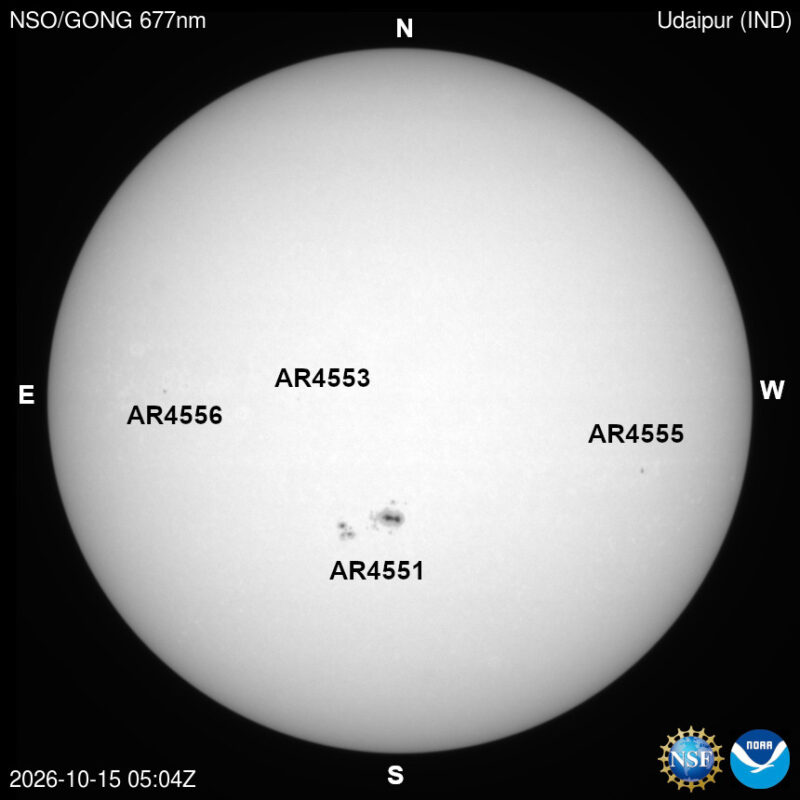
Sunspot regions: Currently the solar disk shows four numbered sunspot regions on its Earth-viewed side. Notably there’s a sunspot region with a beta-gamma-delta magnetic complexity.
- AR4551 (beta-gamma-delta): This region continued its growth and is now a monstrous sunspot region on the Earth-viewed solar disk. It developed a beta-gamma-delta complexity, the strongest there is. That means this sunspot region has potential for M and even X flares. It blasted out all the flares of the period. This is the guy to watch.
- AR4553 (alpha): Reappeared as a numbered active region.
- AR4455 (beta): This active region remained stable.
- AR4556 (beta): Stable inactive region.
Blasts from the sun? The coronal mass ejection (CME) hurled into space during the filament eruption reported above is expected to pass above Earth. No Earth-bound CMEs were registered during the past 24 hours.
Past 24 hours in space weather
Solar wind: Solar wind decreased from moderate-high to moderate-low levels during the period, as fast solar wind from a coronal hole started to wane. There is a large coronal hole forming in the southeast quadrant moving into a geoeffective (Earth-facing) position in the coming days, where its solar wind can reach Earth.
Bt, Bz and magnetic coupling: The total interplanetary magnetic field (Bt) stayed at weak strength. The Bz component’s orientation kept shifting for short periods from north to south orientation through the entire period. A northward orientation was predominant.
Earth’s magnetic field: The geomagnetic field continued at low to unsettled levels during the period (Kp 0-3). At the time of this report the Kp index sits just above level 1.
Sun news October 14: Solar wind disturbs our magnetic field

The anticipated fast solar wind from a coronal hole did arrive over the past day, disturbing our planet’s magnetic field. However, the forecast G1 (minor) geomagnetic storm did not occur. That’s because the expected coronal mass ejections (CMEs) only gave Earth a mild glancing blow. Meanwhile on the sun itself, the very active region of the past few days — AR4549 — continued flaring, even now it’s rotated to the far side of our star. In fact, this now-hidden region was the past day’s top flare producer. We’ve been watching its continued fiery activity in the form of a gorgeous long-lasting prominence on the northwest solar horizon.
Past 24 hours on the sun
(11 UTC October 13 – 11 UTC October 14)
Flare activity: Solar activity kept at low levels. Observers recorded 10 flares during the period: five C-class (common) and five B-class (weak).
- Strongest flare: A C7.0 flare from AR4549, peaking at 2:21 UTC on October 14.
- Other notable flares: On October 13; a C1.1 from AR4551 at 12:42 UTC, a C4.3 from AR4549 at 16:32 UTC and a C1.1 from AR4549 at 2221 UTC. On October 14; a C1.1 from AR44551 at 3:56 UTC.
- Lead flare producer: AR4549 stays at the top of the list with eight flares in total; three C-class and five B-class flares.
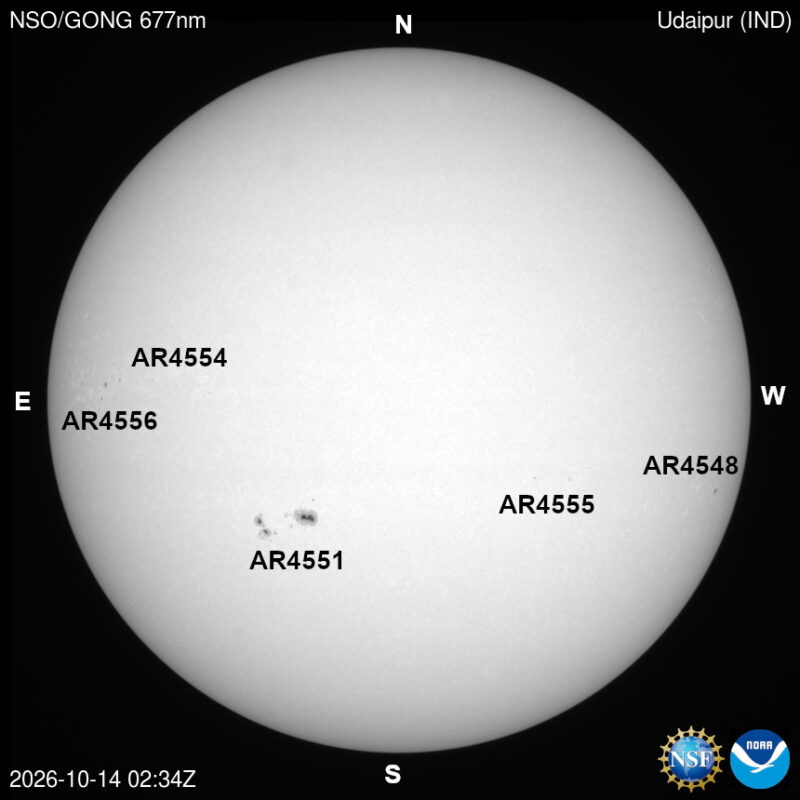
Sunspot regions: Today our sun shows five numbered sunspot regions on its side we see from Earth.
- AR4548 (alpha magnetic complexity): This region kept its alpha configuration and remained stable. It didn’t produce any flares.
- AR4551 (beta-gamma): This region regained its gamma complexity and is the largest sunspot group currently. It blasted out a couple of C flares during the period.
- AR4554 (beta): Having been recently numbered, this region rapidly grew to a beta configuration and became the lead flare producer.
- AR4455 (beta): This active region reemerged from becoming a simpler plage, or bright area.
- AR4556 (beta): Newcomer numbered during the past day.
Blasts from the sun? No new Earth-directed CMEs registered during the past 24 hours.
Past 24 hours in space weather
Solar wind: Solar wind increased from moderate to moderate-high levels during the period, as fast solar wind from a coronal hole arrived.
Bt, Bz and magnetic coupling: The total interplanetary magnetic field (Bt) started the period at strong levels but at around 21 UTC on October 13 it decreased to weak strength. The Bz component’s orientation was mostly north through the entire period, limiting the chance for auroras.
Earth’s magnetic field: The geomagnetic field kept at low to unsettled levels during the period (Kp 1-3). At the time of this report the Kp index sits just above level 3.
Sun news October 13: Auroras tonight? Sun-stuff and solar wind incoming
Fast solar wind is currently streaming to Earth from a coronal hole, or an area of lower density in the sun’s atmosphere. When this stream arrives today, it’s expected to disturb our planet’s geomagnetic field to G1 (minor) geomagnetic storm levels. And conditions could escalate to G2 (moderate) levels after a burst of sun-stuff — a coronal mass ejection (CME) — gives Earth an anticipated glancing blow later today. Together, these effects could combine to trigger auroras tonight at northerly latitudes.
Past 24 hours on the sun
(11 UTC October 12 – 11 UTC October 13)
Flare activity: Solar activity continued at low levels. Observers recorded 5 flares during the period: 4 C-class (common) and 1 B-class (weak).
- Strongest flare: A C1.2 flare from AR4549, peaking at 3:40 UTC on October 13.
- Other notable flares: Three C1s occurred during the period. The first one from AR4549 peaking at 19:16 UTC, the second from AR4554 at 20:39 UTC and the third from AR4549 again, peaking at 23:53. The three flares were produced on October 12.
- Lead flare producer: AR4549 was on top of the list with three C-class flares.
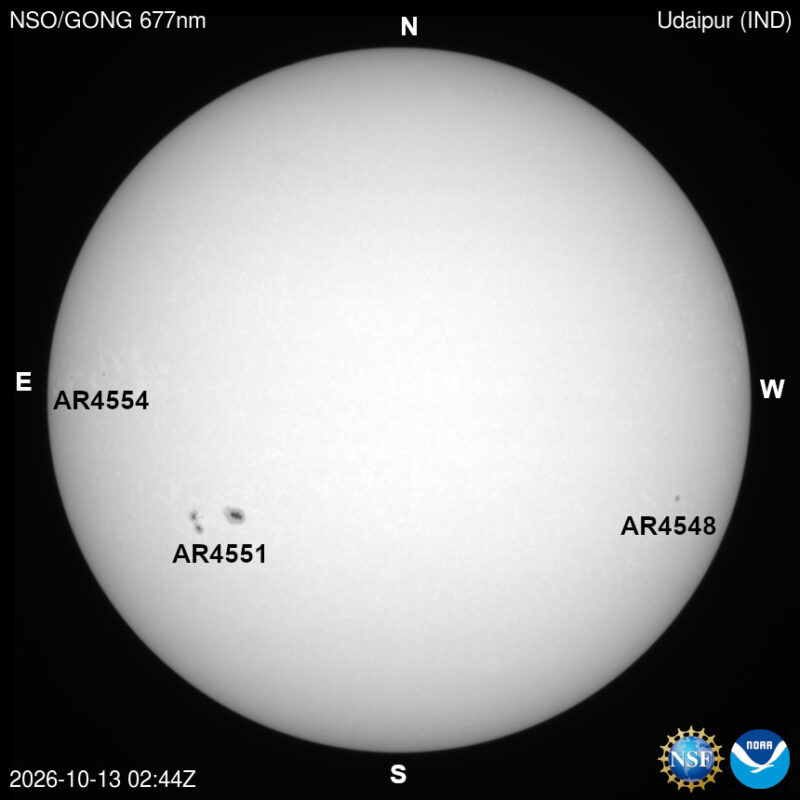
Sunspot regions: Currently three numbered sunspot regions populate the visible disk.
- AR4548 (alpha): This region decayed to a simpler alpha configuration and didn’t produce any flares.
- AR4551 (beta): This region lost its gamma complexity during this period. It remained stable and did not produce flares.
- AR4554 (beta): Having been recently numbered, this region rapidly grew to a beta configuration and became the lead flare producer.
Blasts from the sun? No new Earth-directed CMEs registered during the past 24 hours. A couple of filament eruptions were observed. They both came from the same area in the southeast quadrant. Plasma could be seen hurled into space during the events. The first one at around 22 UTC on October 11 and the second at around 4:30 UTC on October 12. Initial analysis suggests the two events are ahead of Earth’s direction. However, a minor glancing blow on October 14 may bring a slight disturbance on Earth’s magnetic field.
Past 24 hours in space weather
Solar wind: Solar wind averaged at moderate levels during the period, mainly driven by fast solar wind from a coronal hole.
Bt, Bz and magnetic coupling: The total interplanetary magnetic field (Bt) started at weak levels but there was a peak at 0 UTC on October 13 that rose to strong levels. It lasted for about an hour to return to moderate strength. The Bz component pointed northward throughout, limiting geomagnetic coupling.
Earth’s magnetic field: The geomagnetic field showed from low to unsettled levels during the period (Kp 1 – 3). At the time of this report the Kp index sits at level 2.
Sun news October 12: Sun-stuff and solar wind on the way

A fast blob of sun-stuff — a coronal mass ejection (CME) — could give Earth a glancing blow later today. The sun fired this CME our way during an M6.4 (moderate) flare on Saturday. If it does reach us, it could add to the effects of high-speed solar wind currently streaming to us from a coronal hole. Together, these effects could disturb our magnetic field to G1 (minor) geomagnetic storm levels. In fact, the U.K. Met Office sees a chance of G2 (moderate) or even G3 (strong) levels. Aurora-watchers across the northern U.K, northern U.S. states, southern New Zealand and similar geomagnetic latitudes should stay alert!
Past 24 hours on the sun
(11 UTC October 11 – 11 UTC October 12)
Flare activity: Solar activity stayed at low levels. Observers recorded 8 flares during the period: 6 C-class (common) and 2 B-class (weak).
- Strongest flare: A C1.2 from AR4545, peaking at 17:01 UTC on October 11.
- Other notable flares: AR4549 contributed a C1.1, peaking at 22:37 UTC on October 11.
- Lead flare producer: AR4545 led the list with three C-class flares.
Sunspot regions: Five numbered sunspot regions populated the visible disk, including one newcomer. A sixth, AR4552, decayed to plage.
- AR4549 (beta-delta): This region remained the most magnetically complex on the disk. However, it’s getting very close to the western horizon, which is making classification increasingly difficult. It produced only one minor C flare during the period. Still, forecasters consider it the main source of possible M-class and X-class (strong) flares in the days ahead.
- AR4545 (beta): This region saw new magnetic field emergence during the period. It was also the most prolific flare producer, firing the strongest flare (C1.2) plus two other C-class events. Even so, analysts noted overall decay in the region.
- AR4551 (beta-gamma): This region grew in both size and magnetic complexity. It’s now the largest region on the disk. Despite that growth, it stayed mostly quiet, producing only B-class flares during this window.
Blasts from the sun? Observers detected no new Earth-directed CMEs during the past 24 hours. However, the October 10 CME from AR4549’s M6.4 flare remains of interest.
Past 24 hours in space weather
Solar wind: Solar wind steadily decreased to a little above normal, reflecting the fading effects of the October 10 CME arrivals.
Bt, Bz and magnetic coupling: The total interplanetary magnetic field (Bt) started strong and slowly decreased to moderate, before dropping sharply to near-normal levels. The Bz component pointed northward throughout, limiting geomagnetic coupling.
Earth’s magnetic field: The geomagnetic field started the period at active levels (Kp 4). Conditions then eased to quiet as CME effects waned.
The sun in recent days
Earlier sun images
Sun images from our community
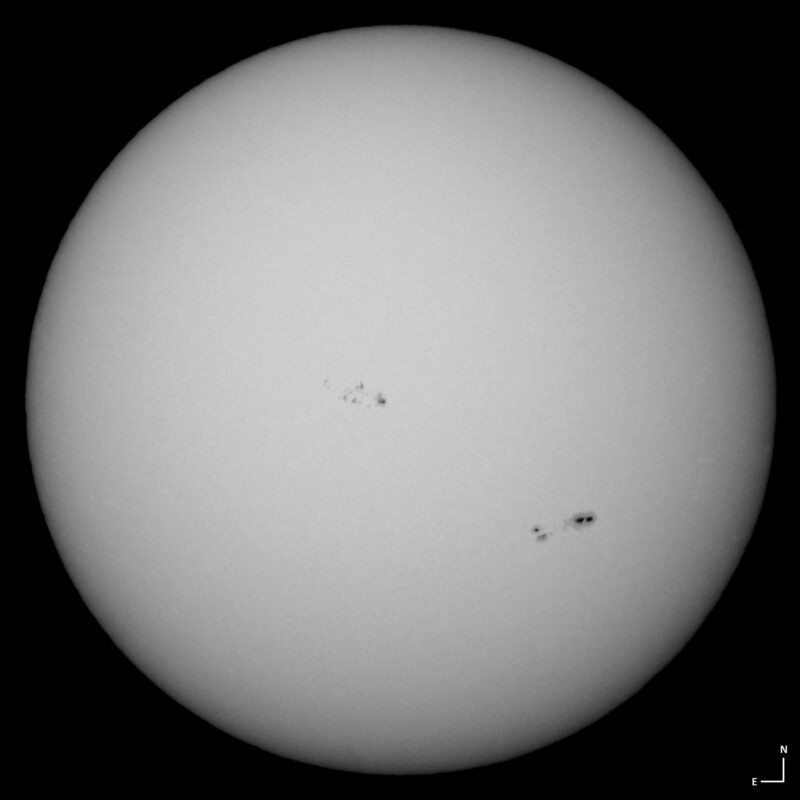
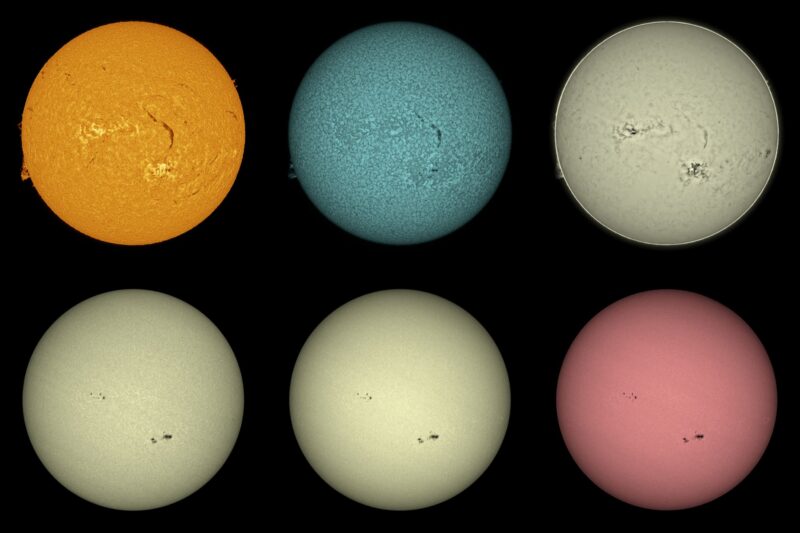
More sun images from our community
We sometimes feature sun images obtained using hydrogen-alpha filters. Read why.
Bottom line: Sun news, October 17, 2026: Monster sunspot delivered an impulsive M1.4 flare at 15:42 UTC on October 16. Meanwhile a large coronal hole rotated now facing directly Earth.
Like what you read?
Subscribe and receive daily news delivered to your inbox.
More from
C. Alex Young


Yes, there’s an aurora season, and it’s here

Sun activity archive for September 2026
Sun activity archive for August 2026
Sun activity archive for July 2026



