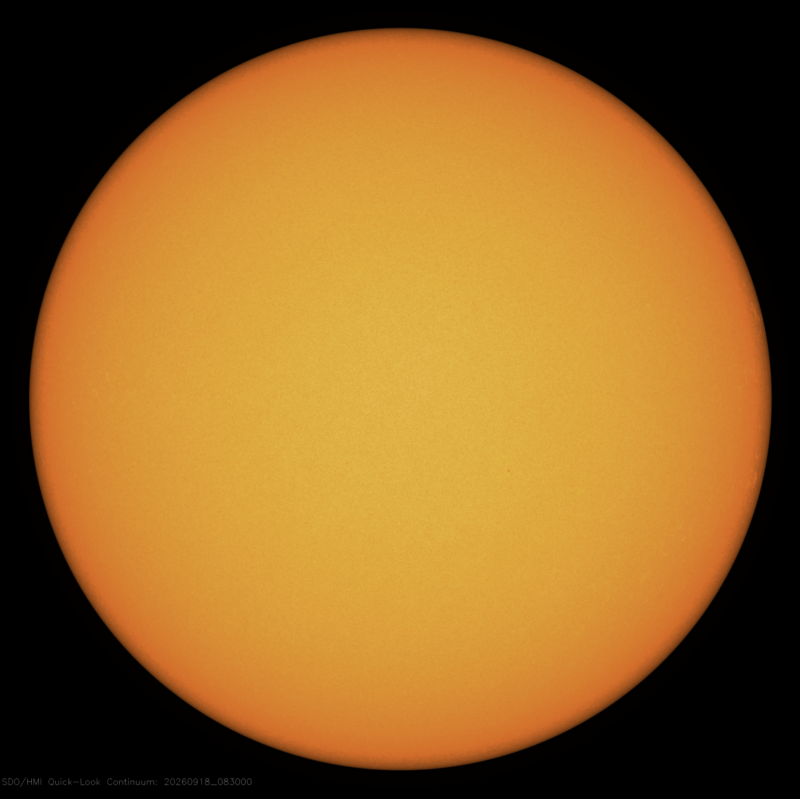
Sun news September 18: A spotless day today?
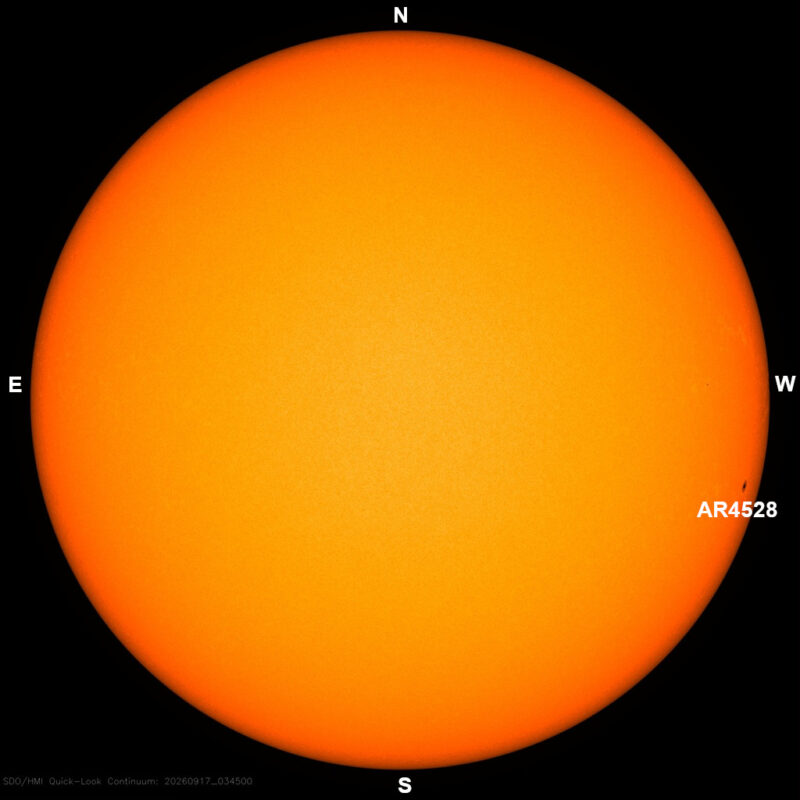
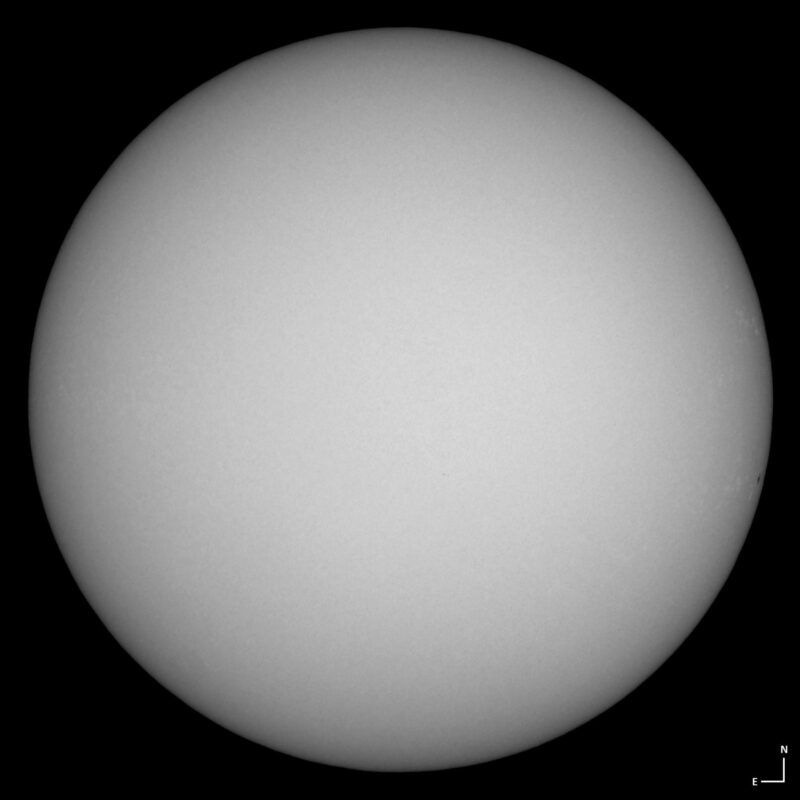
Today’s top story: Are we looking at the first spotless day since February 24, 2026? In the image above, captured by the Solar Dynamics Observatory at 8:30 UTC this morning, we can see no numbered active regions on the solar face as we see it from Earth. We’re awaiting official confirmation, but for practical purposes — at least momentarily — we are now looking at a spotless sun. And if no newcomer region is numbered today, the sun will be officially spotless. Spotless days are a sign that we’re moving away from the peak of the 11-year solar cycle, which arrived in late 2024.
Past 24 hours on the sun
(11 UTC September 17 – 11 UTC September 18)
Flare activity: Solar activity continued at very low levels over the past 24 hours, with only 1 faint B-class flares observed.
- Strongest flare: The only flare produced during the period, a B3.2 peaking at 12:16 UTC on September 17. The flare came from AR4521, which has rotated to the far side.
- Lead flare producer: The only flare producer of the period was the now-departed AR4521.
Sunspot regions: Over the past day, the solar disk as we see it from Earth briefly featured one numbered sunspot region.
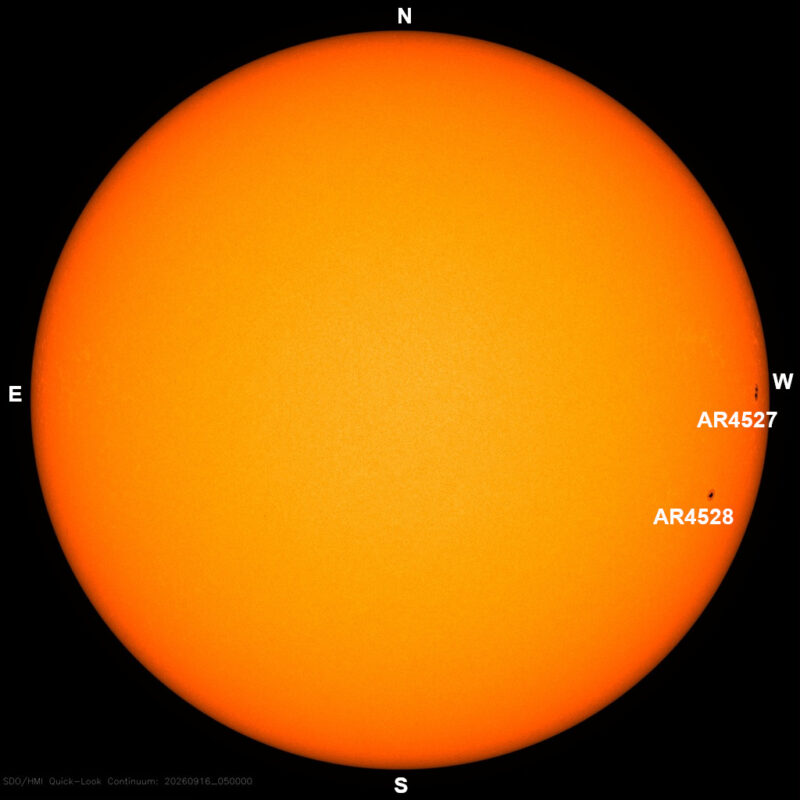
- AR4528 (alpha magnetic configuration): Visible earlier in the day (see below), this region appears to have now rotated out of view.
- The unnumbered spot on the northeast limb that has been producing B flares is now considered as only a plage region and has not been assigned an official number.
Blasts from the sun? Observers spotted no new Earth-directed coronal mass ejections (CMEs) during the period.
Past 24 hours in space weather
Solar wind: Solar wind speeds averaged moderate levels during this period. Moderate speeds are expected to continue, driven by fast solar wind from a coronal hole.
Bt, Bz and magnetic coupling: The total interplanetary magnetic field remained at weak levels for the period. Meanwhile, the north-south component (Bz) kept shifting from north to south, limiting geomagnetic coupling. At the time of this writing, the Bz points northward.
Earth’s magnetic field: The geomagnetic field ranged from quiet to unsettled levels, with the Kp index reaching 3 (unsettled) at 12 UTC on September 17. At the time of this report, the Kp index sits just above level 2.
What’s ahead? Sun–Earth forecast
Flare activity forecast: Forecasters expect solar activity to remain at very low levels. NOAA’s Space Weather Prediction Center gives a chance for isolated C-class flares through September 19. The SIDC puts C-class flares at 15% probability. The chance for M-class (moderate) flares decreased to 1% today from 5% yesterday. After all, no complex regions sit on the disk to drive stronger activity. X-class chances remain minimal.
Geomagnetic activity forecast:
- September 18: Unsettled-to-active conditions anticipated (Kp 3 to 4). A return toward quieter levels should follow. Aurora chances limited to high latitude areas.
- September 19 – 20: Quiet-to-unsettled conditions (Kp 0 to 3) are expected as the solar wind returns to near-background levels.
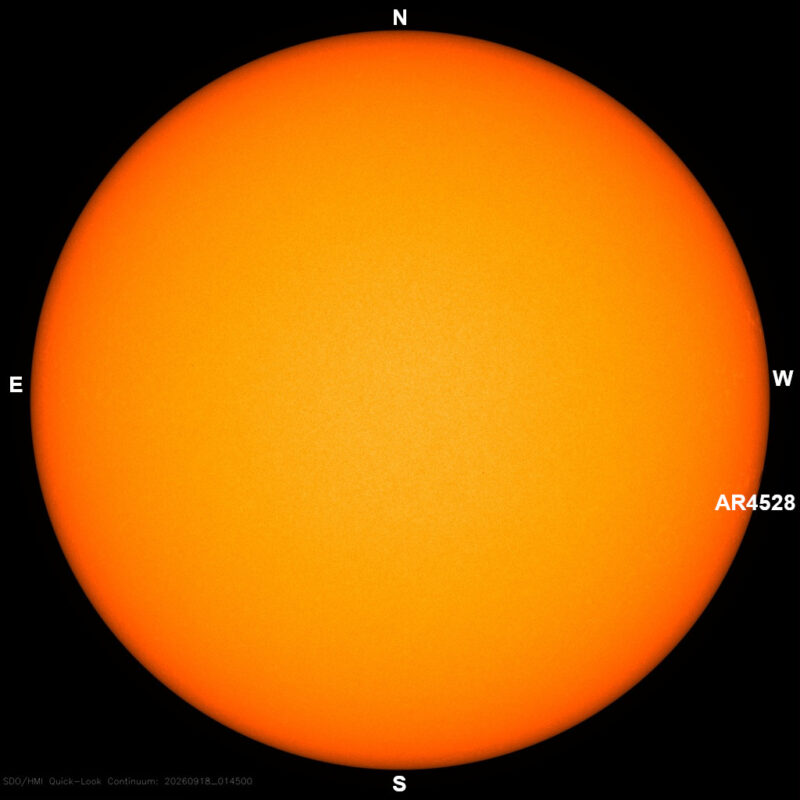
Sun news September 17: A near-spotless day on our star
We’re about to see a spotless sun! Today, the Earth-viewed side of our star shows only one numbered active region: AR4528. And that lone sunspot group will rotate out of view within the next 24 hours. If no newcomer emerges, the sun will be spotless for the 1st time since February 24, 2026. Spotless days are a sign that we’re moving away from the peak of the 11-year solar cycle, which arrived in late 2024. Will tomorrow be the next one? We’ll keep watching.
Past 24 hours on the sun
(11 UTC September 16 – 11 UTC September 17)
Flare activity: Solar activity stayed at very low levels over the past 24 hours, with only 3 faint B-class flares observed.
- Strongest flare: A B7.9 peaking at 23:45 UTC on September 16. This faint eruption came from an unnumbered region on the northeast limb.
- Other notable flares: That same unnumbered region produced two more B flares: a B3.9 peaking at 11:02 UTC and a B3.4 peaking at 11:32 UTC, both on September 16.
- Lead flare producer: The unnumbered northeast region ended as the lead and only flare producer of the period. It fired all three B flares.
Sunspot regions: The solar disk, as we see it from Earth, shows one numbered sunspot region.
- AR4528 (alpha magnetic configuration): This is now the only active region on the Earth-facing disk, since AR4527 rotated to the far side. AR4528 is about to follow it out of view. It remains magnetically simple, with no relevant activity and no flares.
- No new numbered regions rotated onto the disk during this period. However, the unnumbered spot on the northeast limb has been producing B flares. It’s worth watching as it comes into view.
Blasts from the sun? Observers spotted no new Earth-directed coronal mass ejections (CMEs) during the period. Meanwhile, the earlier CMEs from September 13 and 14 either haven’t arrived or delivered only a weak impact. As a result, NOAA canceled its alert for a G1 (minor) geomagnetic storm. Even so, active levels remain possible through the rest of today, September 17.
Past 24 hours in space weather
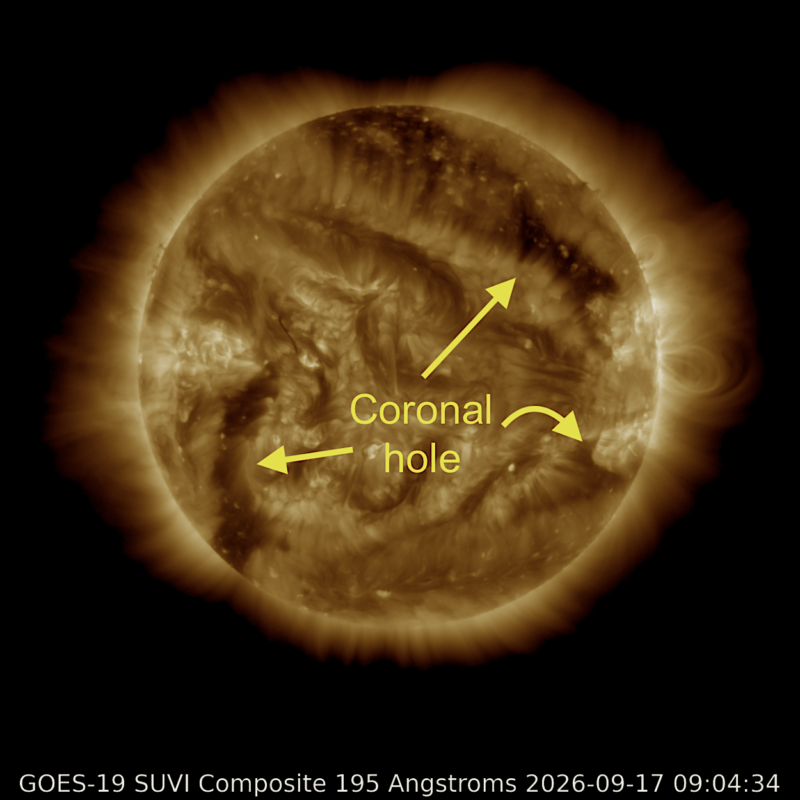
Solar wind: Solar wind speeds decreased from high to moderate levels during this period. Moderate speeds should persist for the rest of the day, driven by fast solar wind from a coronal hole.
Bt, Bz and magnetic coupling: The total interplanetary magnetic field held at weak levels for most of the period, with just a momentary moderate peak at 2 UTC this morning. Meanwhile, the north-south component (Bz) pointed mostly northward, limiting geomagnetic coupling. Observers noted only a few weak south-oriented peaks. At the time of this writing, the Bz points northward.
Earth’s magnetic field: The geomagnetic field ranged from quiet to unsettled levels, with the Kp index reaching 3 (unsettled) at 0 UTC on September 17. The anticipated G1 storm either didn’t arrive or is running late. So NOAA canceled its G1 geomagnetic storm watch. At the time of this report, the Kp index sits just above level 1.

Sun news September 16: Beautiful prominence, auroras tonight?
Wisps of plasma twirled over the sun’s horizon over the past day, following an eruption on our star’s far side. Meanwhile, we on Earth could see the effect of some previous eruptions later today. Forecasters expect up to two bursts of solar material to reach our magnetic field by this evening, fired by the sun on Sunday and Monday. Combined with an ongoing stream of fast solar wind from a coronal hole, these glancing coronal mass ejections (CMEs) could push geomagnetic conditions to G1 (minor) storm levels, with a chance of G2 (moderate) and even a slight chance of G3 (strong) storms. So aurora watchers around the latitudes of Scotland and possibly northern England should keep an eye on the skies tonight!
Past 24 hours on the sun
(11 UTC September 15 – 11 UTC September 16)
Flare activity: Solar activity continued at very low levels, with only faint B-class flares. Observers counted just two flares, both B-class (weak).
- Strongest flare: A B5.5 peaking at 15:16 UTC on September 15. It came from an unnumbered region on the northeast limb.
- Other notable flares: A B3.6 peaked at 8:14 UTC on September 16 from AR4521.
- Lead flare producer: AR4521 and the unnumbered northeast region ended tied, with one B flare each.
Sunspot regions: Currently, the Earth-viewed solar disk shows two numbered sunspot regions.
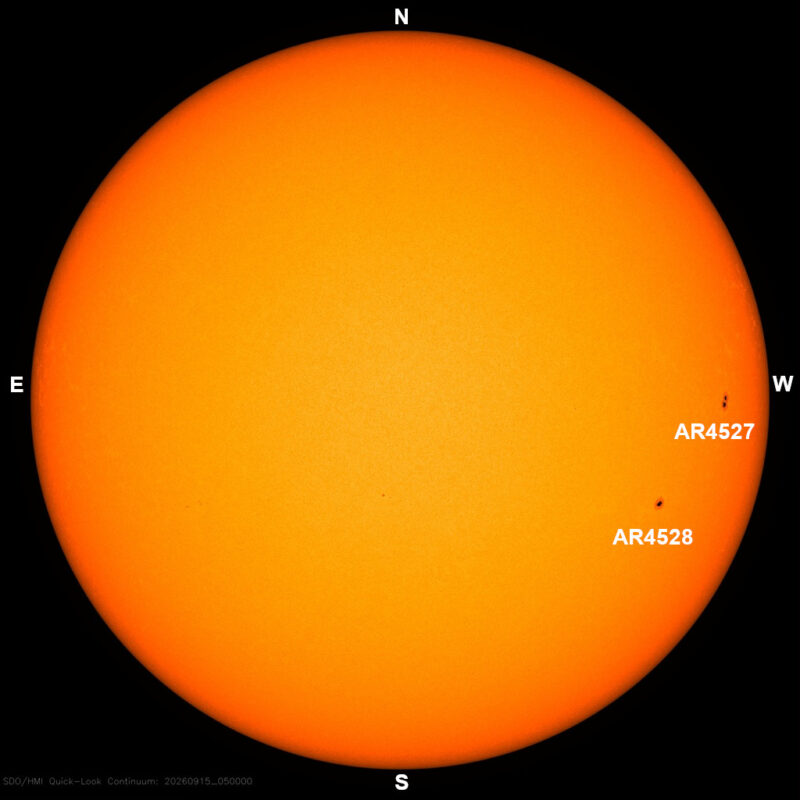
- AR4527 (alpha) and AR4528 (alpha): Both numbered regions are magnetically simple, with no relevant activity. They pose little threat of strong flaring.
- No new regions rotated onto the disk during this period. However, the unnumbered spot on the northeast limb that produced the B 5.5 bears watching as it comes into view.
Blasts from the sun? A CME appeared off the northwest limb in SOHO LASCO C2 imagery starting at 16:48 UTC on September 15. Analysts believe it erupted on the far side of the sun, since SDO and GOES SUVI imagery showed no matching eruption on the Earth-facing disk. Observers spotted no new Earth-directed CMEs during the period. However, three earlier CMEs from September 13 and 14 remain in play for Earth impact.
Past 24 hours in space weather
Solar wind: Solar wind conditions were enhanced, likely from the edge of a coronal hole high-speed stream. Speeds showed two sharp, short-lived spikes.
Bt, Bz and magnetic coupling: The total interplanetary magnetic field held strong through most of the period, then dropped to weak strength around 9 UTC this morning. Meanwhile, the north-south component (Bz) pointed mostly northward for much of the period, limiting geomagnetic coupling. Then, around 18:52 UTC on September 15, it swung sharply southward. It stayed south until roughly 0 UTC, then began shifting between south and north in short stretches. At the time of this writing, the Bz points northward.
Earth’s magnetic field: The geomagnetic field ranged from quiet to active levels, with the Kp index reaching 4 (active) at times. Conditions hit the Kp 4 threshold at 0:30 UTC on September 16. Despite the southward Bz swing late in the period, conditions did not reach G1 storm thresholds during this window. Auroras were not widely reported. At the time of this report, the Kp index sits at level 2.
Sun news September 15: Chunk of sun-stuff on its way to Earth
It’s now confirmed: a chunk of sun-stuff fired into space during yesterday’s filament eruption is on its way to Earth. Forecasters anticipate an arrival by September 17, which could trigger G1 (minor) geomagnetic storming and auroras at far-northern latitudes. Meanwhile, the filament that fired the burst continued its fiery activity throughout the past day. Observers have spotted no other coronal mass ejections (CMEs) yet, but this region could send more plasma into space at any moment. Stay tuned.
Past 24 hours on the sun
(11 UTC September 14 – 11 UTC September 15)
Flare activity: Solar activity stayed very low. Observers counted 5 flares: 1 C-class (common) and 4 B-class (weak).
- Strongest flare: A C1.0 peaking at 14:33 UTC on September 14 from active region AR4530.
- Lead flare producer: AR4530 reached the top of the list with three flares: the only C flare of the period plus two B-class flares.
Sunspot regions: The solar disk we see from Earth shows two numbered sunspot regions.
- AR4527 (alpha) and AR4528 (alpha): Both numbered regions are magnetically simple, with no relevant activity.

Blasts from the sun? The filament eruption in the southwest on September 14 hurled a CME into space. After modeling and analysis, specialists confirmed it carries an Earth-directed component, with arrival expected by September 17. Beyond that event, observers spotted no other Earth-directed CMEs in available coronagraph imagery during the past 24 hours.
Past 24 hours in space weather
Solar wind: Solar wind speeds increased from low to moderate levels through the period. A combined effect may explain the rise: a chunk of solar stuff the sun hurled out on September 9, plus fast solar wind from a coronal hole.
Bt, Bz and magnetic coupling: The total interplanetary magnetic field started the period weak. It then climbed, ending the period at strong levels. Meanwhile, the north-south component (Bz) held a mostly northward orientation throughout. Only a couple of faint peaks shifted southward. At the time of this writing, the Bz points north at moderate levels.
Earth’s magnetic field: The geomagnetic field ranged from quiet to active levels, with the Kp at 0-4. Kp reached level 4 at 17:43 UTC on September 14. At the time of this report, the Kp index sits at level 2.

Sun news September 14: Violent filament eruption last night

The solar southwest was lit up last night by a violent filament eruption. The eruption came from the vicinity of sunspot region AR4528, and has been associated with a C1.4 (common) flare at 19:45 UTC. The blast sent a chunk of sun-stuff into space, which could give Earth a glancing blow by early Thursday.
Past 24 hours on the sun
(11 UTC September 13 – 11 UTC September 14)
Flare activity: Very low. Observers counted 2 flares: 1 C-class and 1 B-class (weak).
- Strongest flare: C1.4, peaking at 19:45 UTC on September 13 from an as-yet-unnumbered active region now located in southwest solar quadrant.
- Lead flare producer: The southwestern region and AR4529 were tied for the lead with just one flare each.
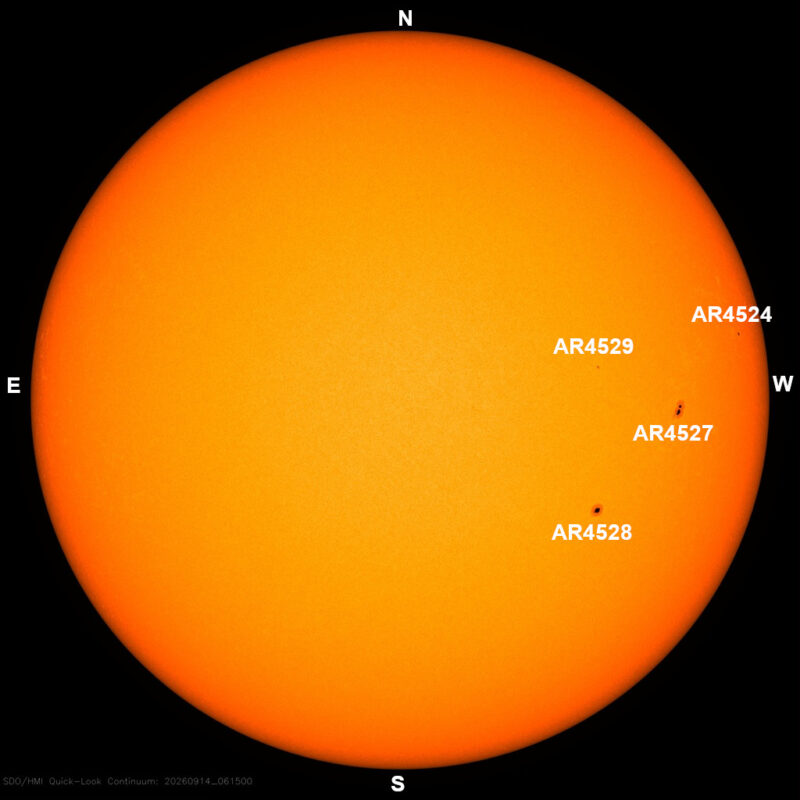
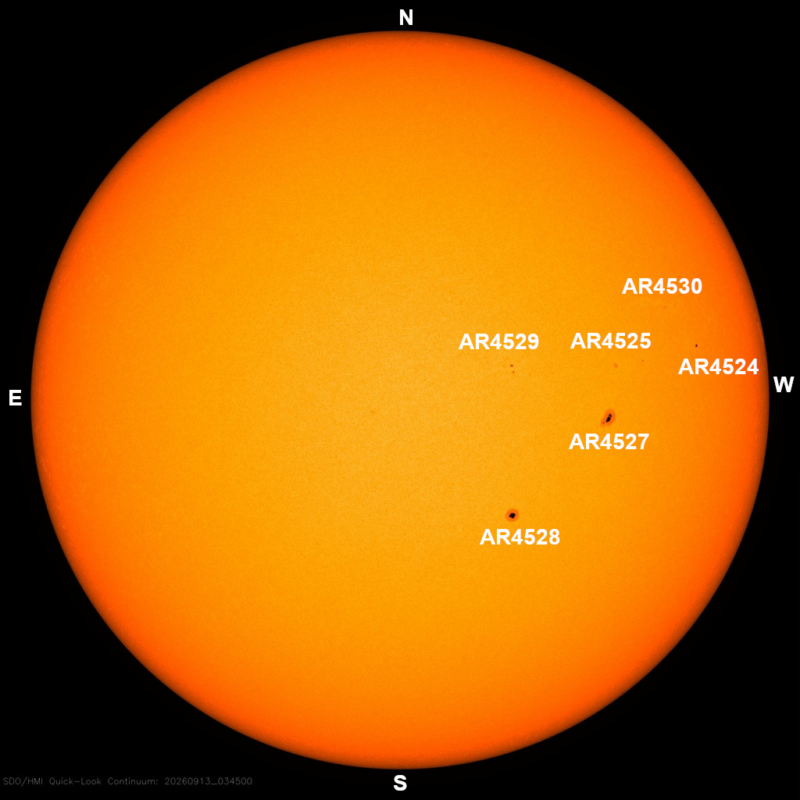
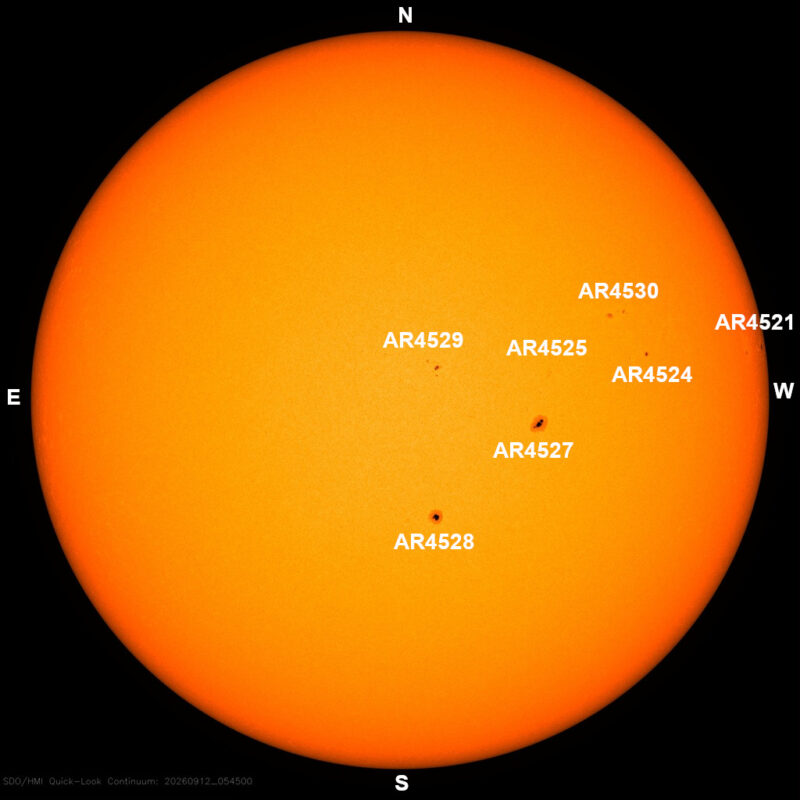
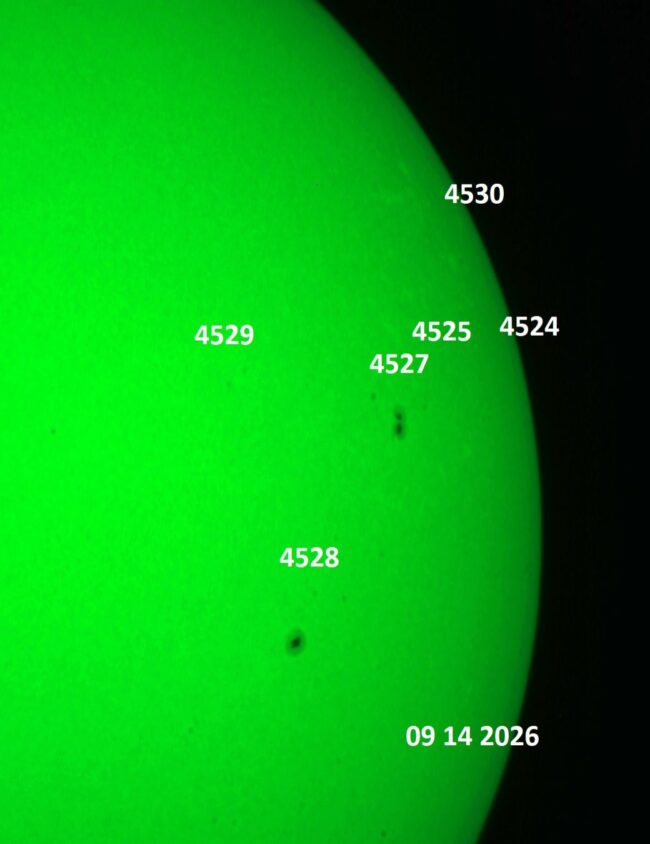
Sunspot regions: Currently, the sun shows four numbered regions on its Earth-viewed side. They are grouped to the west of the solar disk, leaving a wide area on the east hemisphere with no active regions at all.
- AR4524 (alpha), AR4527 (alpha), AR4428 (alpha), AR4529 (beta): All regions are magnetically simple and are either stable or slowly decaying.
Blasts from the sun? The abovementioned filament eruption hurled plasma into space at 19:45 UTC on September 13. A glancing blow is anticipated by early September 17. Other than that, observers detected no Earth-directed coronal mass ejections (CMEs) in available coronagraph imagery during the past 24 hours.
Past 24 hours in space weather
Solar wind: Solar wind speeds reached moderate levels through the 1st half of the period. At around 21 UTC on September 13, conditions started to decrease to background levels.
Bt, Bz and magnetic coupling: The total interplanetary magnetic field was weak. The north-south component (Bz) kept a moderately southward orientation throughout most of the period.
Earth’s magnetic field: The geomagnetic field kept quiet, with the Kp at 0-2.
The sun in recent days
Earlier sun images
Sun images from our community
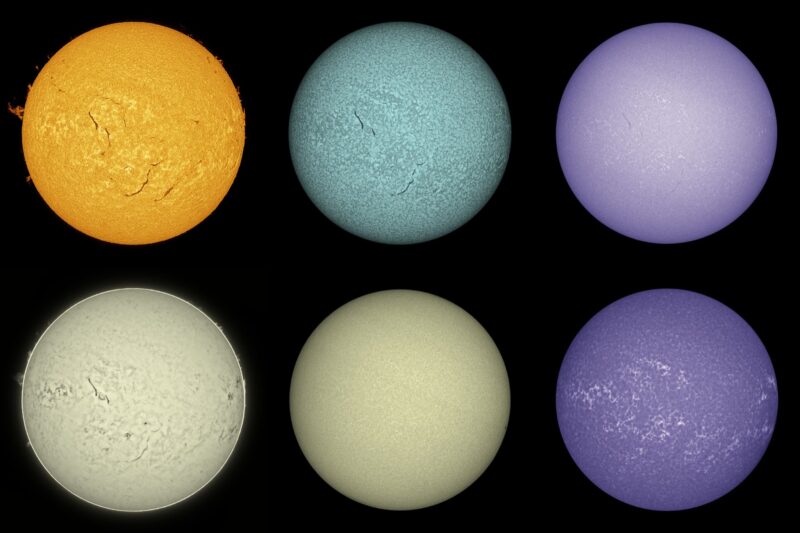
We sometimes feature sun images obtained using hydrogen-alpha filters. Read why.
Bottom line: Sun news September 18, 2026: Are we looking at a sun spotless day today? We await official confirmation, but it certainly seems like it.
Like what you read?
Subscribe and receive daily news delivered to your inbox.
More from
C. Alex Young


Yes, there’s an aurora season, and it’s here

Sun activity archive for July 2026
Sun activity archive for June 2026
Sun activity archive for May 2026