



Sun news August 25: Sunspot region roars with 5 M flares


Today’s top story: After a quiet few days, promising sunspot region AR4513 roared back to life over the past 24 hours! It fired all 16 of the past day’s flares, including an impressive five M flares. The largest was an M7, peaking at 10:02 UTC on August 25 and triggering an R2 (moderate) radio blackout over Africa. This sunspot region is finally unleashing the potential of its beta-gamma-delta magnetic complexity, the most volatile configuration there is. Notably, it’s now sitting almost dead center on the solar disk. So if the powerful M7 flare hurled a coronal mass ejection (CME) into space, a good portion of it could head straight for Earth. Specialists are analyzing the event now. Stay with us for the results!
Past 24 hours on the sun
(11 UTC August 24 – 11 UTC August 25)
Flare activity: Solar activity jumped to high levels, thanks to five M flares. In total, the sun fired 16 flares during the period: 5 M flares, 9 C flares, and 2 B flares.
- Strongest flare: An M7.0 from AR4513 peaking at 10:02 UTC on August 25. The event provoked an R2 (moderate) radio blackout centered over Africa.
- Second strongest: An M2.0 at 1:26 UTC on August 25. It produced an R1 (minor) radio blackout over the Philippine Sea.
- Other M flares: An M1.8 at 19:36 UTC on August 24, with an R1 (minor) radio blackout over the Pacific Ocean west of Central America. Then an M1.0 at 4:02 UTC on August 25, producing an R1 (minor) radio blackout over the Philippines and Southeast Asia. Finally, another M1.8 at 6:40 UTC on August 25, with an R1 (minor) radio blackout over the southeast coast of India.
- Lead flare producer: AR4513 fired all 16 flares tracked over the period.
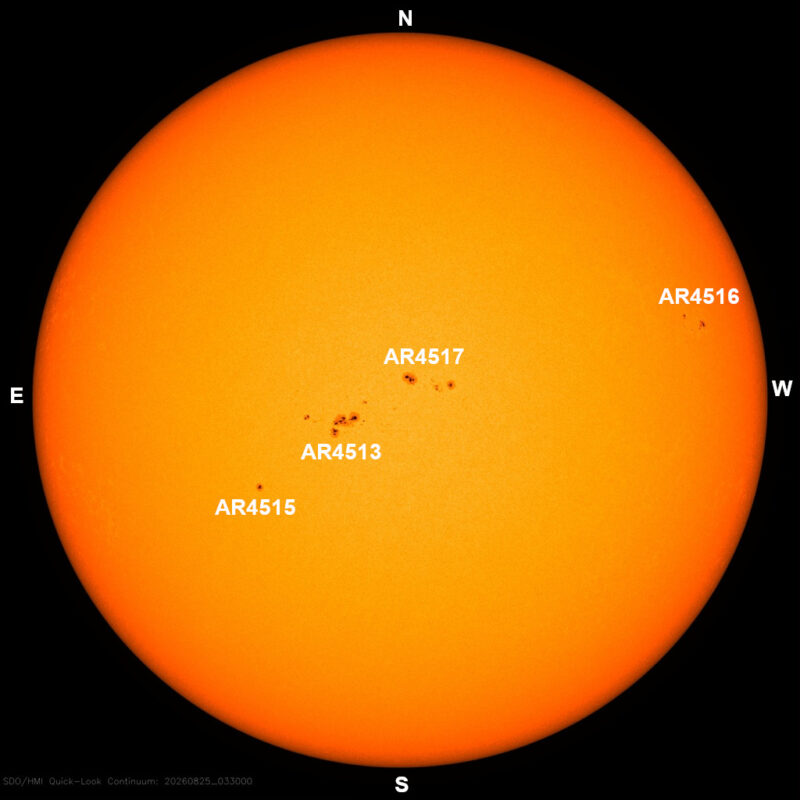
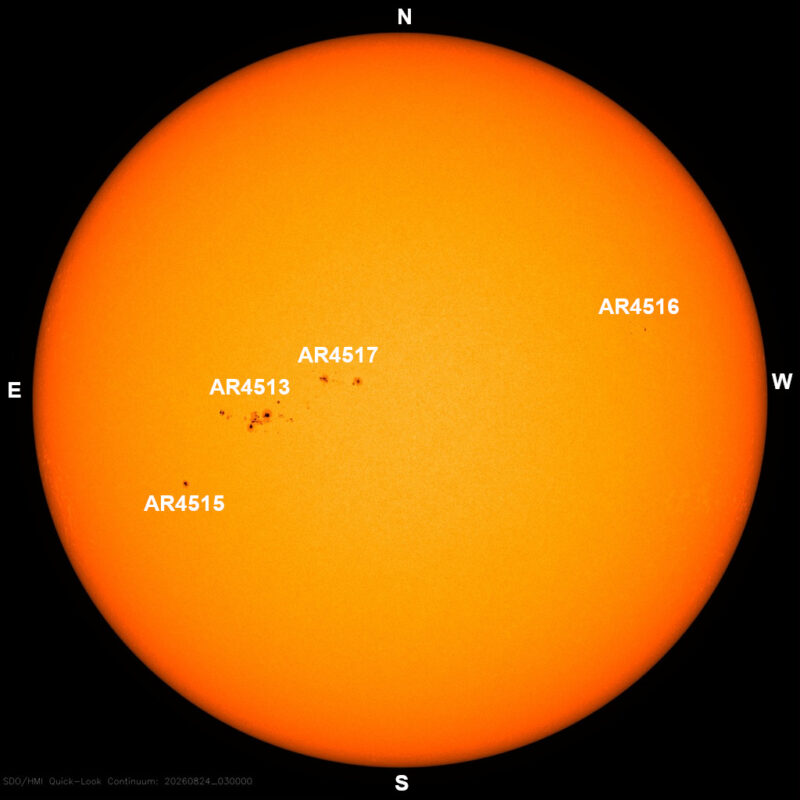
Sunspot regions: Currently, the solar disk displays four numbered sunspot regions on the side we see from Earth.
- AR4513 (beta-gamma-delta): This region reawakened during the period, and did so dramatically. It was the only flare producer, delivering all five M flares. It also now sits near the disk’s center, which means its eruptions could affect Earth.
- AR4515 (alpha): This sunspot region stayed stable during the period.
- AR4516 (beta): This region reported growth in its trailing spots. Even so, it produced no flares.
- AR4517 (beta): This region continued growing in both its leading and trailing spots. Still, it produced no flares.
Blasts from the sun? Observers are concentrating their attention on the five M flares from AR4513, especially the M7.0. Review is ongoing to find any Earth-directed component among the coronal mass ejections (CMEs) hurled into space during those events. Given the region’s near-central position, an Earth-directed component is a real possibility this time.
Past 24 hours in space weather
Solar wind: Solar wind speeds averaged at low levels through the period. No significant space weather was reported.
Bt, Bz and magnetic coupling: The interplanetary magnetic field (IMF) stayed weak, showing only a slight increase at the end of our observation period. Meanwhile, the Bz component pointed northward the whole time. That orientation is unfavorable for aurora production.
Earth’s magnetic field: The field stayed quiet-to-unsettled throughout the period, with Kp values of just 0-3. As a result, aurora sightings stayed limited to the far northern auroral zone: Iceland, northern Scandinavia, northern Alaska, and Canada.
What’s ahead? Sun–Earth forecast
Flare activity forecast: Forecasters expect moderate levels to continue over August 25 and 26. Today, the chance for M-class flares increased to 55%, up from 45% yesterday. Likewise, the chance for an X-class event rose from 5% yesterday to 10% today. With the M7.0 now on the books, those odds may climb further in the next update. All eyes stay on AR4513 and its beta-gamma-delta complexity.
Geomagnetic activity forecast:
- August 25-26: Anticipate quiet conditions (Kp 0-2) for now. Background solar wind will prevail with no significant drivers. However, this outlook does not yet account for any CME from the M7.0 flare. Watch for updates.
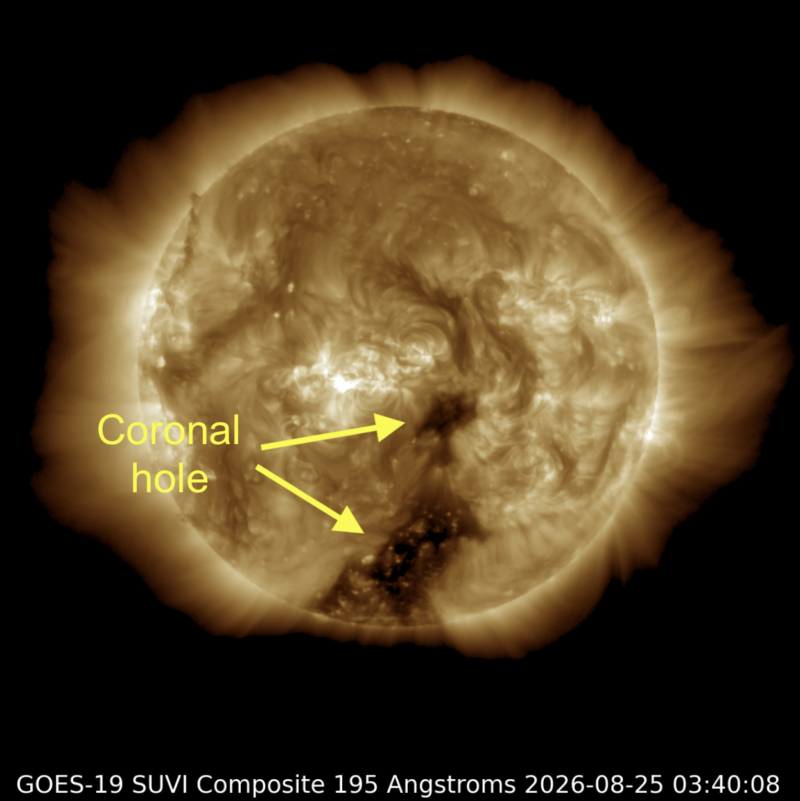
- August 27: Late in the day, fast solar wind from a coronal hole might lift activity to unsettled-to-active levels (Kp 3-4). The chance of G1 (minor) storm intervals (Kp 5) increases as that fast wind arrives. If the stream arrives on schedule, auroras may appear over Seattle, Minneapolis, Edinburgh, and the Scottish Highlands.
- August 28 (extended outlook): The coronal hole stream is more likely to peak on this day, and solar wind speeds should increase to elevated levels. Forecasters expect unsettled-to-active conditions (Kp 3-4), with a chance of G1 (minor) storm intervals (Kp 5). Aurora watchers across northern Europe, northern Canada, and the northern tier of the United States should stay alert for possible displays.
Sun news August 24: Quiet sun, but fast solar winds to come
(11 UTC August 23 – 11 UTC August 24)
With the Earth-facing solar disk currently quiet, forecasters are looking ahead to a likely round of fast solar wind later this week. The solar wind is streaming from an area of low density in the sun’s outer atmosphere known as a coronal hole, and it should start reaching Earth late on August 26 or, more likely, on August 27. That could open the door for auroras across northerly latitudes, including northern Scotland.
Past 24 hours on the sun
Flare activity: Solar activity remained at low levels. The sun fired 8 C-class flares and 2 B-class events during the period.
- Strongest flare: C3.5 from AR4513 at 22:03 UTC on August 23.
- Lead flare producer: AR4513 was responsible for 7 of the 10 flares tracked over the period.
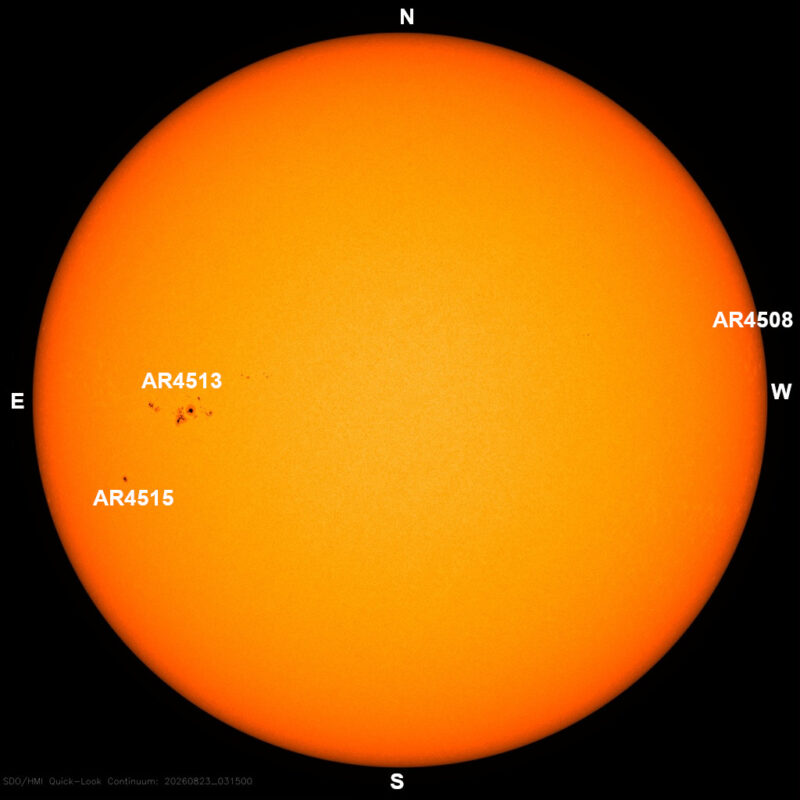
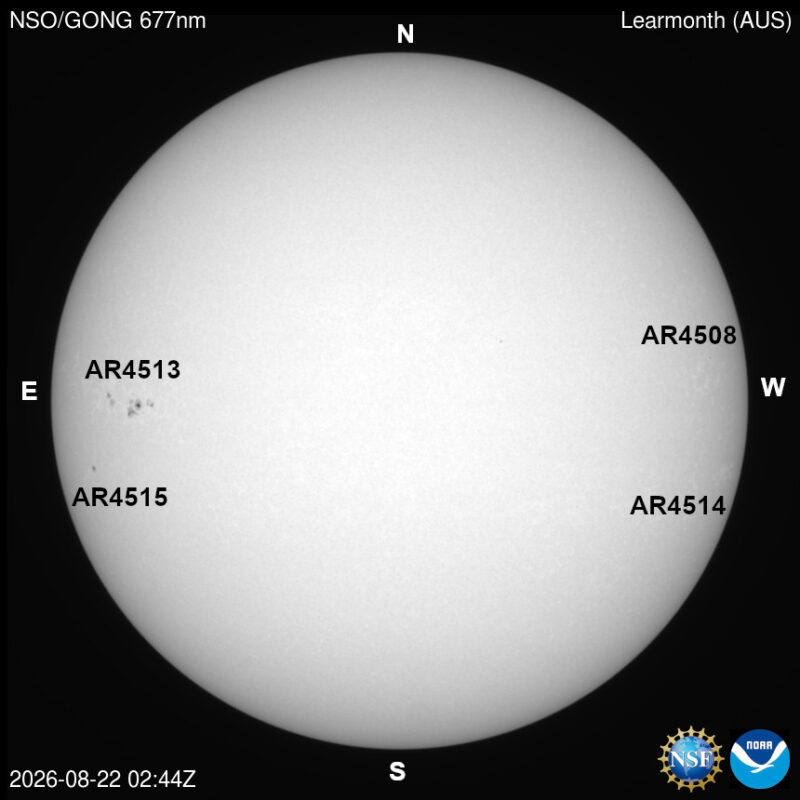
Sunspot regions: The Earth-facing solar disk displayed four numbered active regions over the past day.
- AR4513 (beta-gamma) remained the most significant region on the disk, and was the source of nearly all the flaring.
- AR4517 (beta) grew in both its leader and trailer spots. Still, it kept a relatively simple magnetic structure.
- AR4508 and AR4514 rotated across the western horizon during the period. AR4514 produced two minor C-class flares before departing the visible disk.
- The remaining two smaller regions on the disk were magnetically simple. Neither showed significant activity.
Blasts from the sun? Observers spotted no Earth-directed coronal mass ejections in available coronagraph imagery during the period.
Past 24 hours in space weather
Solar wind: Speeds declined through the period, dropping to a slow background level.
Bt, Bz and magnetic coupling: The interplanetary magnetic field (IMF) stayed weak. The Bz component varied weakly, with no significant or sustained southward intervals. That is unfavorable for aurora production.
Earth’s magnetic field: The field was quiet throughout the entire period, with Kp values of just 1-2. Aurora sightings stayed confined to the far northern auroral zone: Iceland, northern Scandinavia, northern Alaska, and Canada.

The sun in recent days
Sun images from our community
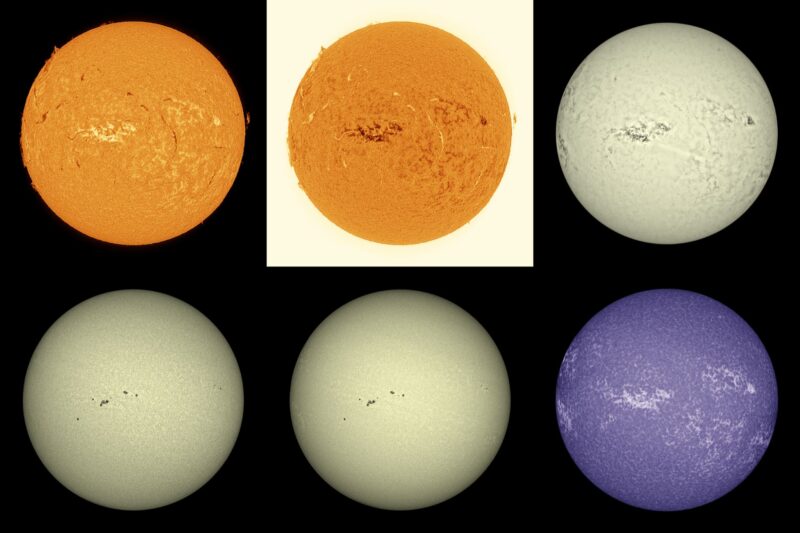
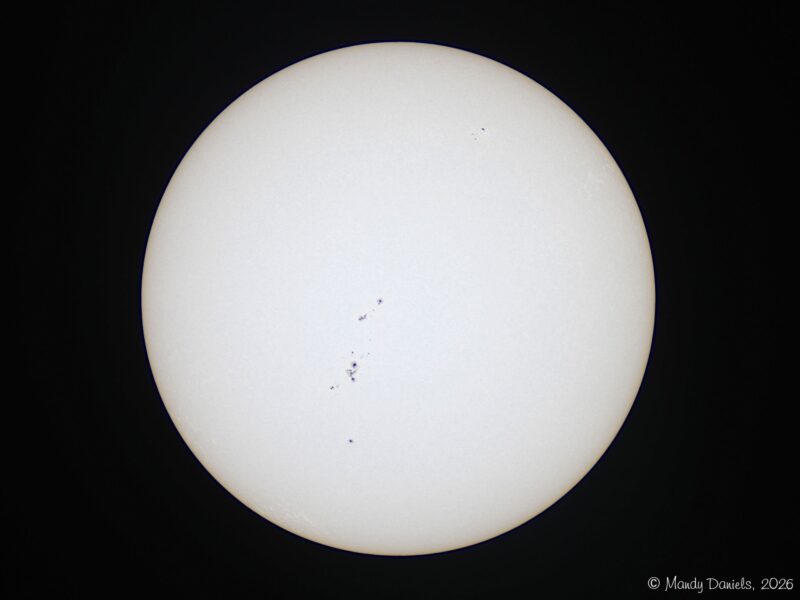
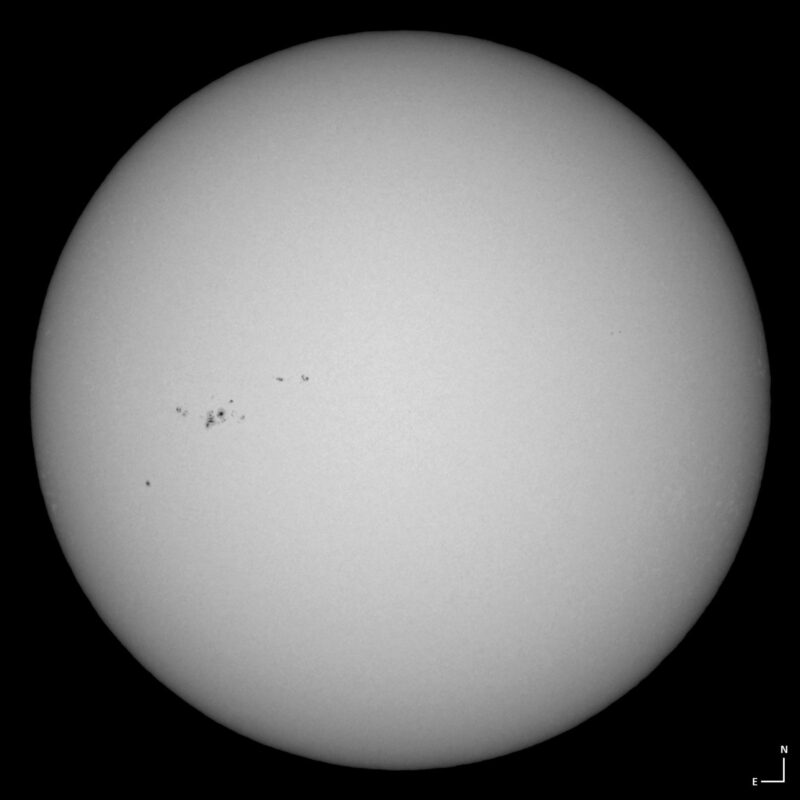
We sometimes feature sun images obtained using hydrogen-alpha filters. Read why.
Bottom line: Sun news August 25, 2026: AR4513 roared back to life with five M flares, capped by an M7. Sun-stuff from that blast could be heading our way.
Like what you read?
Subscribe and receive daily news delivered to your inbox.
More from
C. Alex Young


Sun activity archive for July 2026

Sun activity archive for June 2026
Sun activity archive for May 2026
Sun activity archive for April 2026


