Sun news October 14: Solar wind disturbs our magnetic field

Today’s top story: The anticipated fast solar wind from a coronal hole did arrive over the past day, disturbing our planet’s magnetic field. However, the forecast G1 (minor) geomagnetic storm did not occur. That’s because the expected coronal mass ejections (CMEs) only gave Earth a mild glancing blow. Meanwhile on the sun itself, the very active region of the past few days — AR4549 — continued flaring, even now it’s rotated to the far side of our star. In fact, this now-hidden region was the past day’s top flare producer. We’ve been watching its continued fiery activity in the form of a gorgeous long-lasting prominence on the northwest solar horizon.
Past 24 hours on the sun
(11 UTC October 13 – 11 UTC October 14)
Flare activity: Solar activity kept at low levels. Observers recorded 10 flares during the period: five C-class (common) and five B-class (weak).
- Strongest flare: A C7.0 flare from AR4549, peaking at 2:21 UTC on October 14.
- Other notable flares: On October 13; a C1.1 from AR4551 at 12:42 UTC, a C4.3 from AR4549 at 16:32 UTC and a C1.1 from AR4549 at 2221 UTC. On October 14; a C1.1 from AR44551 at 3:56 UTC.
- Lead flare producer: AR4549 stays at the top of the list with eight flares in total; three C-class and five B-class flares.
Sunspot regions: Today our sun shows five numbered sunspot regions on its side we see from Earth.
- AR4548 (alpha magnetic complexity): This region kept its alpha configuration and remained stable. It didn’t produce any flares.
- AR4551 (beta-gamma): This region regained its gamma complexity and is the largest sunspot group currently. It blasted out a couple of C flares during the period.
- AR4554 (beta): Having been recently numbered, this region rapidly grew to a beta configuration and became the lead flare producer.
- AR4455 (beta): This active region reemerged from becoming a simpler plage, or bright area.
- AR4556 (beta): Newcomer numbered during the past day.
Blasts from the sun? No new Earth-directed CMEs registered during the past 24 hours.
Past 24 hours in space weather
Solar wind: Solar wind increased from moderate to moderate-high levels during the period, as fast solar wind from a coronal hole arrived.
Bt, Bz and magnetic coupling: The total interplanetary magnetic field (Bt) started the period at strong levels but at around 21 UTC on October 13 it decreased to weak strength. The Bz component’s orientation was mostly north through the entire period, limiting the chance for auroras.
Earth’s magnetic field: The geomagnetic field kept at low to unsettled levels during the period (Kp 1-3). At the time of this report the Kp index sits just above level 3.
What’s ahead? Sun–Earth forecast
Flare activity forecast: The expectation of solar activity decreased to low. Chances for M-class (moderate) flares are reduced to 20% today compared to 35% yesterday. Chances for X-class (strong) flares remained at 5%. The drop in activity reflects AR4549’s departure from the Earth-viewed solar disk.
Geomagnetic activity forecast:
- October 14: Unsettled to active conditions expected as effects from a coronal hole high-speed stream continue. An isolated G1 (minor) geomagnetic storm is possible.
- October 15: Quiet conditions might return as the fast wind from a coronal hole starts to fade.
- October 16: Quiet conditions might be extended through the day.
Sun news October 13: Auroras tonight? Sun-stuff and solar wind incoming
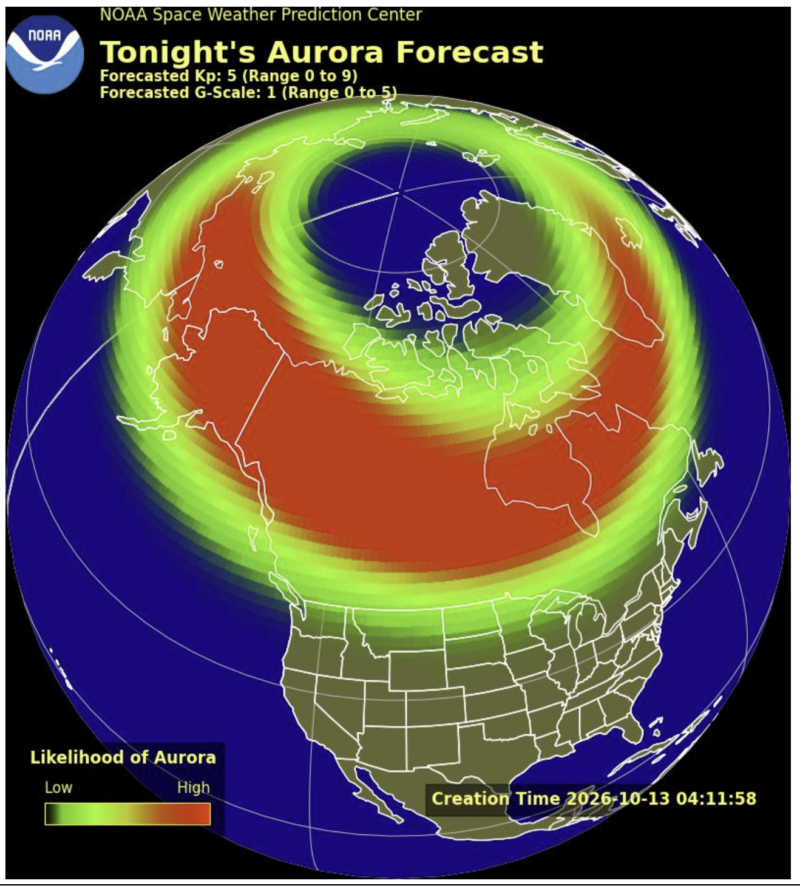

Fast solar wind is currently streaming to Earth from a coronal hole, or an area of lower density in the sun’s atmosphere. When this stream arrives today, it’s expected to disturb our planet’s geomagnetic field to G1 (minor) geomagnetic storm levels. And conditions could escalate to G2 (moderate) levels after a burst of sun-stuff — a coronal mass ejection (CME) — gives Earth an anticipated glancing blow later today. Together, these effects could combine to trigger auroras tonight at northerly latitudes.
Past 24 hours on the sun
(11 UTC October 12 – 11 UTC October 13)
Flare activity: Solar activity continued at low levels. Observers recorded 5 flares during the period: 4 C-class (common) and 1 B-class (weak).
- Strongest flare: A C1.2 flare from AR4549, peaking at 3:40 UTC on October 13.
- Other notable flares: Three C1s occurred during the period. The first one from AR4549 peaking at 19:16 UTC, the second from AR4554 at 20:39 UTC and the third from AR4549 again, peaking at 23:53. The three flares were produced on October 12.
- Lead flare producer: AR4549 was on top of the list with three C-class flares.
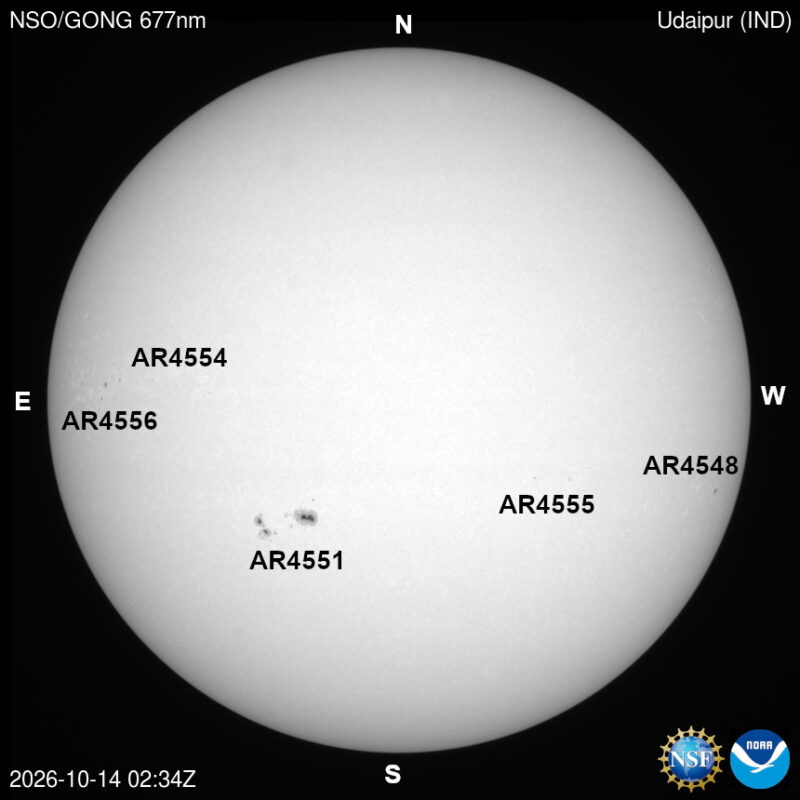
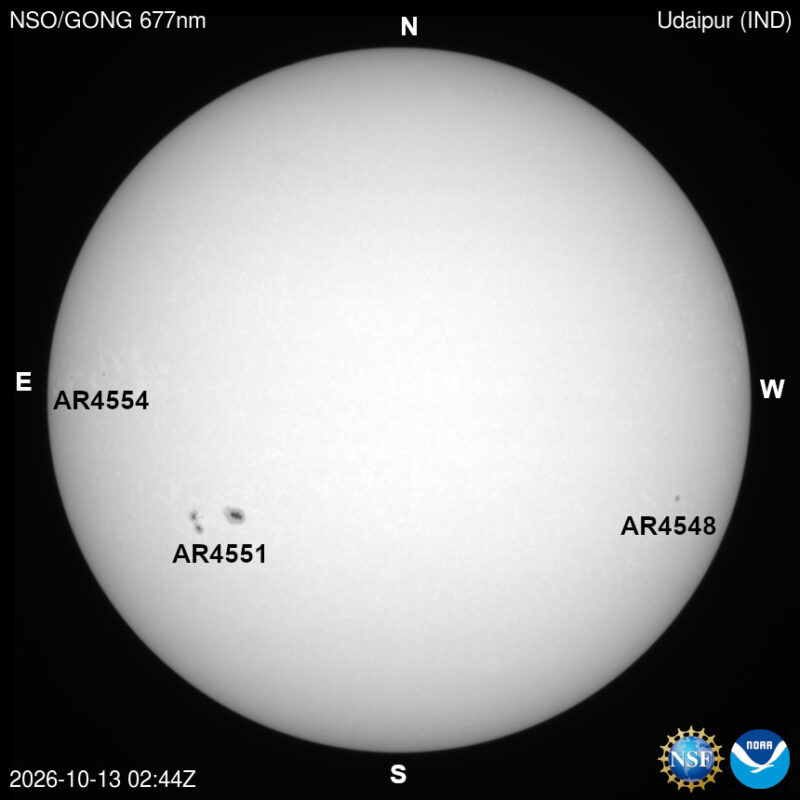
Sunspot regions: Currently three numbered sunspot regions populate the visible disk.
- AR4548 (alpha): This region decayed to a simpler alpha configuration and didn’t produce any flares.
- AR4551 (beta): This region lost its gamma complexity during this period. It remained stable and did not produce flares.
- AR4554 (beta): Having been recently numbered, this region rapidly grew to a beta configuration and became the lead flare producer.
Blasts from the sun? No new Earth-directed CMEs registered during the past 24 hours. A couple of filament eruptions were observed. They both came from the same area in the southeast quadrant. Plasma could be seen hurled into space during the events. The first one at around 22 UTC on October 11 and the second at around 4:30 UTC on October 12. Initial analysis suggests the two events are ahead of Earth’s direction. However, a minor glancing blow on October 14 may bring a slight disturbance on Earth’s magnetic field.
Past 24 hours in space weather
Solar wind: Solar wind averaged at moderate levels during the period, mainly driven by fast solar wind from a coronal hole.
Bt, Bz and magnetic coupling: The total interplanetary magnetic field (Bt) started at weak levels but there was a peak at 0 UTC on October 13 that rose to strong levels. It lasted for about an hour to return to moderate strength. The Bz component pointed northward throughout, limiting geomagnetic coupling.
Earth’s magnetic field: The geomagnetic field showed from low to unsettled levels during the period (Kp 1 – 3). At the time of this report the Kp index sits at level 2.
Sun news October 12: Sun-stuff and solar wind on the way
A fast blob of sun-stuff — a coronal mass ejection (CME) — could give Earth a glancing blow later today. The sun fired this CME our way during an M6.4 (moderate) flare on Saturday. If it does reach us, it could add to the effects of high-speed solar wind currently streaming to us from a coronal hole. Together, these effects could disturb our magnetic field to G1 (minor) geomagnetic storm levels. In fact, the U.K. Met Office sees a chance of G2 (moderate) or even G3 (strong) levels. Aurora-watchers across the northern U.K, northern U.S. states, southern New Zealand and similar geomagnetic latitudes should stay alert!
Past 24 hours on the sun
(11 UTC October 11 – 11 UTC October 12)
Flare activity: Solar activity stayed at low levels. Observers recorded 8 flares during the period: 6 C-class (common) and 2 B-class (weak).
- Strongest flare: A C1.2 from AR4545, peaking at 17:01 UTC on October 11.
- Other notable flares: AR4549 contributed a C1.1, peaking at 22:37 UTC on October 11.
- Lead flare producer: AR4545 led the list with three C-class flares.
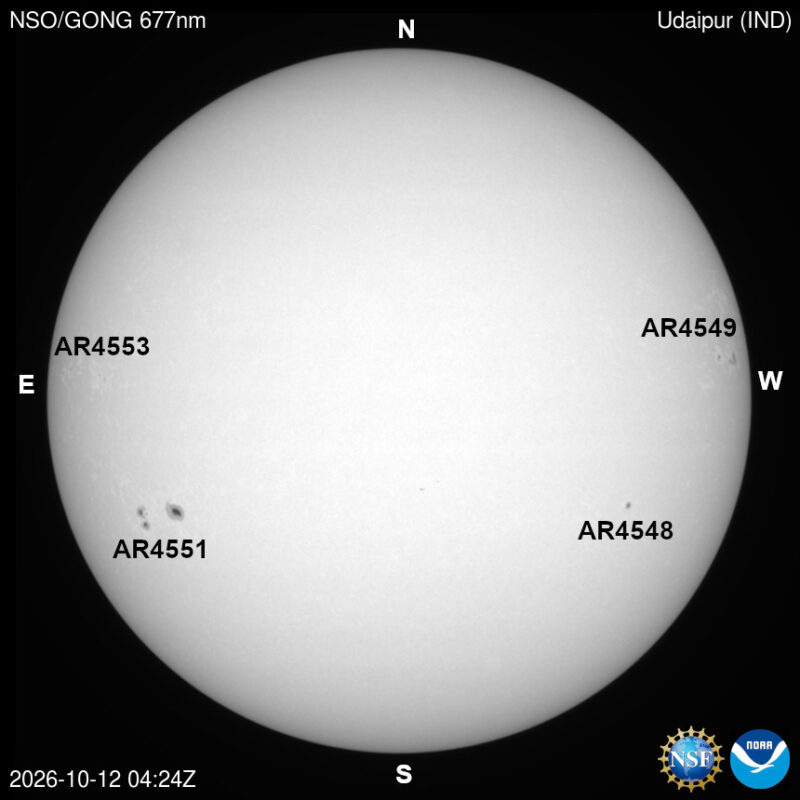
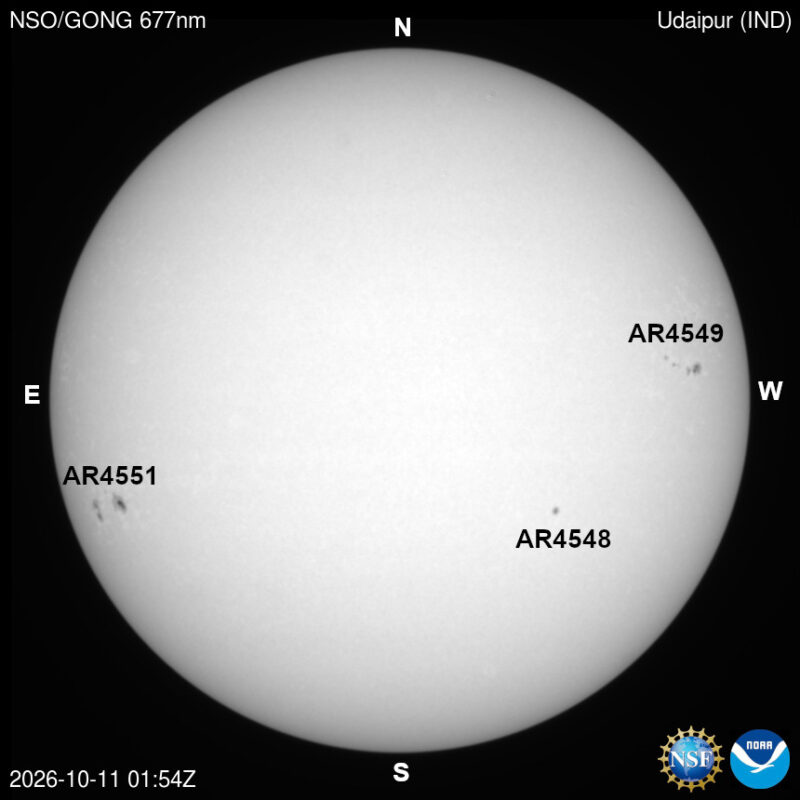
Sunspot regions: Five numbered sunspot regions populated the visible disk, including one newcomer. A sixth, AR4552, decayed to plage.
- AR4549 (beta-delta): This region remained the most magnetically complex on the disk. However, it’s getting very close to the western horizon, which is making classification increasingly difficult. It produced only one minor C flare during the period. Still, forecasters consider it the main source of possible M-class and X-class (strong) flares in the days ahead.
- AR4545 (beta): This region saw new magnetic field emergence during the period. It was also the most prolific flare producer, firing the strongest flare (C1.2) plus two other C-class events. Even so, analysts noted overall decay in the region.
- AR4551 (beta-gamma): This region grew in both size and magnetic complexity. It’s now the largest region on the disk. Despite that growth, it stayed mostly quiet, producing only B-class flares during this window.
Blasts from the sun? Observers detected no new Earth-directed CMEs during the past 24 hours. However, the October 10 CME from AR4549’s M6.4 flare remains of interest.
Past 24 hours in space weather
Solar wind: Solar wind steadily decreased to a little above normal, reflecting the fading effects of the October 10 CME arrivals.
Bt, Bz and magnetic coupling: The total interplanetary magnetic field (Bt) started strong and slowly decreased to moderate, before dropping sharply to near-normal levels. The Bz component pointed northward throughout, limiting geomagnetic coupling.
Earth’s magnetic field: The geomagnetic field started the period at active levels (Kp 4). Conditions then eased to quiet as CME effects waned.
The sun in recent days
Earlier sun images
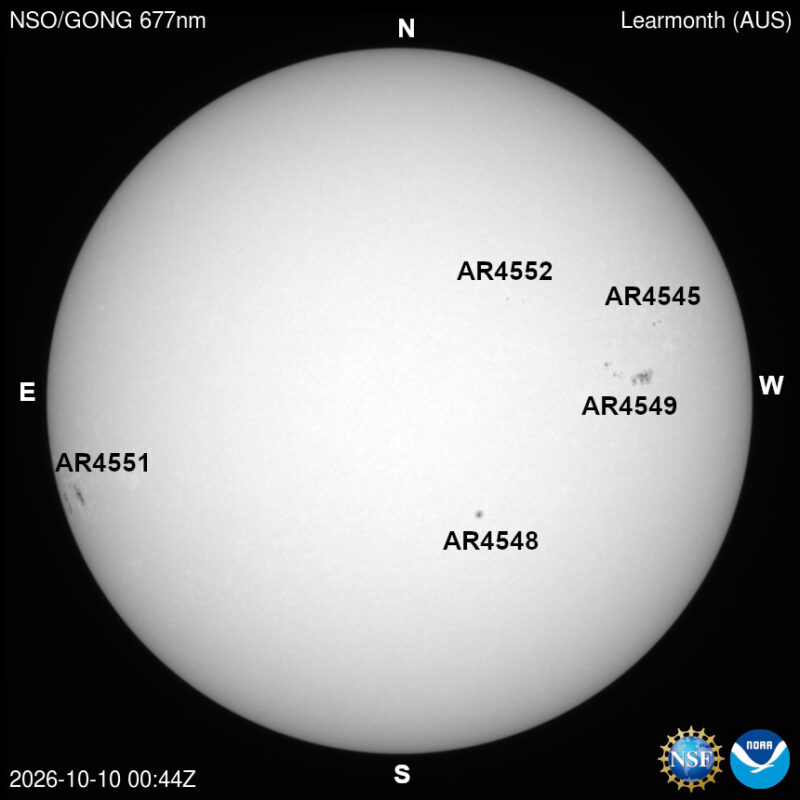
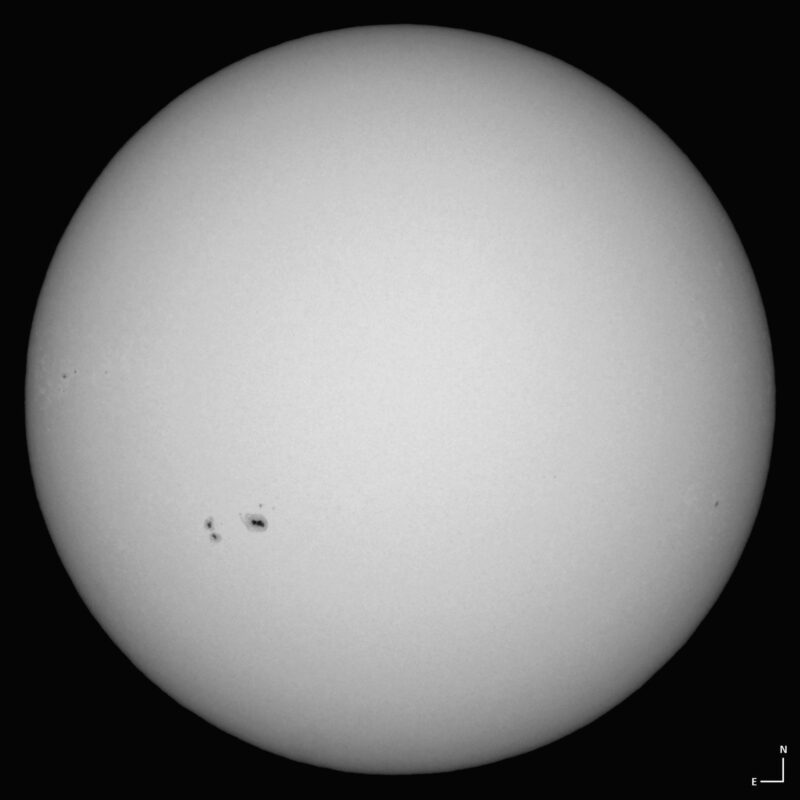
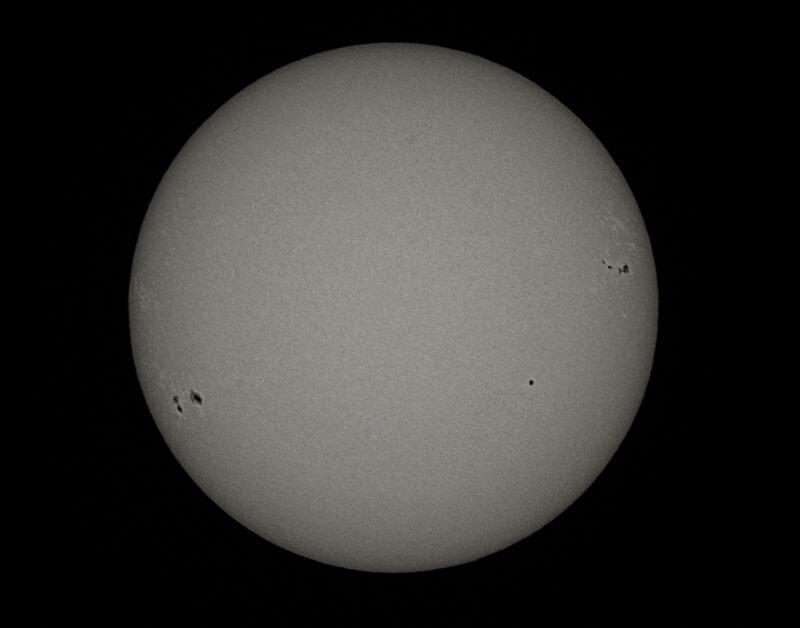
Sun images from our community
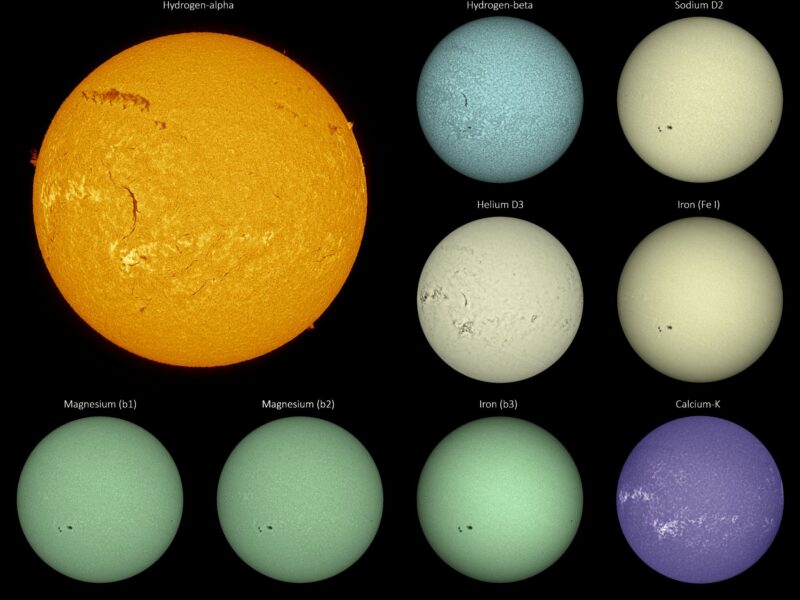
We sometimes feature sun images obtained using hydrogen-alpha filters. Read why.
Bottom line: Sun news, October 14, 2026: Fast solar wind from a coronal hole did arrive, but did not trigger G1 storm levels. Now-departed AR4549 stole the show with long lasting prominences on the solar northwest.
Like what you read?
Subscribe and receive daily news delivered to your inbox.
More from
C. Alex Young


Yes, there’s an aurora season, and it’s here

Sun activity archive for September 2026
Sun activity archive for August 2026
Sun activity archive for July 2026