



Sun news April 30: Prolific region is back after a trip round the sun
(11 UTC to 11 UTC)

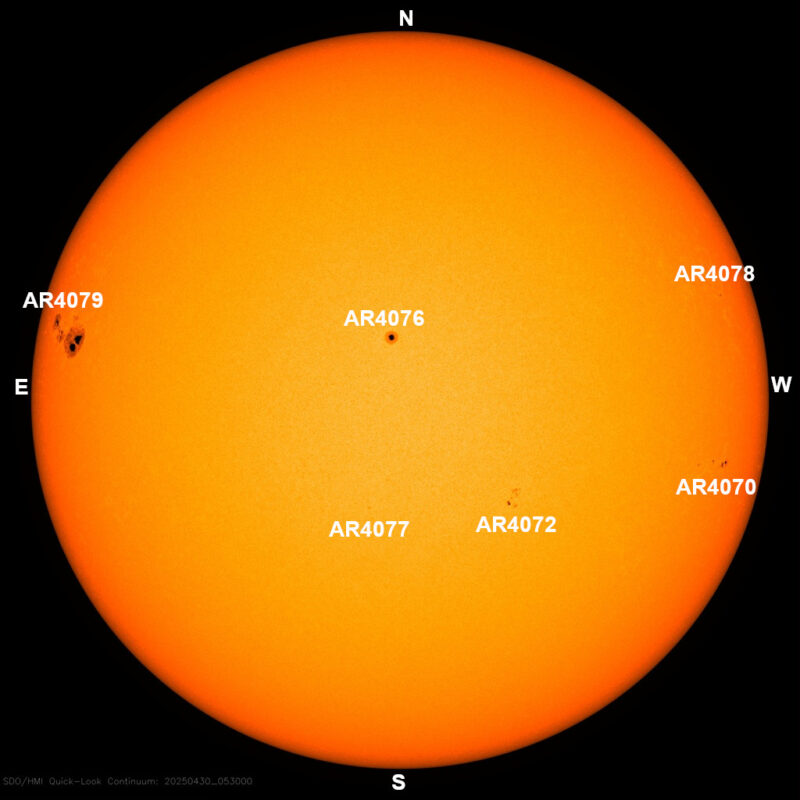
The spotlight is on AR4079: a giant, newly arrived sunspot group. It may have only just rotated onto the Earth-viewed sun, but it seems we’ve seen this region before. AR4079 appears to be the return of AR4055, which was a prolific M-flare producer when it was on the Earth-facing sun last month. It now appears to have rotated round the sun and back onto its visible face. And it’s still looking potent! Now labeled AR4079, it made its presence known this morning with an M2.1 flare. And as the region rotates further into view, specialists have identified a promising beta-gamma complexity. It is already the largest active region currently on the solar disk and has quickly become the lead flare producer, delivering two M flares in as many days. Expect more M-class and possibly X-class activity as this impressive region begins another journey across the Earth-viewed face of the sun.
- Flare activity remained moderate over the past 24 hours with the production of two M (moderate) flares. The largest event was an M2.1 flare at 7:51 UTC on April 30 from active region AR4079. Shortly after the blast, an R1 (minor) radio blackout affected an area over the Arabian Sea. The second largest event was an M1.7 from AR4078 that ended at 11:14 UTC on April 29. It produced an R1 (minor) radio blackout over the north Africa. The sun produced 10 flares during the past 24 hours: the two M flares and eight C flares. AR4079 is the day’s biggest flare producer, with four C flares and one M flare.
- The sun has six numbered active regions on its Earth-facing side. Active region AR4079 in the northeast shows a beta-gamma magnetic configuration, indicating good flaring potential. AR4070 lost its gamma configuration and the remaining sunspot regions have simpler alpha or beta configurations.
- Blasts from the sun? No Earth-directed coronal mass ejections (CMEs) were observed in the available coronagraph imagery.
- Solar wind: Solar wind averaged between ~417–450 km/s (~932,802-1,007,000 mph). At the time of this writing (11 UTC on April 30), the solar wind speed is ~428 km/s (about 957,409 mph). The total interplanetary magnetic field is at a low level. The Bz component (north-south orientation) was mostly oriented southward during the period. At the time of this writing, it has turned northward. A southward Bz is more favorable for auroras.
- Geomagnetic activity: Earth’s geomagnetic field was at quiet levels (between Kp = 1 – 2) over the past 24 hours.
What’s ahead? Sun-Earth forecast
- Low-to-moderate flare activity is expected in the coming day. The chance for M (moderate) flares increased from 20% yesterday to 50%, and the chance for X (strong) flares increased from 1% yesterday to 10% today. These increases are largely thanks to the appearance of active region AR4079.
- Geomagnetic activity forecast: At the time of this writing (11 UTC on April 30), geomagnetic activity is quiet at a Kp = 3 level. Mostly quiet conditions are expected for the rest of the day through June 1. G1 (minor) geomagnetic storming may occur on June 2 due to an incoming high-speed solar wind stream.
Sun news April 29: It’s here. Mammoth sunspot region now visible
(11 UTC to 11 UTC)

The long-anticipated giant sunspot region has finally made its appearance. And it’s making a bold entrance! Just designated as AR4079, this massive newcomer rolled into view over the sun’s northeast limb (edge), carried by the sun’s rotation. It immediately fired off the first M-class (moderate) flare we’ve seen in days, and produced a noticeable uptick in flare activity over the past day. Although it’s still hugging the solar limb — meaning its full size and magnetic complexity can’t be fully analyzed yet — it already appears to be the largest sunspot region on the visible solar disk. Stay tuned! As the sun’s rotation carries AR4079 into better view, specialists will get a clearer look — and we’ll bring you all the fiery details!
- Flare activity jumped to moderate over the past 24 hours, with the production of two M (moderate) flares. Flare productivity increased from six C (common) flares yesterday to 19 flares in total during the past day: the two M flares and 17 C flares. The largest event was an M1.7 flare from new region AR4079 at 5:13 UTC on April 29. Shortly after the blast, an R1 (minor) radio blackout affected an area over Thailand. The second M (moderate) flare of the period was an M1.3 from AR4078 at 10:02 UTC on April 29. It produced a correspondent R1 (minor) radio blackout over Egypt. AR4079 was the day’s biggest flare producer, with 12 flares, one M included.
- The sun has eight numbered active regions on its Earth-facing side. Active region AR4070 in the southwest developed a beta-gamma magnetic configuration, indicating more flare potential. The remaining sunspot regions show simpler alpha or beta configurations.
- Blasts from the sun? No Earth-directed coronal mass ejections (CMEs) were observed in the available coronagraph imagery.
- Solar wind: Solar wind averaged between ~350–450 km/s (~782,900-894,800 mph) with a peak up to 1,147 km/s (2,565,766 mph). At the time of this writing (11 UTC on April 29), the solar wind speed is about 399 km/s (about 892,538 mph). The total interplanetary magnetic field is at a low level. The Bz component (north-south orientation) has been mostly south oriented during the period. At the time of this writing, it turned into north directed. A southward Bz is more favorable for auroras.
- Geomagnetic activity: Earth’s geomagnetic field was at quiet levels (between Kp = 1 – 2) over the past day.
Sun news April 28: See the moon photobomb the sun!

The moon passed in front of our star yesterday morning, from the perspective of NASA’s sun-observing SDO spacecraft. Astronomers call this a transit, when a space object passes in front of a larger body. And from SDO’s point of view, it was a partial solar eclipse! From its geostationary orbit – when a satellite appears stationary from Earth – SDO is used to seeing these lunar transits. And it also experiences two “eclipse seasons” every year, when Earth blocks its view of the sun for a short period every day for several weeks.
(11 UTC to 11 UTC)
- Flare activity was low over the past 24 hours, with six C (common) flares fired. The largest event was a C2.3 flare from AR4067. The blast occurred at 5:46 UTC on April 28.
- The sun has nine numbered active regions on the Earth-facing disk. All the active regions on the solar disk show low flaring potential, with either alpha or beta magnetic configurations. However, helioseismic observations have detected a large active region on the far side of the sun. This region, currently out of Earth’s view, will rotate into view in the coming days, possibly bringing some solar action.
- Blasts from the sun? No Earth-directed coronal mass ejections (CMEs) were observed in available coronagraph imagery.
- Solar wind: Solar wind averaged between ~350–450 km/s (~782,900-894,800 mph) with a peak up to 535 km/s (1,197,000 mph). At the time of this writing (11 UTC on April 28), the solar wind speed is about 386 km/s (about 863,457 mph). The total interplanetary magnetic field is at a low level. The Bz component (north-south orientation) has been northward most of the period. A southward Bz is more favorable for auroras.
- Geomagnetic activity: Earth’s geomagnetic field was at quiet levels (between Kp = 0 – 2) over the past day.

Sun news April 27: It’s a quiet sun day
(11 UTC to 11 UTC)

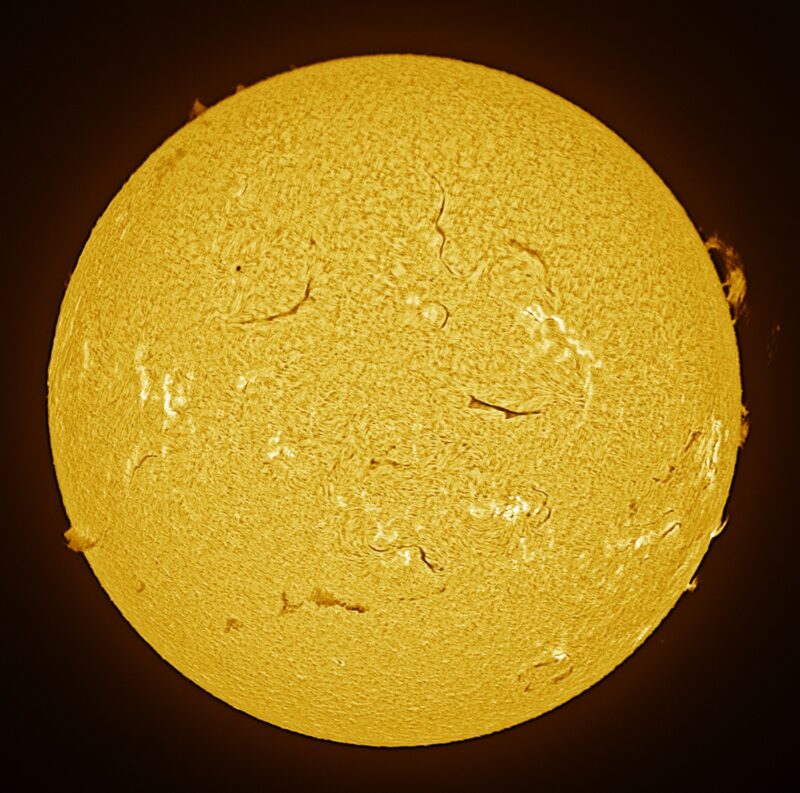
Happy quiet sun day! The past day has been calm on the sun, with only two C (common) flares. There could be more action around the corner: a region just over the sun’s southeast limb (edge), observed via helioseismology, shows promise. We might already have observed some of its presence, in the form of eruptions over the limb (edge). In the meantime, two beautiful filaments erupted from the sun’s southeast quadrant. One from filaments was curved in a sigmoid (s-like) structure over AR4075 and erupted around 10 UTC on April 26. The other filament was lying across the solar disk just southeast of AR4075 and it erupted at about 13 UTC on April 26, 2025. Neither event is likely to have an Earth-directed component, but further analysis is needed to be more certain.
- Flare activity was low over the past 24 hours, with only two C (common) flares. The largest event was a C1.3 flare from a region in the sun’s southeast. The blast occurred at 8:18 UTC on April 27.
- The sun has 12 numbered active regions on the Earth-facing disk. All the active regions on the solar disk show low flaring potential, either alpha or beta magnetic configurations.
- Blasts from the sun? No Earth-directed coronal mass ejections (CMEs) were observed in available coronagraph imagery.
- Solar wind: Solar wind averaged between ~450 to ~400 km/s (1,007,000 mph to 894,775 mph) with a peak up to 475 (1,063,000 mph). At the time of this writing (11 UTC on April 26), the solar wind speed is about 415 km/s (about 941,750 mph). The total interplanetary magnetic field is at a low level. The Bz component (north-south orientation) has been northward most of the period. A southward Bz is more favorable for auroras.
- Geomagnetic activity: Earth’s geomagnetic field was at quiet levels (between Kp = 1 – 2) during the past day. Whatever minor effects were there were due to fast solar wind from the huge coronal hole becoming weaker.
What’s ahead? Sun-Earth forecast
- Low-to-moderate flare activity is expected in the coming day. The chance for M (moderate) flares is 25%, and the chance for X (strong) flares is 1% today.
- Geomagnetic activity forecast: At the time of this writing (11 UTC on April 27), geomagnetic activity is quiet at a Kp = 1 level. Quiet-to-unsettled conditions are expected for the rest of the day through April 27 as the high-speed solar wind continues to wane.
Sun news April 26: Fiery action on the eastern horizon
(11 UTC to 11 UTC)
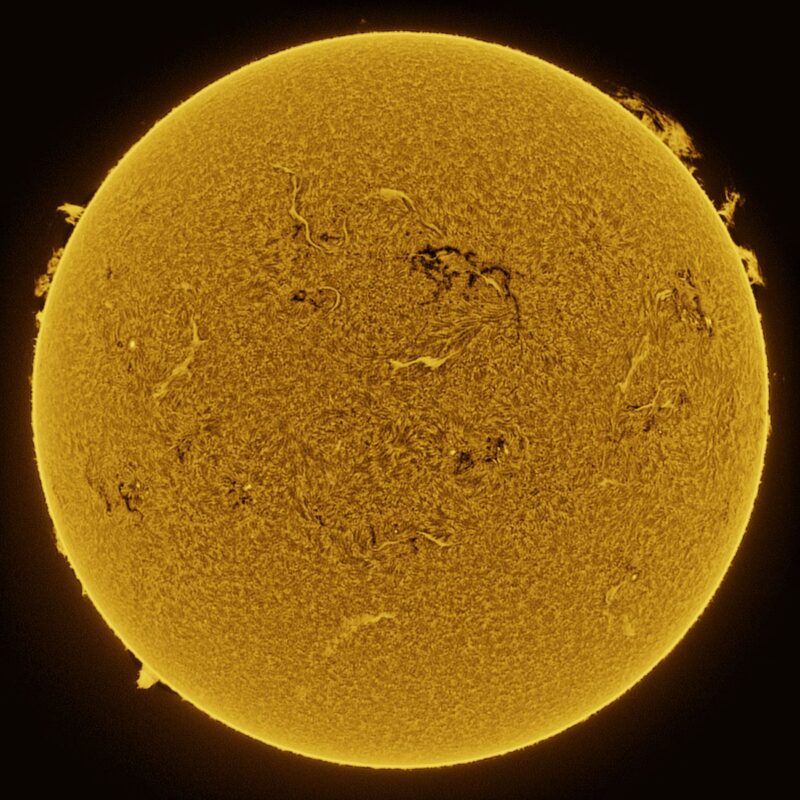
After several days of quiet, where the sun has appeared to be in a lull, we now can see a large, active region churning on the sun’s far side, just beyond the eastern (incoming) limb. How can we see it on the far side of the sun? The answer is helioseismology, essentially using the sun’s vibrations, or “sound waves,” to probe its interior, much as seismic waves from earthquakes let us probe Earth’s interior. As our star rotates, this far-side region will soon come into view, potentially bringing renewed flare activity and space weather impacts. Stay tuned for updates.
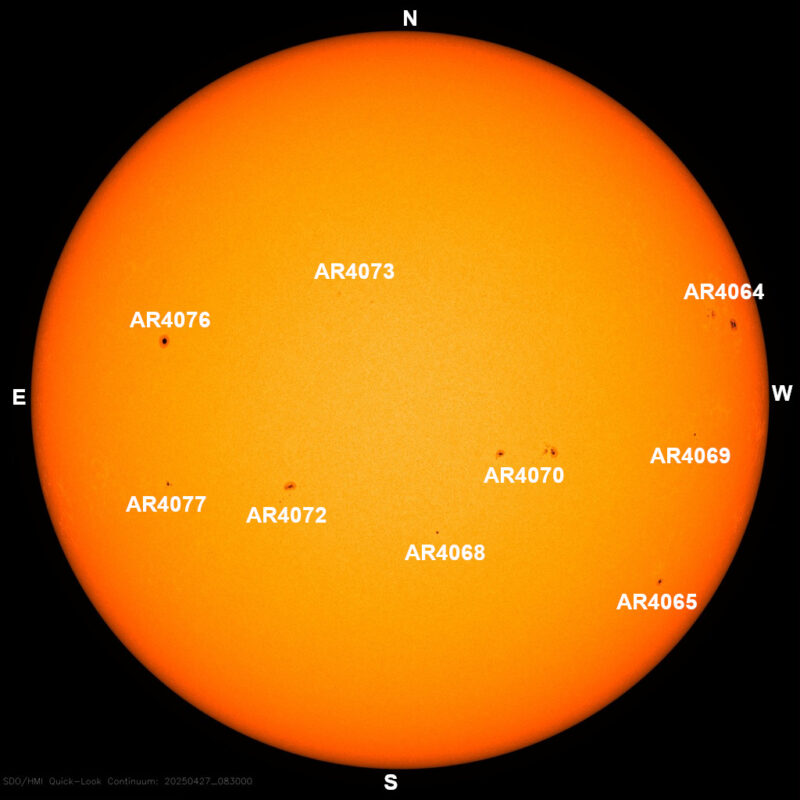
- Flare activity was low over the past 24 hours, with only eight C (common) flares. The largest event was a C1.6 by active region AR4075 in the sun’s southeast. The blast occurred at 10:07 UTC on April 26. This sunspot region, AR4073 produced four of the eight C flares of the day.
- The sun has 11 numbered active regions on the Earth-facing disk. All the active regions on the solar disk show low flaring potential, either alpha or beta magnetic configurations. There are three newcomers. AR4074 emerged in the southwest near the limb (edge), plus we now see AR4076 in the northeast and AR4077 in the southeast.
- Blasts from the sun? No Earth-directed coronal mass ejections (CMEs) were observed in available coronagraph imagery.
- Solar wind: Solar wind averaged around 430 km/s (about 961,883 mph) with a peak up to 600 Km/s (1,342,000 mph). At the time of this writing (11 UTC on April 26), the solar wind speed is about 421 km/s (about 941,750 mph). The total interplanetary magnetic field is at a low to moderate level. The Bz component (north-south orientation) has been northward most of the period but turned southward briefly at the time of this writing. A southward Bz is more favorable for auroras.
- Geomagnetic activity: Earth’s geomagnetic field was at quiet levels between Kp = 1 – 2 during the observation period. This is due to the effects of fast solar wind from the huge coronal hole becoming weaker.


Sun news April 25: A sun snooze before the weekend?
(11 UTC to 11 UTC)
Over the past day, the sun produced fewer and lower-level flares. But not all is quiet on the sun. Remember that yesterday we reported a beautiful prominence, a huge rope of solar material and magnetic fields extending from the sun’s visible edge. Over the past day, the northwest horizon continued showing solar activity, originating from the sun’s far side. Meanwhile, on the Earth-viewed side of the sun, the filament channel activation we reported yesterday – where we can see plasma flowing along a filament channel on the sun – continued all day over the past day, too. And we saw the development of a sigmoid structure, a filament taking the shape of an “S,” at the center of the sun’s disk. The sun always has more!
- Flare activity continues at low levels, with only C (common) flares during the past 24 hours. This time, the largest flare was a C3.0 by an-as-yet-unnumbered incoming active region in the sun’s southeast. The blast took place at 4:05 UTC on April 25. Flare productivity decreased dramatically with only 6 C flares compared to 16 over the previous day.
- Today, the sun has nine numbered active regions on its Earth-facing side. Active region AR4070 lost its gamma region and is now showing a beta magnetic configuration. Similarly, all the rest of the sunspot regions currently have simpler alpha or beta magnetic configurations (and, therefore, lower flaring potential). There is a newcomer on the solar disk, AR4073, that emerged in the middle of the northeast quadrant.
- Blasts from the sun? No coronal mass ejections (CMEs) were observed in available coronagraph imagery.
- Solar wind: Solar wind averaged 500 km/s (about 1,133,000 mph) with peaks up to 570 Km/s (1,275,000 mph). At the time of this writing (11 UTC), the solar wind speed is about 461 km/s (about 1,031,000 mph). The solar wind reflects the waning influence of the high-speed solar wind stream from the huge coronal hole. The total interplanetary magnetic field is at a low to moderate level. The Bz component (north-south orientation) has been northward most of the time during the period. A southward Bz is more favorable for auroras.
- Geomagnetic activity: Earth’s geomagnetic field was at quiet-to-unsettled levels. Kp 4 level reached at 12 UTC on April 24. The rest of the period at (Kp = 2 -3) as effects of fast solar wind from the huge coronal hole were waning.


Sun news April 24: Spectacular prominence signals far side action
(11 UTC to 11 UTC)
A beautiful prominence – a huge rope of solar material and magnetic fields – erupted on the sun’s northwest limb (edge) in the past day. This solar tendril, far larger than Earth, likely originated in an explosion from a sunspot region just over the horizon. With the Earth-facing side of the sun relatively calm today, only featuring C-class flares, it seems the party is on the other side for now.
- Flare activity dropped to low levels over the past 24 hours with only C (common) flares. The largest event was a C3.9 from active region AR4064 in the sun’s northwest at 14:55 UTC on April 23. Flare productivity increased, with 16 C flares fired over the past day compared to six the previous day.
- The sun currently has eight numbered active regions on its Earth-facing side. Active region AR4070 developed a gamma region, now showing a beta-gamma magnetic configuration. All the rest of the sunspot regions have simpler alpha or beta magnetic configurations (and, therefore, lower flaring potential). There is a newcomer on the solar disk, AR4072, in the southeast quadrant.
- Blasts from the sun? No coronal mass ejections (CMEs) were observed in available coronagraph imagery.
- Solar wind: Solar wind averaged 500 km/s (about 1,133,000 mph) and peaked at 644 Km/s (1,440,000 mph). At the time of this writing (11 UTC), the solar wind speed is about 520 km/s (about 1,163,000 mph). This is the influence of a high-speed solar wind stream from the huge coronal hole, although this is waning. The total interplanetary magnetic field is at a moderate level. The Bz component (north-south orientation) has been mostly southward during the period and still is southward at the time of this writing. A southward Bz is more favorable for auroras.
- Geomagnetic activity: Earth’s geomagnetic field was at quiet-to-unsettled levels (Kp 3-4) as effects of fast solar wind from the huge coronal hole started to wane.


Sun news April 23: Goodbye and hello to colossal coronal holes
(11 UTC to 11 UTC)
Fast solar wind from a massive coronal hole on the south of the solar disk has been disturbing Earth’s magnetic field. It triggered G1 (minor) and G2 (moderate) geomagnetic storms. But now these effects are beginning to wane, as this huge coronal hole move out of geoeffective position, that is, a position on the sun where it is capable of affecting Earth. But wait! As this huge coronal hole leaves, another pretty big coronal hole is moving into position. The high speed solar wind from this second hole might start reaching us at Earth soon. And that could mean more auroras at high latitudes! Keep watching, aurora chasers.
- Flare activity remained at moderate levels again during the past 24 hours, thanks to an isolated M (moderate) flare. The flare was an M1.3 from active region AR4060 in the sun’s northwest at 11:34 UTC on April 22. It caused an R1 (minor) radio blackout that affected an area over Africa. Flare productivity was at the same level as yesterday, six flares, one M flare and five Cs.
- The sun has nine numbered active regions on its Earth-facing side. All the sunspot regions have simple alpha or beta magnetic configurations (and subsequent low flaring potential). There are three newcomers on the solar disk, AR4069 near the disk center, AR4070 in the southeast quadrant and AR4071 in the southwest near the limb (edge).
- Blasts from the sun? Three coronal mass ejections (CMEs) were observed in available coronagraph imagery. One from AR4065 at 9:36 UTC on April 22 might give Earth a glancing blow on April 25.
- Solar wind: Solar wind averaged 500 km/s (about 1,233,000 mph). At the time of this writing (11 UTC), the solar wind speed is about 468 km/s (about 1,047,000 mph). All this continued under the influence of high-speed solar wind stream from the coronal hole, but effects have begun to wane. Specialists anticipate a return to high levels of the solar wind up to 600 – 700 Km/s. The total interplanetary magnetic field now at low level. The Bz component (north-south orientation) has been mostly north oriented during the period but it moved southward at the time of this writing. A southward Bz is more favorable for auroras.
- Geomagnetic activity: Earth’s geomagnetic field was at quiet levels (Kp = 3) as effects of fast solar wind from the huge coronal hole started to wane.


Sun news April 22: Solar wind surge could bring auroras
(11 UTC to 11 UTC)

Earth’s magnetic field is currently being buffeted by a surge of fast solar wind, which is coming from a massive coronal hole on the south of the solar disk. This has already triggered a G1 (minor) geomagnetic storm, and G2 (moderate) storming is possible tonight. And that could mean auroras at high latitudes! Keep an eye out, aurora chasers.
- Flare activity remained at a moderate level over the past 24 hours thanks to an isolated M (moderate) flare. The M1.9 flare came from active region AR4062 in the southwest at 18:37 UTC on April 21. It caused an R1 (minor) radio blackout that affected an area over Mexico. Flare productivity reduced to seven flares in the past 24 hours (one M flare and six Cs), down from 11 the day before. One of these C flares was a C9.9, so just a hair from being an M flare. It came from an as-yet-unnumbered region in the southeast at 1 UTC on April 22.
- The sun currently has seven numbered active regions as seen from Earth. Sunspot region AR4062 lost its gamma configuration and now all the sunspot regions have simpler alpha or beta configurations. Magnetic complexity is a signal for possible strong flaring. The more complex, the greater the chance for M and X flares.
- Blasts from the sun? No Earth-directed coronal mass ejections (CMEs) were observed in available coronagraph imagery during the past 24 hours.
- Solar wind: Solar wind speeds increased, averaging 620 km/s (about 1,387,000 mph) and peaking at 700 km/h (1,566,000). At the time of this writing (11 UTC), the solar wind speed is about 613 km/s (about 1,371,000 mph). This is due to the high-speed solar wind stream from the coronal hole. The total interplanetary magnetic field is increasing. The Bz component (north-south orientation) has been mostly southward during the period but it moved northward at the time of this writing. A southward Bz is more favorable for auroras.
- Geomagnetic activity: Late yesterday, Earth’s geomagnetic field was active, reaching G1 (minor) geomagnetic storming levels (Kp = 5). This activity is due to the arrival of fast solar wind from the huge coronal hole we have been observing.


Sun news April 21: Massive coronal hole sending solar wind our way
(11 UTC to 11 UTC)
Here comes the solar wind! Analysts have noticed an increase in the strength of the interplanetary magnetic field, along with an uptick in solar wind speeds. It’s a shift from a solar breeze to the stirrings of a solar gale, suggesting that Earth is starting to receive an anticipated high-speed solar wind stream from a massive coronal hole in the solar south. If confirmed, this could mean G1–G2 (minor–moderate) geomagnetic storming is on the way, likely tomorrow through Wednesday. Aurora watchers, stay tuned!
- Flare activity increased to a moderate level due to an isolated M (moderate) flare. This M1.0 flare came from over the southeast limb (edge) at 11:37 UTC on April 20. It caused an R1 (minor) radio blackout over Africa. The total flare production increased to 11 flares in the past 24 hours, from four the day before.
- The sun has seven numbered active regions on the Earth-facing disk. AR4062 retained its beta-gamma configuration and remains the only one with a complex magnetic structure. The remaining sunspot regions have simpler alpha or beta configurations. Magnetic complexity is a signal for possible strong flaring. The more complex, the greater the chance for M and X flares.
- Blasts from the sun? No Earth-directed coronal mass ejections (CMEs) were observed in available coronagraph imagery during the past 24 hours.
- Solar wind: Solar wind speeds averaged ~380–435 km/s (about 850,036-973,067 mph), increasing slightly over much of the past 24 hours, then ramping up toward the end of the period. At the time of this writing (11 UTC), the solar wind speed is about 520 km/s (about 1,163,000 mph). This could be the beginnings of the expected high-speed stream from a coronal hole. The total interplanetary magnetic field is increasing. The Bz component (north-south orientation) has been mostly southward during the period and is southward at the time of this writing. A southward Bz is more favorable for auroras.
- Geomagnetic activity: Earth’s geomagnetic field ranged between quiet and active for most of the past 24 hours and is currently active (Kp = 4).


Sun news April 20: Colossal coronal hole sends Earth its solar wind
(11 UTC to 11 UTC)
It’s a quiet Sun Day, with solar activity dropping to low levels: just four small C-class flares over the past 24 hours. But don’t get too comfortable! A giant coronal hole in the southern hemisphere is turning to face Earth, and the fast solar wind it’s sending our way is expected to arrive soon. This stream of solar plasma and embedded magnetic fields could rattle Earth’s magnetic field, sparking geomagnetic storms at G1 to G2 (minor to moderate) levels. Keep those aurora alerts handy. Auroral displays may light up high-latitude skies over the next two days!
- Flare activity dropped to a low level with four C (common) flares. This is a significant drop in level though the drop is only one flare in number.
- The sun has seven numbered active regions on the Earth-facing disk. AR4062 retained its beta-gamma configuration and remains the only one with a complex magnetic structure. The remaining sunspot regions have simpler alpha or beta configurations. Magnetic complexity is a signal for possible strong flaring. The more complex, the greater the chance for M and X flares.
- Blasts from the sun? No Earth-directed coronal mass ejections (CMEs) were observed in available coronagraph imagery during the past 24 hours.
- Solar wind: Solar wind speeds averaged ~350–400 km/s (about 782,928 – 894,775 mph). At the time of this writing (11 UTC), the solar wind speed is about 400 km/s (about 894,775 mph). The total interplanetary magnetic field is at a low level. The Bz component (north-south orientation) has been mostly southward during the period and is northward at the time of this writing. A southward Bz is more favorable for auroras.
- Geomagnetic activity: Earth’s geomagnetic field was quiet to unsettled over most of the past 24 hours with one 3-hour period of a G1 (minor) geomagnetic storm (Kp = 5) level starting at 00:55 UTC on April 20.
What’s ahead? Sun-Earth forecast
- Low-to-moderate flare activity is expected. The chance for M (moderate) flares is 40%, and the chance for X (strong) flares is 5% today.
- Geomagnetic activity forecast: At the time of this writing (11 UTC on April 20) geomagnetic activity has returned to quiet, at a Kp = 2 level. Quiet-to-active levels are expected for today (April 20) through tomorrow. G1–G2 geomagnetic storms are possible on April 22 due to a high-speed stream (fast solar wind) from a coronal hole.

Sun news April 19: Hello! Emerging action from the southeast
(11 UTC to 11 UTC)
Solar activity jumped to moderate over the past day, with an isolated M4.4 flare. The flare happened at 23:50 UTC on April 18. An unnumbered active region over the sun’s southeast limb produced it. It was accompanied by a Type II radio sweep, a type of solar radio emission associated with coronal mass ejections (CMEs) and the shock waves they generate. The radio sweep had an estimated velocity of 349 km/s and caused a minor (R1) radio blackout over the Pacific Ocean, west of Hawaii. Meanwhile, the quiet in Earth’s magnetic field, following the G4 (severe) geomagnetic storm on April 16, might be short-lived. A large coronal hole, possibly the same one responsible for driving strong auroras a couple of weeks ago, is rotating into a geoeffective position, meaning its fast solar wind could soon stir up activity once again.
- Flare activity increased to a moderate level due to an isolated M (moderate) flare. The sun’s productivity reduced with five flares, one M and four C, compared to the previous period’s 11 C flares.
- The sun has six numbered active regions on the Earth-facing disk. There is a newcomer, AR4067. It emerged near the equator to the east of AR4066. Active region AR4060 lost its delta magnetic complexity, and today it shows a simpler beta configuration. AR4062 retained its beta-gamma configuration and is now the only one with the more complex magnetic structure. The remaining sunspot regions have simpler alpha or beta configurations. Magnetic complexity is a signal for possible strong flaring. The more complex, the greater the chance for M and X flares.
- Blasts from the sun? No Earth-directed coronal mass ejections (CMEs) were observed in available coronagraph imagery during the past day, but the M4.4 event released ejecta that is under analysis and modeling.
- Solar wind: Solar wind speeds averaged around 400 km/s (about 894,775 mph). We saw a peak of 520 km/s (1,163,000 miles/h). At the time of this writing (11 UTC), the solar wind speed is about 387 km/s (about 865,694 mph). The total interplanetary magnetic field is at a low level. The Bz component (north-south orientation) has been mostly southward oriented during the period and is southward at the time of this writing. A southward Bz is more favorable for auroras.
- Geomagnetic activity: Earth’s geomagnetic field was quiet to unsettled over the past 24 hours with two 3-hour periods showing a (Kp = 4) level, one at 0:00 UTC and the second at 9 UTC both on April 19.
- Flare activity has been low over the past day, with only C (common) flares. The largest event was a C4.6 flare, produced at 14:22 UTC on April 14 by AR4062 in the northeast quadrant. The sun produced a total of 11 C flares during the past day.
- There are currently seven numbered active regions on the Earth-facing side of our star. There are two newcomers now numbered: AR4065, in the southeast quadrant, and AR4066, almost over the equator line near the east limb or edge. Active region AR4060 developed a delta in its magnetic complexity and today it shows a beta-delta configurations. AR4062 keeps its beta-gamma configuration. The rest of the sunspot regions have simple alpha or beta configurations. Magnetic complexity is a signal for possible strong flaring. The more complex, the greater the chance for M and X flares.
- Blasts from the sun? No coronal mass ejections (CMEs) were observed on available coronagraph imagery during the past day.
- Solar wind: Solar wind speeds averaged between 420 km/s (about 939,513 mph) and 450 km/s (1,007,000 miles/h). At the time of this writing (11 UTC), the solar wind speed is about 430 km/s (about 961,883 mph). The total interplanetary magnetic field is at low levels. The Bz component (north-south orientation) has been jumping between north and south oriented during the period and is southward at the time of this writing. A southward Bz is more favorable for auroras.
- Geomagnetic activity: Earth’s geomagnetic field was quiet to unsettled over the past 24 hours. One 3-hour period around 18 UTC last night was as low as (Kp 1). The highest was a Kp 4 at 3 UTC this morning.
- Flare activity dropped to low level after only 4 C (common) flares were produced over the past day. The largest blast was a C3.1 flare, produced at 23:54 UTC on April 16 by AR4062 in the southeast quadrant.
- There are currently five numbered active regions on the solar disk as we see it from Earth. There are two newcomers: AR4063, near the center of the disk, and AR4064, in the east near the equator. There is one more region emerging at the very edge of the disk in the northeast, but it’s not yet been numbered. Today, two active regions show a beta-gamma configurations. They are AR4060 and AR4062. The other three sunspot regions have simple alpha or beta configurations.
- Blasts from the sun? No coronal mass ejections (CMEs) were observed on available coronagraph imagery during the past day.
- Solar wind: Solar wind speeds averaged around 500 km/s (about 1,1181,00 mph) with peaks of 510 km/s (1,141,000 miles/h). At the time of this writing (11 UTC), the solar wind speed is about 480 km/s (about 1,074,000 mph). The total interplanetary magnetic field is at moderate levels. The Bz component (north-south orientation) has been mostly north-oriented during the period and is northward at the time of this writing. A southward Bz is more favorable for auroras.
- Geomagnetic activity: Earth’s geomagnetic field was active for most of the past day, reaching a peak of a G4 (severe) geomagnetic storm (Kp 8) at 18 UTC last night. We also saw G1 (minor), G2 (moderate) and G3 (strong) geomagnetic storms levels from yesterday evening through to early this morning.
- Flare activity remains at a moderate level thanks to the production of an isolated M (moderate) flare late yesterday. An R1 (minor) radio blackout affected an area over the Pacific Ocean south of Hawaii following the flare. The total number of flares fell from 18 the previous day to only seven flares over the past 24 hours: one M and six C flares. The largest was the M1.3 flare, produced at 18:13 UTC on April 15 by AR4055, the prolific region that rotated out of view yesterday. So this blast was surely much larger, but the sun’s horizon will have blocked much of its light.
- There are currently three active regions on the Earth-facing solar disk. AR4060 remains the most magnetically complex, with its beta-gamma configuration. The other two sunspot regions have simple alpha or beta configurations. There is a newcomer in the east numbered AR4062.
- Blasts from the sun? No coronal mass ejections (CMEs) were observed on available coronagraph imagery during the past day.
- Solar wind: Solar wind speeds increased with peaks of 640 km/s (about 1,432,00 mph). At the time of this writing (11 UTC), the solar wind speed is about 542 km/s (about 1,212,000 mph). The total interplanetary magnetic field is at moderate levels. The Bz component (north-south orientation) has been mostly north-oriented during the period and is northward at the time of this writing. A southward Bz is more favorable for auroras.
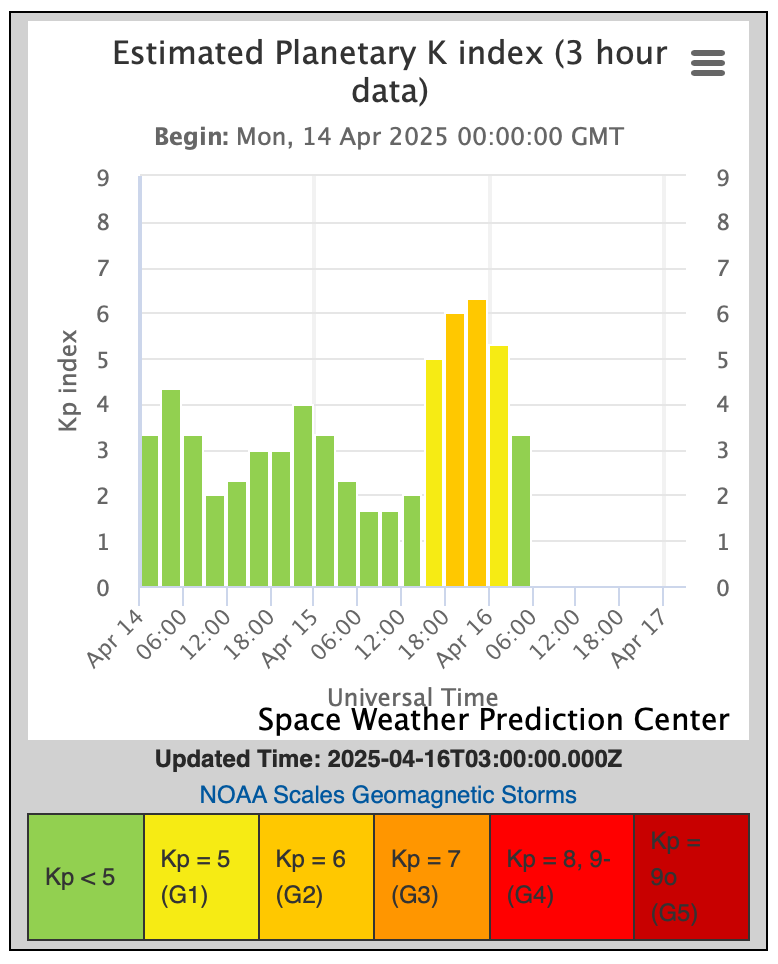
- Geomagnetic activity: The anticipated coronal mass ejection (CME) arrived early, disturbing Earth’s geomagnetic field to active levels (Kp 5-6) for much of the past day. G1 (minor) and G2 (moderate) geomagnetic storms were recorded between 15 UTC on April 15 and 3 UTC on April 16.
- Flare activity is at a moderate level thanks to the production of an isolated M (moderate) flare this morning. The total number of flares over the past 24 hours was 18, the largest being an M1.5 flare blasted out at 10:20 UTC on April 15 from an incoming region on the eastern horizon. We also noticed a flare by AR4055 on the western horizon almost at the same time as this M flare. This region, now out of view, produced 15 flares out of the total 18 of the period. Since they would have been partly blocked by the solar horizon, the flares it produced would have been larger than our spacecraft measured. Shortly after the M flare an R1 (minor) radio blackout was registered, affecting an area over Africa.

- There are three active regions currently on the Earth-facing solar disk, with an as-yet-unnumbered newcomer at the very edge of the eastern limb (edge) looking fairly large. Active region AR4055 is gone, departing as the largest and most magnetically complex on the Earth-facing sun, with a volatile beta-gamma-delta configuration. AR4060 now takes the lead with a less complex beta-gamma configuration. The remaining sunspot regions have simple alpha or beta configurations.
- Blasts from the sun? A small coronal mass ejection (CME) was observed on available coronagraph imagery at around 15 UTC on April 14. No numbered active regions have been connected to the event. Modeling shows most of the ejected plasma is not Earth-bound, but a component might give Earth glancing blow.
- Solar wind: Solar wind speeds decreased to between ~346 km/s and ~440 km/s (about 773,980 and 984,252 mph). At the time of this writing (11 UTC), the solar wind speed is about 404 km/s (about 903,722 mph). The total interplanetary magnetic field (IMF) is at low levels. The Bz component (north-south orientation) has been mostly southward but moved northward at the time of this writing. A southward Bz is favorable for auroras.
- Geomagnetic activity: Earth’s geomagnetic field varied between quiet and active levels (Kp = 2 – 4). The Kp = 4 threshold was reached at 23:01 UTC on April 14.
- Flare activity decreased but still remained high over the past 24 hours, with five M (moderate) flares. The total number of flares decreased to 14 flares, 13 of which – including all 5 M flares – came from AR4055. The largest event was an M4.2 flare, produced at 6:36 UTC on April 14 by AR4055 in the sun’s northwest. An R1 (minor) radio blackout affected an area over Africa.
- There are five active regions on the Earth-facing solar disk currently. Active region AR4055 maintained its position as the largest and most magnetically complex, with a volatile beta-gamma-delta configuration. It has the potential for M and even X flares. AR4060 has a less complex beta-gamma configuration. The remaining sunspot regions have simple alpha or beta configurations.
- Blasts from the sun? The two dramatic filament eruptions we mentioned yesterday launched coronal mass ejections (CMEs) that appear to be Earth-bound, with likely arrival midday April 16.
- Solar wind: Solar wind speeds decreased to between ~465 km/s to ~435 km/s (about 1 million mph to 973,067 mph). At the time of this writing (11 UTC), the solar wind speed is about 432 km/s (about 966,356 mph). The total interplanetary magnetic field (IMF) is at low levels. The Bz component (north-south orientation) has been mostly southward. A southward Bz is favorable for auroras.
- Geomagnetic activity: Earth’s geomagnetic field varied between quiet and active levels (Kp = 2–4).
- Flare activity increased to high over the past 24 hours, with 13 M (moderate) flares. The total number of flares produced decreased but 13 out of 20 flares were M-class and 13 of the flares came from AR4055 with 12 of those M-class. The largest event was an M2.7 flare, produced at 11:35 UTC on April 12 by AR4055 in the sun’s northwest. An R1 (minor) radio blackout affected an area over Africa.
- There are six active regions on the Earth-facing solar disk now. Active region AR4055 maintained its size and magnetic complexity with a beta-gamma-delta configuration. It has the potential for M and even X flares. The remaining sunspot regions have simple alpha or beta configurations.
- Blasts from the sun? The two large filament eruptions near disk center, one around 23:00 UTC on April 12 and one around 7:30 UTC on April 13 are still under analysis. Coming our way? We’ll see.
- Solar wind: Solar wind speeds ranged between 400-500 km/s (about 984,252 mph). At the time of this writing (11 UTC), the solar wind speed is about 500 km/s (about 841,088 mph). The total interplanetary magnetic field (IMF) is at low levels. The Bz component (north-south orientation) has been mostly southward. This means that a Kp = 4 level reached earlier today may have brought conditions for auroral displays at high latitudes, as a southward Bz is favorable for auroras.
- Geomagnetic activity: Earth’s geomagnetic field reached G1 (minor) storming levels (Kp = 5 ) late yesterday, April 12, during the 21 – 0 UTC three-hour synoptic period. The threshold was reached at 21 UTC on April 12.
- Low-to-moderate flare activity is expected, with a chance for additional M flares today. The chance for M (moderate) flares is 70%, and the chance for X (strong) flares is 15% today.
- Blasts from the sun? No Earth-directed coronal mass ejection (CME) are anticipated. However, two filament eruptions at the end of April 12 and beginning of April 13 produced CMEs visible in coronal imagery. These events are currently under analysis.
- Geomagnetic activity forecast: At the time of this writing (11 UTC on April 12) the geomagnetic level is unsettled at a Kp = 3 level. Effects of fast solar wind from a coronal hole that is slowly waning may bring conditions for an isolated G1 (minor) geomagnetic storm. These conditions for more G1 storming may extend through April 14. Alert for aurora hunters. Keep those cameras busy.
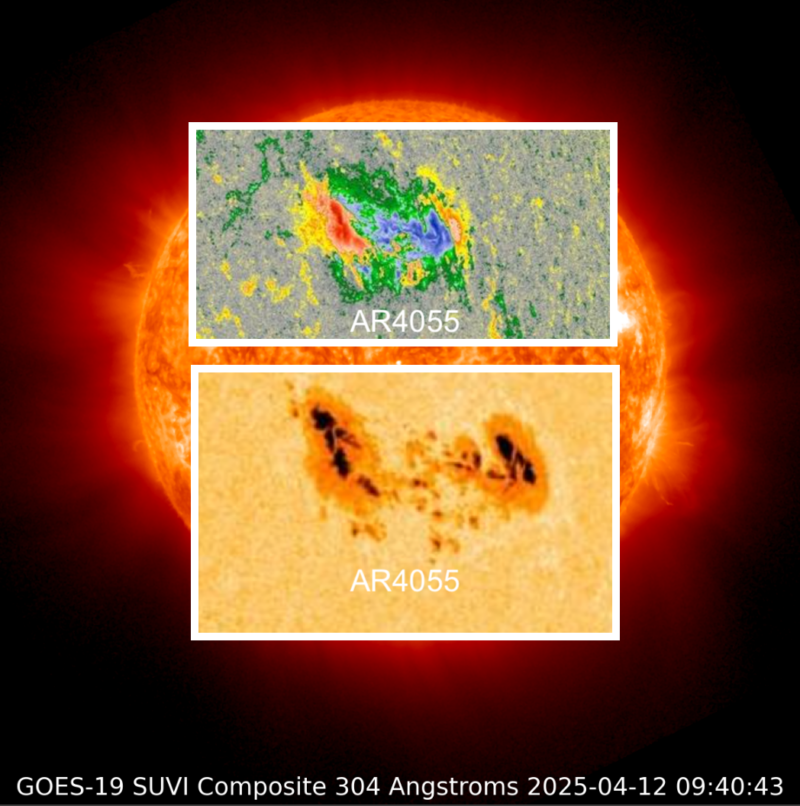
- Flare activity increased to a moderate level over the past 24 hours, with four M (moderate) flares. Flare production jumped with a total flare of 31 flares! All but two C flares came from AR4055. The largest event was an M1.2 flare, produced at 5:49 UTC on April 12 by AR4055 in the sun’s northwest. An R1 (minor) radio blackout affected an area over the Bay of Bengal.
- There are six active regions on the Earth-facing solar disk. Active region AR4055 grew in extent and magnetic complexity now with a beta-gamma-delta configuration. It has the potential for M and even X flares. The remaining sunspot regions have simple alpha or beta configurations.
- Blasts from the sun? No Earth-directed coronal mass ejections (CMEs) were observed in the available coronagraph imagery. But the four M flares from AR4055 are under modeling and analysis to determine if any components are headed toward Earth.
- Solar wind: Solar wind speeds dropped down to 376 km/s (about 984,252 mph). At the time of this writing (11 UTC), the solar wind speed is 403 km/s (about 841,088 mph). The total interplanetary magnetic field (IMF) is at moderate levels showing a slight increase. The Bz component (north-south orientation) has been mostly southward. This means that a Kp = 4 level reached earlier today may have brought conditions for auroral displays at high latitudes, as a southward Bz is favorable for auroras.
- Geomagnetic activity: Earth’s geomagnetic field reached active levels (Kp = 4 ) late yesterday during the 21 – 0 UTC three-hour synoptic period. The threshold was reached at 21 UTC on April 11. This is due to waning high-speed solar wind from coronal holes and the effects from an anticipated CME glancing blow.
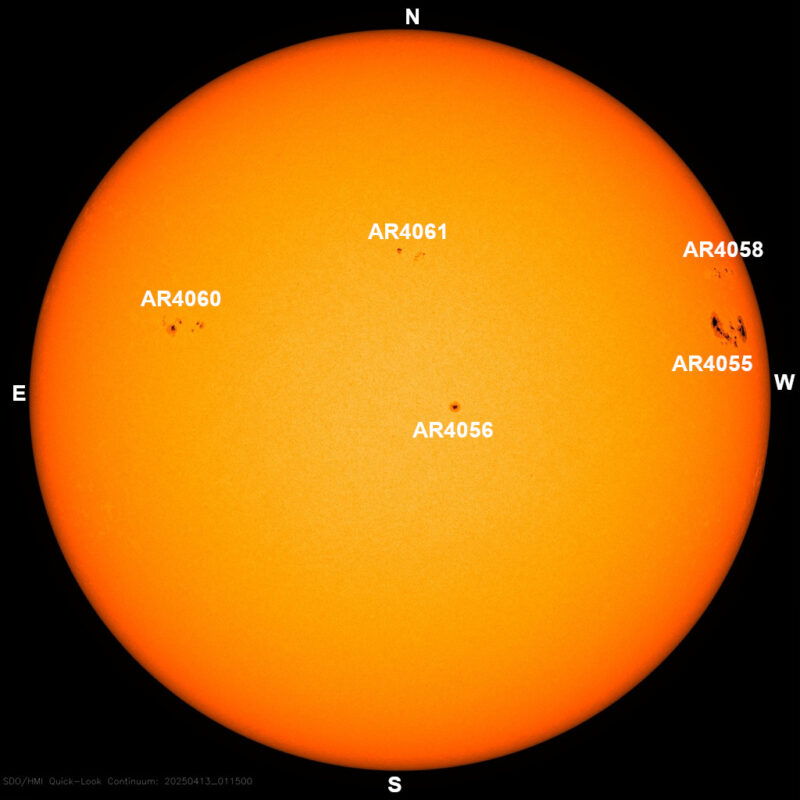
- Flare activity on the Earth-facing side of our star continued at low levels over the past day, with only five C (common) flares. The largest was a C4.4 flare, produced at 7:44 UTC on April 11 by sunspot region AR4055 in the sun’s northwest. AR4055 produced three C flares.
- There are currently seven active regions on the sun’s disk as seen from Earth. Active region AR4055 grew to a beta-gamma configuration, indicating a potential for flares. Yesterday this active region emerged from nothing in the middle of the northwest quadrant to rapidly grow in magnetic complexity and extent. It is now the largest active region on the Earth-viewed side of our star. The rest of the sunspot regions on the solar disk have simple alpha or beta configurations. There is a newcomer today, AR4060 in the northeast quadrant.
- Blasts from the sun? No Earth-directed coronal mass ejections (CMEs) were observed in available coronagraph imagery.
- Solar wind: Solar wind speeds dropped over the past day to an average of around 440 km/s (about 984,252 mph). At the time of this writing (11 UTC), the solar wind speed is 458 km/s (about 1,025,000 mph). The total interplanetary magnetic field (IMF) is at moderate levels. The Bz component (north-south orientation) has been mostly southward. That means that a Kp = 4 level reached earlier today may have brought conditions for auroral displays at high latitudes, as a southward Bz is favorable for auroras.
- Geomagnetic activity: During two three-hour synoptic periods, Earth’s geomagnetic field reached active levels (Kp = 4 ) over the past 24 hours. First the Kp= 4 threshold was reached at 22:47 UTC on April 10. This condition was possible as we received continuing but waning high-speed solar wind from coronal holes.
- Flare activity once again dropped to low levels with the production of only C (common) flares over the past 24 hours. The largest event was a C9.0 flare, nearly reaching the M (moderate) threshold. It was produced at 17:30 UTC on April 9 by an incoming sunspot region in the southwest. The total flare production over the period was 12 C flares. AR4045 produced six of those flares.
- There are currently seven active regions on the solar disk as seen from Earth. Active region AR4048 decayed and lost its beta-gamma configuration. This morning, all the sunspot regions on the solar disk have simple alpha or beta configurations. There are two newcomers today: AR4058, which emerged in the northwest quadrant, and AR4059 in the northeast.
- Blasts from the sun? No new Earth-directed coronal mass ejections (CMEs) to report over the past 24 hours.
- Solar wind: Solar wind speeds dropped over the past day to an average of around 460 km/s (about 1,029,000 mph). At the time of this writing (11 UTC), the solar wind speed is 476 km/s (about 1,065,000 mph). The total interplanetary magnetic field (IMF) is at low-to-moderate levels. The Bz component (north-south orientation) has been mostly southward. That means that a Kp 4 level reached earlier today may have brought conditions for auroral displays at high latitudes, as a southward Bz is favorable for auroras.
- Geomagnetic activity: Earth’s geomagnetic field reached active levels (Kp 4 ) over the past 24 hours. The Kp 4 threshold was reached at 1:41 UTC on April 10. However, the three coronal holes have started to decay and the high-speed solar wind we’re receiving has started to wane, although it continues to unsettle our magnetic field.
- Flare activity has jumped up to moderate with the production of an isolated M1.6 (moderate) flare. It was produced at 22:22 UTC on April 8 by sunspot region AR4048 in the southwest. Shortly after the blast, an R1 (minor) radio blackout affected an area over the Pacific Ocean south of Hawaii. The sun produced 15 flares: the M and 14 C flares. AR4048 blasted out six flares, including the M flare, while a new as-yet-unnumbered region in the northeast produced six C flares.
- There are currently 6 active regions on the Earth-facing solar disk. Active region AR4048 continues to be the only region with a relatively complex beta-gamma configuration, and its flare production proves it has potential for stronger flares. The remaining regions have simpler alpha or beta configurations.
- Blasts from the sun? A filament eruption in the southwest around 16 UTC on April 8 produced a coronal mass ejection (CME). Modeling and analysis is ongoing to determine if there is an Earth-directed component, but initial analysis suggests a glancing blow is possible on April 11. Prominences and filament eruptions were observed in the northeast quadrant, but the ejecta was not fired the right direction for any to be Earth-directed.
- Solar wind: Solar wind speeds increased over the past day, averaging around 520 km/s (about 1,163,000 mph) with a peaks of 587 km/s (1,313,000 mph). At the time of this writing (11 UTC) the solar wind speed is 510 km/s (about 1,141,000 mph). The total interplanetary magnetic field (IMF) remained at moderate levels. The Bz component (north-south orientation) has been mostly southward, and is so at the time of this writing. A southward Bz is favorable for auroras.
- Geomagnetic activity: Earth’s geomagnetic field has been at active levels (kp = 4 – 5). G1 (minor) geomagnetic storm levels were reached late yesterday and early today. The remainder of the past day saw Kp = 4 levels.
- Flare activity remains at low levels. Only 15 C (common) flares were produced over the past 24 hours. The largest was a C5.3 from sunspot region AR4048 in the southwest at 15:36 UTC on April 7. AR4048 produced 12 flares of the 15.
- There are currently 7 active regions on the Earth-facing solar disk. Only AR4048 has a relatively complex beta-gamma configuration, indicating a potential for stronger flares. The remaining regions have simpler alpha or beta configurations. There is one newcomer, AR4057, in the northeast quadrant.
- Blasts from the sun? No Earth-directed coronal mass ejections (CMEs) were observed in available coronagraph imagery.
- Solar wind: Solar wind speeds increased over the past day, averaging around 480 km/s (about 1,074,000 mph). At the time of this writing (11 UTC) the solar wind speed is 510 km/s (about 1,141,000 mph). The total interplanetary magnetic field (IMF) remained at moderate levels. The Bz component (north-south orientation) has been mostly oriented south, but at the time of this writing is northward. A southward Bz is favorable for auroras.
- Geomagnetic activity: Earth’s geomagnetic field was between unsettled and active levels (kp = 3 – 4). Kp = 4 levels were reached late yesterday and early today.
- Flare activity has dropped to low levels with only eight C (common) flares over the past 24 hours. This is a slight increase in productivity. The largest event was a C3.0 at 15:46 UTC on April 6 from active region AR4045. Three flares came from AR4045 and AR4048 each.
- There are between 9 and 11 active regions on the Earth-facing side of our star. There are many small regions on the limb (edge) about to rotate out of view, making it difficult to determine the exact number of visible sunspot regions. AR4048 and AR4054 both have relatively complex beta-gamma configurations, indicating a potential for stronger flares. The remaining regions have simpler alpha or beta configurations. There is one newcomer, AR4056.
- Blasts from the sun? No Earth-directed coronal mass ejections (CMEs) were observed in available coronagraph imagery over the past 24 hours.
- Solar wind: Solar wind speeds increased over the past day, ranging between 600-700 km/s (about 1,342,000 – 1,566,000 mph). But at the time of this writing (11 UTC) the solar wind speed is 483 km/s (about 1,080,000 mph). The total interplanetary magnetic field (IMF) remained at low levels. The Bz component (north-south orientation) fluctuated between north and south. A southward Bz is favorable for auroras.
- Geomagnetic activity: Earth’s geomagnetic field was between quiet and unsettled levels (kp = 2-3).
- Flare activity reached moderate levels, due to an isolated M flare but productivity levels dropped significantly with only six flares produced over the past 24 hours. The largest event was an M1.0 at 19:54 UTC on April 5 from region AR4048. Four of the flares came from AR4048 and the remaining two from AR4043.
- There are 11 active regions on the Earth-facing side of our star. AR4048 retained its relatively complex beta-gamma configuration, indicating a potential for stronger flares. The remaining regions have simpler alpha or beta configurations. There are two newcomers on the solar disk seen from Earth, AR4054 and AR4055.
- Blasts from the sun? No Earth-directed coronal mass ejections (CMEs) were observed in available coronagraph imagery over the past 24 hours. The large filament and resulting large CME over the northeast limb may signal a new region rotating into view.
- Solar wind: Solar wind speeds ranged between 500-600 km/s (about 1,476,000-1,736,000 mph) over the last 24 hours. At the time of this writing (11 UTC) the solar wind speed is 668 km/s (about 1,199,000 mph). The total interplanetary magnetic field (IMF) dropped to low levels. The Bz component (north-south orientation) was mostly southward during the past 24 hours but is currently northward. A southward Bz is favorable for auroras.
- Geomagnetic activity: Earth’s geomagnetic field reached a G1 (minor) geomagnetic storm levels (Kp = 5) at 17:40 UTC on April 5 driven by fast solar wind and possible CME influence.
- Moderate flare activity is expected, with a chance for X flares today. The chance for M (moderate) flares is 60%, and the chance for X (strong) flares is 15% today.
- Blasts from the sun? No Earth-directed CMEs are expected. An April 3 CME may cause a glancing impact early today.
- Geomagnetic activity forecast: At this writing (11 UTC on April 4), the geomagnetic disturbance level is quiet (Kp = 3). Unsettled to G1–G2 (minor–moderate) storming is possible on April 6. Unsettled-to-active conditions are likely to persist.
- Flare activity shows a slight increase in flare production but levels remain low with 15 C flares over the past 24 hours. The largest eruption was a C5.7 flare from sunspot region AR4043 at 23:38 UTC on April 4, 2025. AR4043 continues being the leading producer, this time with eight flares.
- There are 10 active regions on the Earth-facing side of our star. AR4048 retained its relatively complex beta-gamma configuration, indicating a potential for stronger flares. The remaining regions have simpler alpha or beta configurations. There are thee newcomer on the solar disk as we see it from Earth, AR4051, AR4052 and AR4053.
- Blasts from the sun? No Earth-directed coronal mass ejections (CMEs) were observed in available coronagraph imagery over the past 24 hours.
- Solar wind: Solar wind speeds ranged between 660–776 km/s (about 1,476,000-1,736,000 mph) over the last 24 hours. At the time of this writing (11 UTC) the solar wind speed is 536 km/s (about 1,199,000 mph). The total interplanetary magnetic field (IMF) continues at moderate levels. The Bz component (north-south orientation) was mostly southward oriented during the day and is currently southward. A southward Bz is favorable for auroras.
- Geomagnetic activity: Late yesterday, early this morning April 5, Earth’s geomagnetic field reached a G1 (minor) and G2 (moderate) geomagnetic storm levels (Kp = 5 – 6). The G1 threshold was reached at 13:07 UTC on April 4 and G2 at 2:59 UTC on April 5. All this was caused by residual effects of the arrival of a reported CIR, a complex region of compressed solar wind. At this writing (11 UTC on April 4), the geomagnetic disturbance level is active (Kp = 4). More unsettled-to-active conditions – with chances for more G1 storm levels – are anticipated for April 5 through April 6.
- Flare activity continues at low levels, with only C flares over the past 24 hours. The largest event was a C2.2 flare from sunspot region AR4043 at 6:02 UTC on April 4, 2025. During the past 24 hours, the sun produced six C flares. AR4043 was the leading producer with four flares.
- There are seven active regions on the Earth-facing side of the sun. AR4048 retained its relatively complex beta-gamma configuration, indicating a potential for stronger flares. The remaining regions have simpler alpha or beta configurations.
- Blasts from the sun? A filament eruption was observed at 3:34 UTC on April 3. Analysis and modeling of the event shows a coronal mass ejection (CME) mostly oriented south of Earth. But a glancing blow is possible around April 6.
- Solar wind: Solar wind speeds ranged between 480–490 km/s (about 1,074,000-1,096,000 mph) over the last 24 hours. At the time of this writing (11 UTC) the solar wind speed is 324 km/s (about 725,000 mph). The total interplanetary magnetic field (IMF) continues at moderate levels. The Bz component (north-south orientation) was mostly southward oriented during the day and is currently southward. A southward Bz is favorable for auroras.
- Geomagnetic activity: Late yesterday Earth’s geomagnetic field reached a G1 (minor) geomagnetic storm level for much of the past day (Kp 5), due to the arrival of an expected CIR, a complex region of compressed solar wind.
- Moderate flare activity is expected, with a chance for X flares today. The chance for M (moderate) flares is 70%, and the chance for X (strong) flares is 15% today.
- Blasts from the sun? No Earth-directed CMEs were observed in available coronagraph imagery.
- Geomagnetic activity forecast: At this writing (11 UTC on April 4), the geomagnetic disturbance level is active (Kp = 4). Unsettled-to-active conditions are anticipated for April 4 through April 5. A corotating interaction region (CIR), and a coronal hole’s high-speed solar wind stream, are expected to raise activity levels. There are chances that the geomagnetic disturbance may reach levels of G1 (minor) storming. Conditions are likely to ease again by April 6.
- Flare activity dropped to low levels with only C flares over the past 24 hours. The largest event was a C6.3 flare from sunspot region AR4048 at 11:14 UTC on April 2, 2025. During the past 24 hours the sun produced nine C flares. AR4048 remains the leading producer with four flares.
- There are eight active regions on the Earth-viewed side of the sun. AR4048 showed signs of decay and lost its delta configuration. Slight growth occurred in regions AR4044 and AR4049, and new region AR4050 emerged. The remaining regions have either alpha or beta configurations.
- Blasts from the sun? No Earth-directed coronal mass ejections (CMEs) were observed in available imagery.
- Solar wind: Solar wind speeds ranged between 410–490 km/s (920,000-1,096,000 mph) over the last 24 hours. At the time of this writing (11 UTC) the solar wind speed is 445 km/s (about 1 million mph). The total interplanetary magnetic field (IMF) has been at moderate levels. The Bz component (north-south orientation) fluctuated between northward and southward over the past day, and is currently northward. A southward Bz is favorable for auroras.
- Geomagnetic activity: Earth’s geomagnetic field ranged from quiet to active (Kp 1-4), due to lingering effects of a CME arrival.
- Flare activity dropped back to moderate levels after a single M (moderate) flare over the past 24 hours. The event was an M2.5 from active region AR4048 at 22:31 UTC on April 1. The flare caused an R1 (minor) radio blackout over the Pacific Ocean south of Hawaii. During the past 24 hours the sun produced 13 flares: the M flare and 12 C (common) flares. AR4048 remains the lead flare producer with seven C flares.
- There are six active regions on the Earth-viewed side of the sun. AR4048 retained its beta-gamma-delta magnetic complexity, remaining the most complex region, followed by AR4046 with a beta-gamma configuration. The rest of the regions have either alpha or beta configurations.
- Blasts from the sun? Minor shockwave effects from the X1.1 (strong) flare on March 28 started to wane. An S2 (moderate) solar radiation storm dropped down to an S1 (minor) storm, which affected high frequency (HF) radio over Earth’s poles.
- Solar wind: Solar wind speeds rose to around 450 km/s during the last 24 hours. At the time of this writing (11 UTC) the solar wind speed is 465 km/s. The total interplanetary magnetic field (IMF) is at low levels. The Bz component (north-south orientation) has been mostly south oriented over the period. A southward Bz is favorable for auroras.
- Geomagnetic activity: Earth’s geomagnetic field was at active levels early this morning. The Kp = 4 threshold was reached at 1:32 UTC on April 2.
- Flare activity has jumped to high after the production of an M5.6 (moderate) flare from AR4046 at 6:46 UTC on April 1. The flare caused an R2 (moderate) radio blackout over the Indian Ocean south of India. During the past 24 hours the sun produced 16 flares: the M5.6 and 15 C (common) class flares. AR4048 remains the most prolific flare producer with 10 C flares.
- There are seven active regions on the solar disk as seen from Earth. AR4048 developed a beta-gamma-delta magnetic complexity, becoming the most complex region. AR4046 has a beta-gamma configuration, and the remaining sunspot regions have either alpha or beta configurations. We have a newcomer, AR4049, which emerged in the southeast quadrant.
- Blasts from the sun? No new Earth-directed coronal mass ejections (CMEs) have been observed in available coronagraph imagery. A minor shockwave from the X1.1 (strong) flare on March 28 appears to have reached us, causing an S2 (moderate) solar radiation storm.
- Solar wind: Solar wind speeds rose to around 480 km/s during the last 24 hours. At the time of this writing (11 UTC) the solar wind speed is 410 km/s. A weak shock was observed at 10:17 UTC from the March 28 CME. The total interplanetary magnetic field (IMF) is at low levels. The Bz component (north-south orientation) has been mostly northward. A southward Bz is favorable for auroras.
- Geomagnetic activity: Earth’s geomagnetic field was at quiet levels during the past 24 hours, Kp = 1-2.
Sun news April 18: An enormous coronal hole becomes geoeffective
(11 UTC to 11 UTC)

After the storm, a calm. Effects from the G4 (severe) geomagnetic storming on April 16 have now waned in earnest. Earth’s magnetic field is quiet at the time of this writing. But disturbances to Earth’s magnetic field might soon return, due to a large coronal hole now moving into a geoeffective position. Its fast solar wind soon will be coming Earth’s way. This large coronal hole might be the same huge one we saw a couple of weeks ago; it also brought interesting auroral activity. The hole might be now returning into sight, after its transit on the far side of our star!
Sun news April 17: Huge geomagnetic storm brings auroras galore!
(11 UTC to 11 UTC)
Earth experienced a huge geomagnetic storm last night, causing amazing auroral displays. Forecasters had predicted geomagnetic storming up to G3 (strong) levels, but we actually saw a peak of G4 (severe) storming at 18 UTC on April 16. And that led to reports of auroras in the Northern Hemisphere as far south as the U.K., and in the Southern Hemisphere as far north as New Zealand. This was all provoked by the arrival of a double coronal mass ejection (CME) from two filament eruptions on April 12. This created what is known as a cannibal CME, when a faster blob of sun-stuff catches up to a slower one and combines with it. And it gave Earth’s magnetic field quite an impact! Did you see the auroras? Share your photos with us here.
Aurora visible from my garden in the UK! ? #aurora #auroraborealis #northernlights
— Astro Ben ?? I take photos of space ? (@bbroastro.bsky.social) 16 de abril de 2025, 16:49
Sun news April 16: Auroras possible tonight and tomorrow!
(11 UTC to 11 UTC)

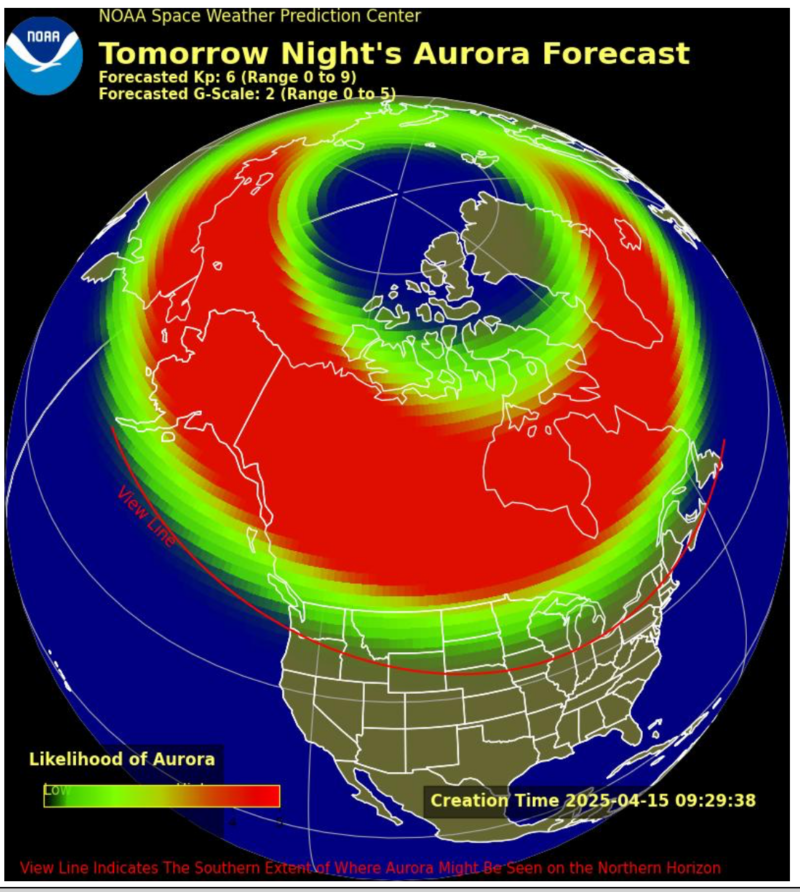
Earth’s magnetic field was disturbed last night after a blast of sun-stuff reached us earlier than expected. When it arrived at Earth, the coronal mass ejection (CME) triggered up to G2 (moderate) geomagnetic storming overnight, and disturbance is expected to continue through today and tomorrow. NOAA forecasts up to G3 (strong) storming tonight, which means a good chance of auroras at northern latitudes! And if it’s cloudy tonight, you may get another chance tomorrow, with G1 (minor) storming expected to persist through tomorrow evening. Good luck, aurora chasers. Share your aurora photos with us here!
Sun news April 15: Prolific sunspot region departs
(11 UTC to 11 UTC)
Sunspot region AR4055, which has provided almost all the action over the past few days, has finally rotated out of view over the sun’s western horizon. It departed still retaining its volatile beta-gamma-delta configuration, so it may continue blasting out big flares on the other side of our star. And even as it departed, it still fired almost all of the past day’s flares. The exception was an M1.5 flare from an as-yet-unnumbered region just rotating into view on the sun’s opposite horizon. It’s hard to study currently, but it appears fairly large. Could this be AR4055’s replacement? Those are big shoes to fill, but let’s wait and see.

Sun news April 14: M flare barrage continues, solar blobs Earth-bound
(11 UTC to 11 UTC)

Prolific sunspot region AR4055 took the limelight over the weekend, and it’s still going strong. Despite a slight drop in activity, it produced all but one of the 14 flares blasted over the past day, including an impressive 5 M (moderate) flares. And amid this high sun activity, action appears to be on its way to Earth. Analysts have determined that two filament eruptions spotted late Saturday night and early Sunday morning are headed to Earth, and should reach us by midday Wednesday. The impacts are expected to trigger G1-G2 (minor to moderate) geomagnetic storms, with a chance for G3 (strong) storming. And that could mean beautiful auroral displays! Stay tuned, and keep your fingers crossed for clear skies.
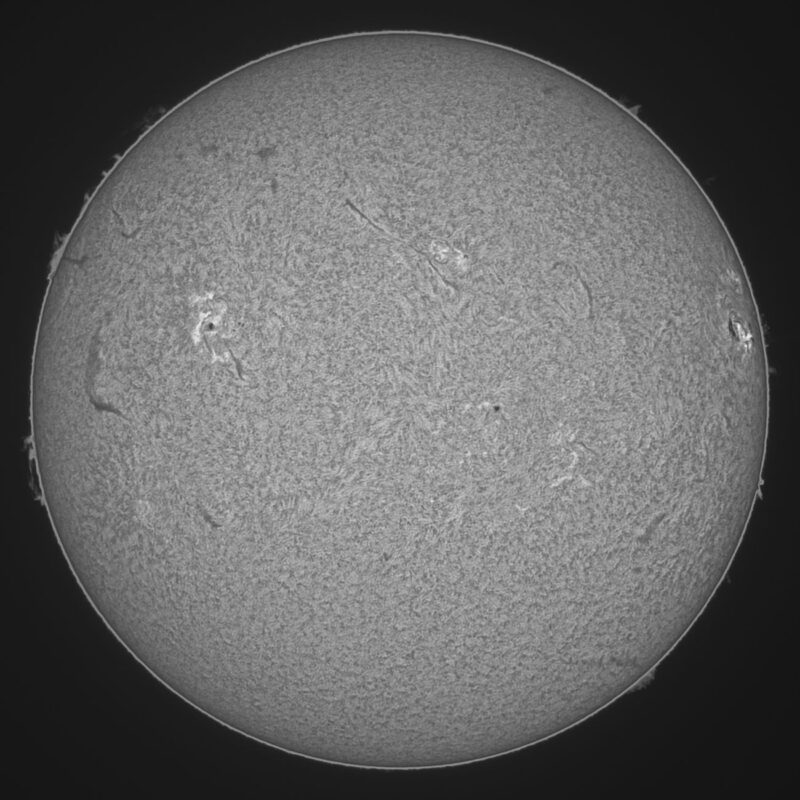
Sun news April 13: Flares, filaments, and a lonely sungrazing comet
(11 UTC to 11 UTC)

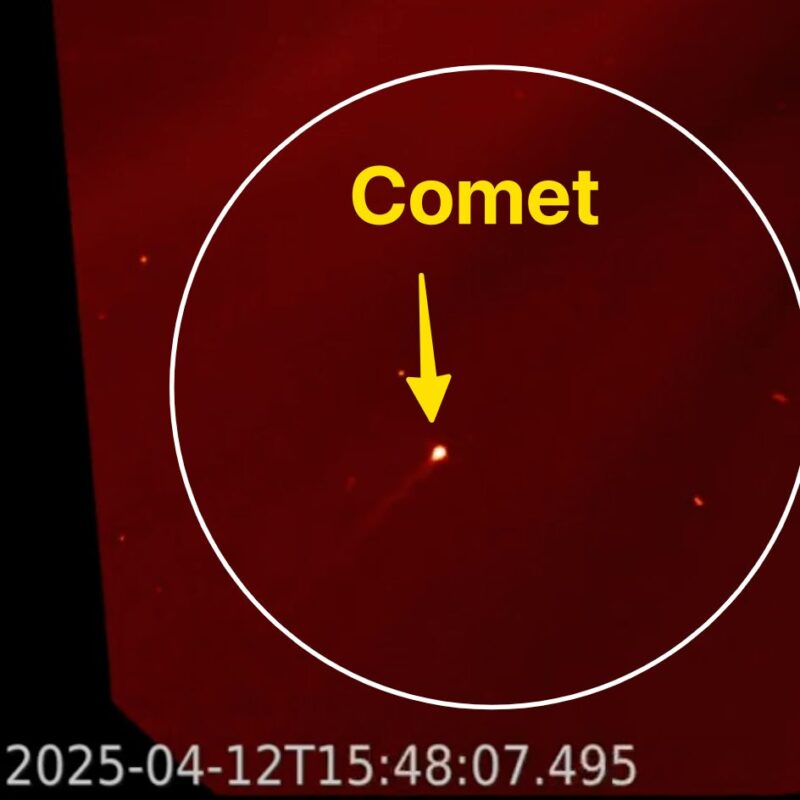
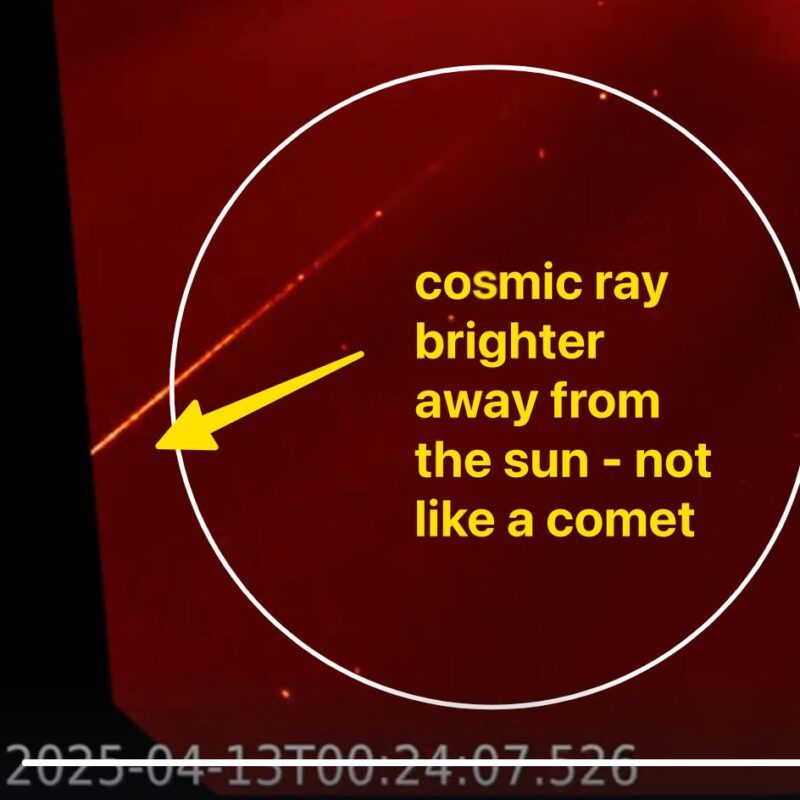

Today’s top story: Pow, pow, pow! After days of dominating space weather headlines, sunspot region AR4055 showed no sign over the past day of slowing down. It blasted out 13 M (moderate) flares in the past 24 hours. Wow! This powerhouse sunspot continues to expand in size and magnetic complexity, boasting a rare and volatile beta-gamma-delta magnetic configuration, the most intense of its kind. Will AR4055 unleash an X-class flare today? Stay tuned. Meanwhile, the sun added drama with two spectacular filament eruptions near the disk center late yesterday and early today. Both unleashed fast, dynamic coronal mass ejections (CMEs), captured in images from the SOHO spacecraft’s LASCO C2 coronagraph. And we saw a dazzling sungrazing comet streaking across the field of view between 12 UTC and 19 UTC on April 12, just before the eruptions began. All in all … an electric performance.
What’s ahead? Sun-Earth forecast
Sun news April 12: Will mighty AR4055 unleash an X flare today?
(11 UTC to 11 UTC)
Whoah! We saw a dramatic increase in solar flares over the past 24 hours! Yesterday we reported just five C (common) flares. Today, we can report 31 flares, including four M (moderate) flares. All but two were produced by a single region on the sun, active region AR4055, which rapidly emerged on April 10 and quickly began expanding in size and magnetic complexity. This region is located in the sun’s northwest quadrant, as seen from Earth. It is nearing the western limb or edge and soon will rotate from view. Today, this active region reached a beta-gamma-delta magnetic configuration, the most complex type, with the most potential for strong flare production. Will AR4055 unleash an X-class flare before it rotates out of view? Time will tell, and we’re keeping a close watch.

Sun news April 11: Suddenly, a colossal blast from the far side
(11 UTC to 11 UTC)

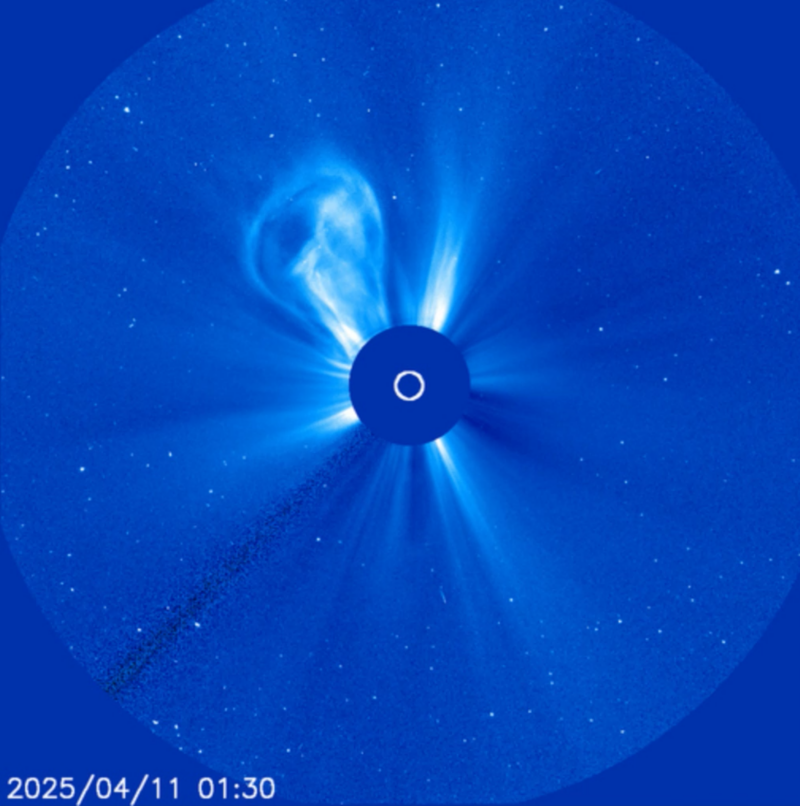
A massive farside blast lit up the northeast limb of the sun yesterday (April 10). The SOHO spacecraft’s LASCO C2 coronagraph caught it at 17 UTC. And the LASCO C3 imager caught it at 19:30 UTC. This was a coronal mass ejection (CME), a giant burst of solar materials and magnetic fields that left the sun. Observers didn’t see a flare on Earth’s side of the sun, confirming that the blast originated on the far side. But ESA’s Solar Orbiter spacecraft, positioned behind the sun, slightly west of center, did detect a hard X-ray flare at 16:40 UTC. The flare was estimated at C2–C4 class. Because it’s likely a part of the sun’s body was in front of the flare, it could have been much stronger. The region responsible should soon rotate onto the Earth-facing side of our star. Stay tuned!
Sun news April 10: Whoa! See SDO’s calibration maneuver
(11 UTC to 11 UTC)


What’s going on with our view of the sun? Don’t worry: the disturbance you can see above is just the result of NASA’s Solar Dynamics Observatory (SDO) performing a calibration maneuver last night. It briefly pointed away from the sun in all four directions to realign its cameras, ensuring accurate observations moving forward. And it picked a good moment to do so, as sun activity has dropped to low over the past day. The sun hasn’t fired off any Earth-directed coronal mass ejections (CMEs) and none have arrived, although the solar wind remains slightly elevated thanks to the three coronal holes currently on the Earth-facing solar disk. Additional disturbances are likely to continue through tomorrow, with the chance of more G1 (minor) storming and auroral displays.
Sun news April 9: A new sun-observing eye in the sky
(11 UTC to 11 UTC)


In late February, NOAA released the first preliminary imagery from CCOR-1, a sun-observing coronagraph aboard the new GOES-19 satellite. Now, this satellite is fully operational, and NOAA’s Space Weather Prediction Center has just unveiled a new webpage featuring its live sun imagery. The new site also includes imagery from the SOHO spacecraft’s LASCO C2 and C3 instruments, which space weather forecasters have been relying on for many years. This marks GOES-19’s transition to becoming NOAA’s primary space weather spacecraft, replacing GOES-16. Congratulations to NOAA on this milestone!
Sun news April 8: Solar wind bombardment could bring auroras
(11 UTC to 11 UTC)

There are currently three coronal holes adorning the visible side of the sun, and the fast solar wind they produce has started buffeting Earth. This stirred up our magnetic field to Kp = 4 (active) levels late yesterday into early today. And unsettled-to-active conditions are expected to continue today through Thursday, with G1 (minor) geomagnetic storms possible. And that means the chance for auroras at high latitudes!
Sun news April 7: A blast of solar wind is on the way
(11 UTC to 11 UTC)

The new week is kicking off with low flare activity and a calm solar wind. But action is on its way, as a stream of fast solar wind is expected to bring disturbance to our magnetic field tomorrow. This will be from a coronal hole that’s moving into geoeffective position. Forecasters are predicting we could see up to G1 (minor) geomagnetic storming.
Sun news April 6: More auroras at high latitudes tonight?
(11 UTC to 11 UTC)


Today’s top story: Earth’s magnetic field lit up again early on April 6, reaching G1 (minor) geomagnetic storm conditions thanks to persistent fast solar wind from a coronal hole and a possible glancing blow from a coronal mass ejection (CME) – a chunk of solar materials and magnetic fields – on April 3. Solar wind speeds surged and the Bz component remained mostly southward, fueling geomagnetic unrest. Expect ongoing disturbances with unsettled to active levels likely through April 8. Aurora watchers get ready and clear skies!
What’s ahead? Sun-Earth forecast

Sun news April 5: See a prominence ‘walk’ across the sun
(11 UTC to 11 UTC)
A prominence is solar material from the sun’s lower atmosphere, held aloft by magnetic fields. In the image below, caught over the past day, a dramatic prominence appears to walk across the sun’s limb (edge), driven by the dynamic solar environment. Prominences – aka filaments when facing Earth – can often become unstable, launching into space as coronal mass ejections, or CMEs. Reaching Earth, they can create powerful geomagnetic storms and auroral displays. But this one is not turned our way. On the other hand, Earth’s magnetic field is unsettled at the time of this writing (11 UTC on April 5). The disturbance follows G1 (minor) – G2 (moderate) geomagnetic storms, triggered by a corotating interaction region CIR and fast solar wind. More auroras are possible tonight, especially at high latitudes. Read more below.
Sun-Earth highlights in the past day


Sun news April 4: Beautiful auroras possible today and tomorrow
(11 UTC to 11 UTC)
A complex region of compressed solar wind – known to sun scientists as a corotating interaction region or CIR – arrived over the past day and triggered a G1 (minor) geomagnetic storm and subsequent auroras. The storm started late yesterday (18 UTC April 3) and extended for much of the day. An active level (Kp 4) disturbance is ongoing at this writing (11 UTC on April 4). More geomagnetic disturbance is expected during the rest of the day today, through tomorrow, with chances for more G1 storm levels. That means auroras are possible at high latitudes today and tomorrow. Stay tuned.
Sun-Earth highlights in the past day
What’s ahead? Sun-Earth forecast


Sun news April 3: Coronal hole set to blow solar wind our way
(11 UTC to 11 UTC)
A coronal hole is rotating into a geoeffective position, meaning its fast solar wind will soon be heading straight to Earth. Forecasters are expecting this stream, along with a corotating interaction region (CIR) – a complex region of compressed solar wind – to arrive tomorrow, potentially triggering a G1 (minor) geomagnetic storm. Stay tuned for some upcoming action.
Sun-Earth highlights in the past day

Sun news April 2: New data shows activity dipped in March
(11 UTC to 11 UTC)
NOAA has just released its solar activity data for March 2025, combining sunspot number and radiowave emissions. And although the sun produced some strong action last month, including an X flare and multiple displays of vibrant auroras, there was a notable overall dip in activity. But despite this drop, we remain firmly within solar maximum, the peak of the sun’s 11-year cycle. This phase could continue for months, or even into 2026. So there should be plenty more big flares and auroral displays to look forward to!
Sun-Earth highlights in the past day


Sun news April 1: Activity jumps to high after surprise M flare
(11 UTC to 11 UTC)
We were ready for some big flares from prolific new sunspot region AR4048 today. But it was AR4046 that raised sun activity to high with a surprising M5.6 (moderate) flare this morning. AR4048 did contribute 10 C (common) flares, but no M flares. However, it’s continuing to show growth in size and magnetic complexity, now showing a potent beta-gamma-delta configuration. That means it’s got the potential for big Ms and even X (strong) flares. Stay tuned to see what it’s got in store!
Sun-Earth highlights in the past day


Like what you read?
Subscribe and receive daily news delivered to your inbox.
More from
C. Alex Young


Sun activity archive for April 2026

Sun activity archive for March 2026


