The Vera C. Rubin Observatory in Chile is poised to scan the sky – deeply, rapidly, nightly – for the coming 10 years. And we got our first look at the images from the Rubin Observatory on Monday morning, June 23, 2025. EarthSky’s Deborah Byrd has details. Watch in the player above or on YouTube.
The first images from the Vera C. Rubin Observatory
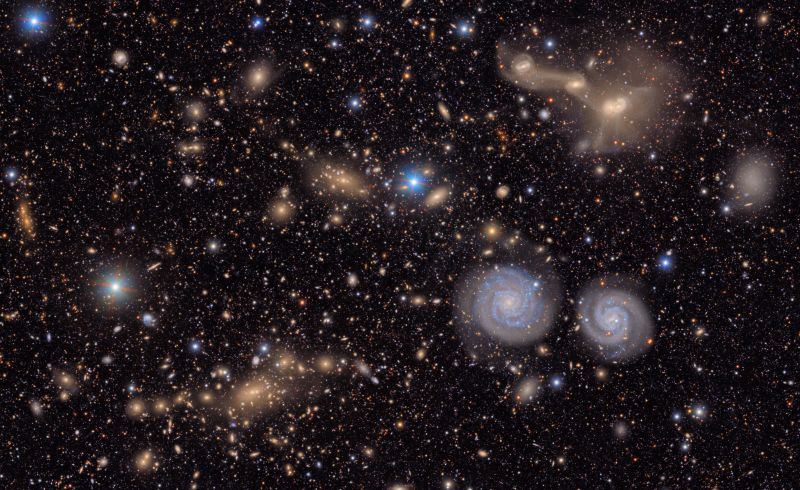
On Monday, June 23, 2025, we got our first look at the images from the Vera C. Rubin Observatory in Chile, and they are stunning! Some of the first images focused on the galaxies in the Virgo cluster. But the images we saw were only a small part of what the Rubin Observatory captured. It would take 400 ultra HD TV screens for our eyes to see the full images. The field of view of the Rubin Observatory is 45 times the area of the full moon.
We also got a sneak peek at some of the millions of asteroids that the new observatory will discover. In just 10 hours of observations, Rubin has already discovered thousands of never-before-seen asteroids. Seven of those are near-Earth asteroids, and, fortunately, none of those pose any threat to us. However, it is a glimpse at how the new observatory will help find any possible threats from rogue space rocks.
And this is just the tip of the iceberg for what Rubin Observatory will discover, from transient objects to a possible Planet 9 to a better understanding of dark matter. As Aaron Roodman, director of the LSST Camera and deputy director of NSF–DOERubin Construction from SLAC National Accelerator Laboratory, said:
Making the world’s largest digital camera will let scientists explore the cosmos in new ways, and at a scale that enables discoveries that should fundamentally change our understanding of the universe.
Now check out the video!
Made from over 1,100 images captured by NSF–DOE Vera C. Rubin Observatory, the video begins with a close-up of 2 galaxies then zooms out to reveal about 10 million galaxies. Those 10 million galaxies are roughly 0.05% of the approximately 20 billion galaxies Rubin Observatory will capture during its 10-year Legacy Survey of Space and Time. Image via NSF–DOE Vera C. Rubin Observatory.
See thousands of new asteroids
As the new images came in during the livestream, the EarthSky team was watching and sharing their thoughts via WhatsApp. We all agreed that the video of the brand-new asteroid discoveries gave us chills. See the video below.
In about 10 hours of observations, NSF–DOE Vera C. Rubin Observatory discovered 2,104 never-before-seen asteroids in our solar system. This includes 7 near-Earth asteroids (which pose no danger). Annually, about 20,000 asteroids are discovered in total by all other ground and space-based observatories. Rubin Observatory alone will discover millions of new asteroids within the first 2 years of the Legacy Survey of Space and Time. Rubin will also be the most effective observatory at spotting interstellar objects passing through the solar system. Image via NSF–DOE Vera C. Rubin Observatory.
Watch the image reveal here
You can watch the 90-minute reveal of the first images from the Vera C. Rubin Observatory in the player below.
The much-anticipated 1st look from the Vera C. Rubin Observatory, starring our universe, came on Monday. Watch in the player above or on YouTube.
More about the observatory
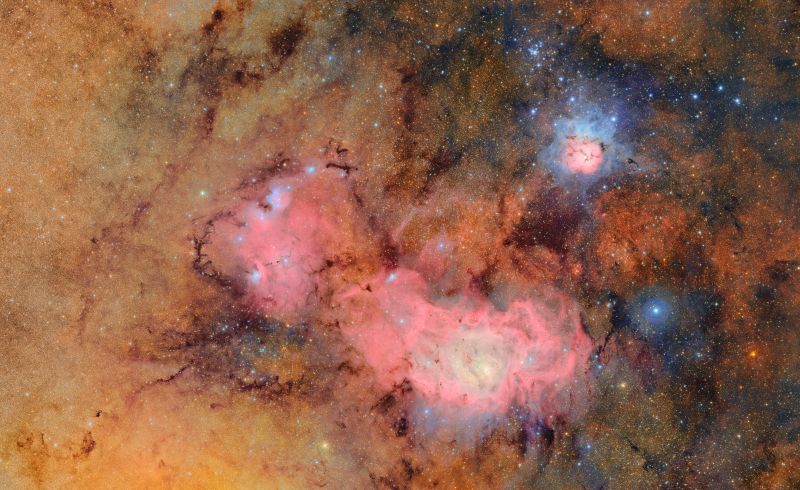
The Vera C. Rubin Observatory in Chile is poised to scan the sky – smoothly, rapidly, nightly – for the coming 10 years. The observatory will use the world’s largest digital camera to create an ultra-wide, ultra-high-definition timelapse record of our universe. The stars of this show will be real stars being born in stellar nurseries, exploding in supernovas, getting sucked into black holes and spinning with their entourage of planets, asteroids and comets, forming the backbones of galaxies.

Vera Rubin was the first astronomer to share convincing evidence for the existence of dark matter. Dark matter is one of the great mysteries in astronomy. All the light we see in the universe is ordinary matter, and it makes up just 5% of our universe. But 27% of the universe is a mysterious substance scientists call dark matter, and the remaining 68% is a mysterious force called dark energy. One of the major goals of the Rubin Observatory is to unlock the mysteries of dark matter and dark energy.
Legacy Survey of Space and Time
This ultimate recording of our cosmos is what scientists are calling the Legacy Survey of Space and Time. The goals of the survey are to:
- Understand the nature of dark matter and dark energy
- Create an inventory of the solar system
- Map the Milky Way
- Explore the transient optical sky
Recently, a new study said that the Rubin Observatory will find millions of new objects in our own solar system, revealing them in technicolor. The observatory could also discover the elusive Planet 9. In addition, it should be able to spot supernovas just before they explode, so we can catch them in the act. These are just a few of the marvels that await us.
The U.S. National Science Foundation and the U.S. Department of Energy’s Office of Science fund the Vera C. Rubin Observatory.
Read about the cuts proposed to science in the U.S.

Bottom line: On Monday, June 23, 2025, we got a peek at the first images from the Vera C. Rubin Observatory in Chile, and they’re stunning! See them here.
Read more: Using exploding white dwarfs to measure the universe
Like what you read?
Subscribe and receive daily news delivered to your inbox.
More from
Kelly Kizer Whitt


Another satellite breakup raises concerns about space junk

Smile mission releases its stunning 1st aurora footage!
Visible planets and night sky guide for October
Hera mission hits the brakes to arrive at asteroid