



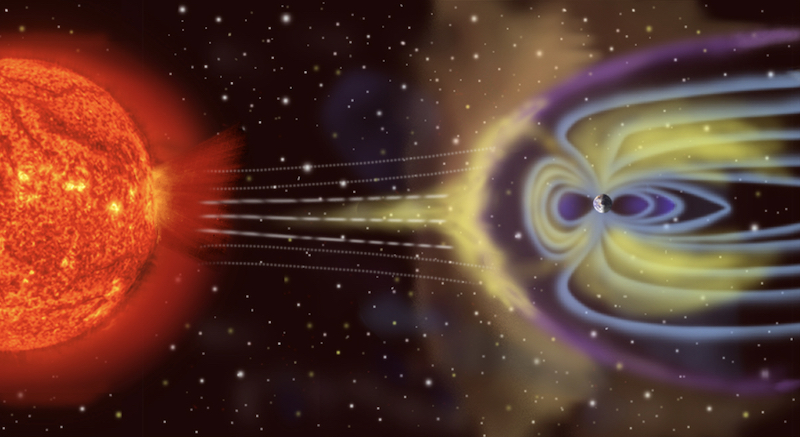
Earth has a magnetic field, as do other planets in our solar system. Earth’s magnetic field is what causes compasses to point north. But it does much more, helping maintain life on the planet. Without the magnetic field, the sun’s radiation would shred Earth’s atmosphere, rendering our planet inhospitable. So scientists are always on the lookout for magnetic fields when they study distant exoplanets, or worlds orbiting other stars. Earlier this month (April 3, 2023), researchers found the first tentative evidence for a rocky, Earth-sized exoplanet with a magnetic field. The planet is only 12 light-years away.
The exoplanet is called YZ Ceti b. And other scientists will need to verify that its magnetic field does exist. But this new study is a positive sign of astronomers’ ability to find rocky exoplanets with magnetic fields.
Astronomers have found magnetic fields on exoplanets before this. But those magnetic fields were all associated with larger worlds. If confirmed, YZ Ceti b will be the first Earth-sized rocky world beyond Earth with a magnetic field.
The researchers published the details of their discovery in the peer-reviewed journal Nature Astronomy on April 3.
First detection of a magnetic field on an Earth-sized exoplanet?
YZ Ceti b orbits a red dwarf star. The planet’s estimated radius is 0.913 times that of Earth. And the planet contains about 0.7 times Earth’s mass.
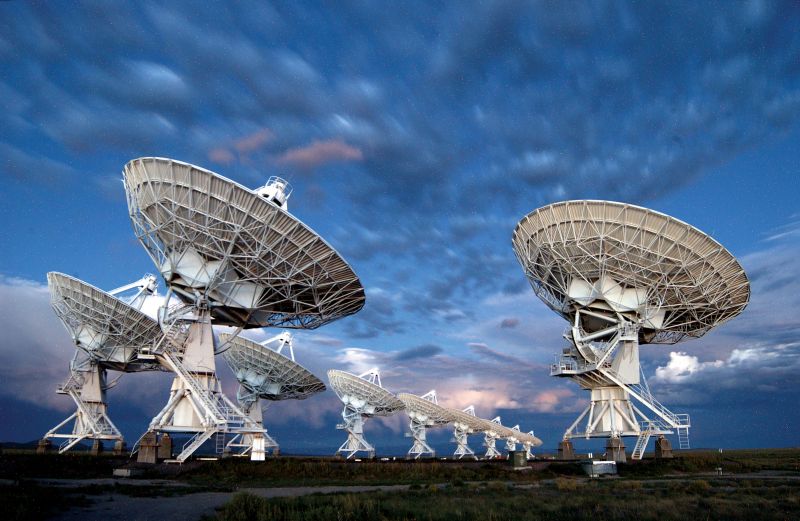
Using the Karl G. Jansky Very Large Array in New Mexico, researchers Sebastian Pineda at the University of Colorado Boulder and Jackie Villadsen at Bucknell University observed a repeating radio signal coming from YZ Ceti b.
Repeating radio signal … rocky exoplanet … is that combo cause for excitement? In this case, the researchers believe it was a natural radio signal, just what a magnetic field would produce. Joseph Pesce, program director for the National Radio Astronomy Observatory, commented:
The search for potentially habitable or life-bearing worlds in other solar systems depends in part on being able to determine if rocky, Earth-like exoplanets actually have magnetic fields.
This research shows not only that this particular rocky exoplanet likely has a magnetic field but provides a promising method to find more.
Atmosphere or no atmosphere?
A magnetic field could mean the difference between having a life-sustaining atmosphere and no atmosphere at all, as Pineda noted:
Whether a planet survives with an atmosphere or not can depend on whether the planet has a strong magnetic field.
Indeed, astronomers already know that some planets orbiting red dwarf stars – as YZ Ceti b does – can completely lose their atmospheres. This is especially true for planets that orbit very close to those stars, again as YZ Ceti b does. Red dwarfs tend to be extremely volatile, emitting massive and dangerous solar flares. Those flares can decimate a planet’s atmosphere if it isn’t protected.
Repeating radio signal hints at magnetic field
Villadsen first found the radio signal while analyzing the data at home. The fact that it repeated made her even more intrigued. She said:
I’m seeing this thing that no one has seen happen before. We saw the initial burst and it looked beautiful. When we saw it again, it was very indicative that, ok, maybe we really have something here.
Why did the signal repeat the way it did? The researchers think it is likely caused by a magnetic field that interacts with the planet’s star. Earth’s magnetic field interacts with our own sun in much the same way.
The researchers caution that this isn’t quite a slam-dunk detection yet. The two signals might have originated from the star itself instead of YZ Ceti b. The paper says:
On the basis of their luminosity and proximity in orbital phase, we consider these two events as candidate SPI [star–planet interaction] events, but cannot rule out stellar magnetic activity as a possible cause.
Detecting magnetic fields around smaller rocky planets isn’t easy when they are so far away. With this in mind, astronomers are first looking at planets similar in size to Earth that orbit very close to their stars. They would produce the strongest magnetic fields. YZ Ceti b, like many red dwarf planets, does orbit close indeed, completing an orbit in only two days. Even Mercury takes 88 days to orbit once around the sun.
YZ Ceti b too hot for life, even with magnetic field
Unfortunately, even if YZ Ceti b has a magnetic field, it is so close to its star that it is a scorching world too hot for life. Villadsen said:
What we’re doing is looking for a way to see them. We’re looking for planets that are really close to their stars and are a similar size to Earth. These planets are way too close to their stars to be somewhere you could live, but because they are so close, the planet is kind of plowing through a bunch of stuff coming off the star. If the planet has a magnetic field and it plows through enough star stuff, it will cause the star to emit bright radio waves.
Consequently, YZ Ceti b is unlikely to be habitable, even though it is Earth-sized and probably has a magnetic field. It is most likely simply too hot. However, if the magnetic field is confirmed, it will show that probably many Earth-sized planets also have one. That could include planets in the habitable zones of their stars. In those regions, temperatures could allow liquid water to exist on the planets’ surfaces. That would be even more likely on those planets with magnetic fields and suitable atmospheres.
Auroras on YZ Ceti b?
So, if YZ Ceti b has a magnetic field, does that mean it could also have auroras – or northern lights – as Earth does? The researchers say that there is indeed evidence for auroras, but on the star, not the planet. But there should also be auroras on the planet itself, which we just haven’t detected yet. Pineda said:
We’re actually seeing the auroras on the star. That’s what this radio emission is. There should also be auroras on the planet, if it has its own atmosphere.
So the results so far are promising. They do appear to show that YZ Ceti b really does have a magnetic field. But the researchers don’t know for certain yet. So the work continues. Villadsen said:
This could really plausibly be it. But I think it’s going to be a lot of follow-up work before a really strong confirmation of radio waves caused by a planet comes out.
Pineda added:
Once we show that this is really happening, we’ll be able to do it more systematically. We’re at the beginning of it.
The potential discovery of a magnetic field on a rocky exoplanet brings us another step closer to finding other worlds that could support life. If scientists can confirm it, then the possibility grows that many more will be found as well.
Bottom line: For the 1st time, astronomers have detected a possible magnetic field on a rocky exoplanet similar in size to Earth, only 12 light-years away.
Source: Coherent radio bursts from known M-dwarf planet-host YZ Ceti
Like what you read?
Subscribe and receive daily news delivered to your inbox.
More from
Paul Scott Anderson


Did formaldehyde on ancient Mars help kickstart life?

Black holes could have planets, new simulations suggest
Is this an alien radio signal from a super-Earth exoplanet?
Life on Enceladus? 2 new studies boost chances



