



Astronomers have found a hidden planet orbiting the star Beta Pictoris. This star, 63 light-years away in the southern constellation Pictor, was already known to have 2 planets. This 3rd planet is now the faintest ever imaged from Earth. Video via ESO.
Hidden planet found around Beta Pictoris
Beta Pictoris is famous as a star system with planets, comets and asteroids still in the process of forming. It’s a young star system, about 20 million years old, which first came to astronomers’ attention because of the thick debris disk around it. Then, in 2008, astronomers discovered the first planet orbiting Beta Pictoris, followed by a second planet in 2019. And in 2024, astronomers said they found evidence of a giant asteroid collision around the star.
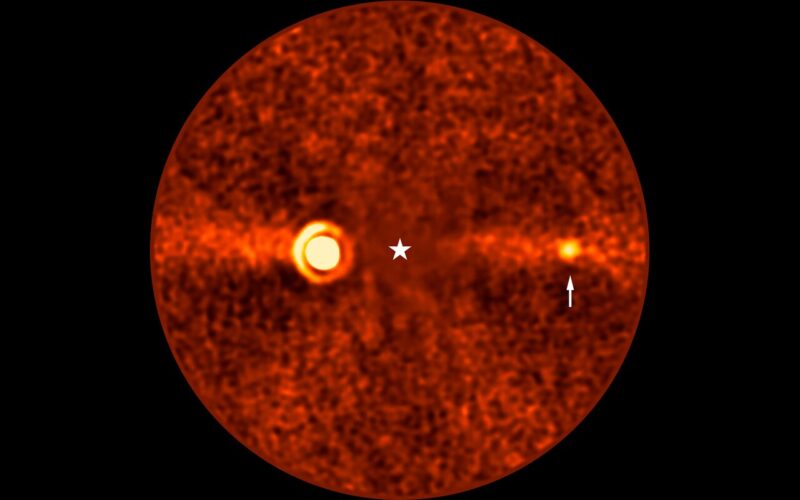
Now, on July 15, 2026, the European Southern Observatory has said that astronomers found a third planet around Beta Pictoris that has been hiding in our images all along.
The team of astronomers found the planet using the European Southern Observatory’s Very Large Telescope in Chile. The planet is named Beta Pictoris d (the first two being named Beta Pictoris b and Beta Pictoris c). The discovery was a surprise to astronomers, who were just trying to take a closer look at Beta Pictoris b. The newly discovered planet is 100 times fainter than Beta Pictoris b. And that makes it the faintest planet ever imaged from Earth.
Co-author Ben Sutlieff at the University of Edinburgh said:
This was a serendipitous discovery. We initially wanted to look more at a known planet in the system, Beta Pictoris b, to see how it changed over time.
The astronomers published their peer-reviewed paper in The Astrophysical Journal Letters on July 15, 2026.
A surprise at Beta Pictoris
There’s something else there, did you see it?
That was what co-author Markus Bonse of ESO said when he saw the data from Beta Pictoris. But to confirm their “eureka” moment, the team didn’t need to take new observations. Astronomers have already well-documented the Beta Pictoris system. So they simply went back to older images from observatories such as SPHERE and the Webb space telescope. They spotted Beta Pictoris d in images going back 11 years.
Co-author Jayne Birkby of the University of Oxford said:
Planet d, it seems, has been playing a game of hide-and-seek with us for over a decade and only now can we say ‘found you!’
What is the new planet like?
The star system Beta Pictoris lies 63 light-years away in the southern constellation Pictor. The two previously known planets are both gas giant planets with about 10 times the mass of Jupiter.
The new planet, Beta Pictoris d, is also a gas giant. But this planet is only 2.4 times more massive than Jupiter. It’s farther from its home star than planets b and c, and therefore it’s cold and faint.
Directly imaging multiple planets at this star is a big deal. In fact, it’s only the second star system that has had more than two planets directly imaged. The other star system with this honor is HR 8799.
Sutlieff said:
Systems with multiple directly imaged exoplanets are the ‘holy grails’ of discoveries, because they can teach us a lot about what different exoplanets are like in the same formation environment.
The discovery helps solve a mystery at Beta Pictoris. Previously, astronomers had trouble explaining the shape of the debris disk leftover from planets forming around this star. But the new planet has exactly the right mass and position to account for the shape of the debris disk.
What’s next? Perhaps more hidden planets will come to light in other star systems. The researchers think there are likely more planets hiding within archival images.
Bottom line: Astronomers have found a hidden planet orbiting the star Beta Pictoris. This previously unseen world is now the faintest planet ever imaged from Earth.
Read more: Alpha Centauri, the star system closest to our sun
Read more: Rare quadruple star system could unlock brown dwarf mystery
Like what you read?
Subscribe and receive daily news delivered to your inbox.
More from
Kelly Kizer Whitt


Visible planets and night sky guide for October

Moon and Jupiter pics here! A cosmic hide-and-seek
Solar system’s most bizarre moons! Take the tour
Hurricane Nolo is now Typhoon Nolo. Where is it going next?



