A companion for Betelgeuse has been suspected for over a century. And now we’ve gained photographic evidence for this hidden star. Does Betelgeuse’s companion have an impact on this star’s mysterious dimming, and could it impact Betelgeuse’s impending supernova? Watch in the player above, or on YouTube.
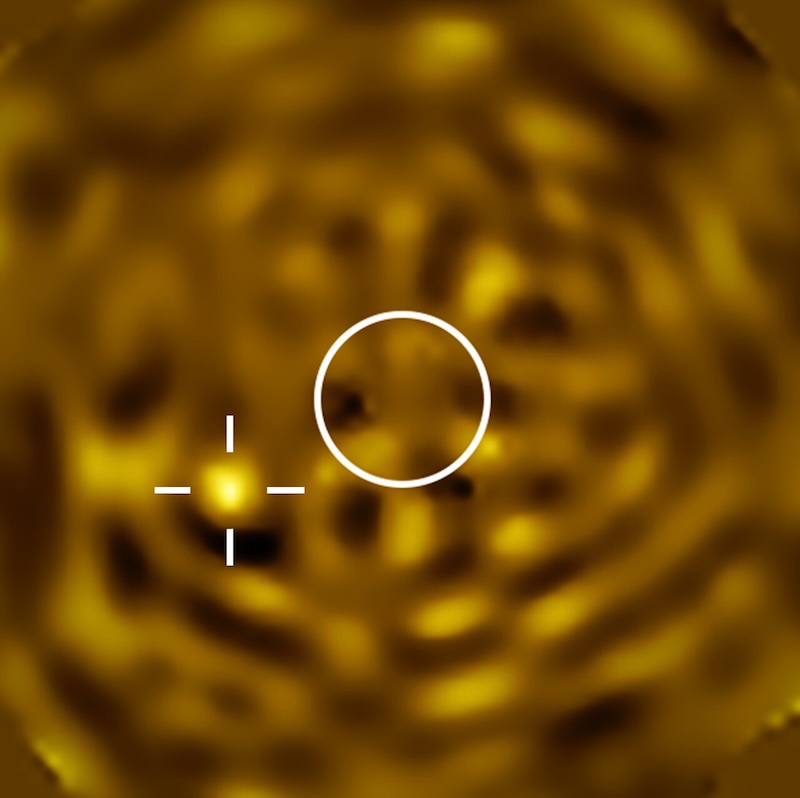
- ESO’s Very Large Telescope has captured an image of the recently discovered companion to the famous red supergiant Betelgeuse at its expected location.
- To confirm the object is Betelgeuse B astronomers will need to observe it in one year on the other side of the star.
- The likely companion star is around 2 to 3 times the mass of our sun.
The European Southern Observatory shared this press release on July 28, 2026. Edits by EarthSky.
Image shows evidence of Betelgeuse companion star
A year ago, U.S. astronomers announced a companion for the red supergiant star Betelgeuse. This star is famous for being nearby and poised to explode. And now European astronomers have confirmed that important discovery. Using the European Southern Observatory’s Very Large Telescope (ESO’s VLT), a team led by French researcher Miguel Montargès obtained the clearest image ever of what is likely Betelgeuse B, the star orbiting Betelgeuse. He’s an astronomer at the Observatoire de Paris – PSL, France, and lead author of the study published today in Astronomy & Astrophysics. Montargès recalls:
I jumped from my chair when I saw the processed images.
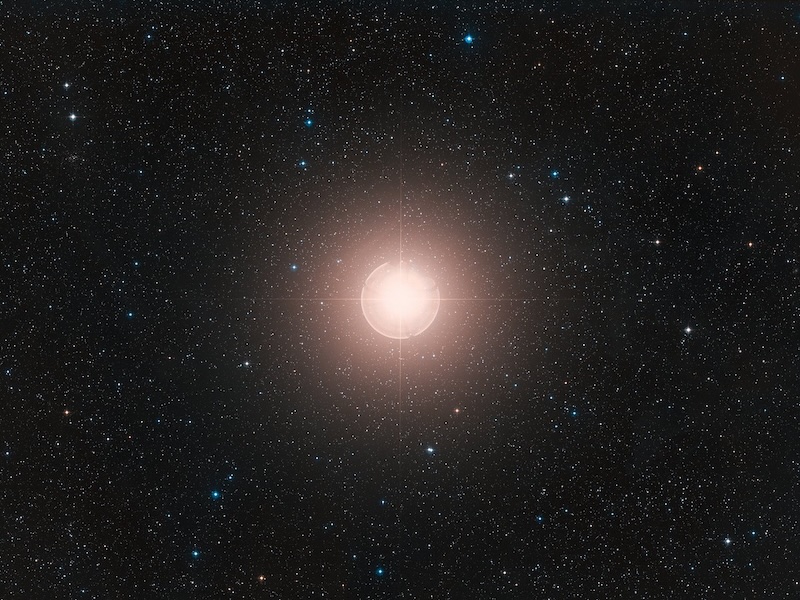
Betelgeuse, in the constellation Orion the Hunter, is easily visible with the unaided eye. Want to see it? Read this article about the return of Orion before dawn at this time of year. Excitingly, the star is known to change in brightness. It has been observed for millennia. However, it still surprises astronomers.
The brightness of Betelgeuse varies
For a long time, astronomers have looked for the potential companion to Betelgeuse. It was originally proposed to explain Betelgeuse’s brightness changes. Then two studies published in 2024 predicted that in December that year, the companion would be furthest from Betelgeuse and hence easier to spot. Montargès and his team got to work, observing the star with ESO’s VLT in December 2024 and spending several months processing the data.
Originally the companion star was thought to be about as massive as the sun. However, the new observations reveal that Betelgeuse B has around two to three times the mass of the sun. Montargès explained:
Honestly, I thought we did not have the sensitivity to detect Betelgeuse B as it was predicted. Because it is more massive than predicted, we see it! The fact that we can still discover a nearby companion, more massive and brighter than the sun, around such a well-studied star is remarkable. These are among the best moments in science: seeing something new, unexpected.
The Betelgeuse companion imaged
Betelgeuse B was directly imaged, meaning the light from the star itself was detected, using the SPHERE instrument on ESO’s VLT. While there was evidence for the existence of this companion star, including a possible direct detection with the Gemini North Telescope in Hawaii, this is the strongest evidence for, and clearest image yet of, Betelgeuse B. Co-author Anthony Boccaletti, also an astronomer at the Observatoire de Paris said:
It is remarkable to see how SPHERE and advanced post-processing techniques, originally developed to find exoplanets, also excel at detecting a companion around a massive, evolved star like Betelgeuse.
Montargès added:
To be certain that the companion is really there, we still need to observe it in one year on the other side of the star. But there is very little space left for doubt.
Betelgeuse’s great dimming caught attention
A few years back, Betelgeuse was the subject of attention from astronomers and non-astronomers alike when it visibly started dimming. As an evolved supergiant star, Betelgeuse is expected to die in a supernova explosion. So the dramatic dimming of Betelgeuse led some to speculate it could be about to explode. A group of astronomers led by Montargès studied the star with ESO’s VLT, finding it was instead obscured by a cloud of dust.
The potential detection of Betelgeuse B will prompt astronomers to investigate how the companion could affect Betelgeuse’s anticipated supernova explosion. Montargès concluded:
The question is truly opened whether this companion is going to have an impact on the evolution of the red supergiant.
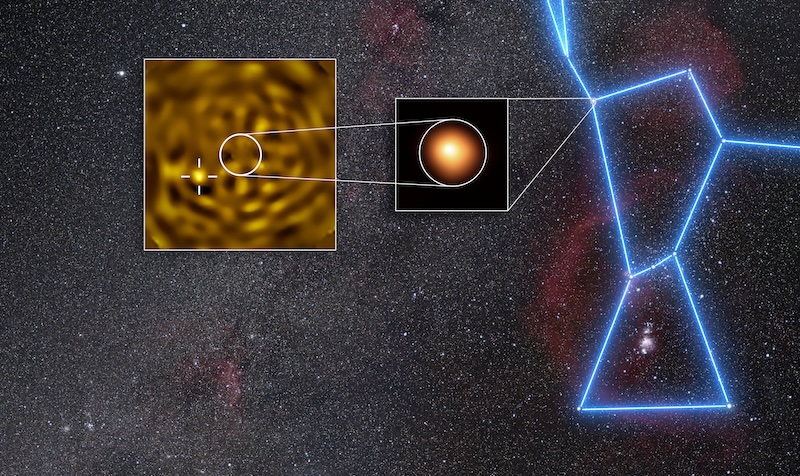
Bottom line: A recent image appears to show the companion star of Betelgeuse, know as Betelgeuse B. It’s the strongest evidence yet that the beloved red supergiant star has a companion star.
Read more: Betelgeuse’s companion star leaves detectable wake
Read more: New details about Betelbuddy, Betelgeuse’s companion star
Like what you read?
Subscribe and receive daily news delivered to your inbox.
More from
EarthSky Voices


Why leaves change color in the autumn

How a helium leak in an exoplanet atmosphere hints at life
Would a Yellowstone supervolcano eruption end humanity now?
Neptune discovered on this date 180 years ago