The moon phase is a whole-Earth phenomenon
Everyone on the moonward-facing side of Earth sees the same moon phase at the same time. But the moon can look different depending on where you are. Its orientation changes with your latitude. And it changes even over the course of a single night.
Why does this happen? It comes down to Earth’s rotation, and its round shape. Both give us different perspectives on the sky.
The moon appears to change its height above your horizon as the night passes. And that change is because Earth rotates. Like the sun and stars, the moon appears to travel westward under the sky. That’s not the moon’s own motion; it’s Earth’s rotation under the sky.
Also, like the sun and stars, the moon moves in an arc across the sky. The illustration below shows the curved line traveled by the stars and the moon each night (or day). They appear to travel curved paths because we live on a round Earth. Their paths across the sky are a reflection of Earth’s own curvature.
Meanwhile, the moon also moves in orbit around Earth. That orbital motion of the moon is eastward, in front of the background stars.

How the moon changes over hours
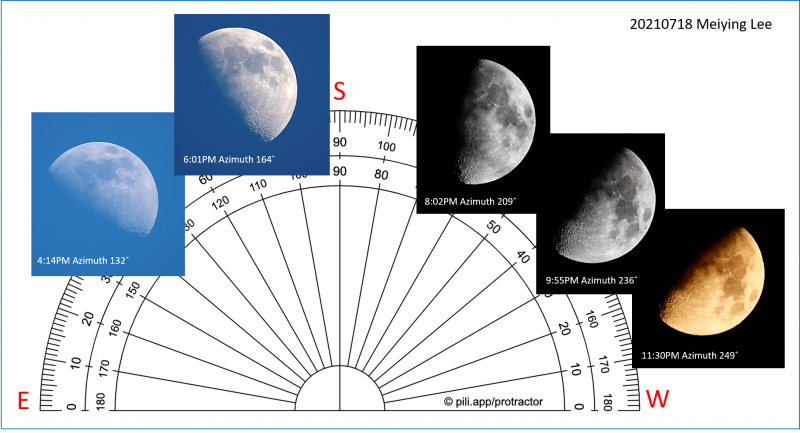
Overnight — or even in a few hours — you can notice that the appearance of the moon changes.

How the moon changes between hemispheres
So people on Earth’s moonward-facing side all see the same moon. Then why do people on different parts of the globe sometimes say they are seeing the moon differently? It’s not a change in phase. Sometimes it’s a physical change in the orientation of the moon with respect to your horizon. And sometimes it’s that, plus a change in perspective. The differences can be hard to comprehend!
For one thing, observers in the Northern and Southern Hemispheres see the moon apparently upside-down with respect to each other.
Also, from the Northern Hemisphere, a waxing moon (from new moon to full moon) increases its phase from right to left. Meanwhile, from the Southern Hemisphere, a waxing moon increases its phase from left to right.
Why so different? Think of the moon’s path across your sky. Just picture yourself standing there, looking at it. From the Northern Hemisphere, we look generally southward to see the moon (or sun) crossing our sky. From the Southern Hemisphere, people look generally northward to see the moon (or sun) crossing the sky. That’s what the illustration below is showing.
Can you see why that shift in your orientation on the globe would cause you to see the moon differently?

A final thought
What we on Earth call moon phases are really about sunrise/set on the moon. Astronomers call the line between light and dark on the moon the terminator. That’s the line of sunrise or sunset on the moon, and it shifts, just as the line of sunrise and sunset on Earth is constantly shifting.
Also, Earth spins relatively fast, approximately once every 24 hours. The moon spins on its axis only about once a month, and its line of sunrise/set moves slowly. It’s wonderful fun to beg or borrow a telescope for a night when the moon is up … and watch for yourself over several hours. The shadows slowly shift on the moon, as the lunar sunrise or sunset slowly creeps across the moon’s face.
Of course, it’s also a great way to clear the mind!

Bottom line: The moon shows one phase to the Earth at the same time, but our different perspectives due to where we are on the globe can make the moon appear differently in our sky.
Want more? Here are 4 keys to understanding the moon’s phases
Like what you read?
Subscribe and receive daily news delivered to your inbox.
More from
Deborah Byrd


A runaway star speeds in an unusual direction

Visible planets and night sky guide for November
Swift spacecraft fell back to Earth in a fiery blaze