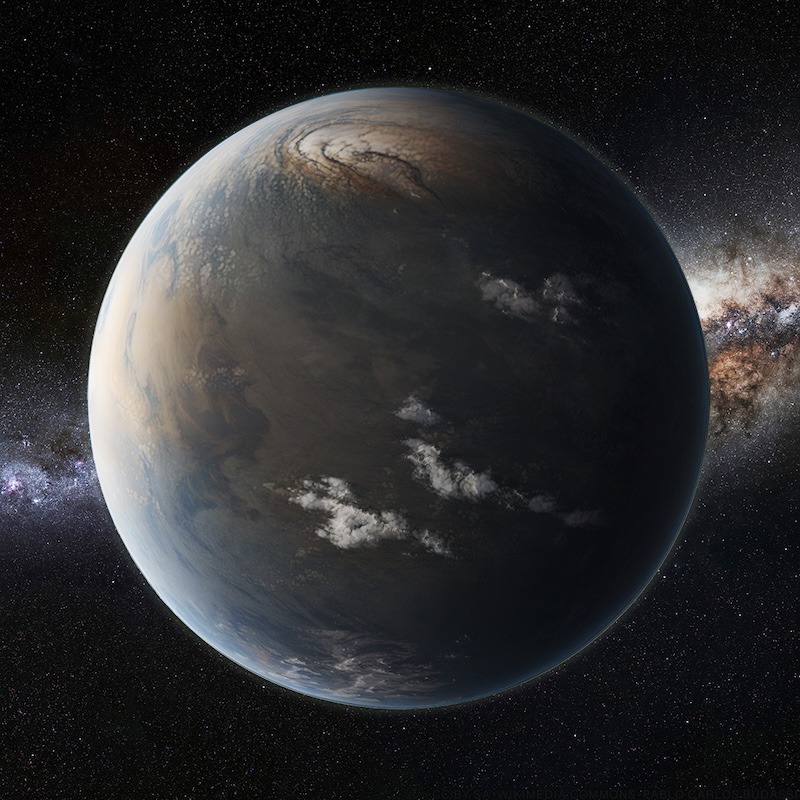
- Astronomers have confirmed an unusual planet called GJ 523b. It belongs to a rare group of worlds known as mega-Earths.
- The planet has 23 times the mass of Earth packed into a ball only 2.5 times Earth’s diameter. So it’s unusually dense.
- Scientists don’t understand how it formed this way. A planet this massive would normally be expected to have a thick atmosphere of hydrogen and helium, like Neptune, which is only slightly less massive than GJ 523b.
Giant mega-Earth has 23 times Earth’s mass
On July 23, 2026, astronomers at the University of Wisconsin-Madison announced the confirmation of GJ 523b, an unusually dense mega-Earth first detected in data from NASA’s TESS telescope.
Rocky exoplanets called super-Earths are also known to exist. In fact, they’re quite common in our Milky Way galaxy. Super-Earths are bigger and more massive than Earth, but smaller than Neptune.
Meanwhile, astronomers are beginning to find mega-Earths. They’ve found fewer mega-Earths than super-Earths so far, but mega-Earths do seem to exist. This newest one – GJ 523b – might be the best example known so far. It packs a whopping 23 times Earth’s mass into a rocky ball only 2.5 times Earth’s diameter. So it is super-dense.
Some super-Earths can be 2.5 times Earth’s diameter. It’s the extreme mass of GJ 523b that’s unusual. What’s more, the GJ 523 system is estimated to be only 170 million years old. That’s in contrast to Earth’s age of 4.54 billion years. So the GJ 523 system is much younger than our own solar system. The planet orbits an orange dwarf star.
Thomas Beatty at the University of Wisconsin-Madison said:
People have been using the phrase ‘mega-Earth’ for more than a decade, but we’ve never had a planet that let us say concretely what one is. GJ 523b finally does. What is also striking is that nailing down the definition of a mega-Earth isn’t something us astronomers can really do by ourselves: We need geologists who understand how iron and rock behave at pressures no laboratory on Earth can reach, and atmospheric scientists who can tell us how much of what we measured is rock at all.
The new paper is still undergoing peer review but was first published on the preprint server arXiv on March 25, 2026.
TESS makes a surprising discovery
Astronomers first used NASA’s TESS space telescope to detect GJ 523b as it passed in front of its star, causing a tiny dip in the star’s brightness. These transits allowed astronomers to estimate the planet’s size.
Lead author Max Kroft at the University of Wisconsin-Madison said:
There’s this periodic dipping of the star’s light. We think that’s a planet passing in front of the star and transiting. It’s blocking some of the light from the star, and the star gets dimmer.
We picked out this planet based on what we thought its size and temperature were. A bigger planet makes a bigger dip, so we get an idea of the size, and based on how often that dip happens, we get the distance of its orbit and we can use that to estimate the temperature of the exoplanet.
The researchers then used the NEID spectrograph and data on the WIYN 3.5-meter (11.48 feet) telescope to determine its mass. High-resolution imaging from Gemini North and Palomar were used to further study GJ 523b. They found some surprises. It was more massive than most rocky planets of its size; 23.5 times more massive than Earth and 2.5 times the diameter of Earth, or 60% the size of Neptune. As Kroft noted, this was an unexpected finding:
This isn’t what we expected at all. Dense planets like this aren’t uncommon, but they’re usually small rocky planets similar to Earth or Mercury. This planet is 2.5 times bigger than the Earth.

How did GJ 523b form this way?
So how did GJ 523b end up being so extremely dense and massive? Why didn’t the planet develop a massive hydrogen atmosphere?
In the words of Kroft, the discovery was:
a real curveball.
During planet formation, worlds with cores around 10 to 20 times Earth’s mass are generally expected to pull in thick atmospheres of hydrogen and helium. GJ 523b is massive enough for this to happen, yet it appears to contain very little gas.
The study found that ordinary heating from the star probably could not remove enough gas. Giant impacts, an extremely close passage by the star or forming without much gas are possible explanations.
Kroft also notes that the planet would still have been hot from its formation. Too hot to hold onto its atmosphere. Krofft explained:
It kind of blows away. A planet can’t hold on to its atmosphere if it’s really hot, and so you could be left with this big glob of rock made by these two planets with very little atmosphere.
The planet’s orbit offers another clue
The researchers estimate that it is tilted by at least 71 degrees relative to the rotation of its star. This unusual alignment suggests that GJ 523b might have migrated from elsewhere in the system or experienced a turbulent event early in its history.
More planets like GJ 523b
The researchers are hopeful that astronomers will find more planets like GJ 523b. There are over 6,000 confirmed exoplanets already found, and thousands more candidates. Kroft said:
It’s hard to infer things about planet formation in general from a sample size of one. We’re not going to get to 10,000 of these over-dense planets, but if we can get to 20 or 30, maybe some trends might pop out, where maybe the heaviest ones have shorter orbital periods, or they tend not to have companion planets.
Bottom line: Astronomers have discovered a mega-Earth, GJ 523b. It’s 23.5 times Earth’s mass but only 2.5 times its diameter. Its extreme density and lack of a thick atmosphere challenge ideas about how massive planets form.
Source: GJ 523b is a Massive, 170 Myr-old Mega-Earth, Likely on a Polar Orbit
Via University of Wisconsin-Madison
Like what you read?
Subscribe and receive daily news delivered to your inbox.
More from
Paul Scott Anderson


2nd-generation planet: Was this world born around a dead star?

Weirdest cloud on Mars formed via ‘exotic physics’
Did formaldehyde on ancient Mars help kickstart life?
Black holes could have planets, new simulations suggest