




- Donaldjohanson is a small asteroid, about 1/2 mile (800 m) across, in the main asteroid belt between Mars and Jupiter.
- NASA’s Lucy spacecraft confirmed it is oblong and peanut-shaped in 2025.
- And it found the strange asteroid is wobbling in two directions: end-over-end and along its horizontal axis.
Tiny asteroid wobbles in space
Donaldjohanson is an intriguing asteroid in the main asteroid belt between Mars and Jupiter. NASA’s Lucy spacecraft flew past Donaldjohanson on April 20, 2025, and found that the 1/2 mile (800 m) diameter asteroid is elongated and shaped like a peanut. And now, astronomers have announced another discovery spawned from the flyby.
Researchers with the Southwest Research Institute (SwRI) said on June 18, 2026, that the asteroid wobbles during its rotation. It rotates end-over-end every 10.5 Earth days, and wobbles on its horizontal axis every 26.5 days.
It’s an interesting surprise for astronomers, who had expected it to move through space in a steady pattern. Lead author and deputy principal investigator for the Lucy mission, Simone Marchi, said:
This is just one of many surprising things learned since NASA’s Lucy spacecraft flew by Donaldjohanson on April 20, 2025.
The researchers published their peer-reviewed results about this tiny tumbling world in Science on June 18, 2026.
New by me for @skyandtelescope.bsky.social : how slowing spin makes gravity win (over centrifugal acceleration) for the peanut asteroid 52246 Donaldjohanson, visited by the Lucy mission last April skyandtelescope.org/uncategorize…
— Emily Lakdawalla ????? Uranus Expert (@elakdawalla.bsky.social) 2026-06-18T18:26:19.291Z
Donaldjohanson does not spin steadily. Lucy observations show the 0.8-kilometer asteroid turns end over end every 10.5 days and wobbles around its horizontal axis every 26.5 days. doi.org/hb77fc
— Science X / Phys.org (@sciencex.bsky.social) 2026-06-18T17:20:20-04:00
Shaped like a peanut
Astronomers suspected that Donaldjohanson was oblong in shape based on ground-based observations from Earth. And the Lucy spacecraft confirmed that. Lucy revealed that the asteroid is actually shaped like a peanut. It has two large lobes connected by a narrow neck. It looks like what scientists call an elongated contact binary (an object formed when two small bodies collide).
Lucy images confirmed its elongated shape, initially suggested by Earth-based telescope observations. The flyby revealed that the small asteroid, half a mile in diameter, resembles a peanut, with a two-lobed structure connected by a narrower neck.
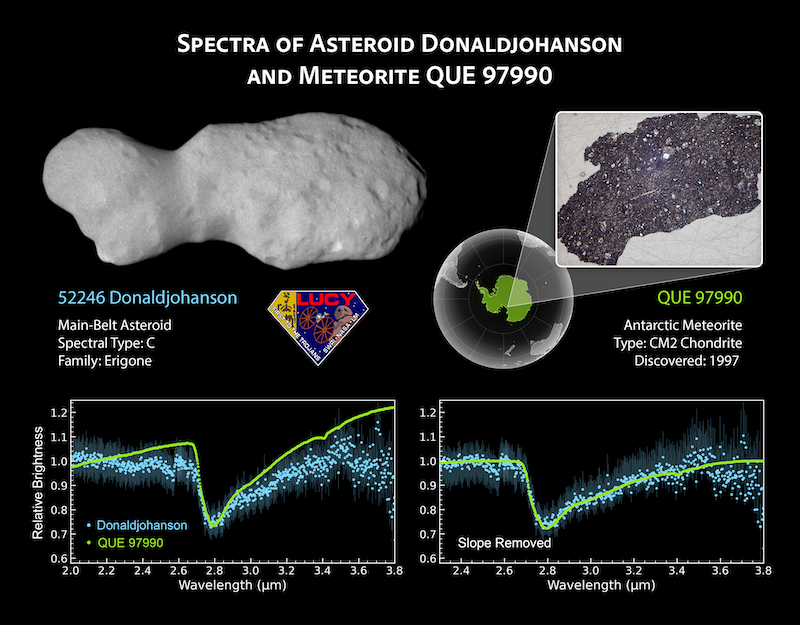
Rich in clay minerals
In addition, Lucy discovered clay minerals on Donaldjohanson. Clay minerals require liquid water to form. So scientists say that the asteroid likely formed from the fragments of a larger asteroid that broke apart about 155 million years ago. That asteroid was rich in water and carbon.
The composition of these minerals is similar to that of other carbonaceous asteroids, or asteroids rich in carbon. But on Donaldjohanson, the aqueous (water) stage seems to have ended earlier. That might have been due to insufficient heat or water.

Journey to Jupiter
Lucy’s primary mission is still ahead. It is now en route to Jupiter, where it will explore two groups of asteroids: the Greek asteroids, which lead Jupiter in its orbit, and the Trojan asteroids, which trail behind it. Together, these two groups are known as the Jupiter Trojans. Marchi said:
This encounter gave us an opportunity to test our instruments and our procedures to make sure we are ready when we get to Jupiter’s Trojans. Once we start learning more about the Trojans, a completely different population of space rocks with very different histories, our understanding of solar system formation is likely to be challenged.
Lucy is expected to reach the first Trojan asteroid, Eurybates, in August 2027.
The Lucy spacecraft is named for a famous fossilized skeleton found in Africa in 1974. Likewise, Donaldjohanson is named for the paleoanthropologist best known for discovering the Lucy fossil.
Bottom line: New analysis shows that peanut-shaped asteroid Donaldjohanson wobbles in space in two directions. The Lucy spacecraft now continues its journey toward Jupiter’s Trojans.
Source: The Lucy flyby of (52246) Donaldjohanson: A bilobed asteroid with tumbling rotation
Read more: Lucy spacecraft 1st images of asteroid Donaldjohanson!
Read more: Lucy mission to Jupiter’s Trojans gets the nod from NASA
Like what you read?
Subscribe and receive daily news delivered to your inbox.
More from
Paul Scott Anderson


Is this an alien radio signal from a super-Earth exoplanet?

Life on Enceladus? 2 new studies boost chances
Water systems on early Mars were complex and hot
Weather on exoplanets: Decoding the atmosphere of SIMP 0136



