



Astronomer Alan Stern – who was principal investigator on the New Horizons mission to Pluto – claims that “most planetary astronomers” want Pluto to be a planet again. He’s the leader of what we might call Team Planet-Pluto. Astronomer Michael Brown – his principal adversary – claims that “Pluto just isn’t a planet.” Hear their contrary views in this 2026 video, hosted by EarthSky’s Deborah Byrd. Watch in the player above, or on YouTube.
Dwarf planet Pluto
On August 24, 2006, the International Astronomical Union (IAU) announced it had re-classified Pluto as a dwarf planet. Moreover, it declared that Pluto was “not a planet.”
From 1930 until that day, Pluto had been considered a planet, and the outermost world of the solar system. As technology advanced, though, astronomers began to see fainter and fainter objects in our neighborhood. That led them to recognize Pluto as only the largest of many small bodies in the outer solar system. So is Pluto a planet or not?
Today, Pluto is known as a dwarf planet, and Neptune – 8th world from the sun – is considered the outermost of our solar system’s planets. It all came about because the IAU formulated and pushed through a new definition of what it means to be a planet.
But some astronomers, and a small segment of the public, are still angry about it.
Why? And what would happen if Pluto were re-classified as a planet today? The video below, produced by EarthSky’s Deborah Byrd, has part of the answer.
Why did Pluto change status?
Prior to 2006, astronomers hadn’t gotten around to establishing clear standards for categorizing a solar system “planet” versus a “dwarf planet.”
They began to see a need when many small bodies – such as Haumea and Makemake – began to be discovered in the outer solar system. Eris, also considered a dwarf planet, has even more mass than Pluto (though it’s not quite as large). So if Pluto is a planet, why shouldn’t Eris be granted planet status as well? That was the question the IAU asked itself, which led to its formation of a Planet Definition Committee and ultimately the 2006 decision.
The committee had a few possible roads to travel down. One would be to choose a size or mass limit that would make Pluto remain a planet. That would mean that Eris and Ceres – the largest body in the inner solar system’s asteroid belt – would become planets, too. And today we know there would be perhaps hundreds of small bodies large enough to call “planets” if we followed this path. This solution – favored by most of the original IAU committee members – looked as if it might be implemented for a while.
Another option for the IAU might have been to define the concept of a planet without any specific logic: Earth is a planet, Pluto is a planet, but Eris is not just because. But would that have been very scientific?

New planetary classifications
On August 24, 2006, the IAU announced its solution. It decided to create a scientific definition of what it means to be a planet. And that definition excluded Pluto from major planet status. Here’s the definition:
A planet is a celestial body that
(a) is in orbit around the sun,
(b) has sufficient mass for its self-gravity to overcome rigid body forces so that it assumes a hydrostatic equilibrium (nearly round) shape, and
(c) has cleared the neighborhood around its orbit.
It’s “c” that causes Pluto to fail as a planet, according to the IAU. For an object to be a major planet, according to this definition, it must be the dominant gravitational object in its orbit. It must either sling other objects away or merge with them.
Pluto is only 0.07 times the mass of the objects in its orbit. Meanwhile, Earth is 1.7 million times the mass of the objects in its orbit.
Still, today, there are astronomers on Team Planet-Pluto who will declare:
But Earth has not cleared its orbit either.

Pluto hasn’t cleared its neighborhood
On that fateful day – August 24, 2006 – the IAU also created a new category of celestial objects for Pluto and all Pluto-like objects:
A “dwarf planet” is a celestial body that
(a) is in orbit around the sun,
(b) has sufficient mass for its self-gravity to overcome rigid body forces so that it assumes a hydrostatic equilibrium (nearly round) shape,
(c) has not cleared the neighborhood around its orbit, and
(d) is not a satellite.
How many dwarf planets are there? According to this page by planetary astronomer Mike Brown of CalTech, as of November 25, 2025, there are:
10 objects which are nearly certainly dwarf planets,
27 objects which are highly likely to be dwarf planets,
68 objects which are likely to be dwarf planets,
130 objects which are probably dwarf planets, and
741 objects which are possibly dwarf planets.

Hundreds of dwarf planets?
Astronomers believe there may be hundreds more undiscovered dwarf planets in the Kuiper Belt of the outer solar system. There may be up to 10,000 in the region beyond.
More about the Kuiper Belt: https://t.co/qNCG1GvgeP https://t.co/kPGvZtR4IY pic.twitter.com/FYX5Cv2PDD
— NASA Solar System (@NASASolarSystem) February 20, 2024
Not a new idea
By the way, it’s not common knowledge that many astronomers started out being quite careful about their use of the word “planet” with respect to Pluto. In 1932, for example, only two years after American astronomer Clyde Tombaugh discovered Pluto, another astronomer, Armin Otto Leuschner, wrote in a journal article:
You may observe that with extreme conservatism I am still referring to Pluto as an object rather than as a planet. There is every probability that it is a planet, as is now universally concluded, from available material … So far only an upper limit for the mass of Pluto … has been established, and such a mass is believed from gravitational considerations to be too small to affect the motions of Uranus and Neptune sufficiently … There is also a remote chance that later investigations will render its mass comparable to that of comets.
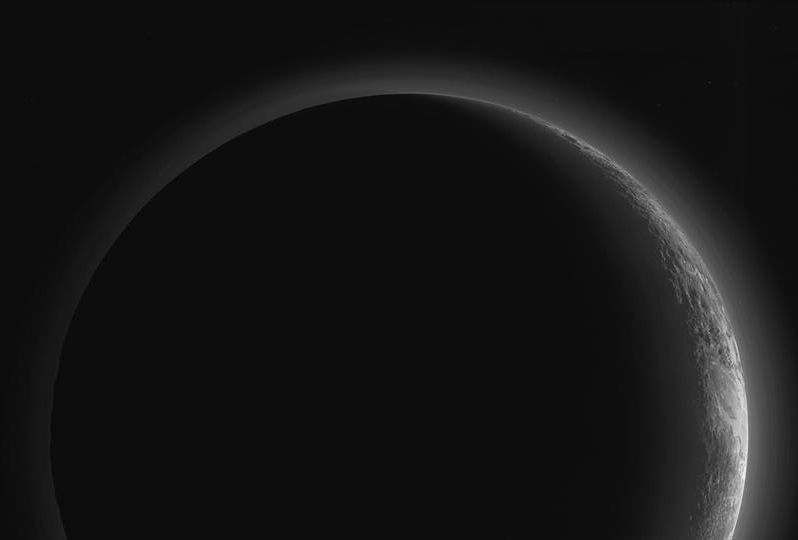
So is Pluto a planet or not?
Recall why astronomers began searching for Pluto in the first place. They expected to find an object large enough to gravitationally disturb the orbit of Neptune. But that’s not Pluto, it’s not large enough to disturb Neptune. Pluto was found by accident.
If Pluto had been discovered a decade or so later, when Edgeworth began speculating about the existence of what we now call the Kuiper Belt – a belt of small Pluto-like objects in the outer solar system – Pluto itself might have never been awarded the status of planet. As explained in the videos at the top of this article, if Pluto were classified as a planet today, our solar system would now contain not just eight or nine, but dozens of “planets.”
Eventually, we are expected to find hundreds of objects that would need to be classified as planets, if the Team Planet-Pluto wins the argument about Pluto’s planet status.
The search for Planet 9
And that’s why astronomer Michael Brown does not believe Pluto should be called a planet. Brown studies the dynamics of our solar system. He perceives it as eight classical planets – Mercury, Venus, Earth, Mars, Jupiter, Saturn, Uranus, Neptune – and two large “belts” of objects: the asteroid belt between Mars and Jupiter and the Kuiper Belt in the outer solar system.
The first eight classical planets formed in a process involving smaller objects sticking together to make larger objects, that eventually became large enough to have enough self-gravity to pull themselves into the shapes of balls.
Did the smaller bodies in the asteroid belt and Kuiper Belt form this way? Perhaps. Pluto, for example, is round. But perhaps not. The formation of the bodies in the asteroid belt and Kuiper Belt might have been different: less complex. Brown thinks we can understand the solar system better if we categorize those objects in a way different from the eight classical planets.
Whatever happens, whether Pluto ultimately re-gained its planet status or not, the de-classification of Pluto has been eye-opening! And if Pluto is not the ninth planet, could there actually be a ninth planet waiting to be discovered?
Bottom line: August 24 is the anniversary of Pluto’s demotion to dwarf planet status. The International Astronomical Union demoted Pluto largely because it is has not “cleared the neighborhood around its orbit.”
The IAU talks about its decision to demote Pluto here
Like what you read?
Subscribe and receive daily news delivered to your inbox.
More from
Editors of EarthSky


Comet Halley is parent of 2 meteor showers

Inferior conjunction — Venus! October 23-24, 2026
Mercury after sunset and great for Southern Hemisphere!
Meteor shower guide 2026: Up next … the Orionids



