Wildfire smoke is choking Canada, Great Lakes and Northeast
Canadian wildfires had a slow start in 2026, but now they’re making up for their quiet stretch. According to NOAA:

On July 13, 2026, numerous wildfires exploded in far northern Minnesota and western Ontario, threatening many communities in the state and province. Thick wildfire smoke billowed out from the flames and spread across the skies over North America during the following days. This smoke has caused air quality issues in the United States and Canada, with thick haze enveloping the skies above major cities such as Toronto, Boston and New York City.
There are currently more than 800 wildfires burning across Canada. The smoke started pouring into northern tier states in earnest on Wednesday. Live cams from places such as Mackinac Island in Michigan and Niagara Falls showed areas choking with smoke.
The smoke should become more widespread on Thursday, pushing into northeastern states along with dropping southward. And weather models show the smoke should continue into Friday and Saturday as well.
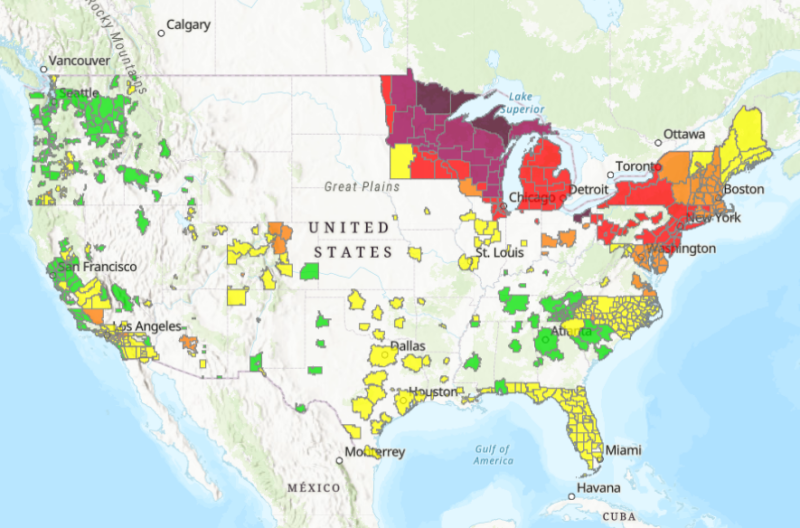
How is the air near you?
To see what the air quality index, or AQI, is in the United States, you can visit Airnow.gov. At one point on Tuesday, Marquette, Michigan, had an AQI of 1008. Hazardous conditions start at 300. Duluth, Minnesota, had 682.
If you’re in Canada, you can find out your air quality index at IQair.com.
Exposure to wildfire smoke can cause coughing, shortness of breath and asthma attacks. It also can put a strain on your heart. To protect yourself from wildfire smoke, limit your time outdoors. If possible, stay inside with the doors and windows shut. Find more tips here.
The high temperatures are exacerbating the problem for those seeking relief. If you do not have air conditioning and are facing poor air quality, look for a cooling shelter near you.
3/ When wildfire smoke occurs during heatwaves in areas where a portion of the population doesn't have access to air conditioning, people face the dilemma of opening their windows to avoid heatstroke, but searing their lungs with smoke. Smoke + heat can become even deadlier than either alone.
— Jonathan Vigh (@skywatcher77.bsky.social) 2026-07-15T00:40:12.515Z
Smoky scenes from social media
There were scenes on social media of fires threatening people in Canada along with views of gray and orange skies in the U.S. See some of the scenes below.
Wow! This footage shows the view from inside a train as it becomes surrounded by raging wildfire flames near Armstrong, Ontario. Canadian National Railway says the crew all got out safely.
— Paul Graf (@paulginva.bsky.social) 2026-07-15T21:25:46.911Z
These images of First Nations community members evacuating Collins, Ontario on motorboats are absolutely surrealwww.facebook.com/reel/1548244…
The Mackinac Bridge (to nowhere) this morning due to the wildfire smoke
— Katie O'Reilly (@drkatfish.bsky.social) 2026-07-15T17:57:14.957Z
The air in my hometown right now. Ontario has some of the worst air quality in the world due to wildfire smoke. It is unnatural lighting outside at the moment. Stay inside if you can. The air is crunchy and smells like wood smoke. Take care, all.????
— Sheila E. Young (@sheilaeyoung1.bsky.social) 2026-07-15T17:08:05.444Z
Wildfire smoke from Minnesota and Canada this morning ???
— Lake Michigan (@lakemichigan13.bsky.social) 2026-07-15T13:14:35.466Z
Boston Harbor today! Not a filter… wildfire smoke from Canada!
— Lisa Fagin Davis (@lisafdavis.bsky.social) 2026-07-15T15:39:13.471Z
Bottom line: Wildfire smoke is pouring across Canada and into the U.S. in the Great Lakes region and northeastern states. These areas will continue to see poor air quality into the weekend.
Read more: This Is Wildfire: Tips on preparing yourself and your home
Read more: How wildfire smoke can harm your health, even from far away
Like what you read?
Subscribe and receive daily news delivered to your inbox.
More from
Kelly Kizer Whitt


Why does anything exist? New theory emerges

Visible planets and night sky guide for October
Euclid was mapping the universe. Then it found a comet
Auriga the Charioteer and bright Capella on October evenings