The giraffe weevil is one of nature’s strangest insects. With its oversized neck, unusual battles and ingenious nests, this tiny Madagascan beetle is full of surprises. Image via Magnusforsberg/ iNaturalist.
If someone asks you to name an animal with a long neck, chances are you’ll say “giraffe.” But if you want to impress your friends at trivia night, there’s another answer worth remembering: the giraffe weevil.
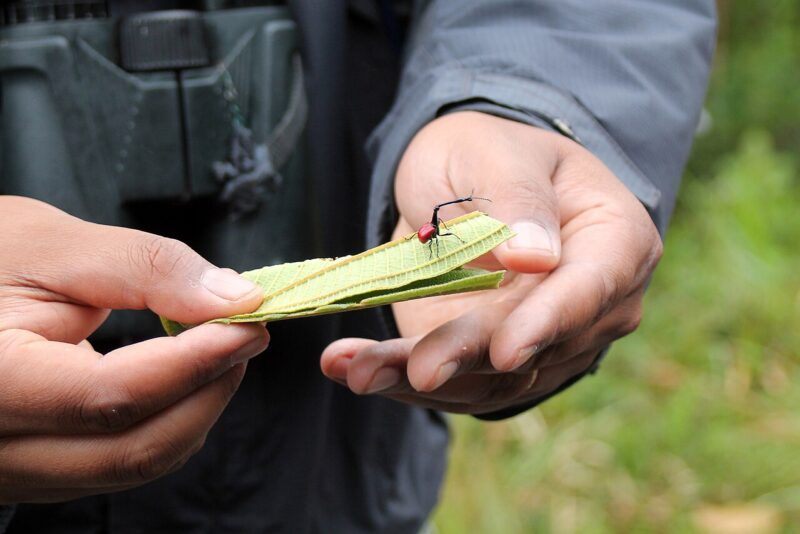
It doesn’t live on the African savanna, nor does it stand several feet tall. In fact, the giraffe weevil is small enough to comfortably fit on the tip of your finger. Yet this insect possesses an extraordinarily long neck, disproportionate enough to rival the giraffe itself.
Males use their elongated necks to fight rivals and compete for mates. Females, whose necks are much shorter, make up for it with a natural talent for building curious cradles out of rolled leaves.
These tiny insects live in Madagascar. Few places on Earth harbor as many biological oddities as the Great Red Island!
Red, black and elegant
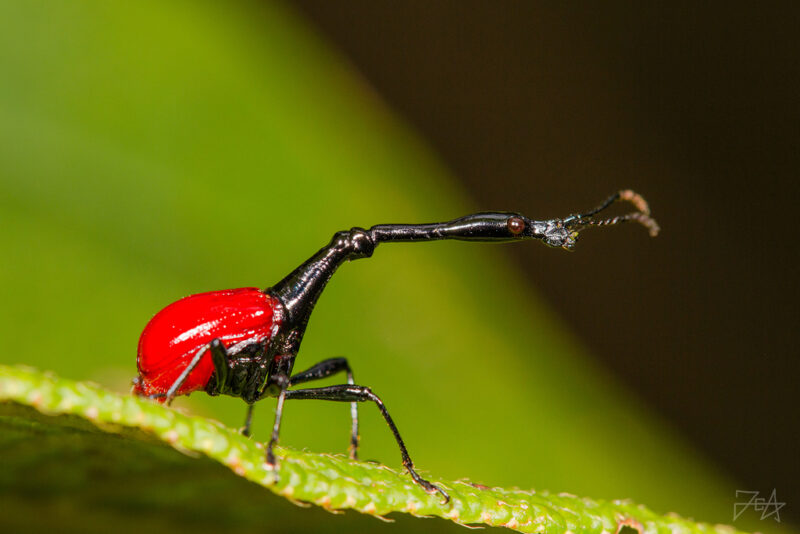
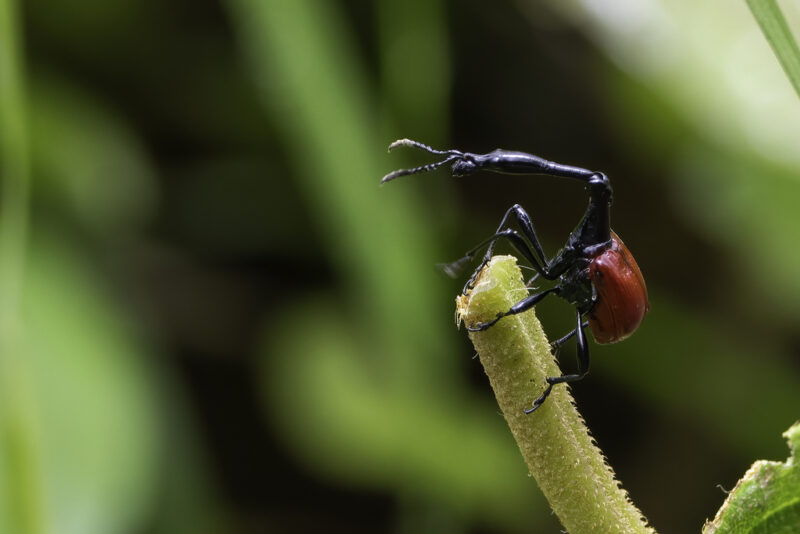
Unlike many beetles with stout, heavy bodies, the giraffe weevil has a surprisingly slender silhouette. Its long legs allow it to move easily among branches and leaves, and they are equipped with small protrusions that help it cling to vegetation.
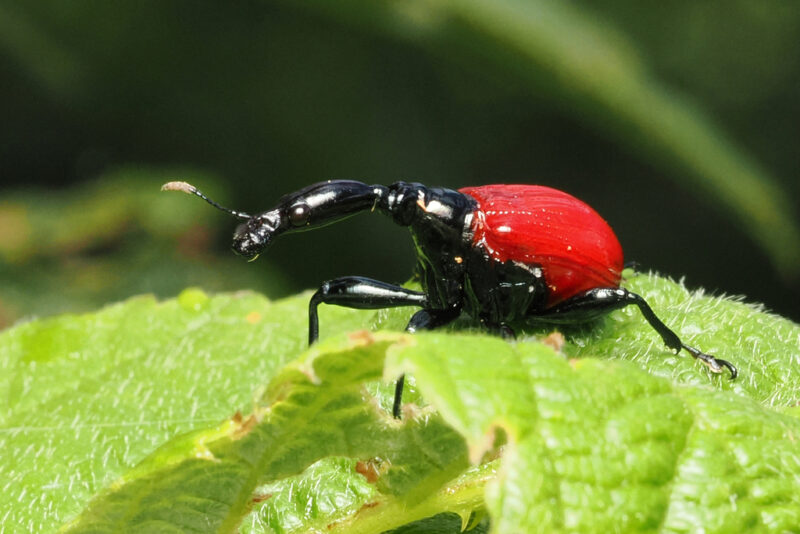
Although the neck is the first thing that catches the eye, it is far from the only feature that makes the giraffe weevil difficult to forget. Its body combines a glossy black coloration with striking red elytra, or their hardened wing covers.
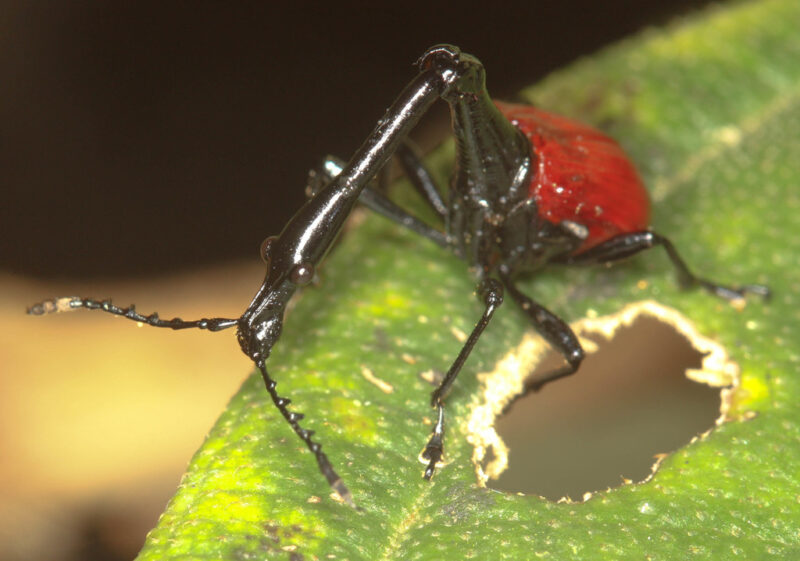
Up close, its appearance becomes even more unusual. At the end of its elongated neck sits a small head equipped with prominent dark eyes and a pair of antennae that constantly probe the surrounding environment. Unlike the bent antennae typical of many weevils, these are relatively straight and end in a small sensory structure specialized in detecting odors and other chemical signals in the environment — an essential ability for navigation and finding mates.
Much more than a long neck
Few body structures are as exaggerated as the neck of the giraffe weevil. In males, it can be several times longer than in females. And this difference is no accident. As in many species, the two sexes have followed different evolutionary paths to meet their respective challenges.
The neck plays a crucial role during the breeding season. When several males compete for a female, they may engage in combat using this structure as a kind of weapon. Rivals wrestle on branches, attempting to unbalance one another until one eventually gains the upper hand.
This phenomenon is known as sexual selection. Much like the antlers of deer, the giraffe weevil’s neck evolved because it provides reproductive advantages to those that possess a more developed version of it.
The giraffe weevil poses no threat to humans. It has no stinger, does not bite and is completely harmless. Its elongated neck may look intimidating, but it plays no role in defending against people or other large animals.
The art of turning a leaf into a cradle
If the neck is the giraffe weevil’s most famous feature, its reproductive behavior is probably its most fascinating.
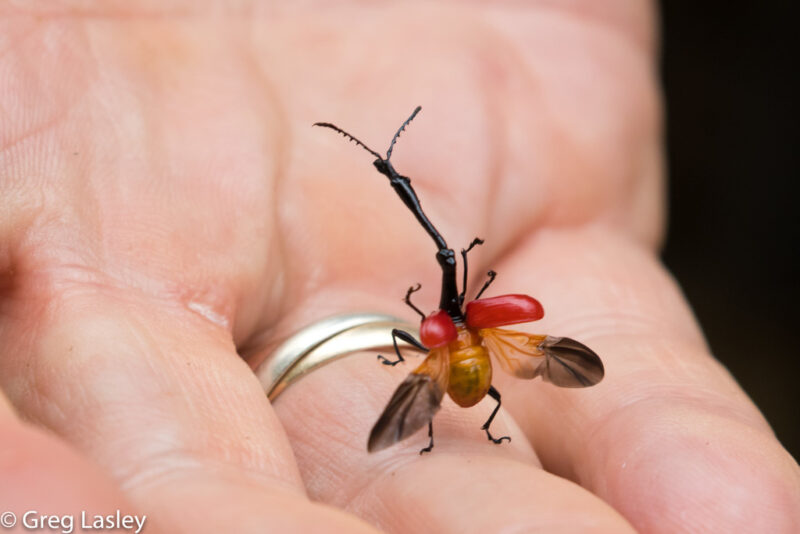
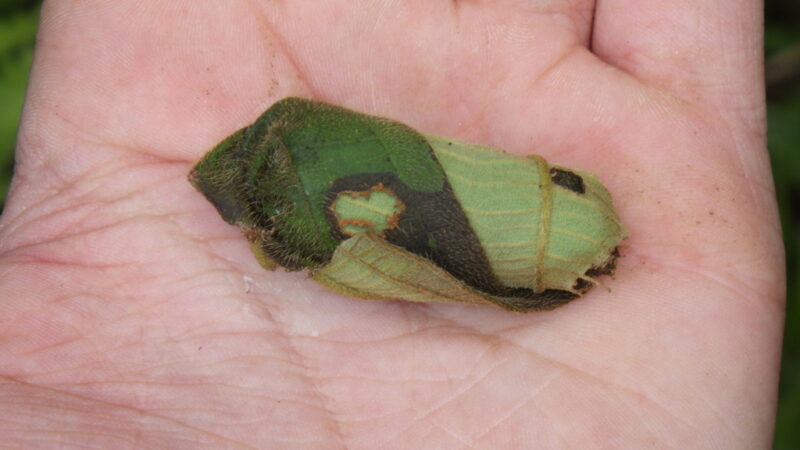
After mating, the female carefully selects a suitable leaf. Just any leaf won’t do. It must have the right size, shape and strength for the task she is about to undertake. Then begins a process that seems more fitting for a skilled craftsperson than for an insect.
Using her legs and the aid of her specialized anatomy, the leaf is gradually folded and rolled into a compact tubular structure. Inside it, the female lays a single egg and continues working until she completes a perfectly protected plant capsule. Once construction is finished, the leaf often detaches and falls to the forest floor.
What makes this so ingenious is that the tiny cradle serves several functions at once. It protects the egg from numerous predators, maintains relatively stable conditions for development and also contains the future larva’s first source of food.
Few insect species display such elaborate behavior when caring for the next generation.
Born inside a pantry
The giraffe weevil’s story does not end once the egg is safely enclosed within the rolled leaf. After some time, a small larva emerges and finds itself surrounded by food from the very first moment of its life. The leaf that forms its shelter also serves as its first meal.
As it grows, the larva slowly consumes the plant tissue around it. In doing so, it obtains the energy needed to complete the various stages of its development.
Eventually, the time for metamorphosis arrives. Like other beetles, it passes through a pupal stage during which its body undergoes a profound transformation.
At last, the adult emerges, equipped with all the characteristics that have made this species one of the most distinctive insects in the world.
An exclusive resident of the Great Red Island
The giraffe weevil lives only in Madagascar, a vast island off the eastern coast of Africa.
This geographic isolation has turned Madagascar into one of the planet’s greatest hotspots of unique evolution. For millions of years, many species evolved there independently, giving rise to animals found nowhere else on Earth.
Lemurs, impossibly shaped chameleons, bizarre insects and unique plants all form part of this extraordinary biological heritage.
The giraffe weevil is one of these endemic species. Its distribution is limited to certain forested regions of the island, where it depends on specific plants for both food and reproduction.
Much of its life unfolds among branches and leaves. There it finds shelter, food and the materials needed to build the structures in which its offspring will develop.
What does the future hold for the giraffe weevil?
The giraffe weevil remains a relatively understudied insect. Scientists do not have as much information about its populations as they do for many mammals or birds. But that does not mean it is free from threats.
Like many of Madagascar’s endemic species, its greatest challenge is habitat loss. Deforestation, agricultural expansion and other human activities are steadily reducing the natural areas on which it depends.
When a species lives exclusively in a single region of the world, any change to that environment can have significant consequences.
And yet, despite measuring only a few inches in length, the giraffe weevil has become one of the most remarkable and instantly recognizable creatures in the natural world.
Bottom line: The giraffe weevil is a tiny Madagascan beetle with a super-long neck, leaf-rolling skills and a fantastic evolutionary story.
Science matters. Wonder matters. You matter. Join our 2026 Donation Campaign today.
Like what you read?
Subscribe and receive daily news delivered to your inbox.
More from
Cristina Ortiz


New clues to how infectious fungus Candida auris resists antifungals

Amazon wildfires hide another threat to the rainforest
The Komodo dragon is the world’s largest living lizard
Scientists discover a new tiger cat hiding in plain sight