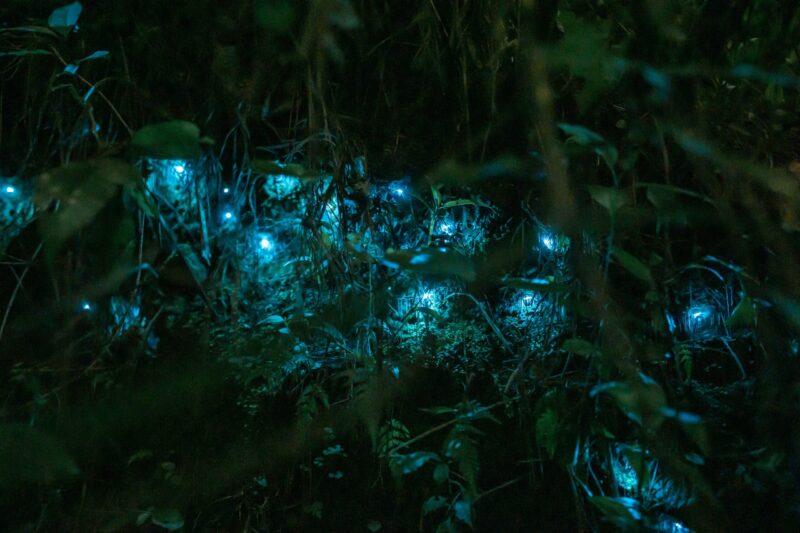
Deep in the darkness, tiny organisms called glowworms have evolved to create a celestial glow that seems almost impossible. Discover the secrets behind this breathtaking living light and watch this video to explore their hidden world. Image via David de Groot/ iNaturalist (CC BY-NC 4.0).
In places sunlight never reaches, life still finds ways to produce light. Inside caves, beneath forests and across humid, hidden landscapes, tiny organisms emit an otherworldly glow that seems almost impossible. These creatures are known as glowworms. But this simple name hides a surprising level of biological diversity.
The term “glowworm” does not refer to a single species. It is a common name applied to several unrelated organisms that independently evolved bioluminescence. What connects them is not their ancestry, but the visual effect they create. These scattered points of living light make dark spaces appear stunningly celestial.
The New Zealand glowworm
The most famous glowworms live on the ceilings of caves in New Zealand, where they spend their larval stage attached to rock surfaces in complete darkness. The species, Arachnocampa luminosa, is not a worm. It’s the immature form of a fungus gnat (a small fly resembling a fragile mosquito) that inhabits damp cave systems and sheltered underground spaces.
In this environment, the light they produce is not decorative; it is a lethal hunting strategy. The glow functions as a lure that attracts flying insects into reach, turning total darkness into an advantage rather than a limitation.
The brightness of the glow varies depending on their hunger. Hungry larvae often increase their light output, making themselves more visible and improving their chances of capturing prey. This ability relies on a biochemical reaction inside specialized organs — an extremely efficient process that generates a steady blue-green glow with almost no energy lost as heat, which is why it is often described as “cold light.”
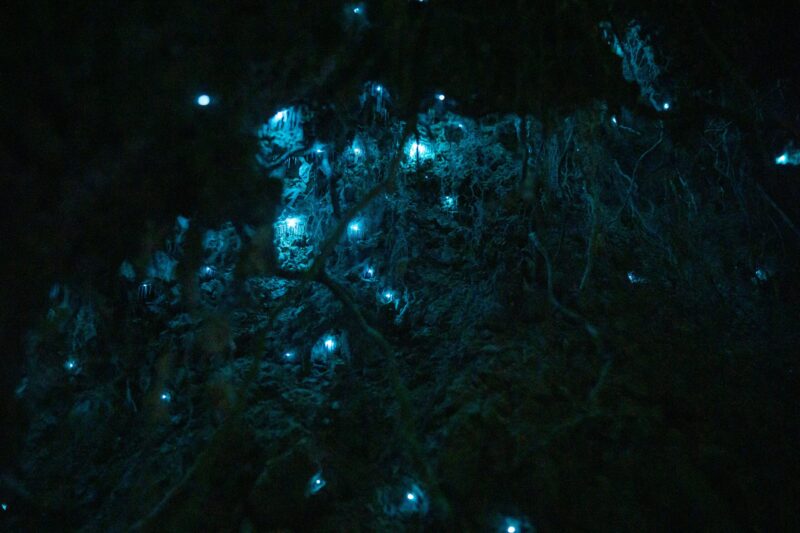
Why glowworms shine: The silk traps
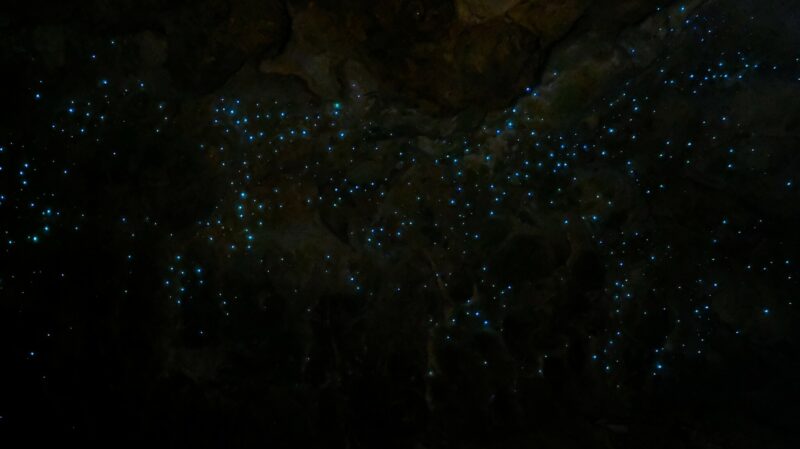
Waitomo Caves is one of the best-known places where this phenomenon can be observed. In this setting, thousands of larvae illuminate cave ceilings, creating the impression of a star-filled sky underground.
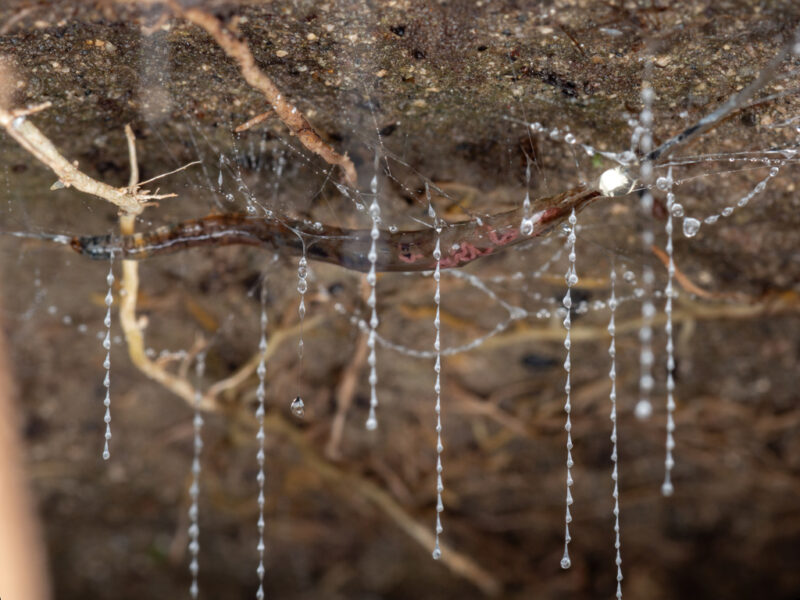
Each larva produces dozens of thin silk threads that hang downward, reaching up to 20 inches (50 cm) long. To make them effective traps, the larva covers these threads with droplets of a sticky liquid. The bioluminescent glow attracts small flying insects, like midges and moths, that move toward the light, become entangled in the sticky filaments and are then reeled upward and consumed alive by the larva.
Inside these caves, darkness is not empty. Instead, it’s filled with suspended points of light deliberately arranged according to environmental conditions. High humidity is crucial to preserve the sticky silk threads, while subtle air currents influence where insects fly. Areas with more passing prey naturally support denser concentrations of larvae, shaping the mesmerizing, starry patterns seen across the cave ceilings. What appears from a distance as a peaceful, glowing cosmos is, in reality, a dense colony of hidden predators suspended in stillness.
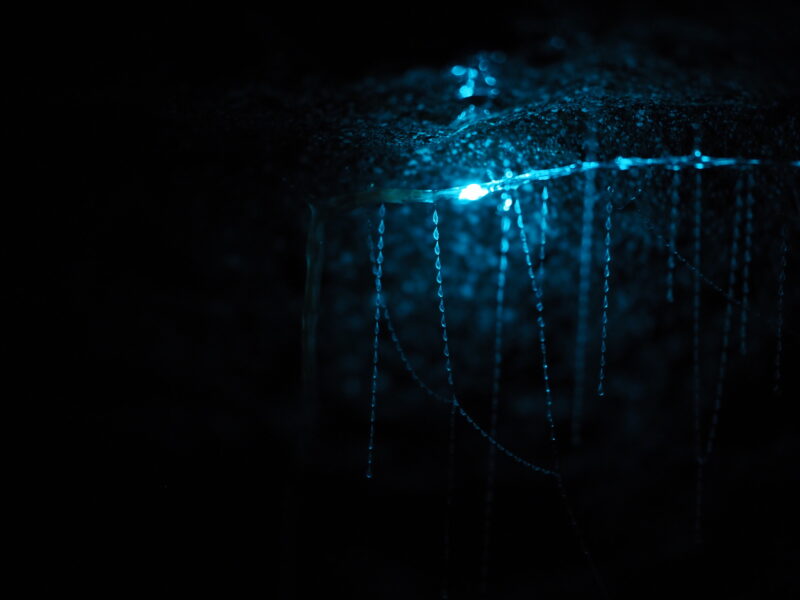
What do glowworms look like?
While the colony looks like a galaxy, the individual physical appearance of the New Zealand glowworm is far less celestial. In its larval stage, it has a soft, elongated and segmented body that resembles a small, translucent maggot, growing up to 1.2 to 1.5 inches (3 to 4 cm) long. Its surface is delicate and semitransparent, allowing faint internal structures to be seen.
The head region is darker and harder, adapted for anchoring silk threads and handling prey with strong mandibles. The light-producing organs are located at the very tip of the tail, where the biochemical reaction takes place.
After several months as a larvae, they pupate and eventually turn into adult fungus gnats. Interestingly, adult gnats cannot feed, because they lack mouthparts. They live for only a few days, using their remaining energy solely to mate, lay eggs and restart the cycle.
Because the adult stage is so brief, these populations rely heavily on their larval phase, which lasts between 9 and 12 months. This ensures that the underground starfield remains active all year round. Since caves provide a stable environment with constant temperature and humidity, the cycle never stops.
However, the display reaches its spectacular peak during the Southern Hemisphere’s summer (November to March). The seasonal influx of insects provides an abundant feast, allowing the larvae to thrive, grow to their maximum size, and generate a much more robust and collective glow across the colony.
Not all glowworms are the same
Although the New Zealand glowworm is the most famous, the term is used for completely different organisms across the world, showcasing a beautiful example of convergent evolution.
In Europe, the name refers to Lampyris noctiluca and its relatives. Unlike the New Zealand gnat larvae, these are actually beetles belonging to the firefly family. Here, it is the wingless adult females that emit a soft, yellowish-green glow from the ground or low vegetation to attract flying males during summer nights, meaning they use light for romance rather than hunting.
Meanwhile, North America’s glowing creatures are often called railroad worms. These are also beetle larvae or wingless females. Their name comes from the fact that they can emit two different colors of light simultaneously – red from the head and green from the body – making them resemble glowing trains at night.
Finally, in Australia and Tasmania, you can find close relatives of the New Zealand species, such as Arachnocampa flava. These insects share the exact same lifestyle, hanging from damp rainforest overhangs and cave ceilings while weaving silk lines to trap forest insects.
What unites all these creatures is not their branch on the tree of life, but their mastery of light.
Nature never stops surprising us
Throughout nature, survival takes many forms. Some species rely on camouflage to avoid detection, while others advertise their toxicity with bright warning colors.
Glowworms take a different approach. Rather than hiding from attention, they attract it, using light to lure prey or find love in places where darkness would otherwise conceal everything. It is one of the many ways life has learned to turn even the most extreme environments into a brilliant advantage.
Bottom line: Glowworms turn dark New Zealand caves into beautiful starscapes all year round. They use their elegant but deadly displays to trap their prey.
Read more: Synchronous fireflies light up these national parks
Read more: The adorable leaf sheep sea slug is bioluminescent
Like what you read?
Subscribe and receive daily news delivered to your inbox.
More from
Cristina Ortiz


New clues to how infectious fungus Candida auris resists antifungals

Amazon wildfires hide another threat to the rainforest
The Komodo dragon is the world’s largest living lizard
Scientists discover a new tiger cat hiding in plain sight