Synchronous fireflies
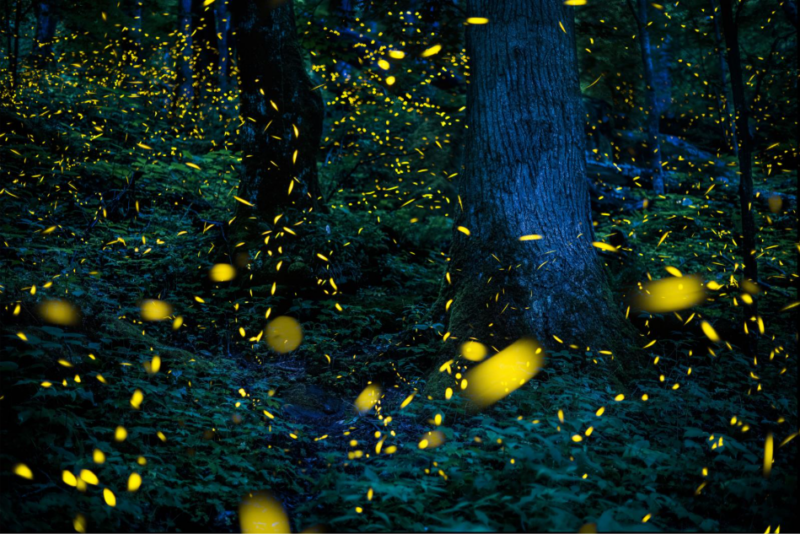
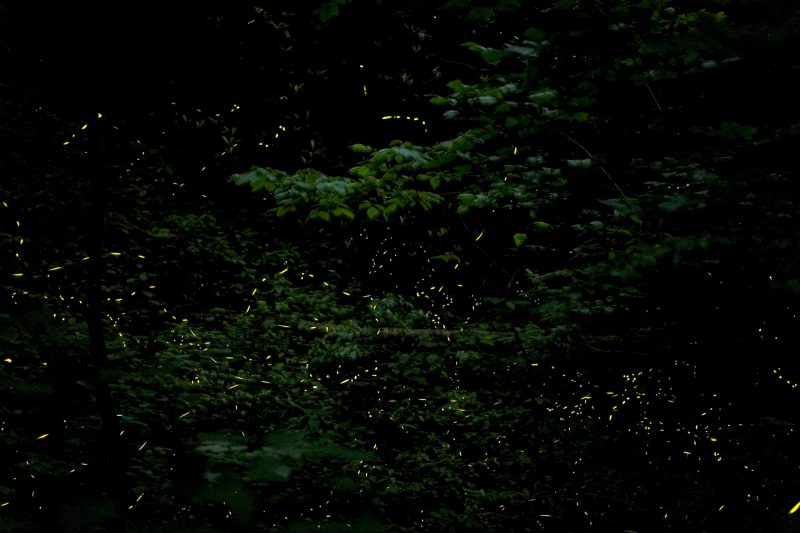
It’s synchronous firefly season! Every year between mid-May and mid-June, locations such as the Great Smoky Mountains National Park in North Carolina and Tennessee, and Congaree in South Carolina, see fireflies flicker in harmony as night falls. The phenomenon happens as male fireflies seek mates. These fireflies – aka lightning bugs – flash with a distinct rhythm: a few quick bursts of light followed by a several-second pause, then more bursts. In person, the display looks like a wave of light passing over a hillside.
The demand to see the synchronous fireflies is high. So much so that the National Park Service has instituted a lottery system for some national parks. The lottery for Great Smoky Mountains has passed. But a lottery for guided viewing at Grandfather Mountain in North Carolina is just about to open.
And you don’t need to join a guided group to see synchronous fireflies. You don’t even have to be in these exact regions of the parks. In fact, people who live in the Smokies have been known to see synchronous fireflies in their backyard.
Just know that these insects prefer northern hardwood forest habitats such as the kind you find in Tennessee, North Carolina and South Carolina.
Fireflies are bioluminescent
Fireflies are bioluminescent. That means that – through a chemical reaction in the insects’ bodies – they’re able to emit light.
Luciferin is the key for creatures that emit this living light. Luciferin is a molecule that reacts in the presence of the enzyme luciferase to produce light. A chemical reaction between the two splits off a molecular fragment. That, in turn, produces an excited state that emits light.
Both words – luciferin and luciferase – come from the same root as lucifer. That word originates from Latin, combining lux (light) and ferre (to bring). It translates to “light-bringer” or “morning star.” It was the Roman name for Venus, when that brightest of planets is visible in the morning. It only later gained a darker association.
A landmark study on synchronous fireflies
A team of researchers from University of Colorado Boulder has been trying to understand how relatively simple insects manage to coordinate such feats of synchronization.
They published an important study about them on September 23, 2020, in the peer-reviewed Journal of the Royal Society Interface. This study suggests that – rather than flash according to some innate rhythm – the fireflies observe what their neighbors are doing. Then they adjust their behavior to match.
The researchers discovered that the fireflies don’t behave the same way when they’re alone as when they’re in a big group. For example, the team found that a single male firefly alone in the tent would flash without a good sense of rhythm, a few bursts here, a few bursts there. But with more fireflies in the tent, things began to change. Raphaël Sarfati, lead author of the study and a postdoctoral researcher at CU Boulder at the time, said:
When you start putting 20 fireflies together, that’s when you start observing what you see in the wild. You’ve got regular bursts of flashes, and they’re all synchronized.
That suggested to the researchers that the fireflies likely aren’t hardwired to flash with a particular pattern. Instead, their light displays seem to be more social. Bugs watch what their neighbors are doing and try to follow along.
A video of fireflies from the research team in the 2020 study.
More synchronous fireflies studies
Since that early study, these researchers have been busy:
- In 2021, they expanded their 3D stereoscopic camera tracking to study large, natural swarms of fireflies in the Great Smoky Mountains. They found that synchronization isn’t just a simultaneous group flash; instead, it propagates through the swarm as “information waves.” See Self-organization in natural swarms of synchronous fireflies in Science Advances (July 2021).
- In 2023, the researchers reported they’d solved a massive puzzle regarding the fireflies’ “dark phase” (the several-second pause between flash bursts). They said that, when completely isolated, an individual firefly has no internal clock or regular rhythm; it just flashes completely at random. See Emergent periodicity in the collective synchronous flashing of fireflies (March 2023).
- In 2026, they successfully calculated a “phase-response curve” — a concrete mathematical formula describing how external light forces a firefly to change its rhythm. See Excitation–inhibition interactions mediate firefly flash synchronization (January 2026), published by CU Boulder engineers.
Fireflies in the wild. Video via University of Colorado.Does the Southern Hemisphere have synchronous fireflies?
Via Daniel Gaussen, Founder & Guide – Stargaze Mackenzie – New Zealand
Fireflies are found across South America, southern Africa, Australia and New Zealand. But large-scale synchronized swarming displays aren’t typically a characteristic feature. Instead, fireflies are typically seen in lower-density populations, appearing as individual or small-group flashes.
Even so, their behavior remains fundamentally tied to night, with males flashing in low light to locate mates and relying on darkness to make their signals visible. Across both hemispheres, these phenomena reinforce a broader theme closely tied to night sky preservation: protecting dark skies also protects the natural behaviors of nocturnal species that depend on darkness to communicate, hunt and survive.
Meanwhile, in the Southern Hemisphere, a closer visual parallel to synchronous fireflies might be found in glowworms, particularly in New Zealand’s cave systems such as Waitomo. There, too, you can take guided tours.
In the caves, darkness becomes the essential stage for Arachnocampa luminosa, commonly known as New Zealand glowworm, whose larvae emit a soft blue-green light to attract prey.
Glowworm lights aren’t synchronized either, though. Here’s what they do instead. Thousands of individual points of glowworm light combine to form a still, star-like canopy, often described as stepping into a terrestrial night sky.
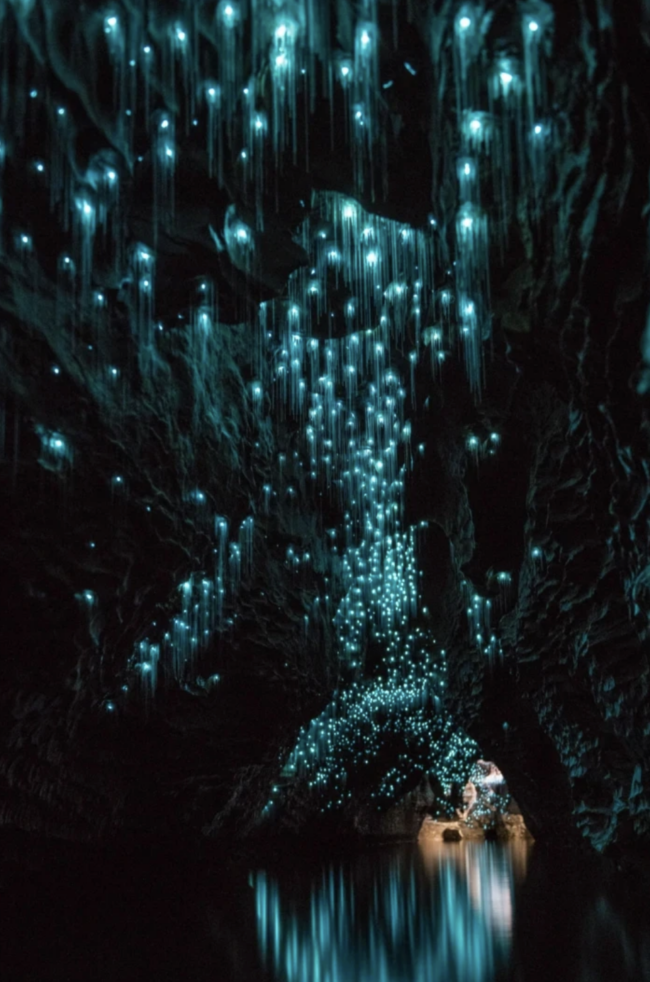
A glowworm cave – Waitmo – in New Zealand. Image via New Zealand.com. Bottom line: The synchronous fireflies are back! These lightning bugs flash in harmony in the Great Smoky Mountains and other nearby parks from mid-May to mid-June. Read more about them here.
Via University of Colorado Boulder
Like what you read?
Subscribe and receive daily news delivered to your inbox.
More from
Editors of EarthSky


Mercury after sunset and great for Southern Hemisphere!

Meteor shower guide 2026: Up next … the Orionids
We fly between the sun and Saturn. At opposition today
October birthstone: Colorful opal and tourmaline