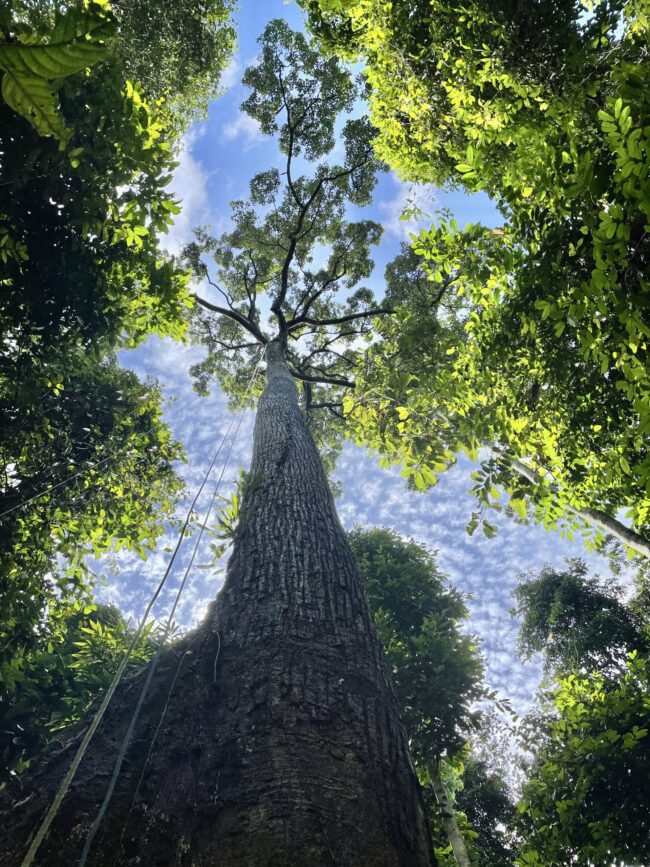
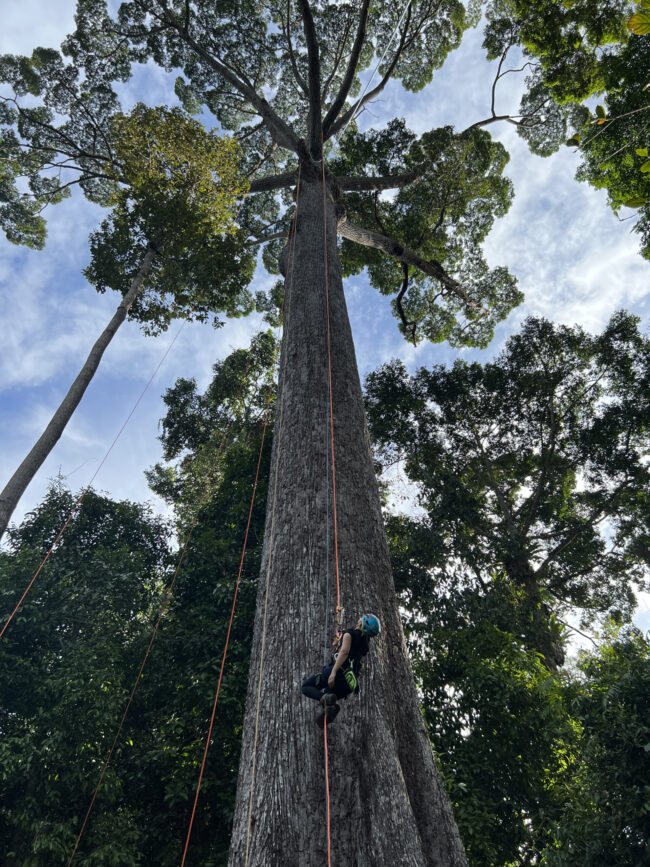
Here’s a 187-foot-tall (57-meter-tall) dipterocarp tree. It’s one of the tallest flowering trees in the world, found mostly in Southeast Asia. How do giant trees like this one transport water from their roots all the way up to their leaves? Image via Palasiah Jotan. Used with permission.
For decades, scientists thought height would eventually become a disadvantage for the world’s tallest trees. The farther water had to travel from roots to leaves, the harder it seemed to move it all the way to the canopy. But a team of researchers from the University of Exeter and Cardiff University now says it has the answer to this puzzle. The team described how giant tropical trees overcome this challenge, even when they grow taller than 230 feet (70 meters).
The researchers published their findings in the peer-reviewed journal Science on July 2, 2026.
When height seemed like a limit
Trees don’t have a heart or a pump to move water from their roots to their leaves. But they do have thousands of tiny vessels running through their trunks. As water evaporates from leaves, it creates a pulling force that draws water upwards from the roots.
For a tree several meters tall, this process already requires a remarkable transport system. For a giant tree reaching tens of meters high, into and above the forest canopy, it becomes hard to see how the water can travel efficiently so far up its trunk. And it becomes easy to see that even small disruptions to the water flow might affect the tree’s ability to function and grow.
This led scientists to think that height placed a natural limit on tree growth. According to this theory, the tallest trees should be struggling to transport water efficiently. Eventually, their height might reduce their ability to photosynthesize and grow. And what happens to very tall trees during droughts?
But the new research suggests the world’s tallest flowering trees (dipterocarp trees) have developed ways to overcome the disadvantage of their height. Professor Lucy Rowland from the University of Exeter explained:
Trees contain lots of thin, hollow vessels and they suck water upwards by creating low pressure at the top. These vessels have evolved intricate adaptations that can maintain the water in liquid form, even under the extreme low pressures required to move to the top of trees which can reach over 80 meters [262 feet].
How giant trees overcome their height challenge
To understand how these trees manage their extraordinary sizes, researchers from the University of Exeter and Cardiff University studied dipterocarp trees in Malaysian Borneo. The trees they studied ranged from 23 to 233 feet (7 to 71 meters) tall.
The team measured different traits related to water transport at multiple points along each tree. They also examined trunk growth rates before, during and after the severe El Niño drought period of 2023–2024.
The researchers found that taller trees compensate for the challenges of their size in several ways.
Their water-conducting vessels become wider closer to the ground, helping move water more effectively through the trunk. Their leaves also adapt to tolerate greater levels of water stress before they begin to wilt.
Together, these adjustments allow giant dipterocarps to maintain an efficient water transport system. This works despite the enormous distance between their roots and their highest branches. Rowland said:
Our results challenge this by showing that the hydraulic systems of very tall dipterocarp trees are perfectly evolved for their height, and should not suffer more than small dipterocarp trees exposed to the same drought conditions.
In the Bornean rainforest, researchers studied trees ranging from 23 to 233 feet (7 to 71 meters) tall to uncover how their hydraulic systems adapt to extreme heights. Here’s a climber measuring the stem diameter at the upper trunk of a dipterocarp tree. Video via Masliadi bin Asri. Used with permission.
A drought tested an old prediction
The researchers also investigated whether extreme height actually made these trees less resilient when water became scarce.
If the traditional theory was correct, the tallest trees should have experienced a greater decline in growth than smaller trees during the El Niño drought.
However, the team found no height-related loss in growth. The tallest trees did not show a greater disadvantage simply because they were larger.
The finding does not mean tropical forests are safe from climate change or that giant trees face no threats. Instead, it suggests that height alone does not make these trees more vulnerable to drought than smaller trees exposed to the same conditions.
Why giant trees matter for the climate
The importance of these findings goes far beyond understanding how trees move water.
Trees play a central role in the global carbon cycle. Through photosynthesis, they absorb carbon dioxide (CO2) from the atmosphere and use that carbon to build their trunks, branches, leaves and roots.
Beyond adding new growth, trees continue to store carbon inside their living tissues throughout their lives. A giant tree can therefore act as a long-term carbon reservoir, keeping carbon locked away for decades or even centuries.
When a large tree dies, burns or decomposes, some of that stored carbon can return to the atmosphere as CO2, contributing to the greenhouse effect. This is why protecting the world’s largest trees matters not only for biodiversity, but also for the climate. Paulo Bittencourt from Cardiff University said:
Understanding tall trees is vital because the tallest 1% of trees store more than half of above-ground carbon in forests.
The tallest trees are especially important because their size allows them to store enormous amounts of carbon. Losing these giants would not only affect forest ecosystems but could also reduce one of nature’s most effective ways of keeping carbon out of the atmosphere.
Researchers found that extreme height did not make giant trees more vulnerable to drought. Their enormous size also makes them important long-term carbon stores in tropical forests. Here, a tree climber works in the canopy of a dipterocarp tree during sample collection. Video via Palasiah Jotan. Used with permission.
Protecting the giants of Borneo
Dipterocarp species dominate the rainforests of Southeast Asia and include some of the tallest flowering trees on Earth. These forests are not only home to remarkable giants but also support some of the planet’s richest ecosystems.
The study shows that extreme height does not make these trees as vulnerable to drought as scientists once thought. However, this resilience does not reduce the need to protect them. Protecting these forests matters because they store vast amounts of carbon and provide habitat for countless species.
Palasiah Jotan, a Malaysian PhD researcher and co-author of the study, hopes these findings will strengthen efforts to protect Borneo’s rainforests. The researchers also say more work is needed to understand whether other tall tree species have evolved similar adaptations.
For now, the study challenges a decades-old assumption: reaching extreme heights does not necessarily make trees weaker. Instead, these forest giants appear to have evolved sophisticated ways to thrive at the limits of plant growth.
Bottom line: Giant trees have evolved remarkable adaptations that allow them to reach extreme heights while maintaining efficient water transport.
Source: Height does not impair the hydraulic system of the tallest tropical Dipterocarp trees
Read more: New study says residential trees can affect human health
Read more: Younger trees excel at capturing – and storing – carbon
Like what you read?
Subscribe and receive daily news delivered to your inbox.
More from
Cristina Ortiz


The Komodo dragon is the world’s largest living lizard

Scientists discover a new tiger cat hiding in plain sight
Reef fish survival threatened by motorboat noise
Walking shark discovered in Papua New Guinea