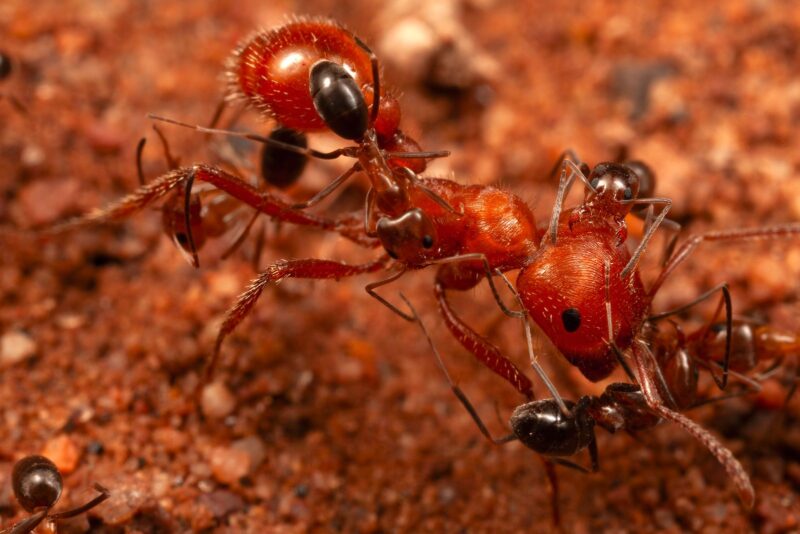
Small ants clean larger ants
A scientist has spotted smaller ants cleaning much larger ones, marking the first known case of interspecies ant grooming. In fact, it’s the first known case of this behavior across all insects, said entomologist Mark Moffett of the Smithsonian National Museum of Natural History on April 13, 2026.
Moffett observed and documented this phenomenon while studying ant behavior in the Chiricahua Mountains of southeastern Arizona. During his research, he noticed that harvester ants actively seek out cone ants and allow them to groom their bodies.
Moffet published his discovery on April 12, 2026, in the peer-reviewed journal Ecology and Evolution.
1st known case of interspecies ant grooming
The behavior begins when a harvester ant leaves its nest and approaches a cone ant colony. Instead of showing aggression or defensive behavior, the large ant stops abruptly, often standing still with its mandibles open and its body held high.
Within seconds, cone ants emerge from the nest and climb onto the harvester ant’s body. They move quickly across its surface, using their mouthparts to lick and scrape tiny particles from its exoskeleton. The cleaning is deliberate and methodical, covering the head, legs and even sensitive areas near the mandibles.
These interactions vary widely in duration. Some last less than 15 seconds, while others continue for several minutes. In more intense encounters, multiple cone ants work simultaneously on a single harvester ant, creating a coordinated cleaning session. Remarkably, even when cone ants enter the open jaws of the larger ant, no aggression occurs. Moffett said:
The potentially dangerous harvester ants even permit the visitors to groom between their open jaws.
Once the interaction ends, the harvester ant suddenly jerks its body and dislodges the smaller ants with force before resuming its normal activities.
Why do small ants clean larger ants?
Scientists are still working to understand the evolutionary logic behind this unusual relationship. But early evidence suggests both species may gain specific benefits from the interaction.
Cone ants appear to consume microscopic particles found on the surface of harvester ants. These particles may include fragments of seed material or organic debris collected during foraging. Interestingly, cone ants only engage in this behavior with living harvester ants and completely ignore dead individuals placed near their nests. This suggests the interaction depends on chemical cues or movement from the host ant.
For harvester ants, the benefit may lie in improved hygiene. While they already perform mutual grooming within their own colonies, cone ants can access regions of the body that are difficult for nestmates to reach. This may help reduce parasites, fungal spores or bacterial buildup that could otherwise affect colony health. Moffett said:
Given the usual tendencies of ants, I first assumed that I was observing aggression. But the larger ants seemed to seek the attention of the smaller ants by first visiting their nests and then allowing the small ants to lick and nibble all over them.
A discovery that mirrors ocean life
This interaction strongly resembles cleaning systems found in marine environments, where small fish and shrimp remove parasites from much larger fish, including predators like sharks. Moffett commented:
This new ant species is the insect equivalent of cleaner fish in the ocean.
The similarity raises interesting questions about whether such cooperative behavior evolves independently in different environments. In both cases, a smaller species gains food while a larger species receives hygiene benefits.
What this means for insect research
Moffett emphasizes that this discovery highlights how much remains unknown about insect behavior in natural environments. He argues that field observation continues to play a crucial role in uncovering complex ecological relationships that laboratory studies might miss. Moffett said:
All kinds of amazing discoveries are still there to be made outside of the lab. Finding new species and behaviors in nature often requires us to pay close attention to the small things — including the ants.
He also notes that the behavior was easy to overlook at first, as it occurs quickly and in a remote desert environment. However, repeated observations confirmed that it was not accidental but a consistent pattern.
The finding opens new research directions, including whether similar interspecies grooming systems exist elsewhere and how widespread this type of cooperation might be among insects.
Bottom line: In the first known case of interspecies ant grooming, small ants have been spotted cleaning larger ants. A researcher spotted this rare behavior in Arizona.
Source: The First Cleaner Ant? A Novel Partnership in the Arizona Desert
Read more: Queen ants found giving birth to 2 different species
Like what you read?
Subscribe and receive daily news delivered to your inbox.
More from
Cristina Ortiz


The Komodo dragon is the world’s largest living lizard

Scientists discover a new tiger cat hiding in plain sight
Reef fish survival threatened by motorboat noise
Giant trees break a decades-old science theory