Meet the mammal that smells like popcorn: the binturong. Image via GabruPawPixels/ Pixabay.
Imagine walking through a Southeast Asian rainforest and catching the unmistakable scent of warm buttered popcorn drifting through the trees. Hmm … is there a popcorn stand in the middle of the forest? The source is likely something far stranger: a shaggy, whiskered mammal with a curling tail and the face of an animal you can’t quite identify.
Meet the binturong, sometimes called the “bearcat,” though it is neither a bear nor a cat. It has dark fur and bright eyes, and travels high through the forest canopy with slow, deliberate movements. There is only one species of binturong in the world. And the deeper scientists look into this creature, the more surprising it becomes.
What does a binturong look like?
At first glance, a binturong looks like several animals stitched together.
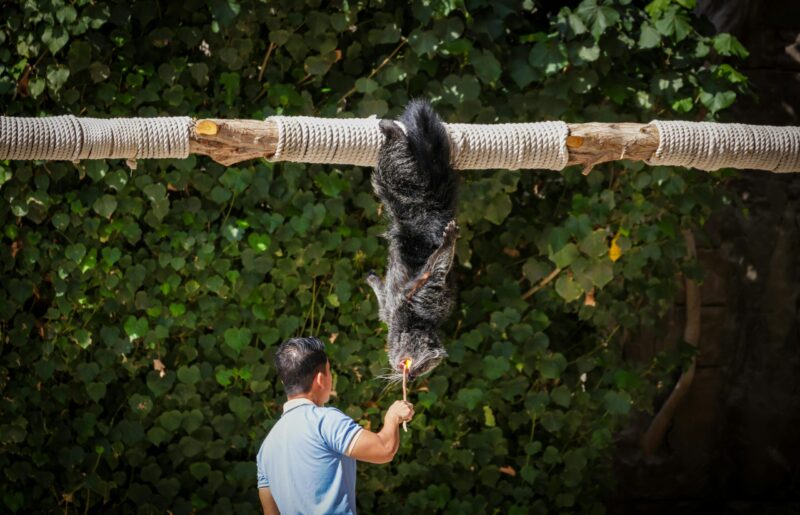
It has the stocky body of a small bear, long whiskers like a cat and shaggy black fur that often appears slightly frosted at the tips. An adult can grow up to 3 feet (about 90 centimeters) in body length, with an equally impressive bushy tail.
But perhaps the binturong’s most remarkable feature is that its tail is prehensile, meaning it can grip branches like an extra limb. This is something only a handful of carnivorous mammals can do. As the binturong climbs through the treetops, its tail acts almost like a built-in safety rope, helping the animal balance and move among branches.
Its long whiskers might be just as important. Since binturongs are mostly active at night, these highly sensitive whiskers help them sense nearby branches and move through the canopy in the dark.
Its ears are small and rounded, often decorated with tufts of fur, giving the animal a permanently curious expression.
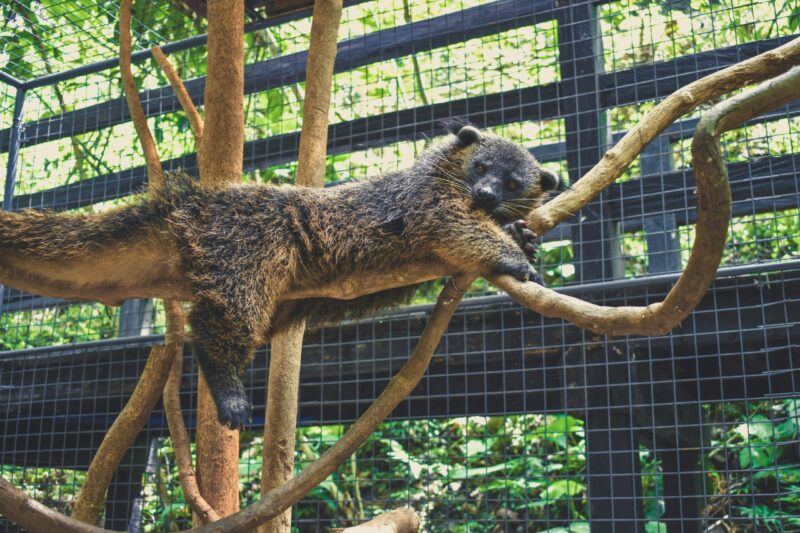
A life above the forest floor
Binturongs live in the tropical forests of South and Southeast Asia, from India and Nepal to Indonesia and the Philippines. But spotting one in the wild is not easy.
These animals spend much of their lives high in the forest canopy and are mostly active at night. Rather than leaping dramatically through the trees, binturongs tend to move slowly and carefully, climbing branch by branch with surprising confidence.
That relaxed attitude becomes especially clear during the day, when binturongs have occasionally been spotted lounging on branches and quietly basking in the sun, as if rainforest life comes with no particular sense of hurry.
Although classified as carnivores, they have an unexpectedly fruit-heavy diet. Their favorite food is figs, which can make up a large part of what they eat. But they are not picky diners. Binturongs may also snack on birds, fish, insects, eggs and small mammals when the opportunity arises.
Their appetite for fruit makes them important forest helpers. After eating, they spread seeds across the rainforest through their droppings, helping new plants grow. In some forests, scientists consider them key seed dispersers.
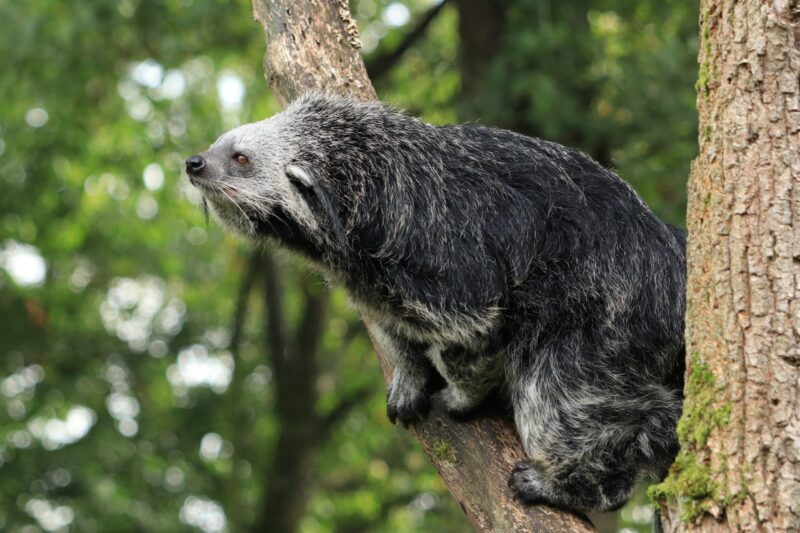
Why does a binturong smell like popcorn?
Perhaps the binturong’s strangest claim to fame is not what it looks like, but what it smells like.
Many people describe its scent as freshly popped popcorn, warm corn chips or even buttered bread drifting through the forest canopy. It is an unexpectedly pleasant aroma for such an elusive rainforest animal. But the source is far less appetizing.
The smell comes from a chemical compound found in its urine called 2-acetyl-1-pyrroline. It’s the same molecule responsible for the scent of popcorn and freshly baked bread.
This surprising “snack aroma” is actually part of how this animal communicates. Binturongs use scent-marking as they move through the trees, leaving invisible messages along branches that may signal territory, announce their presence or even help attract a mate. In a dense rainforest where visibility is limited, smell can work almost like a calling card.
So if you think you smell popcorn in a rainforest, it might be worth wondering who has just passed through …
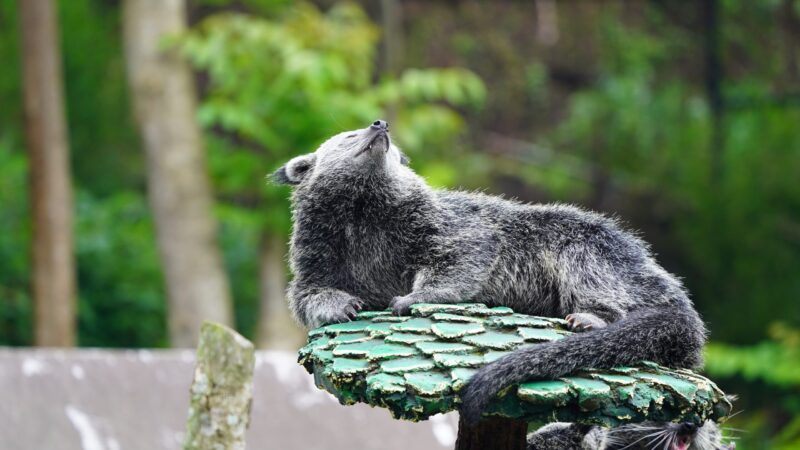
Curious facts about the binturong
The more you learn about binturongs, the stranger they seem.
Despite being called “bearcats,” they belong to neither group. They are unique members of the civet family (Viverridae). There is only one species of binturong in the world.
They can also be surprisingly vocal. Binturongs may chuckle, purr, snort or even make sounds resembling soft giggles, depending on their mood.
And while they often appear calm and slightly clumsy, they are skilled climbers. Their strong claws and grasping tail allow them to descend trees headfirst – no easy task for such a heavy-bodied mammal.
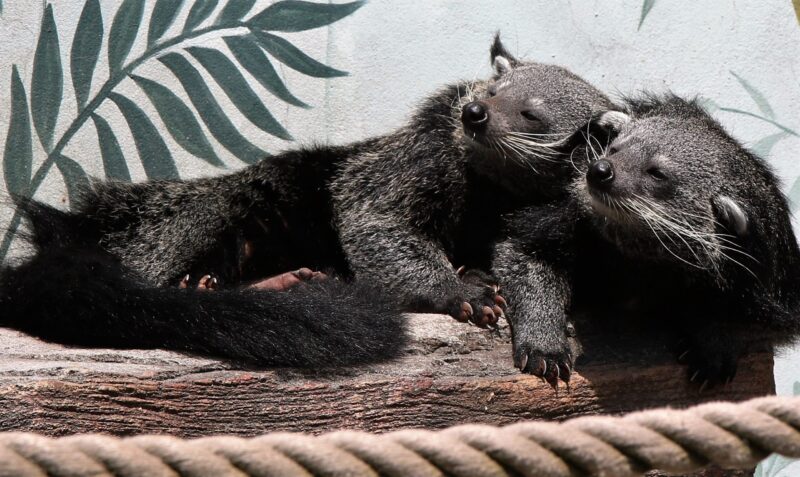
Baby binturongs are tiny tree-dwellers
Life begins in the dark for a newborn binturong, which is born blind and relies entirely on its mother before it’s strong enough to climb.
Binturongs usually arrive in small litters of one to three, nestled in a hidden nest high above the forest floor. For the first weeks, their world is limited to warmth, scent and sound, as their bodies slowly develop the coordination needed for life in the canopy.
As they grow, their movements become more deliberate. What begins as cautious exploration soon turns into practice climbs through branches, guided by a mother who stays close and attentive.
Unlike some solitary mammals, young binturongs may remain with their mother for an extended period, gradually learning the slow, careful way of moving that defines their species. Their grasping tail, which will one day help them move with confidence through the treetops, starts out as just another untrained limb.
By the time they are fully independent, they already carry the habits of the canopy: steady, deliberate and always a little unhurried.
Look at these cubs at Perth Zoo.
Are binturongs endangered?
The binturong is currently considered vulnerable by the International Union for Conservation of Nature.
Its biggest threats are habitat loss from deforestation, the illegal wildlife trade and hunting in some regions. As tropical forests disappear, the quiet pathways binturongs use through the canopy become fragmented.
And that would be a loss not only for the rainforest, but for the rest of us too.
After all, few animals remind us quite so vividly that nature still holds surprises: creatures that smell like popcorn, climb using their tails and quietly help forests grow, all while remaining hidden among the leaves.
Bottom line: The binturong is a strange mammal that smells like popcorn, lives high in the trees and quietly helps tropical forests grow.
Read more: The tree-kangaroo lives in the hidden world of the treetops
Read more: The pangolin: An armored, insect-controlling mammal
Like what you read?
Subscribe and receive daily news delivered to your inbox.
More from
Cristina Ortiz


The Komodo dragon is the world’s largest living lizard

Scientists discover a new tiger cat hiding in plain sight
Reef fish survival threatened by motorboat noise
Giant trees break a decades-old science theory