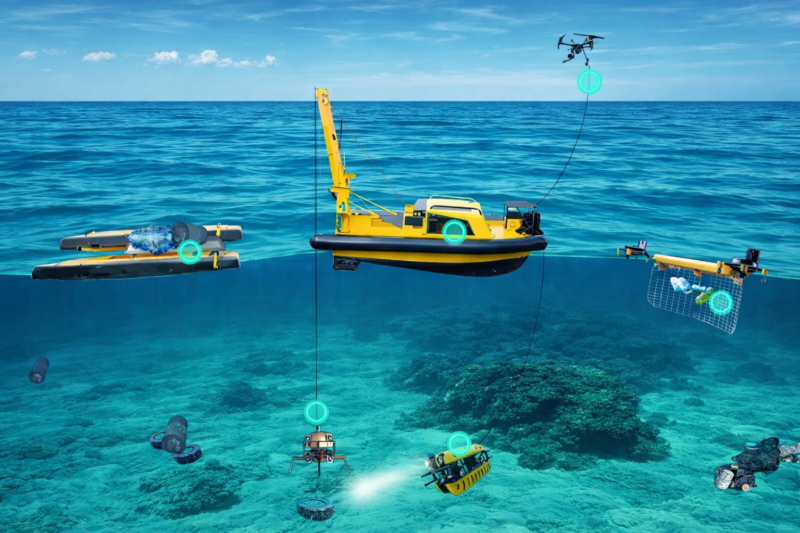
Meet the fleet. Image via SeaClear Project. Used with permission.
AI-powered robots are currently helping scientists clean Europe’s ocean floor. Combining human-led efforts with artificial intelligence and robotics, the EU-funded SeaClear2.0 initiative is taking a collaborative approach to one of the ocean’s most persistent environmental problems.
Unlike many existing cleanup projects that focus on surface debris, this system targets waste that has already sunk to the seafloor. By addressing this deeper layer of pollution, the researchers aim to tackle a part of the problem that has long been overlooked.
The autonomous system features an aerial drone to detect waste, an underwater rover to find it on the seabed, and robotic grippers to bring it up to the surface.
A peer-reviewed study published in Engineering Applications of Artificial Intelligence on April 15, 2026, describes the system in detail.
Focusing on the seafloor
Most marine debris eventually sinks, accumulating on the seabed where it can remain for years. Over time, plastics break into smaller fragments that spread through ecosystems as microplastics, making removal even more difficult.
To address this, researchers on the SeaClear 2.0 team are focusing on detecting and recovering larger debris before it degrades. Their AI systems process camera and sonar data to distinguish objects such as tires, metal structures and plastic waste from natural features like rocks or marine life.
Human operators remain in control of the missions, while autonomous systems handle most of the detection and collection work.
Robot fleets working as one system
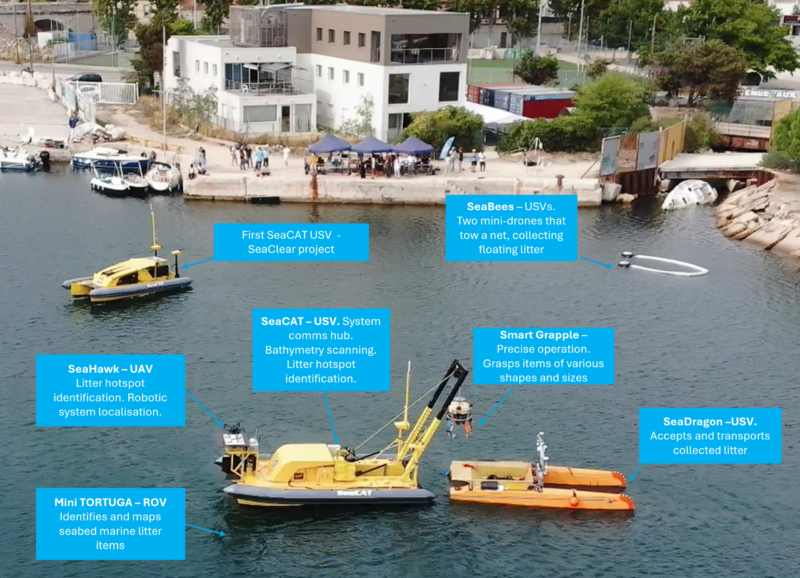
At the center sits an uncrewed surface vessel called the SeaCAT, which acts as the system’s command hub. From there, it coordinates a network of robotic units, each responsible for a different stage of the cleanup process.
An aerial drone called SeaHawk scans the surface to identify likely waste hotspots. A compact underwater rover, Mini TORTUGA (which means turtle in Spanish), maps the seabed and locates debris with precision before collection begins. Smaller agile units such as SeaBees move through narrow or complex areas to gather lighter waste using nets. For heavier objects, a robotic gripper lifts debris from the seafloor, while a separate surface vessel transports the collected material back to shore.
Bart De Schutter, a professor at Delft University of Technology and coordinator of the SeaClear and SeaClear2.0 projects, said the team is aiming to scale up collection capacity:
With SeaClear2.0, we aim to collect larger pieces of rubbish. In tests, we’ve already removed rubber tires, metal fences and parts of ships. Using a crane on the surface vessel, we can lift even heavier objects.
Improving safety and efficiency in cleanup work
Removing seabed waste has traditionally required divers, making operations slow, expensive and potentially risky. Autonomous systems offer a safer alternative, especially when operating in low visibility, rough weather and complex underwater conditions. Yves Chardard, CEO of the French company Subsea Tech and a partner in the project, commented:
It’s about safety, efficiency and cost-effectiveness. Drones will allow us to clean up areas that are today too expensive or dangerous to tackle.
Field tests reflect steady progress. Early trials in Hamburg, Germany, had exposed limitations, when a very heavy object proved too difficult to lift. That led to improvements in the gripping system that paid dividends during the next test in Marseille, France, said Chardard:
In 30 to 40 minutes, we scanned and cleaned up an area. In under an hour, we picked up tires, fences, car seats and other large debris. It worked much better than in Hamburg.
SeaClear2.0’s mission: Restore our ocean and waters. Video via SeaClear Project.
Beyond marine cleanup
Although marine debris remains the main focus, the same technology could support other underwater applications. Researchers are exploring whether it could help detect unexploded mines, or assist with harbor monitoring and security tasks. De Schutter said:
We can detect these objects, so that’s one possible use. We’re also looking at security-related applications, such as monitoring harbours and detecting illegal or dangerous activity.
Further trials are planned in Venice, Italy; Dubrovnik, Croatia; and Tarragona, Spain, as development continues. Chardard explained:
We’re not exactly where we want to be yet, but we’re not far off. The goal now is to streamline the technology.
SeaClear2.0 demonstration in Marseille. Video via SeaClear Project.
Moving toward real-world deployment
Researchers aim to refine the system before the project concludes in late 2026. The goal is to integrate the autonomous robotic fleets into real-world operations through local authorities across Europe.
If successful, these systems could help reduce the long-term accumulation of waste on the seabed and support the gradual restoration of marine environments.
The 1st live showcase of the SeaClear2.0 robotic system. Video via SeaClear Project.
Bottom line: AI-powered robotic systems are helping researchers locate and remove waste from Europe’s seafloor, making underwater cleanup safer and more efficient.
Via Horizon: The EU Research & Innovation Magazine
Via CORDIS: EU research results
Read more: Sea turtles are as old as dinosaurs: Lifeform of the week
Like what you read?
Subscribe and receive daily news delivered to your inbox.
More from
Cristina Ortiz


The Komodo dragon is the world’s largest living lizard

Scientists discover a new tiger cat hiding in plain sight
Reef fish survival threatened by motorboat noise
Giant trees break a decades-old science theory