



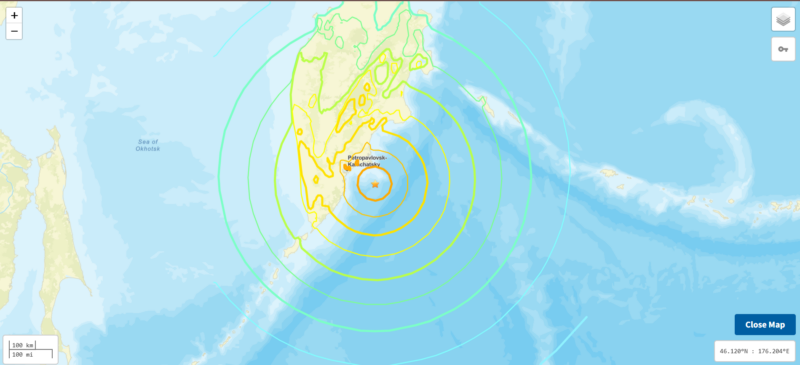
A 8.8-magnitude earthquake struck 73 miles (118 km) off the coast of Russia’s far eastern Kamchatka Peninsula at 11:24 a.m. PETT Wednesday, July 30 (23:24 UTC on Tuesday, July 29), the USGS said. Only 5 earthquakes with higher magnitudes have ever been recorded. A tsunami as tall as 13 feet (4 meters) also struck the Russian coast following the quake, the news agency Reuters reported.
Video footage shared via social media appears to show widespread damage on the Russian coastline, although no serious injuries or fatalities have been reported.
The U.S. Tsunami Warning System issued tsunami warnings and advisories for Russia, Japan, Alaska, the U.S. Pacific Coast and Hawaii following the quake. The Japan Weather Agency also issued a warning. It expected tsunami waves of up to 10 feet (3 meters) to reach the country’s large coastal areas starting around 1:00 UTC on Wednesday, July 30, and up to 1.9 million people in Japan were told to evacuate.
With initial impacts appearing less severe than predicted, most tsunami warnings have been reduced to advisories as of 7:30 a.m. CDT (12:30 UTC) on Wednesday, June 30, including across the entireties of Japan and Hawaii and most of the U.S west coast.
Russia: Tsunami destroyed the Port of Severo-Kurilsk in Kamchatka following an 8.8 magnitude earthquake.Coasts all across the Pacific Ocean including Japan, Hawaii, Alaska, and even California are on tsunami alert.
— Igor Sushko (@igorsushko.bsky.social) 2025-07-30T04:28:38.809Z
Russian earthquake 6th largest ever recorded
The earthquake was originally reported by the USGS as magnitude 8.0. However, that number was later updated to magnitude 8.7 and now 8.8, making it the 6th largest quake in recorded history. It occurred at a depth of 13 miles (21 km). The epicenter was located at 52.530°N 160.165°E.
Holy moly. A magnitude *8.8* quake off of Kamchatka a short while ago. Tsunami warning issued for Japan, Hawaii, and Alaska.
— Phil Plait (@philplait.bsky.social) 2025-07-30T02:08:49.007Z
The magnitude has been further refined to M8.8. It may seem like 8.7 and 8.8 are close, but the difference actually means about 40% more energy released. Logarithmic scales will do that!Want to know the difference between any two magnitudes? Try this calculator: earthquake.usgs.gov/education/ca…
— Celeste Labedz (@celestelabedz.bsky.social) 2025-07-30T02:07:01.453Z
Scientists on Bluesky share info on the earthquake and tsunami
Note the source time functions here–the magnitude 7.4 earthquake lasted about 25 seconds, the magnitude 8.8 earthquake lasted *3 minutes.*
— Brandon Bishop (@brandontbishop.bsky.social) 2025-07-30T08:39:56.655Z
Watch the seismic waves from the magnitude 8.8 earthquake off the coast of Russia sweep beneath seismic stations in North America. By the time the waves reached North America, they are far too small to be felt by people, but can still be detected by seismic instruments. ?
— Dr. Wendy Bohon (@drwendyrocks.bsky.social) 2025-07-30T05:19:38.274Z
1115Z, 7/30: Here are some of the highest #tsunami heights that were observed so far…- #Kahului #Maui, #Hawaii: 5.7 feet – #Hilo, HI: 4.9 feet- #Haleiwa, HI: 4.0 feet- #Hanalei, HI: 3.9 feet- #CrescentCity, #California: 3.6 feet – #ArenaCove, CA: 3.0 feet- #Adak, #Alaska: 2.7 feet
— Dr. Stephen Bieda III (@drwildcatwx.bsky.social) 2025-07-30T11:16:39.503Z
A rule of thumb for tsunamis is that in open ocean, they move at similar speeds to commercial airliners. If you're ever curious how long it would take for a tsunami to get from one place to another, look up the duration of a similar-length flight.
— Celeste Labedz (@celestelabedz.bsky.social) 2025-07-30T01:38:48.470Z
Bottom line: A magnitude-8.8 earthquake struck off the coast of eastern Russia on Wednesday, July 30. The resulting 13-foot (4-meter) tsunami struck the Russian coast.
Like what you read?
Subscribe and receive daily news delivered to your inbox.
More from
Kelly Kizer Whitt


No more leap seconds! Timekeeping is officially changing

Space is getting crowded. Here’s the latest satellite report
Planetary systems fall into 2 distinct families, astronomers say
Visible planets and night sky guide for October



