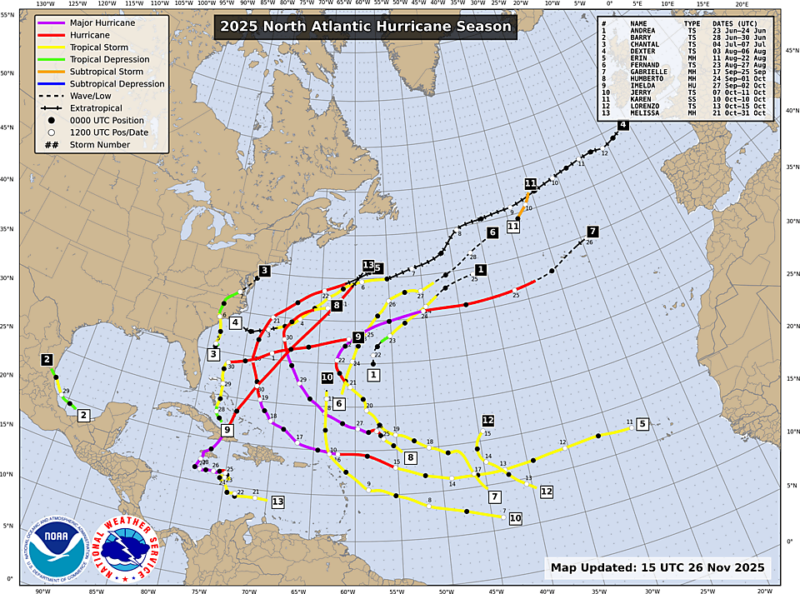
The Atlantic hurricane season officially ends November 30. And since the tropics in this ocean basin have been quiet since Hurricane Melissa barrelled through the Caribbean in late October, it’s time to look back on what happened this season.
The 2025 Atlantic hurricane season ended up with 13 named storms, including five hurricanes. Of those five hurricanes, four would become major hurricanes (Category 3 or higher) and three would become Category 5 hurricanes. This is the most Category 5s in a single season since the record-breaking 2005 season.
Below-average season?
On average, a typical hurricane season has 14 overall storms, including seven hurricanes and three major hurricanes. That means this past season was technically below average for overall storms and hurricanes. However, the number of major hurricanes was above average, and so was the accumulated cyclone energy (ACE), which measures the wind energy of all tropical storms and hurricanes for their entire durations. The season ended up with an ACE of 132.6, according to Colorado State University, which is above the normal season ACE of 121.2.
It is also important to note that while the Atlantic hurricane season runs from June 1 through November 30, according to the National Hurricane Center, 70% of tropical activity this season occurred after the climatological peak, which is September 10.
Pre-season forecasts for the 2025 Atlantic hurricane season
So what did the experts expect for this season? Pre-season forecasts from both NOAA and Colorado State University predicted a more-active-than-average season. Notably, NOAA called for between 13 and as many as 19 named storms.
A couple of key factors played into this pre-season forecast. First, the presence of above-average water temperatures in the main development region of the tropical Atlantic Ocean. And second, the expected development of La Niña. La Niña is a global climate pattern where waters in the tropical Pacific Ocean are cooler than average. And when this occurs, it can lead to more tropical activity in the Atlantic due to the presence of less wind shear.
However, after the first few months of the season passed, La Niña never fully developed. That’s why NOAA in their August forecast update reduced the expected number of overall storms, as well as the likelihood of a more-active-than-average season.
Tropical storms and hurricanes during the 2025 hurricane season were 50% more challenging to predict compared to average. This is thanks in part to multiple storms undergoing rapid intensification, which is when a storm intensifies by 35 miles per hour (56 kph) or more in a 24-hour period.

Most noteworthy storms of the 2025 Atlantic hurricane season
This was the first season in 10 years that a hurricane did not make landfall on the United States. But elsewhere, many felt the force of some powerful storms.
Tropical Storm Chantal was the 3rd named storm of the season, and the only storm (not hurricane) to make landfall on the United States. While not a strong storm, its sustained winds of 50 miles per hour (80 kph) still left a mark on the Carolinas, causing devastating flooding during the 4th of July holiday weekend.
Hurricane Erin was not only the first hurricane of the season when it developed in August, but it also quickly became the 1st Category 5 of the season. At its strongest, it had sustained winds of 160 miles per hour (257 kph). Erin became the 5th-fastest rapidly intensifying storm when it went from Category 1 to 5. Erin didn’t make landfall, but caused dangerous swells, rip currents and flooding along the East Coast of the United States, particularly the Outer Banks of North Carolina.
While also never making landfall or having direct impacts on land, Hurricane Humberto became the 2nd Category 5 hurricane of the season in late September, with maximum sustained winds of 160 miles per hour (257 kph).
Hurricane Melissa was the 3rd and final Category 5, and also the final storm of the season. Melissa became one of the strongest hurricanes to make landfall in the Atlantic when it struck Jamaica on October 28, with its sustained winds of 185 miles per hour (298 kph) causing catastrophic damage. Melissa was the 4th storm this season to undergo rapid intensification.

Hurricane hunters vital for forecasts
NOAA Hurricane Hunter aircraft flew 417 mission hours this past season, collecting vital weather information that directly impacts hurricane forecasts, models, and research. They flew through the eyes of hurricanes more than 50 times and dropped more than 1,000 dropsondes. These are tubes that fall down through tropical cyclones, collecting weather data through all layers of the storm.
During Hurricane Melissa alone, the Hurricane Hunters flew for more than 100 hours, dropped more than 250 dropsondes and were critical in determining the strength of Melissa before it made landfall in Jamaica. Even after the storm had passed, the Hurricane Hunters helped recovery missions by flying an additional 55 hours to provide support for response and recovery missions, while taking thousands of photos highlighting the devastation.

Bottom line: The 2025 Atlantic hurricane season was less active than normal in terms of total storms, but was still a more-active-than-average season in terms of overall storm energy.
Read more: 2025 Atlantic hurricane season marked by striking contrasts
Read more: 2025 National Hurricane Center Verification Report Preview
Like what you read?
Subscribe and receive daily news delivered to your inbox.
More from
Rachel Duensing


US winter weather outlook: What will El Niño bring?

Isaias is a major hurricane, headed for the Gulf Coast