With a little imagination, you can see the stars of Scorpius tracing the shape of a scorpion. The bright red star Antares marks the Scorpion’s Heart. There’s even a Stinger. Think constellations don’t look like their names? Meet the Scorpion! Night sky veteran Deborah Byrd has details. Watch here or on YouTube.
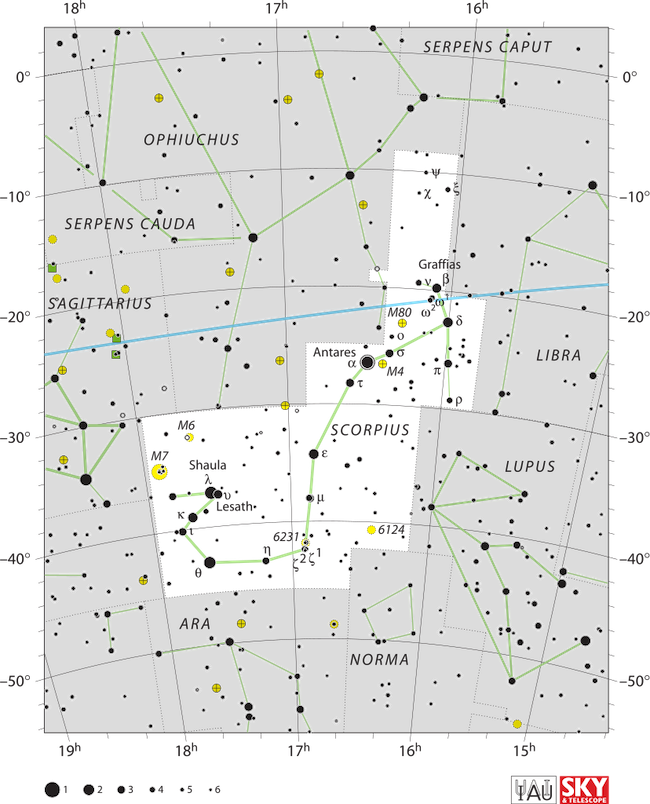
Of all the constellations of the zodiac, Scorpius the Scorpion is perhaps the easiest to find. With a little imagination, you can see its stars tracing the curved shape of a scorpion’s tail. The constellation has the shape of the letter J, with the curved bottom of the J representing the constellation Scorpion’s curved Tail. There’s even a Stinger, consisting of two stars – Shaula and Lesath – noticeable for their nearness to each other. And, central in the constellation, you’ll find a brilliant red star, Antares, the Scorpion’s Heart.
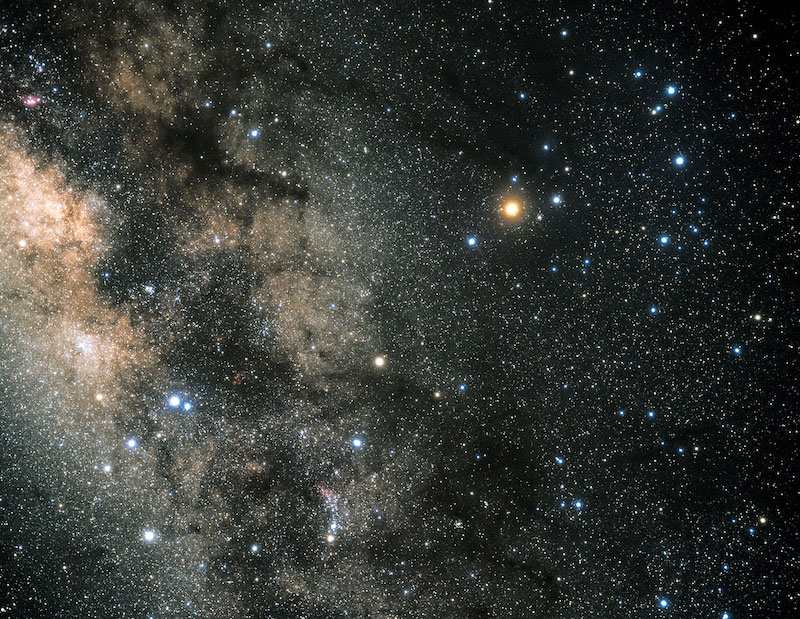
In a dark sky, you can also see many beautiful deep sky treasures – and the starry band of our home galaxy, the Milky Way – behind the constellation Scorpius.
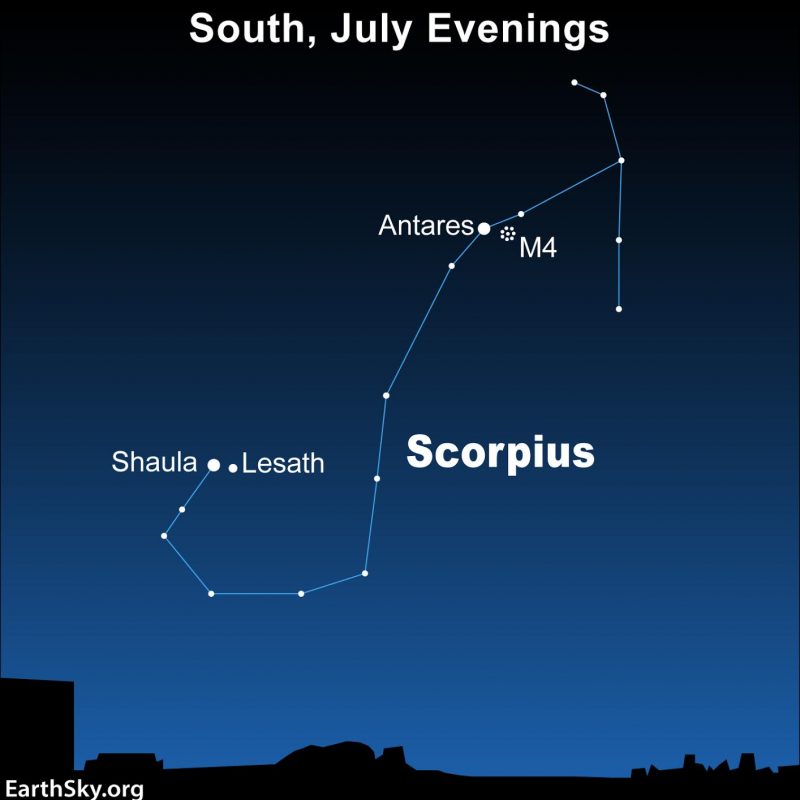
How to find Scorpius from the Northern Hemisphere
For evening viewing, July and August are prime-time months for observing this wondrous constellation. In the Northern Hemisphere, we associate the ruby star Antares – or Ant-Ares, the “rival” of Mars – with the hot summer season. And you might have your own associations with this star during this season. For example, you might associate Antares with the blooming of certain red flowers on a favorite hiking trail.
Then, as the summer season wanes for us in this hemisphere, Antares’ fading into the southwestern dusk signals the cooler days of northern autumn.
At the beginning of July, in either the Northern or Southern Hemisphere, Scorpius climbs to its highest point in the sky in mid-evening. That’s true no matter where you are on the globe.
As seen from mid-northern latitudes, such as the central U.S., Scorpius’ arc is low across the southern sky. But Scorpius’ bright red star Antares can be seen as far north as southern Alaska.
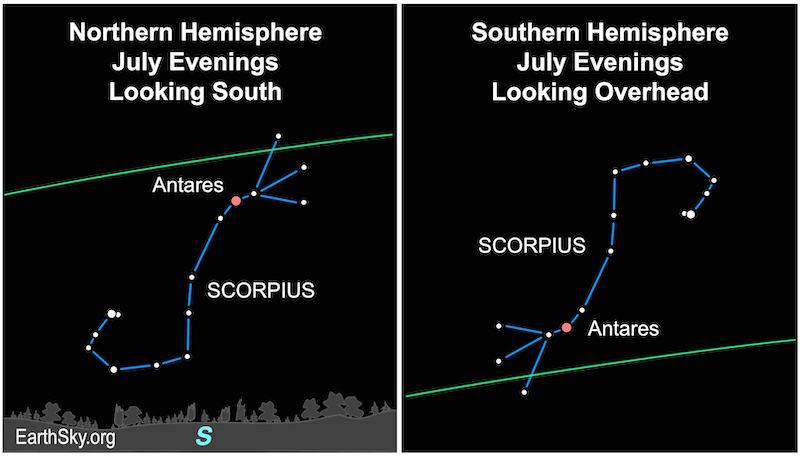
How to find Scorpius from the Southern Hemisphere
Via Daniel Gaussen, Founder & Guide – Stargaze Mackenzie – New Zealand
Meanwhile, from the Southern Hemisphere, Scorpius rides gloriously high in the sky. It’s one of the most spectacular winter constellations. It climbs high into the northern sky, with red Antares amidst the glow of the Milky Way. It’s a star widely known as the Heart of the Scorpion.
The constellation Scorpius lies along one of the richest regions of our Milky Way galaxy. The Milky Way appears brightest and most dense in this region because we are looking close to the galactic center, which lies between Scorpius and Sagittarius the Archer. From the Northern Hemisphere, you must look low in the south to see this region. But from the Southern Hemisphere, Scorpius, Sagittarius and the center of the Milky Way are all high overhead. The view is spectacular!
Many local New Zealanders now refer to their country as Aotearoa New Zealand. Aotearoa is the Maori name for New Zealand; it widely translates to “land of the long white cloud.” In the Maori culture, the brilliant red star Antares in Scorpius is known as Rehua. This prominent star was an important marker in the seasonal cycle and is associated as a highly significant celestial being in Maori traditions.
The Maori didn’t see the constellation Scorpius seen as a scorpion. One well-known Maori interpretation is Te Matau a Maui – the fishhook of the demigod Maui. The curved shape of Scorpius resembles the legendary hook Maui was said to use to catch a great fish from the ocean, which became Te Ika-a-Maui (the North Island). In this tradition, Maui raised up the north island from his canoe Te Waka a Maui (the South Island).
The popular Disney franchise Moana comes in part from these Maori traditions related to the constellation Scorpius. To make the first Moana movie, filmmakers at Disney created what they called an Oceanic Trust: a group of anthropologists, linguists, historians, and elders from Samoa, Tonga, Tahiti, Hawaii, Fiji, and Aotearoa (New Zealand). They said the goal was to ensure the film respected the cultures that inspired it.
The Scorpion in Greek mythology
Greek legends about the Scorpion are quite different. In Greek mythology, it’s said that vain Orion the Hunter grew boastful about his hunting skills. He claimed there was no animal on Earth he couldn’t kill. When Orion began bragging, he would kill every animal, the Earth goddess Gaia sent Scorpius the Scorpion to sting and kill Orion. And thus, Scorpius and Orion became mortal enemies. It’s said that the king of the gods, Zeus, placed Orion and the Scorpion in the heavens in such a way that the two enemies would never meet.
That’s why – according to legend – you can never see these two constellations in the same sky together. Orion only rises after Scorpius has set. And the reverse is also true: Scorpius doesn’t rise until Orion’s departure. And thus, when the Scorpion is at its peak in visibility in the evening sky – high in the sky on late July or early August evenings – Orion is just returning to the east before sunrise.
Read more: Orion the Hunter returns before dawn
Sun’s passage in front of Scorpius
Given Scorpius’ great prominence in the sky, it’s ironic that the sun spends less time in front of the Scorpion than any other constellation of the zodiac. Each year, the sun shines in the constellation Scorpius for a week, from about November 22 through November 29. If these dates seem to be in conflict with what you read on a horoscope page, remember that astrologers are referring to the sign Scorpio, not the constellation Scorpius.
Astrologically speaking, when the sun reaches a point on the ecliptic – the sun’s yearly pathway in front of the stars – that’s 30 degrees to 60 degrees east of the September equinox point, then the sun is said to be in the sign Scorpio. That’s irrespective of which constellation or constellations lie behind the sun in the sky at this time. The sun passes through the sign Scorpio (not the constellation Scorpius) from about October 23 to November 21. But, in the sky, the sun is in front of the constellations Virgo the Maiden and then Libra the Scales during this same time period.
The astrological signs remain fixed relative to the solstice and equinox points. But, in the sky, these seasonal markers slowly shift westward relative to the constellations, or backdrop stars. Some 5,000 years ago, for instance, the star Antares marked the Northern Hemisphere’s September equinox point. In our day, Antares and the sun have their annual conjunction on or near December 1. That’s about three weeks before the December 21 solstice. Antares will mark the December solstice point some 1,500 years from now.
Scorpius and the zodiac
Early astronomers used key stars and easy-to-recognize star patterns (constellations) to track the motions of the sun, moon and planets upon the zodiac. That being the case, early astronomers were no doubt more inclined to use the “fixed” stars of Scorpius than of Ophiuchus for referencing the whereabouts of the wandering planets. After all, the ancients watched the red planet Mars pair up with the ruddy star Antares in recurring cycles.
And so, the Greeks saw Antares – Anti-Ares – as Mars’ rival.
Moreover, the moon routinely occults – passes in front of – Antares at certain stages in the moon’s 18.6-year cycle. There’s been monthly lunar occultations of Antares that began in December 2025 and will end in November 2026. Then they’ll start again in January 2027. Check out Elke Schulz’s photo of a recent lunar occultation of Antares on our Community Photos page.
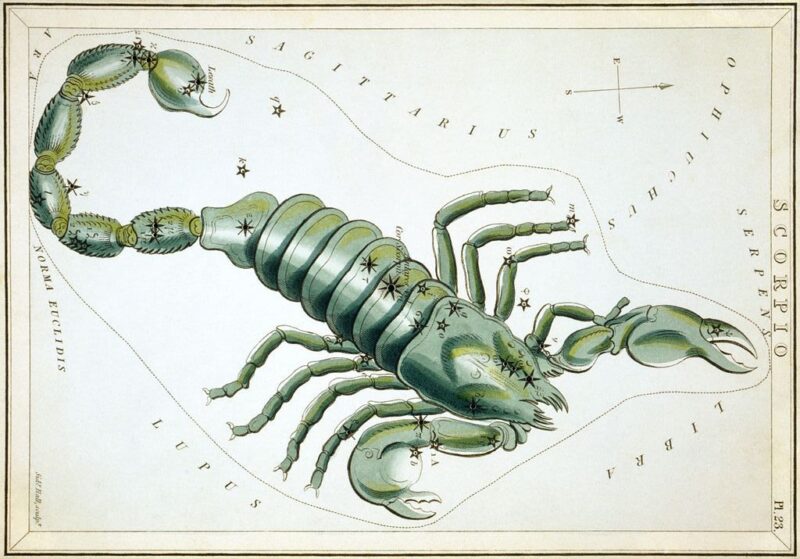
Bottom line: Scorpius the Scorpion traces a J-shaped pattern of stars, making it easy to identify. It is also home to the brilliant red star Antares.
The constellations of the Zodiac
Taurus
Gemini
Cancer
Leo
Virgo
Libra
Scorpius
Sagittarius
Capricornus
Aquarius
Pisces
Aries
Ophiuchus, the 13th zodiac constellation
Like what you read?
Subscribe and receive daily news delivered to your inbox.
More from
Editors of EarthSky


We fly between the sun and Saturn. At opposition today

October birthstone: Colorful opal and tourmaline
Watch for the daytime moon after sunrise this week
Neptune at opposition on September 26, 2026