



Join EarthSky’s Deborah Byrd for a video about the wonder and beauty of the the zodiacal light. It’s easy to see any dark night around the March equinox. Now is a good time to start watching for it.
EarthSky’s 2026 lunar calendar is available now. Get yours today! Makes a great gift.
Zodiacal light on spring evenings
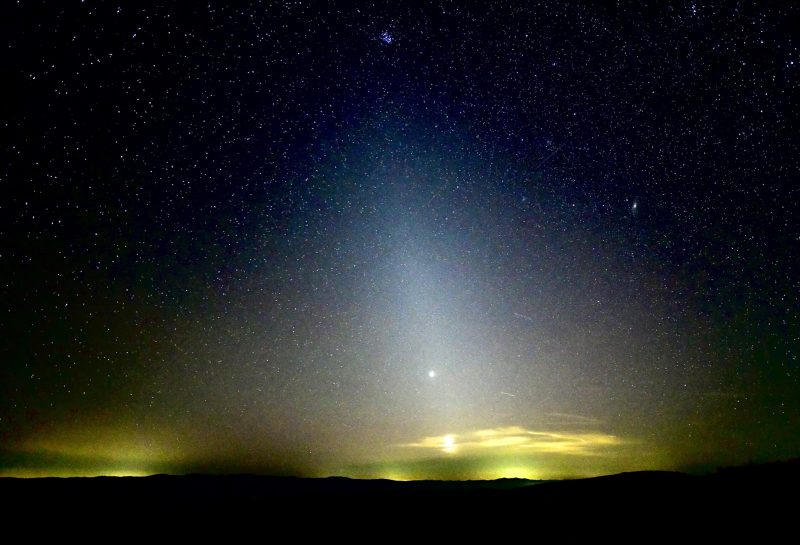
We’re entering the best time of year to see the zodiacal light – or false dusk – in a dark evening sky. This eerie cone of light can be found in the west, just as evening twilight draws to a close. Or, if you’re in the Southern Hemisphere, look for it in the coming months in the east, before twilight begins at dawn. The light is easiest to see (for all of Earth) around the equinoxes. So watch for it now through May whenever you’ve got a moon-free sky.
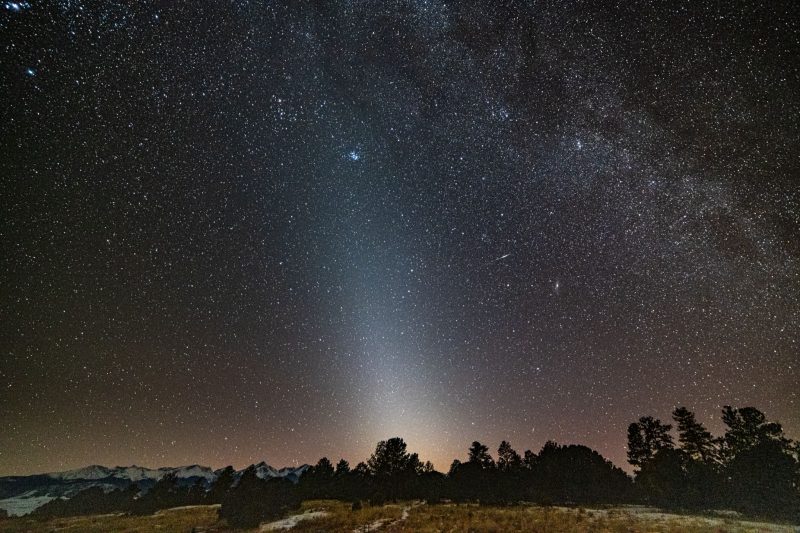
The zodiacal light looks like a hazy pyramid of light, extending up from your horizon.
At this time of year, we in the north call it the false dusk. In the Southern Hemisphere now, where the light is easiest to see in the early morning now, it goes by the name false dawn.
Once you spot it, you’ll know what it is
You might have seen the zodiacal light in the sky and not realized it. Maybe you glimpsed it while driving on a highway or country road at this time of year. Suppose you’re driving toward the west in springtime around 90 minutes after sunset. You notice what you think is the lingering evening twilight, or the light of a nearby town, over the horizon. Instead, you might be seeing the zodiacal light.
Note for Southern Hemisphere: Around February through March, and into early May – for you – the zodiacal light looks like a hazy pyramid of light. It extends up from your eastern horizon before morning twilight begins.
If you see it, let us know! If you capture a shot of the zodiacal light, you can submit it here at EarthSky Community Photos.

What is this eerie light?
People used to think the zodiacal light originated somehow from phenomena in Earth’s upper atmosphere. But today we understand it as sunlight reflecting off dust grains that circle the sun in the inner solar system. These grains were once thought to be left over from the process that created our Earth and the other planets of our solar system 4.5 billion years ago. In recent years, though, there’s been discussion about their possible origin in dust storms on the planet Mars. Read more: Do Mars dust storms cause the zodiacal light?
Whatever their origin, these dust grains in space spread out from the sun in the same flat disk of space inhabited by Mercury, Venus, Earth and Mars. This flat space around the sun – the plane of our solar system – translates on our sky to a narrow pathway called the ecliptic. This is the same pathway traveled by the sun and moon as they journey across our sky.
Ancient civilizations called the pathway of the sun and moon the zodiac or pathway of animals. They did this in honor of the constellations seen beyond it. Hence the name zodiacal light.
The grains of dust are thought to range from about millimeter-sized to micron-sized. They are densest around the immediate vicinity of the sun and extending outward beyond the orbit of Mars. Sunlight shines on these dust grains to create the light we see.
Springtime? Autumn? What’s best?
The answer to that varies. For both hemispheres, springtime is the best time to see the zodiacal light in the evening. Autumn is the best time to see it before dawn. Look for the zodiacal light in the east around the time of the autumn equinox. Look for it in the west after sunset around the time of the spring equinox.
But, of course, spring and autumn fall in different months for Earth’s Northern and Southern Hemispheres. So if you’re in the Northern Hemisphere look for the zodiacal light before dawn from about late August through early November. In those same months, if you’re in the Southern Hemisphere, look for the light in the evening.
Likewise, if you’re in the Northern Hemisphere, look for the evening zodiacal light from late February through early May. During those months, from the Southern Hemisphere, look for the light in the morning.
How to see the light
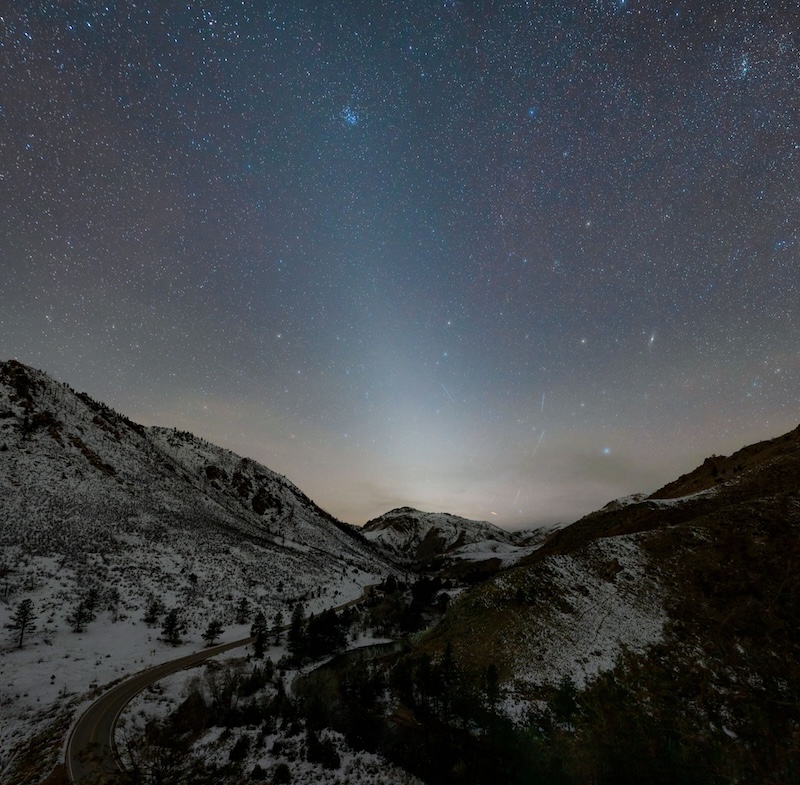
The zodiacal light can be extremely bright and easy to see from latitudes like those in the southern U.S.
Meanwhile, skywatchers in the northern U.S. or Canada sometimes say, wistfully, that they’ve never seen it. But we do see photos of the zodiacal light, taken from northerly latitudes. Photos can sometimes catch a glow of light that the eye has difficulty seeing.
You’ll need a dark sky location to see the zodiacal light, someplace where city lights aren’t obscuring the natural lights in the sky. It’s most visible after dusk in spring because, as seen from the Northern Hemisphere, the ecliptic – or path of the sun and moon – stands nearly straight up in spring with respect to the western horizon after dusk. Likewise, the zodiacal light is easiest to see before dawn in autumn, because then the ecliptic is most perpendicular to the eastern horizon in the morning.
In spring, the zodiacal light can be seen for up to an hour after dusk ends. Or, in autumn, it can be seen for up to an hour before dawn. Unlike true dusk, though, there’s no rosy color to the zodiacal light. The reddish skies at dawn and dusk are caused by Earth’s atmosphere, while the zodiacal light originates far outside our atmosphere.
The best time to look
The darker your sky, the better your chances of seeing it. Your best bet is to pick a night when the moon is out of the sky, although it’s definitely possible, and very lovely, to see a slim crescent moon in the midst of this strange milky pyramid of light. In the springtime, the best time to look for the zodiacal light – and avoid moonlight – is during the weeks around the new moon, when the moon sets soon after sunset, rather than a few days after the full moon.
Bottom line: The zodiacal light is an eerie light extending up from the horizon. During the months around the March equinox is a good time to see it. How to see it, here.
Enjoying EarthSky? Sign up for our free daily newsletter today!
Like what you read?
Subscribe and receive daily news delivered to your inbox.
More from
Editors of EarthSky


Draco the Dragon and Thuban, a former pole star

June solstice 2026: All you need to know
Does the North Star ever move in the sky?
Noctilucent clouds are back: Look for them now!


