



This low-key meteor shower – which always peaks around the solstice – is somewhat overlooked due to the holiday season. Its hourly rate is lower than that of the Geminid shower, which peaks over a week before. And in 2026, the full moon occurs two days after the Ursids peak, so you’ll have a moonlit sky during the meteor shower.
Predicted peak: is predicted** for 20:59 UTC on December 22, 2026.
When to watch: Watch for Ursids on the evening of December 21st through dawn. You’ll have a moonlit sky for watching meteors.
Duration of shower: Ursids range from December 13 to 24, so you might see some intermingling with the Geminids’ peak. This time period is when we’re passing through the meteor stream in space!
Radiant: Circumpolar at northerly latitudes. Due to the northern location of the radiant point in the sky, these meteors are not well seen from southern latitudes and the Southern Hemisphere.
Nearest moon phase: A full moon occurs at 1:28 UTC on December 24. So the bright gibbous moon will probably hinder seeing all but the brightest Ursids in 2026.
Note: This low-key meteor shower – which always peaks around the solstice – is somewhat overlooked due to the holiday season. Its hourly rate – about 5 to 10 meteors per hour – is lower than that of the Geminid shower, which peaked over a week before. However, it’s had an occasional outburst of 100 meteors per hour. So the Ursids are worth a look! In 2026, you’ll have Ursid meteors in moonlight.
Report a fireball (very bright meteor) to the American Meteor Society: it’s fun and easy!
Watching the Ursid meteor shower in 2026
The annual Ursid meteor shower runs from about December 13 to 24 every year. It always peaks around the December solstice, which, in 2026, happens at 20:50 UTC on December 21. The Ursids peak on the morning of December 22. Here’s what to watch for.
Generally, the Ursids are a low-key affair, offering perhaps as many as 5-10 meteors per hour in a dark sky with no moon. In rare instances, bursts of 100 or more meteors per hour have been observed. Those Ursid bursts keep Northern Hemisphere meteor-watchers interested in this shower, despite its peak during the cold of winter.
If you want to watch the Ursids in 2026, a country location is best. There’ll be a bright gibbous moon in the sky, so place yourself in the moon’s shadow. In spite of the moon, you’ll still see the brighter meteors. Dress warmly! Bring a sleeping bag. The best time to watch is overnight on the evening of December 21 through dawn on the morning of December 22. And plan to spend several hours reclining under a starry sky. Will you see some? We sure hope so!
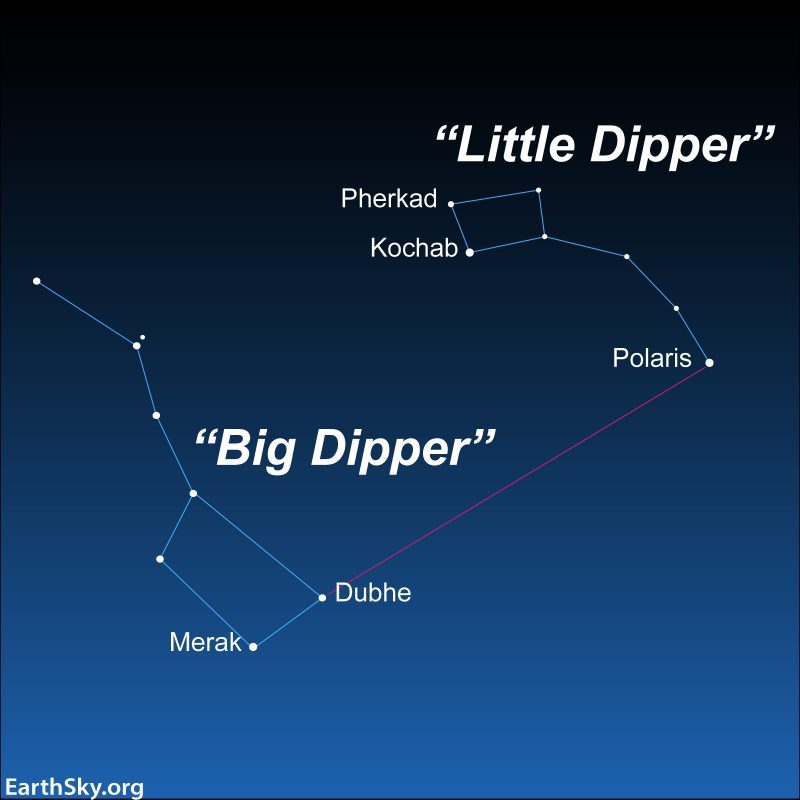
Ursid meteor shower radiant point
The chart above shows the Big and Little Dipper asterisms – in the constellations Ursa Major and Ursa Minor – for which the Ursid meteor shower is named.
As you may know, all meteors in annual showers have radiant points; the showers typically take their names from the constellations in which their radiant lies. If you trace the paths of the slow-moving Ursid meteors backward, they appear to come from the section of sky marked by the Little Dipper star Kochab.
If you look from a Northern Hemisphere location around the time of the solstice, you’ll find the Big Dipper and the star Kochab well up in the north-northeast at around 1 a.m. your local time. That’s about the time of night you’ll want to start watching this meteor shower.
From far-northerly latitudes (for example, in Canada), the Little Dipper is circumpolar (up all night). From there, you’ll find the star Kochab below Polaris, the North Star, at nightfall. Kochab (and all the Little Dipper stars) circle Polaris in a counterclockwise direction throughout the night, with this star reaching its high point for the night in the hours before dawn.
Do you love stargazing? Order your EarthSky Planisphere today!
The Ursids’ parent comet
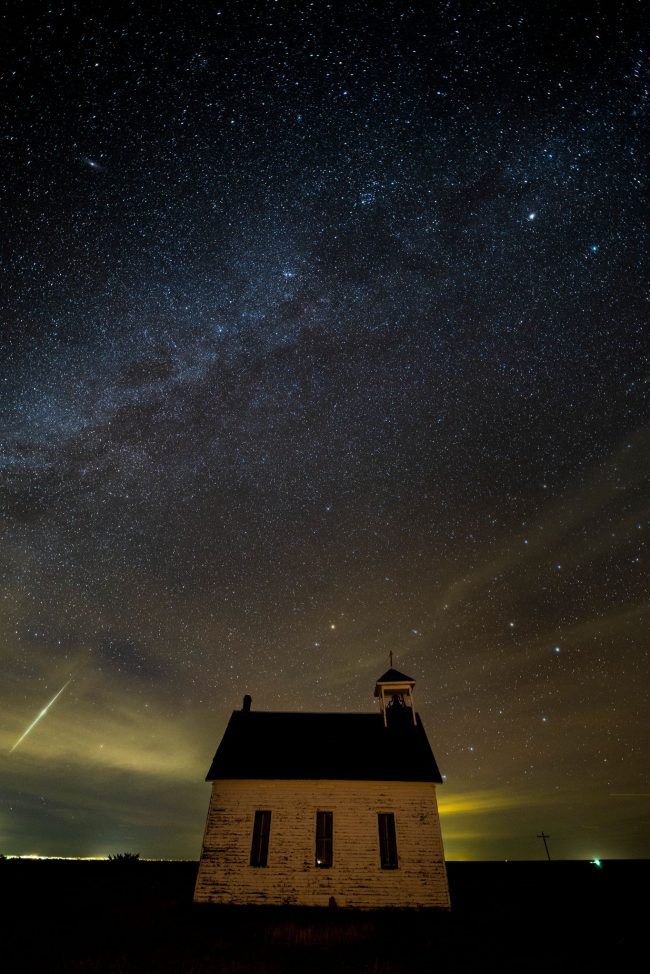
From the late, great Don Machholz (1952-2022), who discovered 12 comets …
8P/Tuttle is the comet responsible for the Ursid meteor shower. Pierre Mechain discovered it on January 9, 1790, from Paris, France. Mechain, an associate of Charles Messier, discovered seven comets that bear his name. But he also discovered two more comets that do not. One, later named Comet Encke after Johann Encke, who calculated its orbit, is responsible for the Southern Taurids meteor shower in early November. The other comet Mechain found that does not bear his name is this one, 8P/Tuttle.
The 1790 appearance of this comet provided an approximate orbit, calculated by Mechain. There were not enough data points to indicate the comet would ever return. But it did. 68 years later, on January 5, 1858, Horace Tuttle of Harvard University College picked it up in the evening sky. It was observed for several months and an orbit was calculated with it returning in 13.7 years. Tuttle linked it to the comet discovered by Mechain in 1790, and it became known as periodic Comet Tuttle. The reason it is not called periodic Comet Mechain-Tuttle is that it was not recognized as a periodic comet from Mechain’s orbit. So, with the new naming procedures that took effect in 1995, the official name of this comet is 8P/Tuttle.
Comet 8P/Tuttle gets as close to the sun as does the planet Earth, then goes out as far as the orbit of Saturn. Its path is tilted to the earth’s orbit, and we intercept the material as it descends from above our orbit. The comet last visited the inner solar system in August 2021.
The meteor shower outbursts are unrelated to the years when the comet visits the inner solar system. That is because the stream of material from the comet creates its own path, and lags behind the comet. In 2007, when the comet visited the inner solar system, there was great anticipation of a shower outburst that December. But none transpired. And it is not unusual for the meteor shower outbursts to occur when the comet is far from Earth.
Ursid meteor shower history
If you decide to watch it, you might enjoy knowing that the Ursids are a relatively new meteor shower. Some meteor showers, such as the Perseids in August, have occurred each year at the same time for many centuries. But around the turn of the 20th century, a skywatcher noticed that some meteors seen around this time of year weren’t random in their direction of motion across our sky’s dome. Instead, they appeared to radiate from near the star Kochab in the bowl of the Little Dipper asterism.
As the years of the 20th century passed, careful observers looked for, and observed, occasional Ursid outbursts.
Although people have observed the Ursid meteor shower for just over a century – and rates are typically around 5-10 meteors per hour – the Ursids have gained popularity in recent years because of these possible outbursts.
Bursts of about 100 meteors per hour happened in 1945 and 1986. An unexpected increase of 30 per hour came in 1973.
Best for the Northern Hemisphere
By the way, the radiant point for the Ursids is just too far north on the sky’s dome to be easily visible from the Southern Hemisphere’s temperate latitudes. The star Kochab – near the Ursids’ radiant point – can’t be seen from there. In other words, for temperate latitudes in the Southern Hemisphere, the radiant stays below the horizon. Since the meteors radiate out in all directions from the radiant point, from those in southerly latitudes, half the meteors or more will never make it above your horizon.
So, from the Southern Hemisphere, you might see a few Ursids come streaking up from your northern horizon around the time the shower peaks. Or you might not see any meteors at all.
Bottom line: The 2026 Ursid meteor shower is best seen overnight from the evening of Dec 21 through the dawn of Dec 22. Find a country location where you can camp out. Dress warmly! The Ursids compete with a bright gibbous moon, so find a way to block out the moonlight.
**Predicted peak times and dates for meteor showers are from the American Meteor Society. Note that meteor shower peak times can vary.
Like what you read?
Subscribe and receive daily news delivered to your inbox.
More from
Editors of EarthSky


Mercury after sunset and great for Southern Hemisphere!

Meteor shower guide 2026: Up next … the Orionids
We fly between the sun and Saturn. At opposition today
October birthstone: Colorful opal and tourmaline



