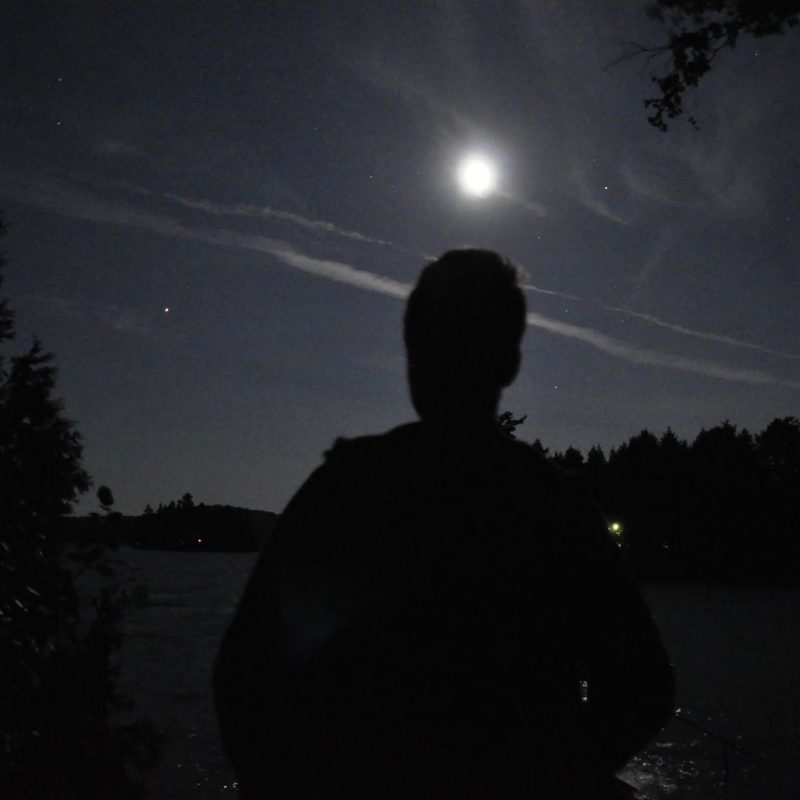
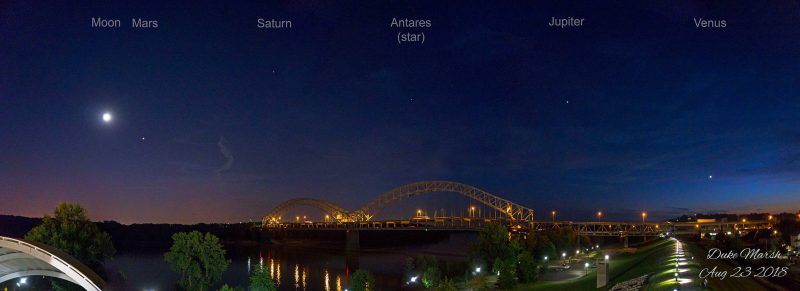
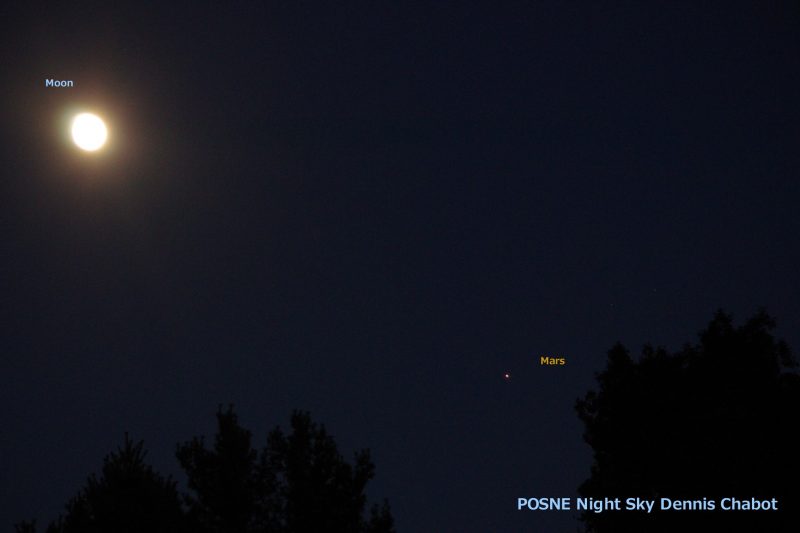
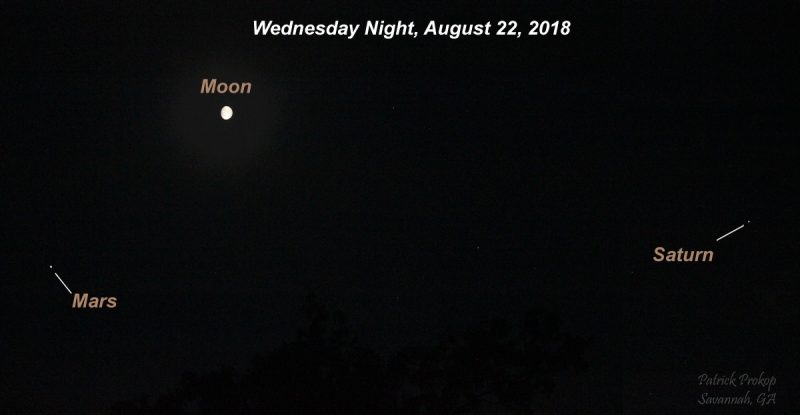
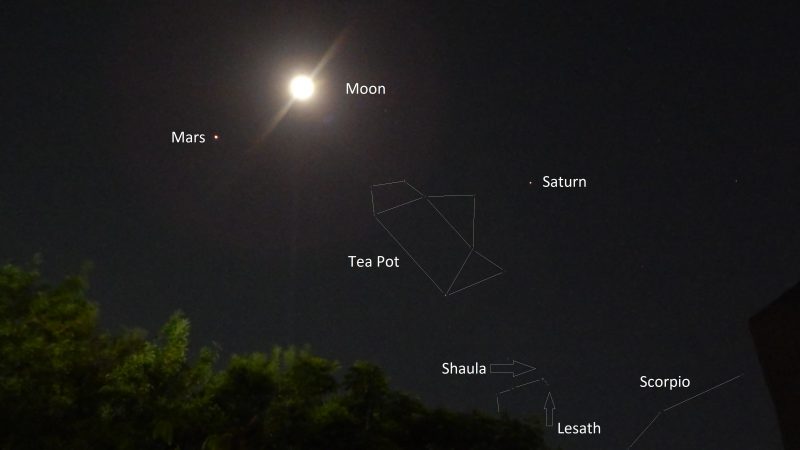
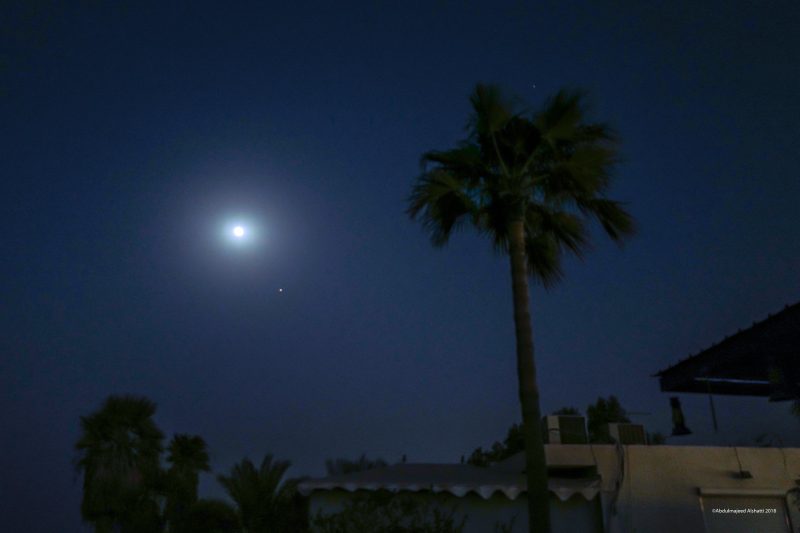
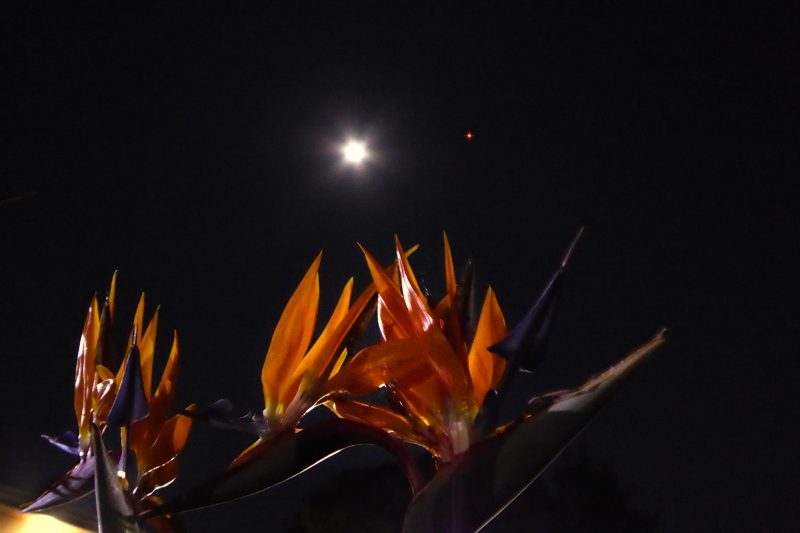
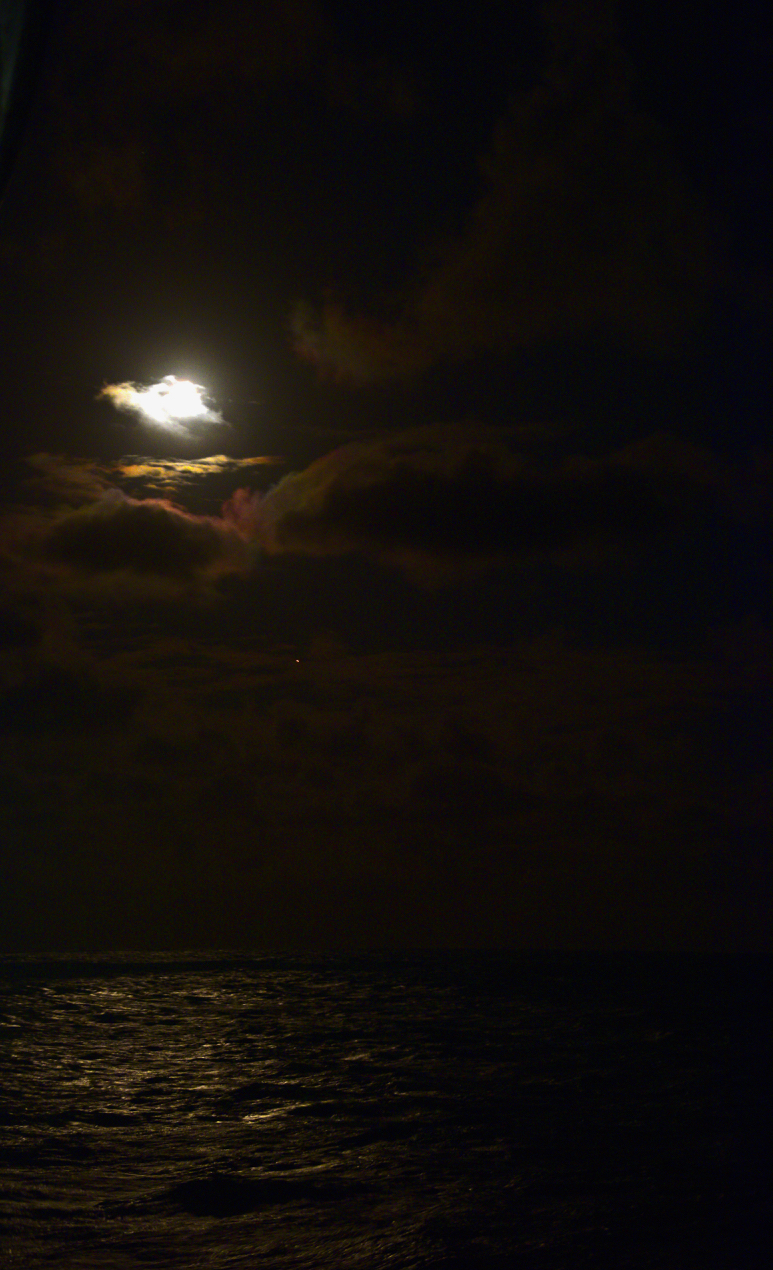
Moon with Mars to the left and Saturn to the right over New Brunswick, Canada. – August 21, 2018 photo via Roxana Soetebeer.View larger. | Our friend Duke Marsh wrote on August 23, 2018: “Four of the five bright planets joined the moon for a lovely sight above the riverfront in New Albany, Indiana, Thursday evening. Each planet can be see directly below its name at the top. Looks best viewed full-screen on a computer monitor or large tablet.”Dennis Chabot of Posne NightSky in Massachusetts wrote: “Moon and Mars on this very rare clear night in New England. Mars is still very bright mag -2.12.” Mars will remain bright for another week to 10 days. In September, it’ll begin to dim dramatically as Earth pulls ahead of Mars in the race of planets around the sun.Alexander Krivenyshev of WorldTimeZone.com caught the moon (bright object in photo, plus shown larger in inset), Mars and Saturn above the Manhattan skyline – New York City – on August 23, 2018.A view of the moon, Mars and Saturn in the southern sky on August 22, 2018, from Patrick Prokop in Savannah, Georgia. Can you see – in contrast to the 2 images above – that the moon has moved closer to Mars from one day to the next? This motion is due to the moon’s movement in orbit around Earth.Raul Cortes in Monterrey, Mexico, caught essentially the same view on August 22 as Patrick Prokop in the photo above. But he has labeled more of the stars and star patterns near Saturn and Mars … the legendary Teapot pattern in the constellation Sagittarius, and the stars Shaula and Lesath in the Tail of Scorpius the Scorpion.Deborah Byrd caught the moon and Mars in early evening, with an iPhone, before the sky was fully dark. They were so bright, they were visible in twilight!Abdulmajeed Alshatti captured the moon and Mars on August 23, 2018, from Kuwait.Peter Lowenstein in Mutare, Zimbabwe, captured the moon and Mars above a flowering strelitzia (bird of paradise) plant on August 23: “Last month the full moon was closest to Mars on the day of the total lunar eclipse (July 27, 2018). This month the waxing moon is closest to Mars 3 days before becoming full … Camera: Panasonic lumix DMC-TZ60 in night scene mode.” Notice that the red color of the bird of paradise flower matches the red color of Mars.Greg Redfern wrote on August 23: “The moon and Mars over a restless North Atlantic Ocean while underway on Azamara Pursuit.” Bon voyage, Greg!
Bottom line: Photos from the EarthSky community of the planets Mars and Saturn – August, 2018 – as the moon swept past.
Deborah Byrd (asteroid 3505 Byrd) helps edit EarthSky.org and is a frequent host of EarthSky videos. Deborah created the EarthSky radio series in 1991 and founded EarthSky.org in 1994. Prior to that, she had worked for the University of Texas McDonald Observatory since 1976, and created and produced their Star Date radio series. She has won a galaxy of awards from the broadcasting and science communities, including having an asteroid named in her honor in 1990, a Public Service Award from the National Science Board in 2003, and the Education Prize from the American Astronomical Society in 2020. A science communicator and educator since 1976, Byrd believes in science as a force for good in the world and a vital tool for the 21st century. "Being an EarthSky editor is like hosting a big global party for cool nature-lovers," she says.
Eleanor Imster has helped write and edit EarthSky since 1995. She was an integral part of the award-winning EarthSky radio series almost since it began until it ended in 2013. She and her husband live in Tennessee, where they enjoy guitar playing and singing. They have 2 grown sons.
Like what you read? Subscribe and receive daily news delivered to your inbox.
Thank you! Your submission has been received!
Oops! Something went wrong while submitting the form.