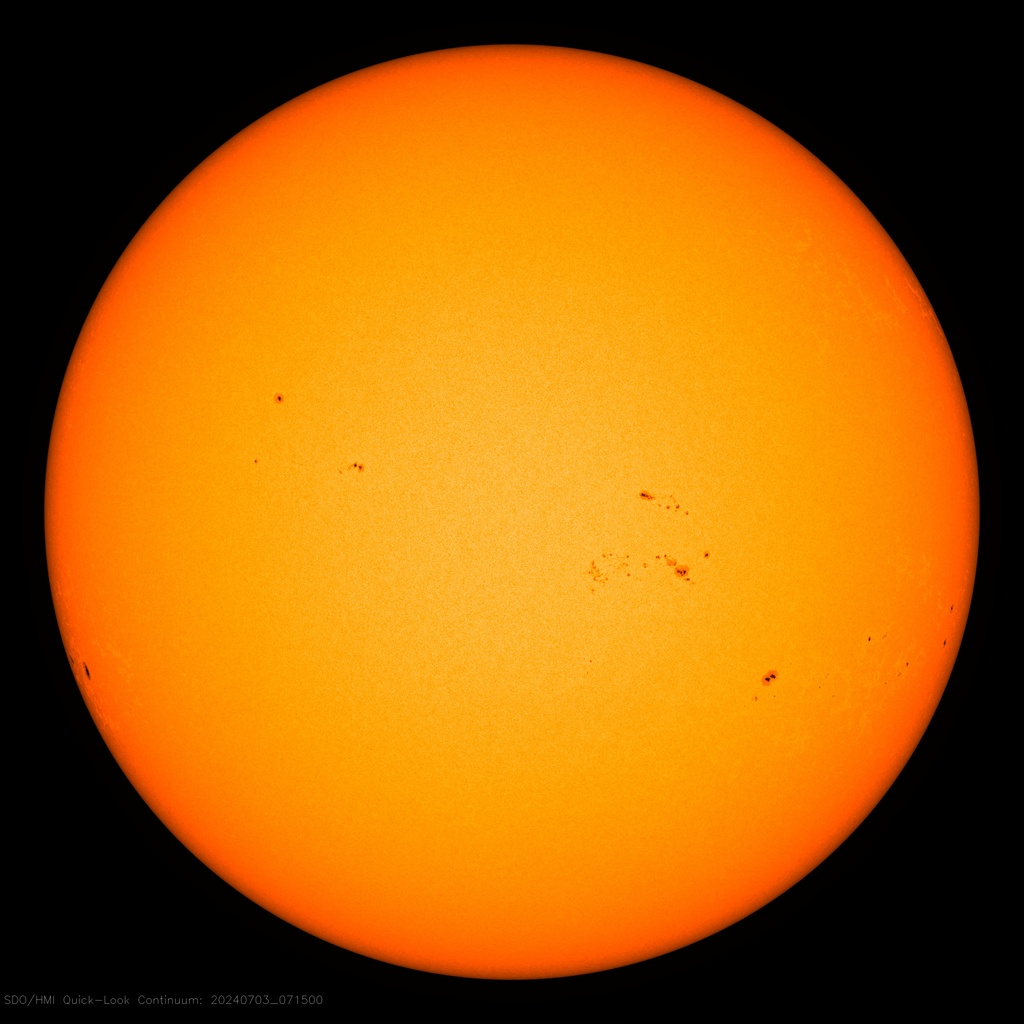
Sun news October 31: Halloween 2003 was a scary time to be a satellite
Twenty-three years ago today, satellite operators were counting the damage. That week, the sun had hurled powerful coronal mass ejections (CMEs) at Earth. The first followed an X17 flare on October 28, 2003. The second followed an X10 flare on October 29. Each one sparked a G5 (extreme) geomagnetic storm at Earth.
By Halloween, the storms at Earth were winding down. But Earth’s satellite fleet was still reeling. In fact, NASA Goddard’s mission operations team later estimated that 59% of NASA’s Earth and space science missions felt the 2003 storms on the sun in some way. A NOAA’s assessment recounted:
- Midori-2 lost: Japan’s ADEOS-II (Midori-2) Earth-observing satellite failed on October 25, during an earlier storm, and never recovered. Investigators suspected space weather but never confirmed a cause. The mission cost about $640 million.
- Kodama in safe mode: Japan’s Kodama data relay satellite dropped into safe mode on October 29. It stayed there until November 7.
- Earth observers shut down: NASA switched off or safed Aqua, Terra, Landsat, TOMS and TRMM on October 29 to protect them.
- Chandra goes dark: The Chandra X-ray Observatory halted observations from October 28 through November 1.
- Trouble at Mars: Mars Odyssey’s MARIE radiation instrument powered off on October 28 and never came back. Then, on Halloween itself, controllers cold-rebooted the orbiter to clear a memory error caused by the storm.
- Sun watchers hit too: ACE, our solar wind sentinel a million miles upstream, suffered permanent damage to one of its particle detectors. Meanwhile, SOHO put one of its instruments into safe mode for three days.
Closer to home, the storms pumped energy into Earth’s upper atmosphere, heating it and puffing it up. As a result, satellites in low Earth orbit ran into extra drag and drifted from their predicted paths. U.S. Air Force operators temporarily lost track of most of them. Crews spent days working around the clock to pin them down again.
So could it happen again? Today, thousands of satellites crowd low Earth orbit, vastly more than in 2003. The possibility of collisions has increased. See the video below an update from satellite debris expert Jonathan McDowell, or watch on YouTube. The danger to Earth satellites is one big reason forecasters watch the sun so closely.
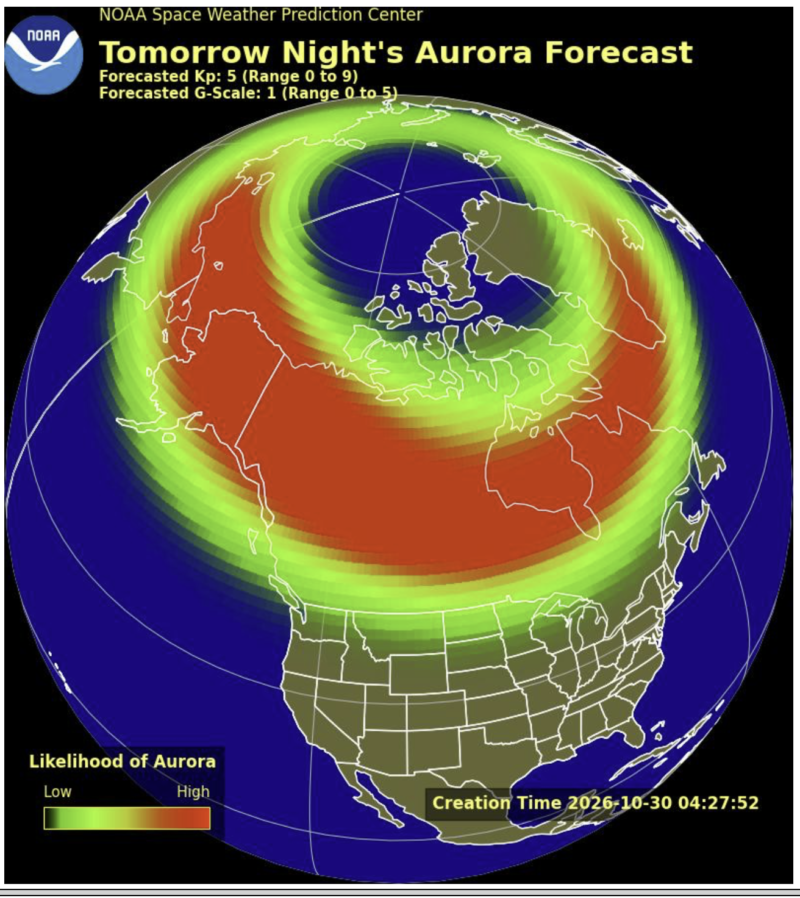
And our Halloween 2026? It brings a small treat! A G1 (minor) storm might light up auroras tonight as far south as Maine and Michigan.
And stay tuned. We’ll follow the Halloween storms into November, when the sun still had one more surprise in store.
Past 24 hours on the sun
(11 UTC October 30 – 11 UTC October 31)
Flare activity: Solar activity stayed very low. During our observation period, the sun produced only B-class (weak) flares. It fired eight of them in total.
- Strongest flare: AR4564 sparked a B7.3 flare at 13:22 UTC on October 30.
- Lead flare producer: AR4564 took the top spot. It blasted out five B flares, including the strongest. AR4565 followed with two B flares.
Sunspot regions: Two numbered sunspot regions dot the sun’s Earth-facing side. One of them is a newcomer, numbered during this period: AR4565.
- AR4564 (beta magnetic configuration): This region kept producing B flares. However, it showed no growth over the past 24 hours, so observers rated it stable.
- AR4565 (alpha): This newcomer sits on the northeast limb. In fact, it was already flaring from the far side before it rotated into view. It blasted out two B flares today.
Blasts from the sun? Observers spotted no new coronal mass ejections (CMEs) in available coronagraph imagery. Even so, the CME the sun launched on October 26 may deliver a glancing blow later today, just in time for Halloween.
Past 24 hours in space weather
Solar wind: Solar wind speeds stayed low for most of the period. Then, at around 3 UTC on October 31, speeds climbed to moderate levels. Meanwhile, density ran low.
Bt, Bz and magnetic coupling: The total interplanetary magnetic field (Bt) reached moderate strength for almost the whole period. Meanwhile, the north-south component (Bz) pointed south for most of the period. A long stretch of southward Bz helps solar wind energy couple into Earth’s magnetic field, which favors auroras. At the time of this report, Bz still points south.
Earth’s magnetic field: Geomagnetic activity ranged from quiet to active, with the Kp index running from 1 to 4. Kp first reached 4 at 22:35 UTC on October 30. It held at that active level for one three-hour period. By the end of our observation window, Kp had eased to 3 (unsettled).
Sun news October 30: More spectacular auroras on this day in 2003
On this day in 2003, Earth’s skies were lit with vivid, widespread auroras for the 2nd night running. Light shows were spotted as far south as Texas and southern Europe. This came after an immensely powerful X10 flare on October 29, which hurled out a coronal mass ejection or CME straight at Earth. The blob of solar stuff arrived on October 30, once again triggering a G5 (extreme) geomagnetic storm. This storm even caused a power blackout in Malmö, Sweden! Stay tuned as we continue to look back at the historic Halloween Storms of 2003. And keep reading to find out what happened on our star over the past day.
Past 24 hours on the sun
(11 UTC October 29 – 11 UTC October 30)
- Strongest flare: A B3.4 flare by active region AR4564 sparked at 22:35 UTC on October 29.
- Lead flare producer: There were only two flares produced, one by AR4564 and the other flare by an as-yet-unnumbered newcomer in the northeast.
Sunspot regions: Currently our sun shows one numbered sunspot region on its Earth-facing side. Yesterday was not officially registered as a spotless day, as the sun didn’t quite remain without a numbered sunspot for the whole day. A newcomer was numbered in this period: AR4564.
- AR4564 (alpha magnetic configuration): This sunspot region emerged from the east, almost over the solar equator line. It blasted one B flare.
Blasts from the sun? After analysis, it seems the slow filament eruption we reported on yesterday has not sent any sun-stuff toward Earth. No other coronal mass ejections (CMEs) were observed in available coronagraph imagery. Meanwhile, a chunk of solar material is coming to us to provide a possible glancing blow on later today or early October 31, just in time for Halloween.
Past 24 hours in space weather
Solar wind: Solar wind speeds stayed at low levels during the whole period. Density ran below average.
Bt, Bz and magnetic coupling: The total interplanetary magnetic field started this period at weak levels, but at 7 UTC this morning it went up to moderate strength. Meanwhile, the north-south component (Bz) showed a northward orientation during most of the period with only a brief southward peak this morning. At the time of this report it has returned to a north orientation.
Earth’s magnetic field: Geomagnetic activity continued quiet, with the Kp index ranging from 0 to 2. At the end of this period the Kp index sits just above level 2.
Sun news October 29: Auroral displays everywhere on this day in 2003
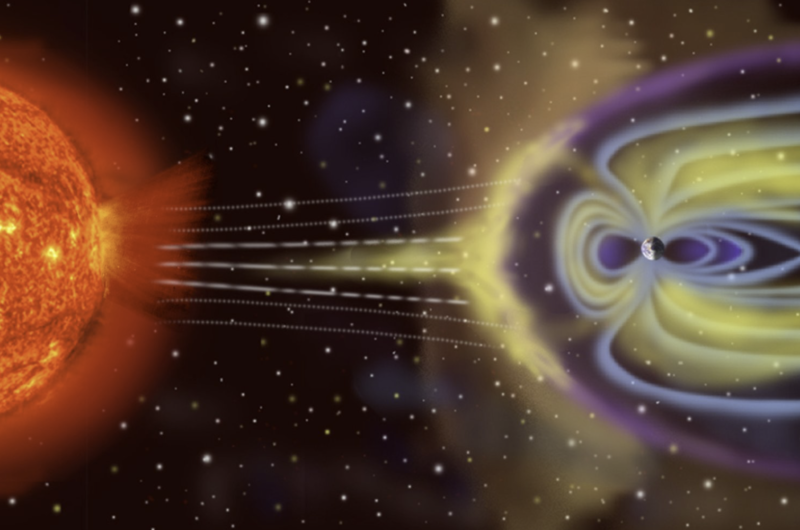
This week we’re looking back at the Halloween Storms of 2003, when three monster sunspot regions unleashed some of the most powerful solar storms of the space age. And on this day, October 29, 2003, our skies were lit up with some of the most widespread auroras on record. This came after sun-stuff from the previous day’s colossally strong X17 flare reached our planet. Hurled out as a coronal mass ejection or CME, it arrived around 6 UTC, meaning it took just 19 hours to make the 93-million-mile (150-million-km) journey to us. When it reached Earth, it rocked our geomagnetic field to G5 (extreme) geomagnetic storm levels. And that triggered auroras visible as far south as Florida and the Mediterranean! Later in the day, our star blasted out another enormous X flare, this time an X10.0 from sunspot region AR10486 at 20:49 UTC. It launched another powerful CME in our direction. Come back tomorrow to hear what happened next.
Past 24 hours on the sun
(11 UTC October 28 – 11 UTC October 29)
Flare activity: Solar activity was very low over the past day. Total flare production of this period was only three B-class (weak) flares.
- Strongest flare: A B6.4 flare by active region AR4561 fired at 12:52 UTC on October 28.
- Lead flare producer: AR4561 continued the top of the list with all three B flares of the period, the strongest included.
Sunspot regions: Our star shows no numbered sunspot regions on its Earth-facing side. Today is the first spotless day of our sun since September 18, when we saw four days in row without a single numbered sunspot. A short-lived newcomer emerged on the southwest quadrant, close to the solar horizon. Numbered AR4563, with only a beta magnetic configuration, it decayed to plage as quickly as it appeared.
- AR4561 (beta magnetic configuration): This sunspot region is still blasting B flares from behind the horizon. It departed among jets and prominences caused by the flares it’s been producing. They appeared to us as B flares, but in reality will have been stronger as the sun itself blocked part of their light.
- AR4562 (alpha): This small numbered region emerged yesterday but rapidly decayed to plage.
Blasts from the sun? At around 7 UTC this morning, a slow filament eruption was observed in the southwest quadrant. At the time of this writing the event is ongoing and has not completed its ejection process. We need to wait for modeling and analysis to determine if any of the sun-stuff is heading our way at Earth. Meanwhile a chunk of solar material is coming to us to provide a possible glancing blow on late October 30-early October 31, just in time for Halloween.
Past 24 hours in space weather
Solar wind: Solar wind speeds averaged slow at what is considered background levels. Density ran below average, with slight peaks during our observation period.
Bt, Bz and magnetic coupling: The total interplanetary magnetic field started this period at slight moderate strength but reduced to weak levels. Meanwhile, the north-south component (Bz) kept shifting from north to south orientation. It showed a prolonged southward period from 12 UTC to 21 UTC on October 28. A continued south orientation favors the appearance of auroral displays. At the time of this report it has returned to a north orientation.
Earth’s magnetic field: Geomagnetic activity continued quiet, with the Kp index ranging from 0 to 2. At the end of this period the Kp index sits just above level 0.
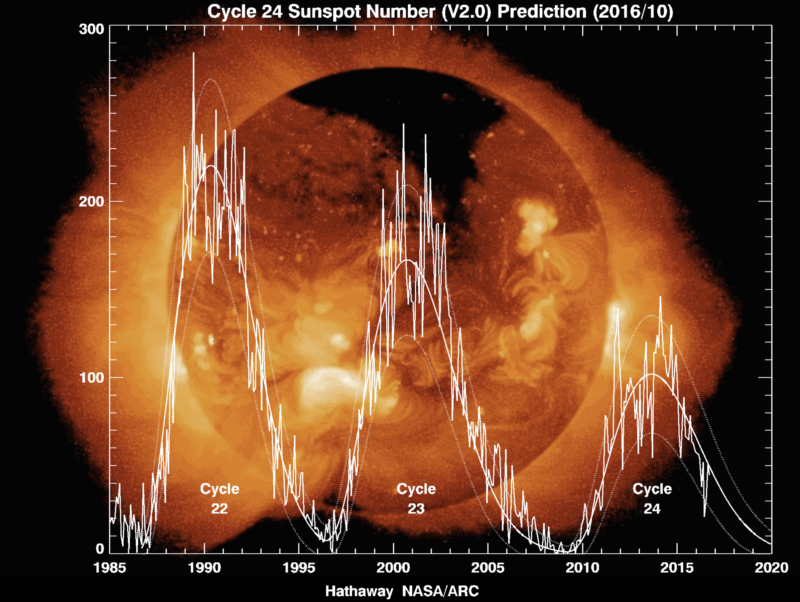
Sun news October 28: On this day in 2003, one of the biggest flares on record
This week we’re presenting a day-by-day account of the Halloween Storms of 2003, when three monster sunspot regions unleashed some of the most powerful solar storms of the space age. And this day in 2003 was a big one. At 11:10 UTC, sunspot group AR10486 fired a colossal X17.2 flare. Yes, X17! That was the biggest flare of that Halloween Storm period so far, and remains one of the largest flares on record. It sent out a barrage of solar energetic particles, to the extent that the energetic-particle-measuring MARIE instrument on the Mars Odyssey spacecraft failed. And this flare also fired out a huge burst of solar material — a coronal mass ejection, or CME — in a full-halo pattern, meaning it was heading straight to Earth. Come back tomorrow to hear about what happened next!
Past 24 hours on the sun
(11 UTC October 27 – 11 UTC October 28)
Flare activity: Solar activity continued at very low levels over the past day. Total flare production of this period was of eight flares: only one C-class (common) and seven B-class (weak).
- Strongest flare: A C1.0 flare by active region AR4561 fired at 6:13 UTC on October 28.
- Lead flare producer: AR4561 remained at the top of the list with seven of the eight flares of the period, including the strongest.
Sunspot regions: Currently our star shows only one numbered sunspot region on its Earth-viewed side. .
- AR4561 (beta magnetic configuration): This sunspot region, yesterday a newcomer, was carried out of view over the western horizon by the sun’s rotation. While departing it continued blasting C and B flares and stayed the lead flare producer.
- AR4562 (alpha): The only numbered region remaining on the solar disk, now located on the southeast. This small active region produced no flares during this period.
Blasts from the sun? A filament eruption was observed at 21 UTC on October 26. Analysts registered a coronal mass ejection (CME). After modeling, they found a component is coming toward us at Earth. Most of it will pass behind Earth, but a glancing blow is possible on late October 30-early October 31.
Past 24 hours in space weather
Solar wind: Solar wind speeds kept at slow levels. Density ran below average, with a slight peak at the end of our observation period.
Bt, Bz and magnetic coupling: The total interplanetary magnetic field (Bt) started weak, but at 18 UTC on October 26 it increased to moderate levels until the time of this writing. Meanwhile, the north-south component (Bz) started this period pointing south but at 16 UTC on October 26 it shifted northward and mostly kept that orientation.
Earth’s magnetic field: Geomagnetic activity stayed quiet, with the Kp index ranging from 0 to 3. At the end of this period the Kp index sits just below level 2.
Sun news October 27: Huge prominence adorns our star
Over the past day, a beautiful prominence – a fiery rope of solar material and magnetic fields – lifted over the sun’s northeastern horizon. It came from a lifting filament that erupted around 17 UTC yesterday, positioned just behind the northeastern limb (edge). It formed a beautiful arch of plasma, with some soaring into space. But most of the ejecta returned back to our sun, lots of it touching down on the Earth-viewed side this time.
Past 24 hours on the sun
(11 UTC October 26 – 11 UTC October 27)
Flare activity: Solar activity dropped to very low levels over the past day. The sun produced a total of 13 flares: only 2 C-class (common) and 11 B-class (weak).
- Strongest flare: A C2.8 flare by active region AR4561 fired at 18:40 UTC on October 26.
- Other notable flare: AR4560 produced a C1.1, peaking at 2:48 UTC on October 27.
- Lead flare producer: Newcomer sunspot region AR4561 rapidly reached the top of the list with 7 of the 13 flares of the period, including the strongest.
Sunspot regions: Our sun shows today two numbered sunspot regions on its Earth-viewed side. Two newcomers received their number in this period: AR4561 and AR4562. In addition, observers spotted one emerging flux in the northeast that has not received a number yet.
- AR4560 (beta): This sunspot region rotated out of view on the west horizon. While departing it continued blasting C and B flares.
- AR4551 (beta): This southern hemisphere region rotated out view.
- AR4561 (beta): This newcomer emerged on the southwest quadrant, close to the solar horizon. It rapidly became the lead flare producer of the period and blasted out the strongest C flare.
- AR4562 (alpha): Emerged on the southeast. This small active region already produced one B flare.
Blasts from the sun? No new coronal mass ejections (CMEs) were registered in available coronagraph imagery.
Past 24 hours in space weather
Solar wind: Solar wind speeds averaged slow levels. Density showed weak levels during all of our observation period.
Bt, Bz and magnetic coupling: The total interplanetary magnetic field (Bt) was weak, but at 6 UTC on October 28 it showed a slight increase to moderate levels until the time of this writing. Meanwhile, the north-south component (Bz) pointed mostly a south orientation with a couple of peaks northward this morning October 28. At the time of this writing the Bz component slightly dropped southward.
Earth’s magnetic field: Geomagnetic activity kept quiet, with the Kp index ranging from 1 to 2. At the end of this period the Kp index sits just below level 2.
Sun news October 26: The Halloween Storms of 2003!
Twenty-three years ago, the sun looked a lot like it does now. Solar Cycle 23 was winding down, and few expected fireworks. Suddenly, three monster sunspot regions appeared and unleashed some of the most powerful solar storms of the space age. They’re known today as the Halloween Storms of 2003.
And they started quietly. Around October 18, 2003, sunspot region AR10484 rotated onto the sun’s northeast limb. It grew fast into one of the cycle’s biggest sunspot groups. Next, AR10486 announced itself from behind the sun’s limb with an M9.9 (moderate) flare on October 22. And the next day, it fired an X5.4 (strong) flare with a large coronal mass ejection (CME). It would become the largest sunspot group of Solar Cycle 23. On October 25, a third region, AR10488, began emerging near the disk center.
Then, 23 years ago today — on October 26, 2003 — the sun fired a double shot. AR10486 launched an X1.2 flare, which sent a huge wave through the sun’s corona. That evening, AR10484 answered with its own X1.2. And the biggest blasts were still to come. Follow along this week as we relive the Halloween Storms, day by day!
Past 24 hours on the sun
(11 UTC October 25 – 11 UTC October 26)
Flare activity: Solar activity stayed low over the past day. Observers recorded 10 flares: 4 C-class (common) and 6 B-class (weak).
- Strongest flares: Three C1.5 flares tied for the top spot. AR4560 fired one at 19:42 UTC on October 25 and another at 01:34 UTC on October 26. Then AR4551 matched them with a C1.5 at 05:44 UTC on October 26.
- Other notable flares: AR4551 also produced a C1.3, peaking at 03:55 UTC on October 26.
- Lead flare producer: AR4560 generated 7 of the 10 flares, including 2 C-class events. AR4551 contributed the other 3, also including 2 C-class events.
Sunspot regions: Two numbered sunspot regions sat on the visible disk during the past day, while a third rotated out of view. In addition, observers spotted two regions of emerging flux in the southwest and southeast quadrants. Neither has received a number yet.
- AR4560 (beta): This moderately sized region was the period’s most prolific flare producer. It now sits right at the western limb, rotating out of view. So its activity should fade as it disappears around the edge.
- AR4551 (beta): This southern hemisphere region produced three flares, including one of the period’s three C1.5 flares. It keeps a simple beta configuration.
- AR4557: According to the SIDC, this region has rotated behind the west limb and is no longer visible. Its sunspot group had decayed into plage.
Blasts from the sun? Observers spotted 2 CMEs on October 25. Neither should impact Earth.
- The first CME appeared in SOHO LASCO imagery starting at 03:15 UTC on October 25. It likely came from a prominence eruption over the east limb. Analysts estimated its speed at about 360 km/s.
- A second, slower CME appeared starting at 05:36 UTC on October 25, at an estimated 275 km/s.
- Meanwhile, a CME from October 21 (SIDC CME 733) may still deliver a glancing blow early on October 26. However, forecasters assign this scenario low confidence, and no model runs predict a definite Earth impact.
Past 24 hours in space weather
Solar wind: Solar wind speeds stayed slow, varying between about 330 and 420 km/s. Density ran below average.
Bt, Bz and magnetic coupling: The total interplanetary magnetic field (Bt) stayed weak, at or below 6 nT. Meanwhile, the north-south component (Bz) varied weakly between about +4 and -4 nT, with no significant sustained southward intervals.
Earth’s magnetic field: Geomagnetic activity stayed quiet, with the Kp index ranging from 0 to 2. No geomagnetic storms occurred. Aurora displays stayed limited to the typical high-latitude ovals.
Energetic particles: The greater than 2 MeV electron flux reached high levels, peaking at 2,864 pfu at 18:20 UTC on October 25. Meanwhile, the greater than 10 MeV proton flux remained at background levels. No solar radiation storms occurred.
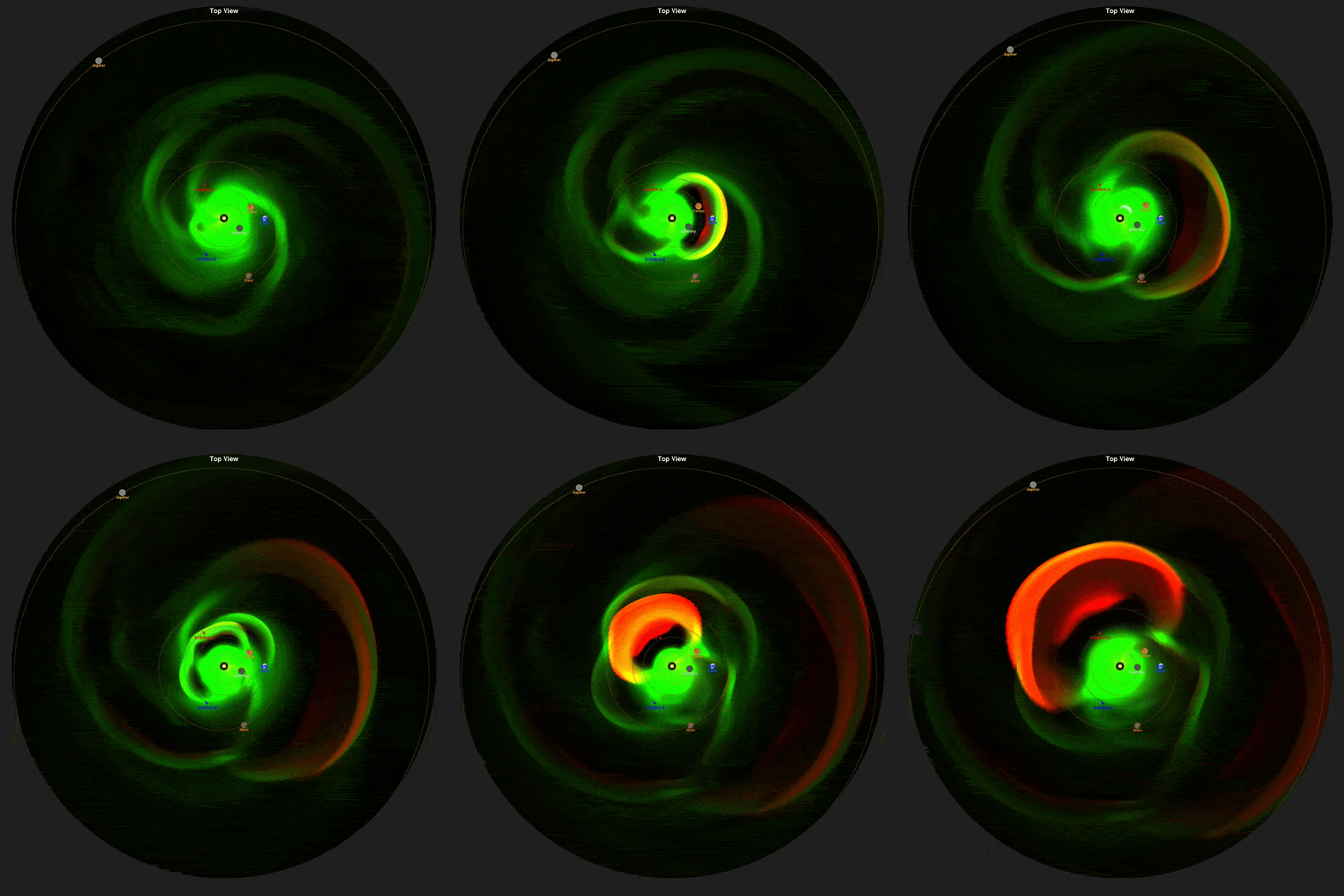
Sun news October 25: Happy 20th birthday, STEREO!
Twenty years ago tonight, the big sun news was that two spacecraft had set out to show us the sun in 3D. NASA’s STEREO mission launched at 8:52 p.m. EDT on October 25, 2006. A Delta II rocket carried the twin observatories into space from Cape Canaveral, Florida. The idea was simple but bold. One spacecraft, STEREO-A (Ahead), would race ahead of Earth in its orbit around the sun. The other, STEREO-B (Behind), would trail behind.
Together, like a pair of eyes, they would give scientists stereoscopic views of the sun and its giant eruptions, called coronal mass ejections (CMEs).
And they delivered. In February 2011, with the two spacecraft on opposite sides of the sun, it delivered our first full, 360-degree view of our star, including the far side we never see from Earth. Then, on July 23, 2012, STEREO-A caught an extreme solar storm more powerful than anything seen in the past 150 years. Luckily, that one missed Earth.
Sadly, STEREO-B fell silent in 2014, and NASA ended its mission in 2018. But STEREO-A is still going strong, two decades later. It remains a key source of space weather information, helping forecasters see CMEs from the side as they head our way. Happy birthday, STEREO!
Past 24 hours on the sun
(11 UTC October 24 – 11 UTC October 25)
Flare activity: Solar activity dropped to very low levels. Observers recorded 5 flares, all B-class. No C-class, M-class, or X.
- Strongest flare: A B5.5 from AR4557, peaking at 07:09 UTC on October 25. This aging region sits right on the west limb (N09W77), about to rotate out of view.
- Other notable flares: AR4560 produced four B-class flares, including a B5.2 at 21:44 UTC on October 24 and a B4.9 at 07:45 UTC on October 25.
- Lead flare producer: AR4560 was the busiest region, firing 4 of the 5 flares.
Sunspot regions: Observers tracked two numbered sunspot regions on the visible disk, both near the west limb (edge). And two small new groups emerged.
- AR4560 (beta-gamma): Located at N13W72, this region kept approaching the west limb. It was the only clearly spotted region on the disk for much of the past day. Despite its beta-gamma configuration, it stayed mostly quiet, producing only low-level B flares. As it nears the limb, its Earth-facing influence is waning.
- AR4557: This region was rotating across the western limb during the past day. It fired the day’s strongest flare, the B5.5. It is effectively leaving the Earth-facing disk.
Blasts from the sun? Observers spotted no new Earth-directed CMEs in available coronagraph imagery during this period. The October 21 CME remains the one to watch with a possible glancing blow.
Past 24 hours in space weather
Solar wind: Solar wind speeds declined steadily over the past day. They dropped from about 425 km/s early on to roughly 350 km/s by the end of the UTC day, as a previous coronal hole high-speed stream waned.
Bt, Bz, and magnetic coupling: The total interplanetary magnetic field (Bt) stayed weak, between 2 and 5 nT, according to the SIDC. Meanwhile, the north-south component (Bz) varied weakly, between minus 6 nT and plus 5 nT. It showed no significant sustained southward intervals.
Earth’s magnetic field: The geomagnetic field stayed quiet, with Kp values of 1 to 2 throughout. No geomagnetic storms occurred, and observers reported no auroral enhancements.
What’s ahead? Sun–Earth forecast
Flare activity forecast: Forecasters expect low activity through October 27, with a slight chance (10%) of isolated M-class flares and their R1-R2 (minor to moderate) radio blackouts. X-class flare chances remain negligible. Geomagnetic activity forecast:
- October 25: Expect quiet to unsettled conditions, with active periods (Kp 3 to 4) possible. A chance exists for G1 (minor) storming (Kp 5), driven by a possible glancing blow from the October 21 CME and the onset of the negative-polarity coronal hole stream. If G1 conditions occur, aurora may appear over the far north of Scotland, Scandinavia, and similar high latitudes, plus far southern New Zealand and perhaps Tasmania. Activity could extend into early October 26.
- October 26: Expect mostly quiet conditions (Kp 0 to 2). However, lingering coronal hole wind may produce brief unsettled intervals. Aurora isn’t expected at typical mid-latitudes.
- October 27: Quiet conditions (Kp 0 to 2) should prevail as solar wind returns to nominal levels. No significant disturbances are anticipated.
- October 28: Quiet conditions (Kp 0 to 2) should continue under slow solar wind. Forecasters have identified no storm drivers.
Sun news October 24: A blob of solar stuff could hit tomorrow
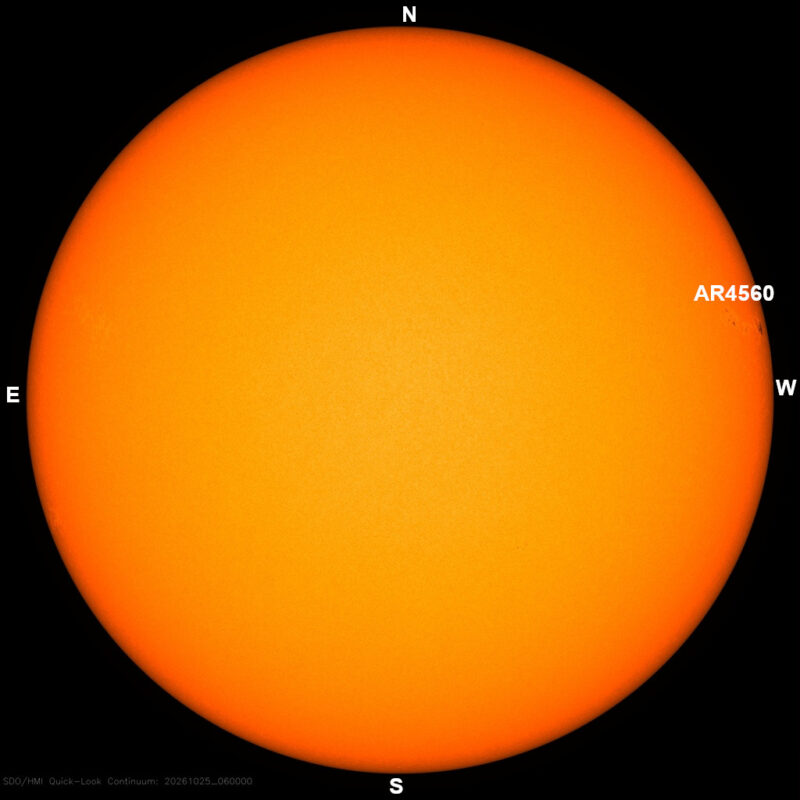
A blob of solar stuff, or coronal mass ejection (CME), is heading our way. It may reach Earth tomorrow and deliver a glancing blow. On top of that, fast solar wind from a coronal hole could help disturb Earth’s magnetic field and enhance auroral displays. Forecasters expect active levels (Kp 4), with a chance of a G1 (minor) geomagnetic storm at high latitudes. So get ready, aurora hunters! These conditions may stretch through the weekend, into October 26. Meanwhile, the sun is running out of sunspots on its Earth-facing side. AR4557 just rotated to the far side. That leaves AR4560 as the only numbered region on the disk, and it’s moving quickly toward the west limb. Soon it, too, will rotate out of view. If no newcomer shows up, we’re a hair away from a spotless sun. We haven’t seen one since September 18. Stay tuned!
Past 24 hours on the sun
(11 UTC October 23 – 11 UTC October 24)
Flare activity: Solar activity stayed at low levels. However, flare production dropped notably. Observers registered only 5 flares this period, compared to 17 yesterday. This time, the tally was three C-class (common) and two B-class (weak).
- Strongest flare: A C1.3 from AR4560, peaking at 19:07 UTC on October 23.
- Other notable flares: On October 23, AR4557 fired a C1.2 at 12:39 UTC before departing to the far side. Then AR4560 added the period’s third C flare, a C1.0 at 6:44 UTC on October 24.
- Lead flare producer: AR4560 held the top spot with three of the period’s 5 flares. AR4557 followed with two.
Sunspot regions: Currently, the Earth-facing solar disk shows only one numbered sunspot region. AR4557 has rotated off, and no newcomers have emerged.
- AR4557 (beta): This region departed to the far side over the sun’s western edge.
- AR4560 (beta-gamma): This region showed decay and lost its delta after just a day. Even so, it fired the strongest flare of the period, the C1.3, and kept its title as top flare producer.
Blasts from the sun? Observers spotted no Earth-bound coronal mass ejections (CMEs) in available coronagraph imagery during this period. However, forecasters still expect a glancing blow on October 25 from the October 21 eruption, which could enhance Earth’s magnetic field.
Past 24 hours in space weather
Solar wind: Solar wind speeds slowly eased from moderate to moderate-low levels over the past day. As the high-speed stream wanes, speeds should drop to low levels through the rest of today.
Bt, Bz and magnetic coupling: The total interplanetary magnetic field (IMF) started this period at moderate-low strength. Then, around 18:30 UTC on October 23, it dropped to weak levels. Meanwhile, the north-south component (Bz) swung between south and north, though southward orientation dominated. Long southward stretches like that favor auroral displays. At the time of this writing, it has swung briefly southward again.
Earth’s magnetic field: The geomagnetic field ranged from quiet to active levels, with the Kp index at 1 to 4. Fast solar wind pushed conditions up to Kp 4, reaching that threshold at 19:53 UTC on October 23. It held there for one three-hour synoptic period. At the time of this report, the Kp index has dropped back to level 1.
Sun news October 23: Active sunspot grows more powerful
August 2024 was the peak in raw monthly numbers of sunspots for Solar Cycle 25. That month saw 216 sunspots. Right now, there are only two numbered sunspots on the Earth-facing solar disk! Yet one of them just surprised us. AR4560, in the sun’s northwest quadrant, grew rapidly and developed a delta in its magnetic configuration. That’s a sign that M and even X flares might be imminent. In fact, AR4560 became the top flare producer, firing the strongest flare, a C3.3, at 5:42 UTC on October 23. This is the guy to watch.
Meanwhile, fast solar wind from a coronal hole kept Earth’s magnetic field active over the past day. It reached Kp 4 for a couple of three-hour periods. More activity may return late on October 24 and through October 25. That’s when fast solar wind from a second coronal hole could combine with a glancing blow from the October 21 eruption. Together, they could push conditions to geomagnetic storm levels and bring a fresh chance for auroral displays at far northern latitudes. Stay tuned!
Past 24 hours on the sun
(11 UTC October 22 – 11 UTC October 23)
Flare activity: Solar activity continued at low levels. Notably, though, flare production rose to 20 flares over the past day: eight C-class (common) and twelve B-class (weak).
- Strongest flare: A C3.3 from AR4560, peaking at 5:42 UTC on October 23.
- Other notable flares: On October 22, AR4560 fired a C1.3 at 11:32 UTC, and AR4557 blasted out a C1.5 at 17:33 UTC. Then, on October 23, AR4557 followed with a C1.4 at 3:55 UTC. AR4560 added three more: a C1.9 at 4:48 UTC, a C1.6 at 6:49 UTC, and a C1.1 at 8:01 UTC.
- Lead flare producer: AR4560 took the top spot with fourteen of the period’s 20 flares. AR4557 followed with six.
Sunspot regions: The solar disk, as we see it from Earth, shows just two numbered sunspot regions, now that AR4551 has rotated off. No newcomers have emerged.
- AR4557 (beta): This region showed modest growth and kept producing flares during this period. It’s the next numbered region set to depart over the west horizon to the far side.
- AR4560 (beta-gamma-delta): This region kept growing and developed a delta complexity. It also fired the strongest flare of the period, the C3.3. Keep your eyes on this one.
Blasts from the sun? Observers spotted no Earth-bound coronal mass ejections (CMEs) in available coronagraph imagery during this period. However, forecasters still expect a glancing blow on October 25 from the October 21 eruption, which could enhance Earth’s magnetic field.
Past 24 hours in space weather
Solar wind: Solar wind speeds slowly eased from moderate to moderate-low levels during the past day. As the high-speed stream wanes, speeds should drop to low levels through the rest of the day today.
Bt, Bz and magnetic coupling: The total interplanetary magnetic field (IMF) averaged moderate-low strength. Meanwhile, the north-south component (Bz) started the period pointing strongly and steadily south. Long southward stretches like that favor auroral displays. Then, around 22 UTC on October 22, it turned north for the rest of the period. At the time of this writing, it has swung briefly southward again.
Earth’s magnetic field: The geomagnetic field ranged from quiet to active levels, with the Kp index at 2 to 4. Conditions reached the Kp 4 threshold at 11 UTC on October 22 and held there for a couple of three-hour synoptic periods. At the time of this report, the Kp index has dropped slightly below level 2.
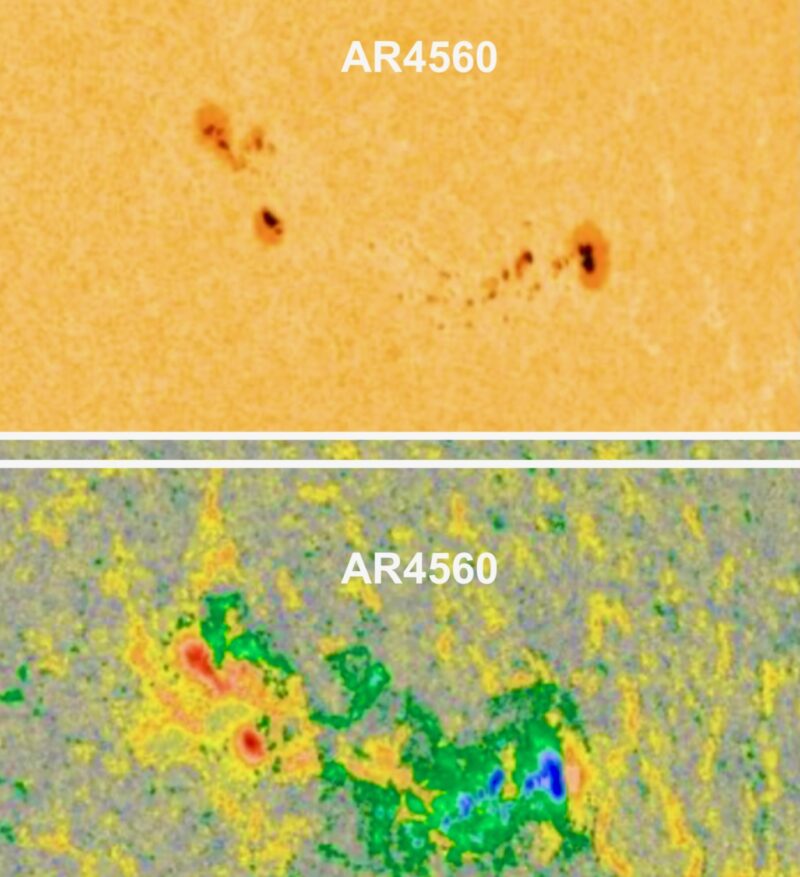
Sun news October 22: Geomagnetic storm arrived last night
It arrived after all! The G1 (minor) geomagnetic storm we’d been expecting finally occurred, a day later than forecast. It was triggered by a coronal hole’s stream of fast solar wind. First, the stream stirred an active disturbance, reaching Kp 4. Then a second surge pushed conditions past the geomagnetic storm threshold (Kp 5) at 23:59 UTC on October 21. And there could be more to come. A second coronal hole is now sending its own fast solar wind our way. It may reach us late on October 23 or early on October 24. That could disturb Earth’s magnetic field again and bring a fresh chance for auroral displays at far northerly latitudes. Did you see the auroras last night? Share your photos with us!
Past 24 hours on the sun
(11 UTC October 21 – 11 UTC October 22)
Flare activity: Solar activity stayed at low levels, with flare production much like the day before. Observers registered 11 flares this period: seven C-class (common) and four B-class (weak).
- Strongest flare: A C3.5 from AR4560, peaking at 3:09 UTC on October 22.
- Other notable flares: On October 21, AR4551 fired a C1.5 at 18:49 UTC. AR4557 followed with a C1.4 at 21:19 UTC. Then AR4560 added a C2.1 at 22:52 UTC.
- Lead flare producer: AR4551 topped the list with five of the period’s 11 flares. AR4560 followed closely with four. Meanwhile, AR4557 contributed the other two.
Sunspot regions: Three numbered sunspot regions still appear on the visible disk, since no newcomers have emerged. In fact, the entire eastern hemisphere remains devoid of numbered regions.
- AR4551 (beta-gamma magnetic configuration): This large region regained its gamma configuration on its way out. It kept blasting flares, too, becoming the lead flare producer of the period. Now it sits right at the southwest limb, ready to rotate to the far side.
- AR4557 (beta): This region kept decaying and lost its gamma configuration. It’s approaching the west horizon.
- AR4560 (beta-gamma): This region kept its gamma configuration and continued to grow. It also fired the strongest flare of the period, the C3.5.
Blasts from the sun? Observers spotted a coronal mass ejection (CME) at 9 UTC on October 21, near the northern coronal hole we’ve been watching. Modeling suggests part of this chunk of solar stuff may deliver a glancing blow to Earth late on October 26 or early on October 27.
Past 24 hours in space weather
Solar wind: Solar wind speeds peaked at moderate-high levels around 14 UTC on October 21. They then settled at moderate levels for the rest of the period. The high-speed stream should keep speeds moderate through the rest of the day.
Bt, Bz and magnetic coupling: The total interplanetary magnetic field started our observation period at moderate levels, then slowly eased to weak strength. Meanwhile, the north-south component (Bz) pointed south for most of the period. A few peaks pointed north. However, the strongest and steadiest peaks pointed south. Long southward stretches like that favor auroral displays.
Earth’s magnetic field: The geomagnetic field ranged from quiet to minor storm levels, with the Kp index at 2 to 5. A G1 (minor) geomagnetic storm struck as conditions reached the Kp 5 threshold at 23:59 UTC on October 21. At the time of this report, the Kp index has dropped to level 3.
Sun news October 21: Fast wind arrives, and more to come
The anticipated stream of fast solar wind from a coronal hole reached Earth today. However, it didn’t trigger the expected G1 (minor) geomagnetic storm. Instead, the wind only triggered active disturbance (Kp 4) in our magnetic field. But there’s another chance ahead. A second coronal hole now is now sitting near the center of the solar disk, facing Earth. Its fast solar wind may start reaching us in the coming days. That could disturb Earth’s magnetic field again and bring a fresh chance for auroral displays.
Past 24 hours on the sun
(11 UTC October 20 – 11 UTC October 21)
Flare activity: Solar activity stayed at low levels, but flare production dropped. Observers registered only 11 flares this period, compared to 22 yesterday. C-class output fell too, with just two C-class (common) flares and nine B-class (weak).
- Strongest flare: A C2.8 from AR4557, peaking at 13:56 UTC on October 20.
- Other notable flare: A C1.4 from AR4551, peaking at 18:36 UTC on October 20.
- Lead flare producer: AR4557 produced eight of the period’s 11 flares, including the strongest. Meanwhile, AR4551 contributed the other three.
Sunspot regions: Currently, only three numbered sunspot regions populate the visible disk. Notably, the eastern hemisphere has run out of numbered regions entirely.
- AR4551 (beta magnetic configuration): This large region is about to rotate to the far side, sitting right on the sun’s southwest shoulder. At that angle, its exact configuration is hard to determine. For now, it’s departing as a beta region with six sunspots, amid jets and prominences.
- AR4557 (beta-gamma): This region underwent minor decay and lost its delta. Even so, it still holds a beta-gamma configuration across 20 spots. And it took over as the period’s flare leader once again, firing eight flares, including the strongest, a C2.8.
- AR4560 (beta-gamma): This region kept growing, increasing in extent and developing additional sunspots. It now counts 21 spots, the most on the disk, and has gained a beta-gamma configuration. That makes it one to watch.
Blasts from the sun? Analysts identified several coronal mass ejections (CMEs) launched toward the north and northeast during this period. Initial analysis suggests none of these chunks of solar stuff are Earth-bound.
Past 24 hours in space weather
Solar wind: Solar wind speeds increased to moderate levels during this period. The arrival of a new high-speed stream drove the jump.
Bt, Bz and magnetic coupling: The total interplanetary magnetic field (Bt) stayed calm early in the period. Then, at around 12 UTC on October 20, it rose to moderate strength and held there through the time of this report. Meanwhile, the north-south component (Bz) pointed south for most of the period. Long, steady southward stretches like that favor auroral displays.
Earth’s magnetic field: The geomagnetic field ranged from quiet to active levels, with the Kp index at 2 to 4. Conditions reached the Kp 4 threshold at 4:29 UTC on October 21. At the time of this report, the Kp index sits at level 2.
Sun news October 20: Fast solar wind approaching Earth
A stream of fast solar wind from a coronal hole — a cooler, less-dense region in the sun’s atmosphere — is expected to reach Earth today. When it does, forecasters expect it to trigger G1 (minor) geomagnetic storm conditions. So aurora-watchers at high latitudes, keep an eye on the sky tonight!
Past 24 hours on the sun
(11 UTC October 19 – 11 UTC October 20)
Flare activity: Solar activity returned to low levels. Observers recorded 22 flares in all: 12 C-class (common) and 10 B-class (weak).
- Strongest flare: A C3.5 from AR4557, peaking at 2:45 UTC on October 20.
- Other notable flares: AR4557 fired most of the period’s flares, with AR4551 and AR4560 adding a handful more.
- Lead flare producer: AR4557 produced 17 of the period’s 22 flares, including the strongest. Meanwhile, AR4551 contributed 3 flares, and AR4560 added 2.
Sunspot regions: Currently, only three numbered sunspot regions populate the visible disk.
- AR4551 (beta-gamma): This large, magnetically complex region started showing signs of decay. Now getting closer to the solar southwest.
- AR4557 (beta): This region lost its delta configuration, but it took over as the period’s flare leader. It fired 17 flares, including the strongest, a C3.5. Its evolving magnetic structure keeps it well worth watching.
- AR4560 (beta): This newcomer emerged on the northeast portion of the disk and kept developing. It produced 2 flares. For now, it remains small and magnetically simple.
Blasts from the sun? Analysts identified no Earth-directed coronal mass ejections (CMEs) during this period. They also confirmed that the CME from yesterday’s M1.7 (moderate) flare is not heading our way.
Past 24 hours in space weather
Solar wind: Solar wind speeds eased toward normal levels as a previous coronal hole’s influence waned. However, that should change soon, as a new high-speed stream is due to arrive today.
Bt, Bz and magnetic coupling: The total interplanetary magnetic field (Bt) stayed mostly calm, briefly reaching moderate levels earlier in the period. Meanwhile, the north-south component (Bz) varied but favored a northward orientation, with brief southward dips.
Earth’s magnetic field: The geomagnetic field stayed at very quiet levels, with the Kp index ranging from 0 to 1. Aurora stayed confined to the highest latitudes. At the time of this report the Kp index sits at level 1.
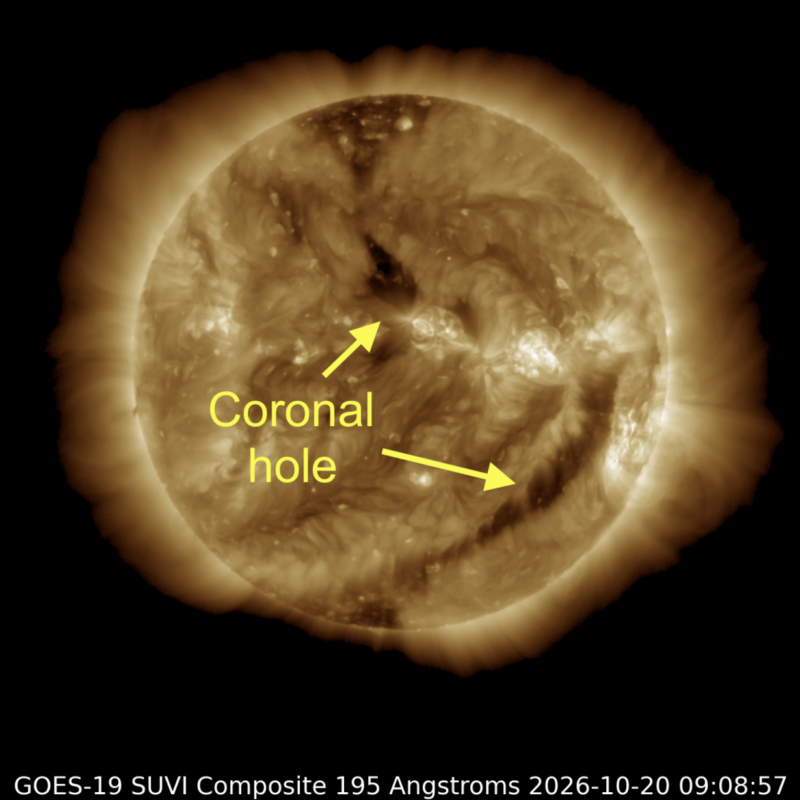
Sun news October 19: M flare erupts as solar wind heads to Earth
A coronal hole — an area of lower density in the sun’s atmosphere — is currently crossing the center of the solar disk. The high-speed solar wind streaming out of it should reach Earth tomorrow. When it arrives, forecasters expect G1 (minor) geomagnetic storm conditions and possible auroras at high latitudes. So what does that mean for skywatchers? If you live in the far north or south, keep an eye out for auroras late on October 19 or on October 20. Those in Northern Scotland and southern New Zealand could catch a glimpse. Meanwhile, AR4551 fired off an M1.7 (moderate) flare near the end of our reporting window, peaking at 9:03 UTC this morning. The blast caused an R1 (minor) radio blackout. This large, magnetically complex sunspot region has dominated flare production for days. And according to forecasters, it still has more to give. Stay tuned!
Past 24 hours on the sun
(11 UTC October 18 – 11 UTC October 19)
Flare activity: Solar activity reached moderate levels. Observers recorded 8 flares in all: 1 M-class, 5 C-class (common) and 2 B-class (weak).
- Strongest flare: An M1.7 from AR4551, peaking at 09:03 UTC on October 19. It produced an R1 (minor) radio blackout over southern Africa.
- Other notable flares: A C2.1 from AR4551 peaked at 19:17 UTC on October 18. Meanwhile, newly numbered AR4559 fired two C-class flares, including a C2.0 at 07:18 UTC on October 19.
- Lead flare producer: AR4551 produced 5 of the 8 flares, including the only M-class event. AR4559 contributed 2 C-class flares, and AR4557 added 1 B-class flare.
Sunspot regions: Four numbered sunspot regions populated the visible disk, including two newcomers: AR4559 and AR4560.
- AR4551 (beta-gamma): This large, magnetically complex region remains one of the biggest on the disk. Its strong, persistent, leader spot keeps it productive. In fact, it produced the bulk of the period’s flares, including the M1.7. Forecasters still consider it a potent source of more moderate flares.
- AR4557 (beta-delta): This region shrank slightly. However, it developed a weak delta configuration. It produced one B-class flare during the period. Despite some decay, its evolving magnetic structure keeps it worth watching.
- AR4560 (beta): This newcomer emerged on the northeast portion of the disk and kept developing. For now, it remains small and magnetically simple.
- AR4559 (beta): This newly numbered region emerged just south of AR4551. Despite being small and simple, this region surprised observers with two C-class flares.
Blasts from the sun? Analysts identified no Earth-directed coronal mass ejections (CMEs) during this period.
Past 24 hours in space weather
Solar wind: Solar wind speeds were slightly elevated as a previous coronal hole’s influence waned. By the end, conditions trended toward normal levels.
Bt, Bz and magnetic coupling: The total interplanetary magnetic field (Bt) stayed mostly calm. Earlier in the period, it briefly reached moderate levels. Meanwhile, the north-south component (Bz) varied but favored a northward orientation, with brief southward dips.
Earth’s magnetic field: The geomagnetic field stayed quiet to unsettled, with the Kp index ranging from 1 to 3. Conditions reached no storm thresholds. As a result, aurora stayed confined to the highest latitudes.
Sun news October 18: Fast solar wind is headed Earth’s way
A coronal hole — a place where the solar magnetic field opens directly into space rather than looping back down to the sun’s surface — is now crossing the central meridian of the sun’s visible disk. And that means charged particles from the sun are now flowing freely into space, from the hole. Forecasters expect this high-speed stream to reach Earth around October 20. That could push geomagnetic activity up to G1 (minor) geomagnetic storm levels and bring auroras into view at high latitudes across Earth.
Meanwhile, the previous high-speed stream keeps fading, and solar wind speeds are easing toward background. So today Earth’s magnetic field should stay mostly quiet, with isolated unsettled intervals. Stay tuned for the pickup late on October 19!
Past 24 hours on the sun
(11 UTC October 17 – 11 UTC October 18)
Flare activity: Solar activity stayed low. Observers counted 12 flares: 9 C-class and 3 B-class. No M-class or X-class events occurred.
- Strongest flare: A C3.7 from AR4551 (S15W35), peaking at 06:44 UTC on October 18.
- Other notable flares: A C3.4 from AR4556 peaked at 03:53 UTC on October 18. Both AR4551 and AR4556 also fired several C1-class flares through the period.
- Lead flare producer: AR4551 produced 7 of the 12 flares. AR4556 contributed the other 5.
Sunspot regions: Three numbered sunspot regions sat on the disk.
- AR4551 (beta-gamma): This region, at S15W32, remained the largest on the disk. However, it lost the delta it carried yesterday, and its smaller spots kept decaying. Even so, a strong, persistent leader spot keeps it capable of moderate flares. It produced the period’s strongest flare, the C3.7.
- AR4557 (beta): This region, at N17E01, kept developing, gaining area and more intermediate spots. In fact, the SIDC rates it beta-gamma, pointing to ongoing changes as some of its southern spots wax and wane.
- AR4556 (beta): This region stayed active, producing 5 flares, including the C3.4.
Blasts from the sun? Analysts tracked two faint coronal mass ejections (CMEs) during the period. Both were slow, at around 427 to 453 km/s, and neither should hit Earth.
Past 24 hours in space weather
Solar wind: Solar wind speeds ranged between about 400 and 514 km/s, reflecting the gradual decline of a negative-polarity coronal hole high-speed stream. Conditions trended toward background levels.
Bt, Bz and magnetic coupling: The total interplanetary magnetic field (Bt) held near 4 to 8 nT, with some moderate readings between 14:42 and 19:05 UTC on October 17. Meanwhile, the Bz component swung between north and south, dipping as far as minus 7 nT.
Earth’s magnetic field: The geomagnetic field stayed quiet to unsettled overall, with Kp ranging from 0 to 3. No geomagnetic storms occurred.
What’s ahead? Sun–Earth forecast
Flare activity forecast: Forecasters expect low activity to continue, with a chance of M-class (R1 to R2) flares. SWPC gives M-class flares a 20% probability, with a small chance of an X-class event. AR4551, AR4556, and AR4557 remain the key players.
Geomagnetic activity forecast:
- October 18: Expect mostly quiet conditions with isolated unsettled periods (Kp 1 to 3) as the waning high-speed stream fades. Aurora will stay limited to the highest latitudes.
- October 19: Quiet early, then rising to unsettled or active conditions (Kp 3 to 4) late in the day as the positive-polarity high-speed stream begins to arrive.
- October 20: Expect active conditions, rising to G1 (minor) storm levels (Kp 5) as the high-speed stream becomes fully geoeffective. A possible glancing CME could add to the mix. Aurora may then appear across high latitudes, perhaps reaching northern Scotland, southern Scandinavia, and southern New Zealand.
Sun news October 17: Huge sunspot still blasting out flares
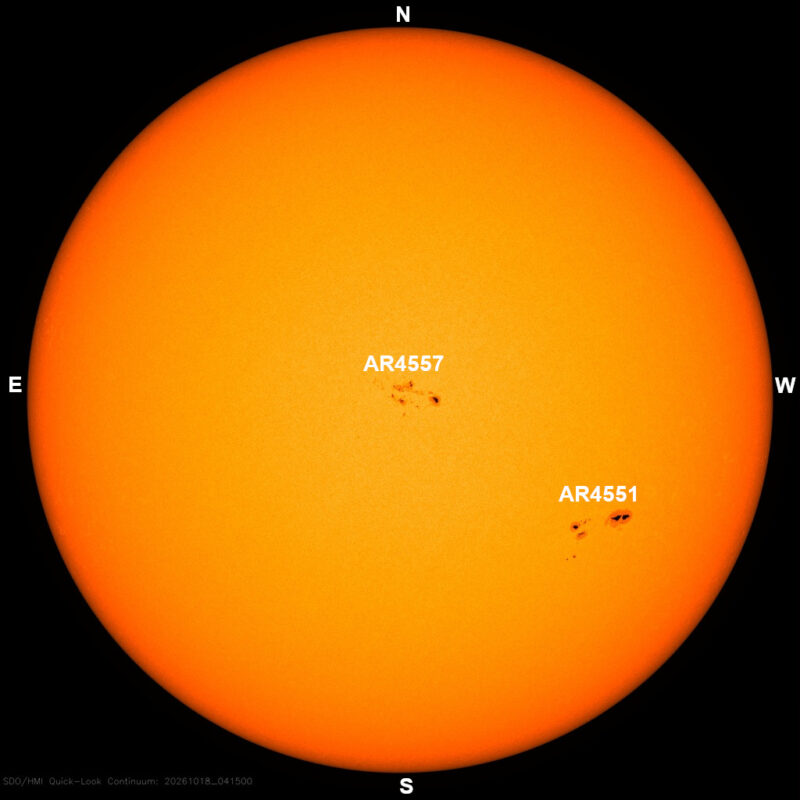
Solar activity reached moderate levels over the past day, thanks to an impulsive M1.4 flare. The flare peaked at 15:42 UTC on October 16. And it was this week’s hero, active region AR4551, fired it. As we mentioned yesterday, this monster sunspot group — as wide as 2 to 3 Earths — has a complex magnetic configuration. So we’ll keep watching this guy to see what else it has in store. Details on the flare are below. Meanwhile, the large coronal hole we’ve been following now faces Earth directly, in a geoeffective position. Its fast solar wind should start arriving soon. When it does, it could stir Earth’s magnetic field and spark auroral displays. Stay tuned for the latest solar news!
Past 24 hours on the sun
(11 UTC October 16 – 11 UTC October 17)
Flare activity: Solar activity jumped to moderate in the past day. Our sun produced 20 flares over this period: one M-class (moderate), 15 C-class (common), and 4 B-class (weak).
- Strongest flare: An M1.4 from AR4551, peaking at 15:42 UTC on October 16. The event caused an R1 (minor) radio blackout on the sunlit side of Earth.
- Other notable flares: A C6.0 at 19:14 UTC on October 16, then a C2.8 at 4:10 UTC on October 17. AR4551 produced both.
- Lead flare producer: AR4551 topped the list again, with 13 flares this period, including the M flare. Meanwhile, AR4557 contributed five flares, and AR4553 sparked two.
Sunspot regions: Our sun still shows three numbered sunspot regions on the side we see from Earth. No new regions appeared. In fact, as the existing ones rotate west, they leave a large stretch of the eastern horizon free of numbered sunspots.
- AR4551 (beta-gamma-delta): This region keeps drawing all the attention. Its beta-gamma-delta complexity is the strongest there is. It has been a prolific C-flare producer, and now it’s an M-flare producer too.
- AR4555 (beta): This region now sits near the west horizon and will soon depart to the far side. It stayed stable and produced no flares during the period.
- AR4557 (beta): This region showed growth. Once again, it produced three flares.
Blasts from the sun? Observers spotted no Earth-bound coronal mass ejections (CMEs) in available coronagraph imagery during the past 24 hours.
Past 24 hours in space weather
Solar wind: Solar wind speeds averaged moderate levels during the period. Fast wind from a previous coronal hole kept waning, though it still produced a brief active spell. Meanwhile, a large coronal hole in the southeast quadrant is now geoeffective and Earth-facing. Its fast solar wind may start reaching Earth within the next couple of days.
Bt, Bz, and magnetic coupling: The total interplanetary magnetic field (Bt) averaged a weak strength. Meanwhile, the Bz component pointed south for about seven hours, from 13:30 to 20:30 UTC on October 16. Then it shifted northward for the rest of the period. At the time of this report, it still points north.
Earth’s magnetic field: The geomagnetic field ranged from quiet to active levels during the period (Kp 0-4). Conditions reached the Kp 4 threshold at 19:40 UTC on October 16, during that southward Bz stretch. At the time of this report, the Kp index sits just above level 0.
Sun news October 16: Meet monster sunspot region AR4551
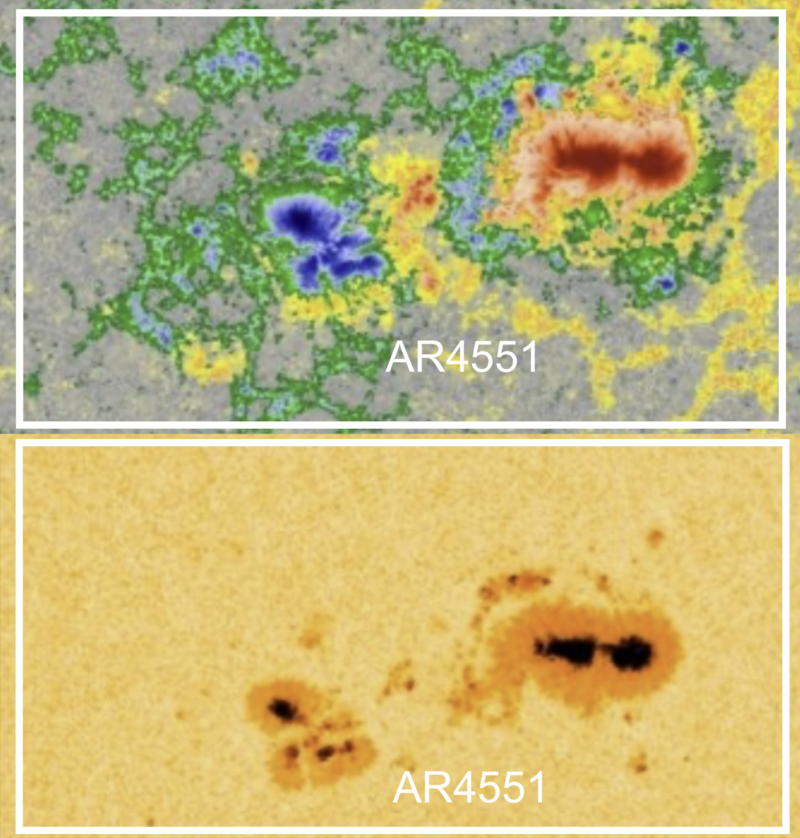
Today’s sun is adorned by a monster sunspot region: AR4551. The active region first emerged on the Earth-viewed solar disk last Friday, and it’s grown rapidly since then, developing a beta-gamma-delta magnetic complexity. That’s the strongest magnetic configuration possible. And that means it has the potential to fire out some major M flares and even X flares. Stay tuned as we keep an eye on this monster sunspot group.
Past 24 hours on the sun
(11 UTC October 15 – 11 UTC October 16)
Flare activity: Solar activity stays at low levels. Our sun produced 17 flares during the period, all C-class (common).
- Strongest flare: A C4.9 flare from AR4551, peaking at 15:55 UTC on October 15.
- Other notable flares: On October 15: a C2.8 at 17:55 UTC. On October 16; a C3.1 at 0:19 UTC. All these flares were produced by active region AR4551.
- Lead flare producer: AR4551 topped the list with 14 flares produced during this period. The other three flares were produced by active region AR4557.
Sunspot regions: Today our sun is populated with three numbered sunspot regions on the side we see from Earth.
- AR4551 (beta-gamma-delta): This region kept its beta-gamma-delta complexity, the strongest there is.
- AR4455 (beta): This active region remained stable.
- AR4557 (beta): Showed growth and produced three C flares.
Blasts from the sun? No Earth-bound coronal mass ejections (CMEs) were observed in available coronagraph imagery during the past 24 hours.
Past 24 hours in space weather
Solar wind: Solar wind averaged at moderate-low levels during the period, as fast solar wind from a coronal hole continued waning. A large coronal hole in the southeast quadrant is moving into a geoeffective (Earth-facing) position in the coming days.
Bt, Bz and magnetic coupling: The total interplanetary magnetic field (Bt) averaged at weak strength. The Bz component kept shifting for short periods from north to south orientation through the entire period. This time the southward orientation was predominant. At the time of this report the Bz component orientation points towards north.
Earth’s magnetic field: The geomagnetic field showed low to unsettled levels during the period (Kp 2-3). At the time of this report the Kp index sits just below level 2.
What’s ahead? Sun–Earth forecast
Flare activity forecast: Specialists expect solar activity to continue at low levels. Chances for M-class (moderate) flares sit at 20% today. Chances for X-class (strong) flares remain at 5%. Active region AR4551 is the main driver with its beta-gamma-delta complexity.
Geomagnetic activity forecast:
- October 16: Unsettled conditions expected to persist. Influence from a coronal hole high-speed stream continues to wane. No G1 (minor) geomagnetic storm levels expected.
- October 17: Quiet conditions might return during the day.
- October 18: Quiet conditions might extend through the day.
Sun news October 15: Huge solar eruption yesterday
A huge filament — a rope of dense plasma suspended by magnetic fields — lifted from the sun yesterday and erupted, hurling plasma into space. The dramatic event occurred at around 10 UTC on October 14 over an area in the northeast solar quadrant. Take a look above, and note how the twisting plasma and magnetic fields make it look like a rubber band that eventually breaks, forming a whirling loop to finally go into space. Initial analysis suggests that none of this solar material is on its way to Earth. And the sun wasn’t done there. After this eruption, the far side of our star responded with a similarly spectacular eruption. Take a look at the imagery below.
Past 24 hours on the sun
(11 UTC October 14 – 11 UTC October 15)
Flare activity: Solar activity continued at low levels. Observers registered 12 flares during the period: eight C-class (common) and four B-class (weak).
- Strongest flare: A C2.9 flare from AR4551, peaking at 2:07 UTC on October 15.
- Other notable flares: On October 14: a C1.9 at 14:44 UTC and a C2.2 at 15:57 UTC. On October 15; a C1.9 at 2:17 UTC. All these flares were produced by active region AR4551.
- Lead flare producer: AR4551 was the only flare producer of the period. This active region produced all 12 flares of this period.
Sunspot regions: Currently the solar disk shows four numbered sunspot regions on its Earth-viewed side. Notably there’s a sunspot region with a beta-gamma-delta magnetic complexity.
- AR4551 (beta-gamma-delta): This region continued its growth and is now a monstrous sunspot region on the Earth-viewed solar disk. It developed a beta-gamma-delta complexity, the strongest there is. That means this sunspot region has potential for M and even X flares. It blasted out all the flares of the period. This is the guy to watch.
- AR4553 (alpha): Reappeared as a numbered active region.
- AR4455 (beta): This active region remained stable.
- AR4556 (beta): Stable inactive region.
Blasts from the sun? The coronal mass ejection (CME) hurled into space during the filament eruption reported above is expected to pass above Earth. No Earth-bound CMEs were registered during the past 24 hours.
Past 24 hours in space weather
Solar wind: Solar wind decreased from moderate-high to moderate-low levels during the period, as fast solar wind from a coronal hole started to wane. There is a large coronal hole forming in the southeast quadrant moving into a geoeffective (Earth-facing) position in the coming days, where its solar wind can reach Earth.
Bt, Bz and magnetic coupling: The total interplanetary magnetic field (Bt) stayed at weak strength. The Bz component’s orientation kept shifting for short periods from north to south orientation through the entire period. A northward orientation was predominant.
Earth’s magnetic field: The geomagnetic field continued at low to unsettled levels during the period (Kp 0-3). At the time of this report the Kp index sits just above level 1.
Sun news October 14: Solar wind disturbs our magnetic field
The anticipated fast solar wind from a coronal hole did arrive over the past day, disturbing our planet’s magnetic field. However, the forecast G1 (minor) geomagnetic storm did not occur. That’s because the expected coronal mass ejections (CMEs) only gave Earth a mild glancing blow. Meanwhile on the sun itself, the very active region of the past few days — AR4549 — continued flaring, even now it’s rotated to the far side of our star. In fact, this now-hidden region was the past day’s top flare producer. We’ve been watching its continued fiery activity in the form of a gorgeous long-lasting prominence on the northwest solar horizon.
Past 24 hours on the sun
(11 UTC October 13 – 11 UTC October 14)
Flare activity: Solar activity kept at low levels. Observers recorded 10 flares during the period: five C-class (common) and five B-class (weak).
- Strongest flare: A C7.0 flare from AR4549, peaking at 2:21 UTC on October 14.
- Other notable flares: On October 13; a C1.1 from AR4551 at 12:42 UTC, a C4.3 from AR4549 at 16:32 UTC and a C1.1 from AR4549 at 2221 UTC. On October 14; a C1.1 from AR44551 at 3:56 UTC.
- Lead flare producer: AR4549 stays at the top of the list with eight flares in total; three C-class and five B-class flares.
Sunspot regions: Today our sun shows five numbered sunspot regions on its side we see from Earth.
- AR4548 (alpha magnetic complexity): This region kept its alpha configuration and remained stable. It didn’t produce any flares.
- AR4551 (beta-gamma): This region regained its gamma complexity and is the largest sunspot group currently. It blasted out a couple of C flares during the period.
- AR4554 (beta): Having been recently numbered, this region rapidly grew to a beta configuration and became the lead flare producer.
- AR4455 (beta): This active region reemerged from becoming a simpler plage, or bright area.
- AR4556 (beta): Newcomer numbered during the past day.
Blasts from the sun? No new Earth-directed CMEs registered during the past 24 hours.
Past 24 hours in space weather
Solar wind: Solar wind increased from moderate to moderate-high levels during the period, as fast solar wind from a coronal hole arrived.
Bt, Bz and magnetic coupling: The total interplanetary magnetic field (Bt) started the period at strong levels but at around 21 UTC on October 13 it decreased to weak strength. The Bz component’s orientation was mostly north through the entire period, limiting the chance for auroras.
Earth’s magnetic field: The geomagnetic field kept at low to unsettled levels during the period (Kp 1-3). At the time of this report the Kp index sits just above level 3.
Sun news October 13: Auroras tonight? Sun-stuff and solar wind incoming
Fast solar wind is currently streaming to Earth from a coronal hole, or an area of lower density in the sun’s atmosphere. When this stream arrives today, it’s expected to disturb our planet’s geomagnetic field to G1 (minor) geomagnetic storm levels. And conditions could escalate to G2 (moderate) levels after a burst of sun-stuff — a coronal mass ejection (CME) — gives Earth an anticipated glancing blow later today. Together, these effects could combine to trigger auroras tonight at northerly latitudes.
Past 24 hours on the sun
(11 UTC October 12 – 11 UTC October 13)
Flare activity: Solar activity continued at low levels. Observers recorded 5 flares during the period: 4 C-class (common) and 1 B-class (weak).
- Strongest flare: A C1.2 flare from AR4549, peaking at 3:40 UTC on October 13.
- Other notable flares: Three C1s occurred during the period. The first one from AR4549 peaking at 19:16 UTC, the second from AR4554 at 20:39 UTC and the third from AR4549 again, peaking at 23:53. The three flares were produced on October 12.
- Lead flare producer: AR4549 was on top of the list with three C-class flares.
Sunspot regions: Currently three numbered sunspot regions populate the visible disk.
- AR4548 (alpha): This region decayed to a simpler alpha configuration and didn’t produce any flares.
- AR4551 (beta): This region lost its gamma complexity during this period. It remained stable and did not produce flares.
- AR4554 (beta): Having been recently numbered, this region rapidly grew to a beta configuration and became the lead flare producer.
Blasts from the sun? No new Earth-directed CMEs registered during the past 24 hours. A couple of filament eruptions were observed. They both came from the same area in the southeast quadrant. Plasma could be seen hurled into space during the events. The first one at around 22 UTC on October 11 and the second at around 4:30 UTC on October 12. Initial analysis suggests the two events are ahead of Earth’s direction. However, a minor glancing blow on October 14 may bring a slight disturbance on Earth’s magnetic field.
Past 24 hours in space weather
Solar wind: Solar wind averaged at moderate levels during the period, mainly driven by fast solar wind from a coronal hole.
Bt, Bz and magnetic coupling: The total interplanetary magnetic field (Bt) started at weak levels but there was a peak at 0 UTC on October 13 that rose to strong levels. It lasted for about an hour to return to moderate strength. The Bz component pointed northward throughout, limiting geomagnetic coupling.
Earth’s magnetic field: The geomagnetic field showed from low to unsettled levels during the period (Kp 1 – 3). At the time of this report the Kp index sits at level 2.
Sun news October 12: Sun-stuff and solar wind on the way
A fast blob of sun-stuff — a coronal mass ejection (CME) — could give Earth a glancing blow later today. The sun fired this CME our way during an M6.4 (moderate) flare on Saturday. If it does reach us, it could add to the effects of high-speed solar wind currently streaming to us from a coronal hole. Together, these effects could disturb our magnetic field to G1 (minor) geomagnetic storm levels. In fact, the U.K. Met Office sees a chance of G2 (moderate) or even G3 (strong) levels. Aurora-watchers across the northern U.K, northern U.S. states, southern New Zealand and similar geomagnetic latitudes should stay alert!
Past 24 hours on the sun
(11 UTC October 11 – 11 UTC October 12)
Flare activity: Solar activity stayed at low levels. Observers recorded 8 flares during the period: 6 C-class (common) and 2 B-class (weak).
- Strongest flare: A C1.2 from AR4545, peaking at 17:01 UTC on October 11.
- Other notable flares: AR4549 contributed a C1.1, peaking at 22:37 UTC on October 11.
- Lead flare producer: AR4545 led the list with three C-class flares.
Sunspot regions: Five numbered sunspot regions populated the visible disk, including one newcomer. A sixth, AR4552, decayed to plage.
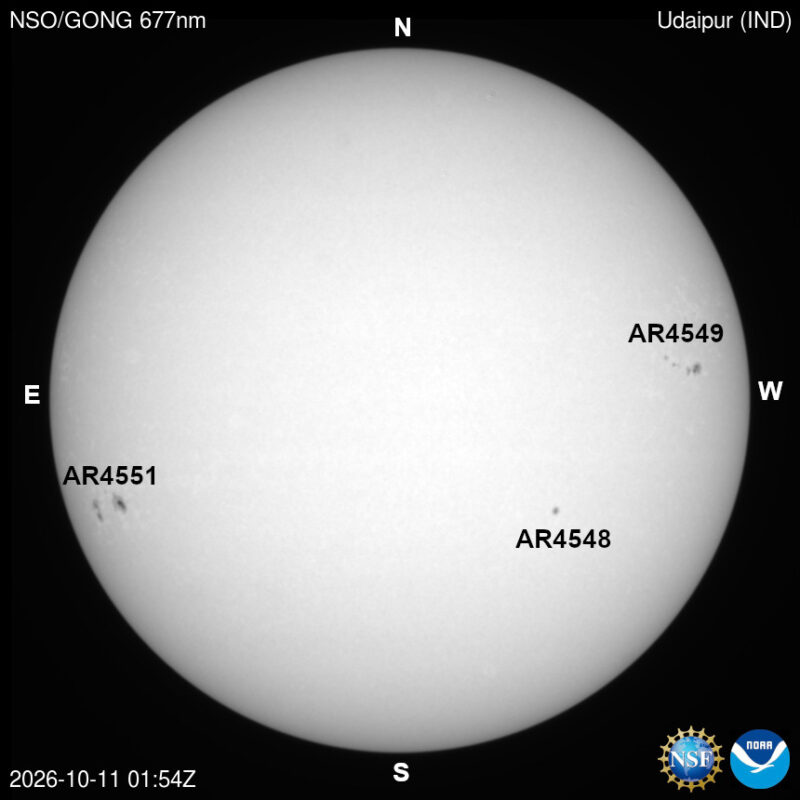
- AR4549 (beta-delta): This region remained the most magnetically complex on the disk. However, it’s getting very close to the western horizon, which is making classification increasingly difficult. It produced only one minor C flare during the period. Still, forecasters consider it the main source of possible M-class and X-class (strong) flares in the days ahead.
- AR4545 (beta): This region saw new magnetic field emergence during the period. It was also the most prolific flare producer, firing the strongest flare (C1.2) plus two other C-class events. Even so, analysts noted overall decay in the region.
- AR4551 (beta-gamma): This region grew in both size and magnetic complexity. It’s now the largest region on the disk. Despite that growth, it stayed mostly quiet, producing only B-class flares during this window.
Blasts from the sun? Observers detected no new Earth-directed CMEs during the past 24 hours. However, the October 10 CME from AR4549’s M6.4 flare remains of interest.
Past 24 hours in space weather
Solar wind: Solar wind steadily decreased to a little above normal, reflecting the fading effects of the October 10 CME arrivals.
Bt, Bz and magnetic coupling: The total interplanetary magnetic field (Bt) started strong and slowly decreased to moderate, before dropping sharply to near-normal levels. The Bz component pointed northward throughout, limiting geomagnetic coupling.
Earth’s magnetic field: The geomagnetic field started the period at active levels (Kp 4). Conditions then eased to quiet as CME effects waned.
Sun news October 11: Bright aurora last night!
A powerful coronal mass ejection (CME) slammed into Earth yesterday (October 10), driving a G3 (strong) geomagnetic storm. Solar wind speeds rocketed to about 900 km/s. And other conditions also aligned to create impressive geomagnetic activity. Auroral displays were possible at mid-latitudes during the storm’s peak. Meanwhile, the sun kept busy. AR4549 unleashed an M6.4 flare, the strongest of the past day, producing an R2 (moderate) radio blackout. That flare also launched a fast CME with an estimated speed of 929 km/s. Forecasters at NOAA’s Space Weather Prediction Center have not ruled out a possible grazing blow to Earth late on October 12 from this new blast. So what’s ahead? Geomagnetic storming is not done yet. G1 (minor) to G2 (moderate) conditions are likely early on October 11 as CME effects persist. Then, a negative-polarity coronal hole high-speed stream is expected to arrive late on October 12. Stay tuned!
Past 24 hours on the sun
(11 UTC October 10 – 11 UTC October 11)
Flare activity: Solar activity has been high over the past day. Forecasters logged 2 M-class and 11 C-class flares, for a total of 13 flares.
- Strongest flare: An M6.4 flare peaked at 15:10 UTC on October 10. It came from AR4549 (N08W53). It caused an R2 (moderate) radio blackout over Brazil. Observers also detected a Type II radio sweep with an estimated shock speed of 929 km/s.
- Second M flare: An M1.2 flare peaked at 14:12 UTC on October 10. It came from AR4549 and produced an R1 (minor) radio blackout.
- Other notable flares: A C4.8 flare peaked at 17:52 UTC on October 10 from AR4551. AR4545 produced a cluster of five C-class flares between 20:18 and 00:12 UTC.
- Lead flare producer: AR4549 produced both M-class flares and four C-class flares, accounting for six of the 13 total flares.
Sunspot regions: Six numbered regions were on the visible disk, with new flux emergence noted near the northeast limb.
- AR4549 (N09W54, beta-gamma-delta): This remains the most complex region on the disk. It maintained its delta magnetic configuration throughout the period, though observers noted slight decay in the trailing and intermediate spots. It produced both M-class flares and multiple C-class events. A fast CME launched from this region is being analyzed for a possible Earth-grazing trajectory.
- AR4545 (N17W60, beta): This region continued to decay. But it surprised forecasters with a burst of C-class flaring late in the period, producing five C-class flares. It is approaching the west limb.
- AR4551 (S14E61, beta): This region continued to rotate into view on the east limb. It produced a C4.8 and a C1.9 flare during the period.
- AR4547 (behind west limb): This region has rotated off the visible disk. Before departing, it produced a C4.2 flare at 8:13 UTC on October 10 with an associated CME, though that CME is not expected to impact Earth.
Blasts from the sun? Observers detected two CMEs during the period. The first, associated with the M6.4 flare from AR4549, was first visible in LASCO C2 imagery at 15:48 UTC on October 10. Initial analysis indicated a near miss just ahead of Earth. However, NOAA analysts noted the trajectory was close enough that a possible grazing blow late on October 12 could not be ruled out. Additional modeling is underway. The second CME, associated with AR4547’s C4.2 flare, was first visible at 8:24 UTC on October 10. Forecasters do not expect this one to affect Earth due to the far-side location of the source region.
Past 24 hours in space weather
Solar wind: Solar wind conditions were dramatically disturbed. An interplanetary shock arrived at L1 at 14:34 UTC on October 10, marking the arrival of the anticipated CME(s) from October 7-8. Speeds jumped from about 400 km/s to over 530 km/s initially, then surged to a peak just above 900 km/s at 17:53 UTC on October 10. Density spiked to over 100 particles per cubic centimeter.
Bt, Bz and magnetic coupling: The total interplanetary magnetic field increased sharply to 26 nT upon the shock arrival, then climbed to a peak of 46 nT at 15:18 UTC on October 10. The Bz component initially reached -16 nT, then plunged further south to -29 nT at 16:24 UTC. After about 20:30 UTC, Bz turned largely northward and weakened.
Earth’s magnetic field: The geomagnetic field began the period at quiet to unsettled levels (Kp 2-4). Following the CME arrival, activity surged to G3 (strong) storm levels (Kp 7) by midday on October 10, with two G3 intervals and one G2 (moderate, Kp 6) interval recorded. Aurora was possible at mid-latitudes, including across Scotland, northern England, and similar geomagnetic longitudes.
What’s ahead? Sun-Earth forecast
Flare activity forecast: Forecasters expect solar activity to remain at low to moderate levels. M-class flares (R1-R2) are likely at 55-65% probability through October 13, primarily from AR4549. The UK Met Office notes a chance of X-class flares as well. There is a slight chance (10%) for an S1 (minor) solar radiation storm through October 12.
- October 11: Geomagnetic activity should remain elevated early in the day as CME effects persist. G1 (minor, Kp 5) storms are likely, with G2 (moderate, Kp 6) levels likely early on. There is a slight chance of an isolated G3 (strong, Kp 7) interval. Conditions should ease to unsettled to active (Kp 3-4) later in the day. Auroras may be visible across Scotland, northern England, southern New Zealand, and similar latitudes where skies are clear.
- October 12: A possible grazing blow from the October 10 CME could arrive late in the day. In addition, a north-south oriented negative-polarity coronal hole high-speed stream is expected to become geoeffective. G1 (minor, Kp 5) storms are likely, with a chance of G2 (moderate, Kp 6) and a slight chance of G3 (strong, Kp 7). Aurora sightings are again possible at higher latitudes.
- October 13: Coronal hole high-speed stream effects are expected to persist. Mostly active conditions are forecast, with a reducing chance of G1 (Minor, Kp 5) storms.
- October 14: A slight chance of G1 (minor, Kp 5) storms remains, with a slight chance of G2 (moderate, Kp 6) as coronal hole effects wane.
Sun news October 10: A farewell M flare from a surprising source
Solar activity held at moderate levels, thanks to an M1.3 flare — a moderate flare — from a surprising source. Active region AR4547 fired it at 14:09 UTC on October 9. Yet this region had rotated out of sight a couple of days ago, carried to the far side by the sun’s rotation. So the blast erupted from just behind the solar limb. That suggests the flare might have been stronger than recorded, since the sun itself blocked part of it from view. Because the source sits off the Earth-facing disk, initial analysis suggests its chunk of solar stuff, or coronal mass ejection (CME), won’t head our way. Even so, modeling and analysis continue. Farewell, AR4547, and what a way to go!
Past 24 hours on the sun
(11 UTC October 9 – 11 UTC October 10)
Flare activity: Solar activity stayed at moderate levels, with an isolated M1.3 flare. Observers registered 18 flares during our observation period: one M-class and seventeen C-class.
- Strongest flare: An M1.3 from AR4547, peaking at 14:09 UTC on October 9. The blast provoked an R1 (minor) radio blackout over the Atlantic Ocean.
- Other notable flares: AR4549 kept popping off C-class flares throughout the period. Those included a C4.3 at 13:12 UTC and a C3.2 at 23:51 UTC on October 9. Then came a C7.9 at 4:38 UTC on October 10.
- Lead flare producer: Once again, AR4549 led the pack, this time with 11 of the period’s 18 flares, all C-class. AR4547 produced three flares and AR4551 produced two flares.
Sunspot regions: Today our star shows five numbered sunspot regions on the side we see from Earth. Two of them are newcomers numbered during this period: AR4551 in the southeast and AR4552, which emerged in the northwest quadrant.
- AR4549 (beta-delta): This region lost its gamma but kept its delta. It remains the largest and most complex region on the disk, and it has led the flare list all week. Now it’s drawing closer to the west limb as the sun rotates.
- AR4545 (beta): This region continued to decay over the period. It produced no flares.
- AR4548 (alpha): This region stayed stable and inactive.
- AR4551 (beta) and AR4552 (beta): Both received their numbers this period. AR4551 fired two C flares. Meanwhile, AR4552 stayed stable with no eruptions.
Blasts from the sun? The CME from AR4547’s M1.3 flare erupted too far around the limb to reach Earth directly. Observers spotted no other CMEs in available coronagraph imagery.
- October 6 CME: The CME from the October 6 M1.4 and M1.8 flares did arrive. However, it landed mostly as a glancing blow, producing only a mild disturbance that peaked at Kp 4. It fell short of the expected G1 to G2 (minor to moderate) geomagnetic storm levels.
- October 7 CME: A CME that left the sun on October 7 remains on track for Earth. It could deliver a glancing blow late on October 10 or early on October 11.
- October 8 CME: The chunk of solar stuff from AR4549’s M6.7 event should arrive on October 11.
Past 24 hours in space weather
Solar wind: Solar wind speeds rose to moderate levels during the period, as the October 6 CME arrived. Next, the October 7 CME should arrive later today. That may keep speeds at moderate to moderate-high levels over the next several hours.
Bt, Bz and magnetic coupling: The total interplanetary magnetic field (IMF) (Bt) showed the full disturbance during this period. It first rose to strong levels, then dropped to weak strength by 21 UTC on October 9. By the time of this report, it had climbed back to moderate. Meanwhile, the north-south component (Bz) made a strong initial swing, tracking the IMF. Then, around 17 UTC on October 9, it turned southward for the rest of the period, with only a few northward peaks. At the time of this report, it still points south.
Earth’s magnetic field: Geomagnetic activity reached active levels, with the Kp index ranging from 1 to 4. Conditions reached the Kp 4 threshold around 11 UTC on October 9 and held there for one three-hour synoptic period. At the time of this writing, the Kp index sits at level 3.
Sun news October 9: Activity high after a powerful M flare
Bam! Solar activity has jumped to high thanks to an M6.7 flare from volatile sunspot region AR4549 at at 15:48 UTC yesterday. We’d been expecting action from this region, due to its beta-gamma-delta magnetic complexity, and it didn’t disappoint. The powerful blast lit up a large portion of the solar disk in extreme ultraviolet imagery across several wavelengths. The eruption also hurled a huge chunk of solar stuff into space, known as a coronal mass ejection (CME). Experts are currently analyzing the event to see if any of this sun-stuff could be heading toward Earth. Stay tuned.
Past 24 hours on the sun
(11 UTC October 8 – 11 UTC October 9)
Flare activity: Solar activity reached high levels thanks to the M6.7. Observers registered 14 flares during the period: one M-class and thirteen C-class.
- Strongest flare: An M6.7 from AR4549, peaking at 15:48 UTC on October 8. Shortly after the blast, an R2 (moderate) radio blackout affected an area over the Atlantic Ocean, off the east coast of Brazil.
- Other notable flares: AR4549 kept popping off small C-class flares throughout the period.
- Lead flare producer: AR4549 topped the list, producing 12 of the period’s 14 flares. In fact, it was nearly the only producer. The other two, both C flares, came from an as-yet-unnumbered newcomer in the southeast.
Sunspot regions: Currently, three numbered sunspot regions occupy the visible disk. In addition, a new region in the southeast is firing C flares but hasn’t received an official number yet.
- AR4549 (beta-gamma-delta): This remains the largest and most complex region on the disk. It showed some growth, and its leading spots have been separating. That kind of motion can build up magnetic shear, which raises the odds of stronger flares.
- AR4545 (beta): This region showed some decay over the period. It produced no flares.
- AR4548 (alpha): This relatively simple region stayed stable and produced no flares.
Blasts from the sun? The M6.7 flare from AR4549 produced a partial halo CME. Specialists are running deeper models and analyses to determine whether any component is heading toward Earth.
- October 6 CME: Meanwhile, we await the CME from the M1.4 and M1.8 flares of October 6. It should arrive later today, bringing a G1 to G2 (minor to moderate) geomagnetic storm.
- October 7 CME: A CME that left the sun on October 7 also remains on track for Earth. It could deliver a glancing blow late on October 10 or early on October 11.
Past 24 hours in space weather
Solar wind: Solar wind speeds averaged low levels throughout the period, holding at ambient background conditions. In addition to this week’s CMEs, a large coronal hole is moving into an Earth-affecting position. Its high-speed stream may start reaching us in the coming days.
Bt, Bz and magnetic coupling: The total interplanetary magnetic field (IMF) (Bt) started the period weak, then rose slightly to moderate strength. Meanwhile, the north-south component (Bz) pointed mostly southward throughout the whole period.
Earth’s magnetic field: Geomagnetic activity stayed quiet to unsettled, with the Kp index ranging from 1 to 3. At the time of this writing, the Kp index sits at level 2.
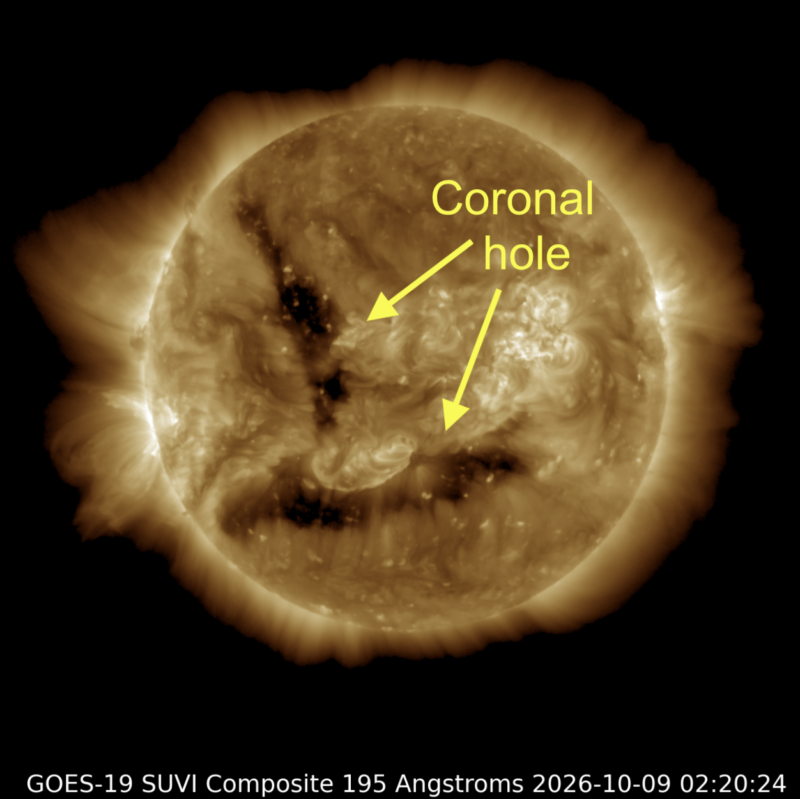
Sun news October 8: Sun-stuff coming to Earth, auroras ahead!
A coronal mass ejection (CME) that left the sun on October 6 is racing toward Earth. Forecasters expect it to arrive in the early hours (UTC) tomorrow, likely triggering G1 to G2 (minor to moderate) geomagnetic storms. There is even a slight chance of G3 (strong) storm intervals. This could mean auroras visible across northern U.S. and U.K. latitudes. Meanwhile, modeling suggests a second CME — launched from the sun on October 7 — will give Earth a glancing blow late on October 10 or early on October 11. So the coming days could be great for aurora watching!
Past 24 hours on the sun
(11 UTC October 7 – 11 UTC October 8)
Flare activity: Solar activity was at low levels. Observers tracked 11 flares during the period: 10 C-class and one B-class.
- Strongest flare: A C8.0 flare peaked at 13:17 UTC on October 7 from AR4549.
- Other notable flares: AR4549 continued popping off small C-class flares throughout the period. AR4545 contributed one C1.6 flare peaking at 00:59 UTC on October 8.
- Lead flare producer: AR4549 dominated, producing nine of the 11 flares.
Sunspot regions: Four sunspot regions occupied the visible disk. One new region was numbered during the period.
- AR4549 (beta-gamma-delta magnetic configuration): This is the largest and most complex region on the disk. Despite its complexity, AR4549 appears generally stable in size. It remains the primary threat for moderate-class flaring.
- AR4550 (beta): This new region emerged in the southwest and was subsequently numbered during the period. It remained relatively quiet after its appearance.
- AR4545: A simpler region that produced one minor C-class flare during the period.
- AR4547: Another relatively simple region. It contributed one near-C-class event (B 9.6) during the period.
Blasts from the sun? The C8 flare from AR4549 at 13:17 UTC on October 7 launched a partial halo CME. STEREO-A coronagraph imagery first captured it at approximately 13:38 UTC. Initial modeling from the Space Weather Prediction Center (SWPC) indicates an Earth-directed component with arrival early on October 11. Other analysis suggests this CME will deliver a glancing blow late on October 10 or early October 11. No other Earth-directed CMEs were observed during the period.
- October 6 CME (prior event): A CME that departed the sun on October 6 remains on track for Earth. SWPC forecasts arrival early on October 9. The U.K. Met Office expects arrival in the early UTC hours of October 9. This is the primary driver for the upcoming geomagnetic storm forecast.
Past 24 hours in space weather
Solar wind: Solar wind speeds continued to decline throughout the period, returning to ambient background conditions. The decline follows the waning influence of a prior coronal hole fast solar wind stream.
Bt, Bz and magnetic coupling: The total interplanetary magnetic field (IMF) (Bt) remained weak. The north-south component (Bz) was generally southward.
Earth’s magnetic field: Geomagnetic activity was quiet to unsettled, with the Kp index ranging from 1 to 3.
Sun news October 7: Sun-stuff headed our way, auroras to come?
A chunk of sun-stuff is heading our way! During yesterday’s M1.4 flare from AR4549, coronagraphs caught a full halo event. That’s when solar material appears to head straight toward Earth in a ring. Then, during the M1.8 flare from the same region, we spotted a second blob of solar material, or coronal mass ejection (CME). Forecasters have confirmed that this material is coming toward Earth, with arrival estimated early on October 9. They anticipate G1 (minor) geomagnetic storming, with G2 (moderate) levels possible. And the timing couldn’t be better. With aurora season underway and a nearly new moon bringing dark skies, conditions look ideal for aurora-watching. Good luck, aurora hunters!
Past 24 hours on the sun
(11 UTC October 6 – 11 UTC October 7)
Flare activity: Solar activity returned to low levels, with only C flares during our observation period. Observers registered 11 flares in total, all C-class (common).
- Strongest flare: A C3.6 from AR4549, peaking at 15:06 UTC on October 6.
- Lead flare producer: AR4549 once again topped the list, firing 10 of the period’s 11 C flares, including the strongest.
Sunspot regions: Currently, the solar disk as seen from Earth holds three numbered sunspot regions, now that AR4547 has departed.
- AR4545 (beta magnetic complexity): This region showed some growth. Even so, it produced no flares.
- AR4547 (beta): This region rotated out of view to the far side of our star.
- AR4548 (alpha): This region showed no flare activity.
- AR4549 (beta-gamma-delta): This region kept growing and maintained its complex beta-gamma-delta configuration. It was once again the lead flare producer. It also carries the potential for more M (moderate) and even X (strong) flares.
Blasts from the sun? It’s now confirmed. After modeling and analysis, forecasters found that the M1.4 and M1.8 flares from AR4549 produced a CME heading directly toward Earth. Arrival should come early on October 9. When it does, it may stir Earth’s magnetic field up to G2 (moderate) storm levels.
Past 24 hours in space weather
Solar wind: Solar wind speeds kept easing over the past day, settling back to low, background levels.
Bt, Bz and magnetic coupling: The total interplanetary magnetic field (Bt) stayed weak. Meanwhile, the north-south component (Bz) behaved much as it did yesterday, pointing mostly southward through the whole period. At the time of this report, it still points south. However, with the field so weak, that southward tilt had little effect.
Earth’s magnetic field: The geomagnetic field reached unsettled levels during the period. The Kp index ranged from 1 to 3.
Sun news October 6: Bam! 3 M flares break the lull!
After days of only weak flaring, our star surprised us over the past day with 3 M (moderate) flares. Two of these came from AR4549, a newcomer sunspot region that has developed rapidly over the past 24 hours. It emerged just east of the solar disk’s center and quickly grew into a monster sunspot group with a beta-gamma-delta magnetic complexity, the most complex possible magnetic configuration. That means it’s capable of producing more M flares and even X (strong) flares. Plus, its position means that any solar material it fires into space would likely head toward Earth. Stay tuned!
Past 24 hours on the sun
(11 UTC October 5 – 11 UTC October 6)
Flare activity: Solar activity jumped to moderate levels with 3 M flares. Flare production also soared, from just 6 B-class (weak) flares the previous day to 22 flares this period: 3 M-class, 9 C-class (common) and 10 B-class.
- Strongest flare: An M1.8 from AR4549, peaking at 8:05 UTC on October 6. It caused an R1 (minor) radio blackout over the Arabian Sea, off the east coast of Somalia.
- Other M flares: First, an M1.1 from AR4545 peaked at 18:48 UTC on October 5, with an R1 (minor) radio blackout over the Pacific Ocean. Then an M1.4 from AR4549 peaked at 6:10 UTC on October 6, with an R1 (minor) radio blackout over the Indian Ocean.
- Lead flare producer: AR4549 topped the list with 16 flares: the two strongest of the period (M1.8 and M1.4), plus seven C flares and seven B flares.
Sunspot regions: Currently, the solar disk as seen from Earth holds 4 numbered sunspot regions. One newcomer received its number during this period: AR4549.
- AR4545 (beta): This region produced the M1.1.
- AR4547 (beta): This region produced three flares.
- AR4548 (alpha): This region showed no flare activity.
- AR4549 (beta-gamma-delta): The newcomer in the neighborhood! It grew rapidly to a large size and developed the strongest magnetic complexity there is. It also produced 2 M flares this period.
Blasts from the sun? Analysts are now modeling all 3 M flares to determine whether any produced a coronal mass ejection (CME) with an Earth-directed component. Given AR4549’s position near disk center, any CME from it deserves close attention.
Past 24 hours in space weather
Solar wind: Solar wind speeds returned to moderate levels over the past day.
Bt, Bz and magnetic coupling: The total interplanetary magnetic field (Bt) decreased to weak levels. Meanwhile, the north-south component (Bz) pointed mostly southward during the whole period.
Earth’s magnetic field: The geomagnetic field reached active levels during the period. The Kp index ranged from 2 to 4.
Sun news October 5: Coronal hole winds caused auroras last night
A stream of fast solar wind has been coming to Earth over the past few days from a coronal hole, or an area of lower density in the sun’s outer atmosphere. This solar wind pushed Earth’s magnetic field to G2 (moderate) geomagnetic storm levels over the past 24 hours. And that triggered beautiful auroral displays at high latitudes! Forecasters expect the fast winds to persist early today before gradually tapering off through midweek. Auroras might be visible again tonight, but likely only at the northernmost latitudes.
Past 24 hours on the sun
(11 UTC October 4 – 11 UTC October 5)
Flare activity: Low. The sun produced only B-class (weak) flares during this period, with 6 events tracked in total.
- Strongest flare: B9.6 from AR4545, peaking at 6:01 UTC on October 5.
- Other notable flares: A B7.9 flare from AR4545 peaked at 5:47 UTC on October 5. AR4547 produced a B4.3 flare at 17:57 UTC on October 4. Three additional B-class flares came from unidentified source regions.
- Lead flare producer: AR4545, responsible for the two strongest flares of the period.
Sunspot regions: Five numbered sunspot regions were on the disk. All were small and magnetically simple. No newcomers were reported.
- AR4545 (alpha): This region produced the period’s two strongest flares (B9.6 and B7.9).
- AR4546 (alpha): Positioned near the western limb, soon to rotate out of view.
- AR4547 (alpha): Quiet and largely unchanged.
- The remaining two numbered regions were quiet and stable throughout the period.
Blasts from the sun? Observers detected no Earth-directed coronal mass ejections ( CMEs) in available coronagraph imagery.
Past 24 hours in space weather
Solar wind: Solar wind speeds climbed dramatically. This acceleration was driven by a coronal hole high-speed stream from a positive-polarity, equatorial coronal hole.
Bt, Bz and magnetic coupling: The total interplanetary magnetic field (Bt) rose to strong. The north-south component (Bz) swung strongly southward.
Earth’s magnetic field: The geomagnetic field reached G2 (moderate) storm levels. The Kp index ranged from 2 to 5, with three separate G1 (minor) storm periods observed (Kp 5).
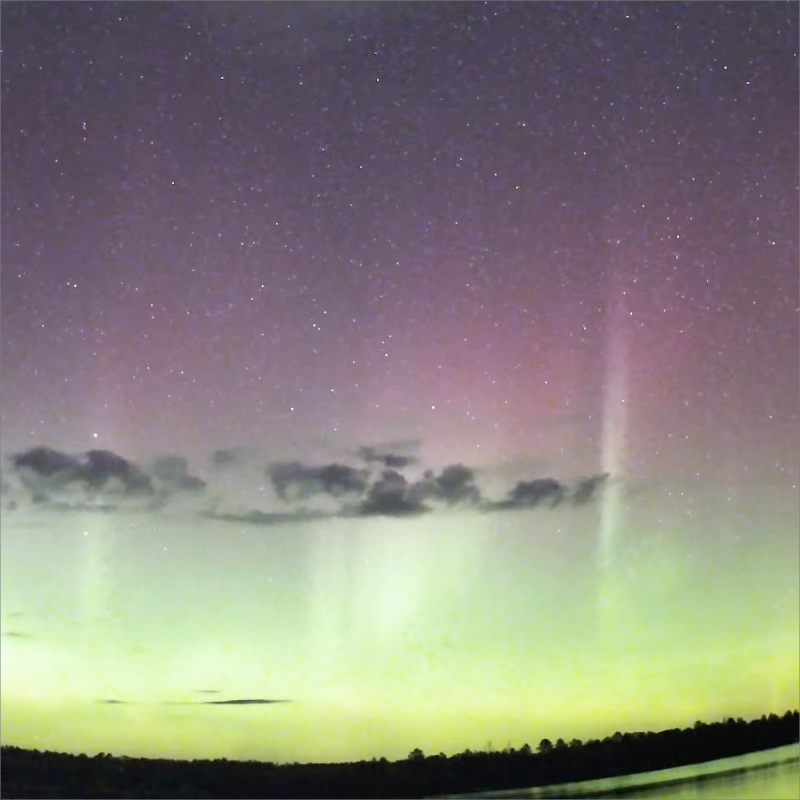
Sun news October 4: Coronal hole winds set to spark auroras
A coronal hole high-speed stream is arriving at Earth today. Forecasters expect it to push solar wind speeds to about 550 to 600 km/s (fast wind speeds), bringing G1 minor geomagnetic storm conditions. There is even a slight chance of G2 moderate storms. Aurora watchers in northern Scotland and similar latitudes could see displays from late October 4 through October 5. Meanwhile, the sun itself remains very quiet. Only B-class flares popped off over the past day. Four small, magnetically simple sunspot regions dot the visible disk. The weak interplanetary coronal mass ejection (CME) from September 28 did graze Earth on October 3. However, it produced only a minor blip in solar wind speed and no significant geomagnetic response. The coronal hole stream is the main act now. Stay tuned!
Past 24 hours on the sun
(11 UTC October 3 – 11 UTC October 4)
Flare activity: Very low. The sun produced 9 B-class flares. No C-class (common) or stronger events occurred.
- Strongest flare: B9.3, peaking at 6:30 UTC on October 4 from AR4546 (S19W61).
- Other notable flares: A B5.0 peaked at 15:07 UTC on October 3 from AR4545. A B4.9 peaked at 00:46 UTC on October 4, also from AR4545. AR4546 contributed three additional B-class flares late in the period.
- Lead flare producer: AR4545 generated 5 of the 9 flares. AR4546 produced the remaining 4, including the strongest.
Sunspot regions: Observers tracked 4 numbered regions on the disk, including 2 newcomers.
- AR4545 (beta): This region grew slightly during the period. It was the most active spot group, producing 5 B-class flares. Still, it managed nothing above B-class. Located in the northern hemisphere, it rotates slowly toward disk center.
- AR4546 (beta): Gained a single trailing spot. Despite being listed as quiet by forecasters early in the period, it became increasingly active later, producing 4 B-class flares, including the period’s strongest, a B9.3. It sits in the southern hemisphere, approaching the western limb.
Blasts from the sun? Analysts observed no Earth-directed coronal mass ejections (CMEs) in coronagraph imagery. A filament was observed lifting off between approximately 02/1845 UTC and 03/0345 UTC (October 2 to 3). However, most of the material appeared to be reabsorbed. Coronagraph imagery confirmed no associated CME.
Past 24 hours in space weather
Solar wind: Speeds were slow, hovering near 270 km/s at the start of the period. A minor enhancement arrived around 03/0118 UTC, pushing speeds to about 300 to 305 km/s. Density briefly jumped at the shock front. By 03/1300 UTC, speeds had dropped back to near 270 km/s and conditions returned to background levels.
Bt, Bz and magnetic coupling: The total interplanetary magnetic field (IMF) increased from about 4 nT to a peak of 9 nT during the minor enhancement, then settled back to around 4 nT. The Bz component dipped as far south as minus 6 nT briefly but was otherwise unremarkable.
Earth’s magnetic field: Geomagnetic conditions stayed at quiet to unsettled levels. The Kp index ranged from 0 to 3. No geomagnetic storming occurred.
What’s ahead? Sun–Earth forecast
Flare activity forecast: Forecasters expect very low activity to continue, with a chance of C-class flares through October 6. All four numbered regions are small and magnetically simple (beta or alpha). No M-class or X-class flares are expected.
Geomagnetic activity forecast:
- October 4: Active conditions expected, with G1 minor storm levels likely and a slight chance of G2 moderate storms. The driver is a coronal hole high-speed stream from a positive-polarity equatorial coronal hole. Aurora may be visible from northern Scotland, New Zealand’s South Island, and similar geomagnetic latitudes. Kp 5 likely, possibly reaching Kp 6.
- October 5: Unsettled to active conditions as coronal hole influence persists but begins to wane. Aurora chances diminish to higher latitudes only.
- October 6: Unsettled to active levels early, then easing to quiet to unsettled as the high-speed stream fades.
- October 7: Mainly quiet to unsettled conditions. No significant drivers expected.
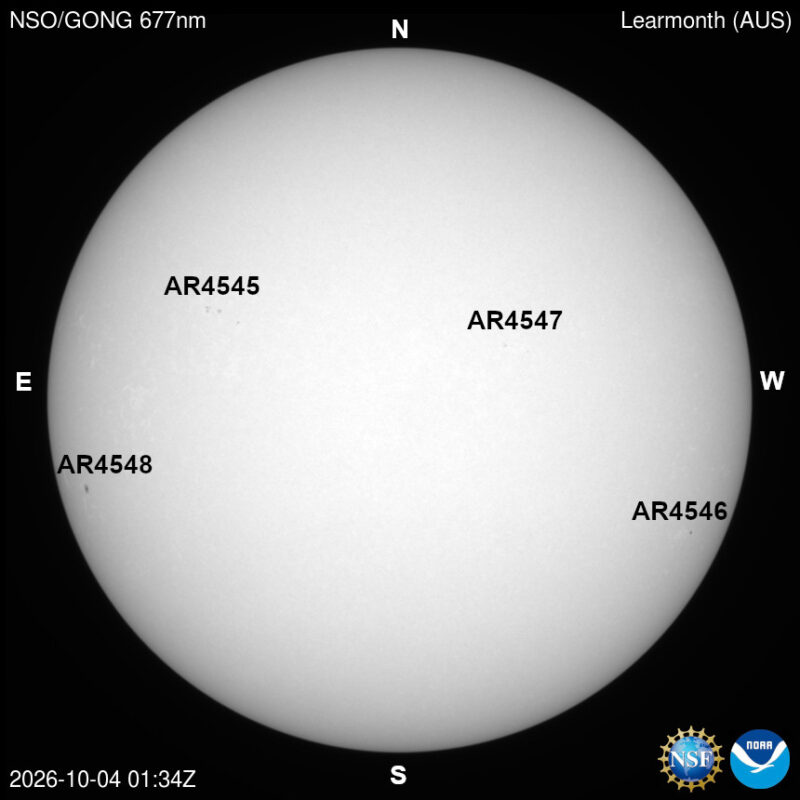
Sun news October 3: Sun-stuff arrives, with more on the way
The anticipated coronal mass ejection (CME) — a moving blob of solar materials and magnetic fields — has arrived. But it brought only a mild disturbance to Earth’s magnetic field. No G1 (minor) geomagnetic storm registered. Still, the show might not be over yet. Forecasters consider G1 disturbances possible today, as a stream of fast solar wind arrives from a large coronal hole on the sun. So we might have auroral displays at high latitudes, especially now that aurora season is here. Then, tomorrow, October 4, a second blob of solar stuff should deliver a glancing blow. Combined with the fast solar wind, it might keep stirring space weather at Earth. So we’ll keep watching …
Do health effects from solar flares bother you? Watch this video
Past 24 hours on the sun
(11 UTC October 2 – 11 UTC October 3)
Flare activity: Solar activity dropped to very low levels over the past 24 hours. Observers registered only two faint B-class (weak) flares in total.
- Strongest flare: A B3.3 from active region AR4535 in the northwest, peaking at 17:37 UTC on October 2.
- Lead flare producer: With just two flares, AR4535 and AR4546 each produced one.
Sunspot regions: Currently, the solar disk as seen from Earth shows two numbered sunspot regions. One of them is a newcomer that emerged from nowhere in the southwest quadrant and received its number this period: AR4546. Meanwhile, AR4544, numbered earlier this week, no longer appears on the list.
- AR4535 (alpha): This region has now departed to the far side of our sun. Just two days ago it showed a beta-gamma configuration. Its simpler alpha label today likely reflects its position right at the limb, where foreshortening makes analysis difficult. Before leaving, it still produced one B flare during the period.
- AR4545 (beta): This is the northeast newcomer that produced faint B flares earlier this week, now with an official number. Today it stayed quiet.
- AR4546 (beta): This newcomer emerged in the southwest and received its official number. It produced one B flare during the period.
Blasts from the sun? Observers registered no Earth-bound CMEs during the period. A huge filament eruption on October 2 hurled plasma into space, but it occurred far from Earth’s direction, so that material won’t reach us.
Past 24 hours in space weather
Solar wind: Solar wind speeds averaged low levels, with slight peaks from the arriving CME. Meanwhile, a coronal hole high-speed stream from a large coronal hole is on its way. So conditions should change today and tomorrow, especially as a second CME delivers a glancing blow.
Bt, Bz and magnetic coupling: The total interplanetary magnetic field (IMF) stayed weak early in the period. Then, at 3 UTC this morning, it began climbing to moderate strength. Meanwhile, the north-south component (Bz) held a southward orientation for the entire period, with just a faint northward peak early on. The strongest peaks pointed south. At the time of this writing, it remains strongly southward.
Earth’s magnetic field: Geomagnetic activity rose from quiet to unsettled levels during this period. The Kp index ranged from 0 to 3. At the time of this report, it sits at level 3.
Sun news October 2: Two bursts of sun-stuff heading to Earth
Two blobs of solar stuff — or coronal mass ejections (CMEs) — are heading our way at Earth. The first is expected to arrive later today, likely disturbing Earth’s magnetic field up to G1 (minor) geomagnetic levels. That could trigger auroral displays at high latitudes, especially now we’re in an aurora season. And the show may be extended through the weekend. Tomorrow, a stream of fast solar wind coming from a large coronal hole might continue stirring space weather at Earth. And adding to all this, a second CME might deliver a weak glancing blow to us on October 4. Good luck and clear skies, aurora chasers!
Past 24 hours on the sun
(11 UTC October 1 – 11 UTC October 2)
Flare activity: Solar activity increased from very low to low levels over the past 24 hours. Observers registered five flares in total: a C-class (common) event and four B-class (weak) flares.
- Strongest flare: A C1.5 flare by active region AR4545 in the northeast. It peaked at 21:37 UTC on October 1.
- Lead flare producer: Active region AR4535 reached the top position, producing three flares during this period. The sparks were three B-class (weak) flares.
Sunspot regions: Today the sun continued showing two numbered sunspot regions, but one is a newcomer in the northeast that’s been producing C and B flares. Finally it received an official number: AR4545.
- AR4535 (alpha magnetic complexity): This region is now at the very edge of the northwest solar horizon and is soon to depart to the far side of our star. This position makes it difficult to analyze, but it appears to have lost its gamma complexity and now shows a simple alpha setup. But it produced three B flares before departing.
- AR4544: This region decayed to only plage and remained inactive.
- AR4545 (beta): This active region that has been blasting flares the whole week finally got numbered and produced today’s only C flare.
Blasts from the sun? The arrival of two coronal mass ejections (CMEs) is anticipated over the next few days. Other than that, no Earth-bound CMEs were registered during the period.
Past 24 hours in space weather
Solar wind: Solar wind speeds averaged low, at background levels. A coronal hole high-speed stream from a large coronal hole is on its way. Space weather conditions are expected to change in the next couple of days.
Bt, Bz and magnetic coupling: The total interplanetary magnetic field (IMF) stayed weak during the period. Meanwhile, the north-south component (Bz) kept shifting from northward to southward for the entire period. The strongest peaks were northward.
Earth’s magnetic field: Geomagnetic activity increased to quiet levels during this period, starting to show some action. The Kp index ranged from 0 to 2. At the time of this report, it sits at level 2.
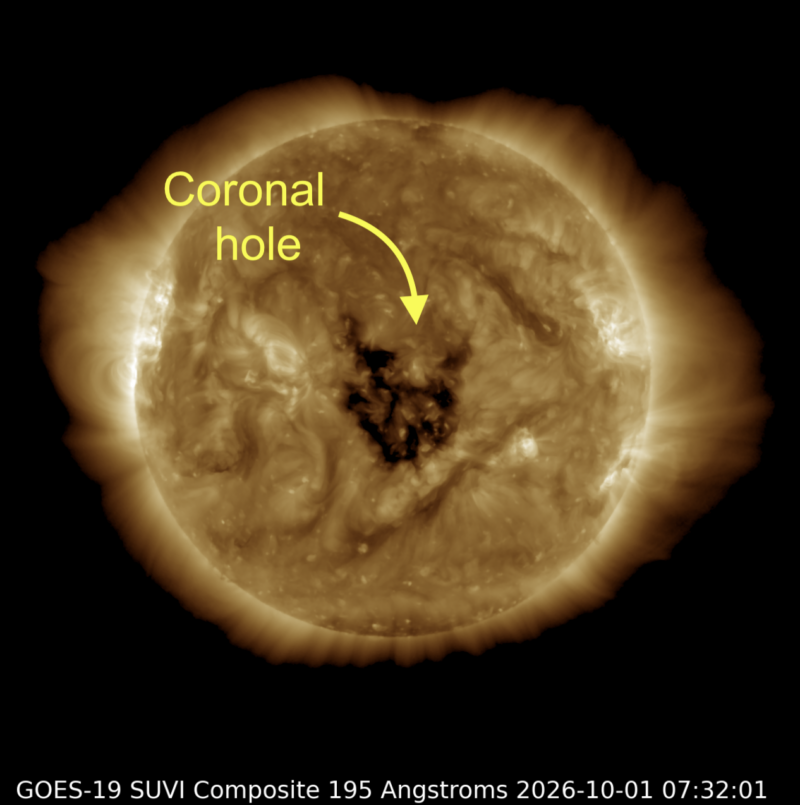
Sun news October 1: Heart-shaped coronal hole facing Earth?
Today’s sun brings something of a Rorschach test. What does that central coronal hole look like to you? Some members of our team see a heart … and others see a devilish face! Whatever it looks like, it’s sending fast solar wind straight at Earth. This should disturb our magnetic field from Saturday. And that’s not all. First, a chunk of solar stuff — or coronal mass ejection (CME) — from the September 28 eruption should reach us tomorrow. Then a CME from yesterday’s C8.6 flare may deliver a weak glancing blow on October 4. All together, these could create promising conditions for auroras over the next few nights. So keep watching the sky, especially at high latitudes.
Past 24 hours on the sun
(11 UTC September 30 – 11 UTC October 1)
Flare activity: Solar activity dropped even lower, to very low levels, during the past 24 hours. Observers registered just one flare: a B-class (weak) event.
- Strongest flare: The period’s only flare, a B5.0, came from an incoming, as-yet-unnumbered region in the northeast. It peaked at 2:50 UTC on October 1.
- Lead flare producer: With only one flare, there was only one producer: that unnumbered newcomer in the northeast quadrant.
Sunspot regions: Today the sun continued showing two numbered sunspot regions. Meanwhile, the northeast region producing B flares hasn’t received an official number yet.
- AR4535 (beta-gamma magnetic complexity): Yesterday, this region produced an almost M-class flare. During this period, however, it produced no flares.
- AR4544 (beta): This region showed growth. Still, it stayed inactive.
Blasts from the sun? Specialists have confirmed the CME that AR4535 hurled into space during the C8.6 event. They anticipate a weak glancing blow at Earth, with arrival expected on October 4.
Past 24 hours in space weather
Solar wind: Solar wind speeds stayed low, at background levels, as the previous coronal hole high-speed stream waned. However, a large new coronal hole now sits at the center of the Earth-facing disk. Its fast solar wind may start reaching us in a couple of days.
Bt, Bz and magnetic coupling: The total interplanetary magnetic field stayed weak during the period. At the time of this writing, though, it peaked at moderate levels. Meanwhile, the north-south component (Bz) pointed mostly northward for the entire period, with only a couple of very faint southward peaks.
Earth’s magnetic field: Geomagnetic activity stayed at very quiet levels during this period. The Kp index again ranged from 0 to 1. At the time of this report, it sits slightly above level 0.
Sun news September 30: Near-M flare! Sun waking up?
Our star surprised us again over the past day. This time the sun’s activity lull was broken by a near-M flare from sunspot region AR4535. The blast, a fiery C8.6, peaked at 2:46 UTC on September 30. We can clearly see a huge chunk of solar stuff was sent to space by this eruption. Modeling and analysis is underway to see if this blast could be heading to Earth. We have been observing this sunspot region, AR4535, since it developed a gamma magnetic complexity, and it’s now showing an even-more-promising beta-gamma configuration. A spark like this is what we have all have been expecting from this region. Is this AR4535 — and the sun — waking up?
Past 24 hours on the sun
(11 UTC September 29 – 11 UTC September 30)
Flare activity: Solar activity continued at low levels during the past 24 hours, but the near-M flare increased flare activity almost to moderate levels. We have not seen an actual M flare since September 5. Observers registered 5 flares in total: 3 C-class (common) and 2 B-class (weak).
- Strongest flare: A C8.6 from AR4535, peaking at 2:46 UTC on September 30.
- Lead flare producer: There is a newcomer in the northeast that dominated, firing three of the five flares: two Cs and one B flare.
Sunspot regions: Today our sun shows two numbered sunspot regions. A newcomer in the southwest received its official number during this period: AR4544. But the sunspot region producing C and B flares in the northeast hasn’t received an official number yet.
- AR4535 (beta-gamma magnetic complexity): This region surprised with an almost-M flare during the period.
- AR4544 (beta): Newcomer numbered during this period. Remained inactive.
Blasts from the sun? All eyes concentrated on the C8.6 flare by AR4535 this morning. An imminent coronal mass ejection (CME) may be confirmed. For now specialists are running modeling and analysis to determine if there is an Earth-directed component from this event.
Past 24 hours in space weather
Solar wind: Solar wind speeds held at low at background levels as the coronal hole high-speed stream waned.
Bt, Bz and magnetic coupling: The total interplanetary magnetic field stayed weak but we saw some moderate peaks during the period. Meanwhile, once again, the north-south component (Bz) pointed mostly southward for the entire period.
Earth’s magnetic field: Geomagnetic activity continued at very quiet levels during this period. Kp index ranged from 0 to 1. At the time of this report, the Kp index sits at level 1.
Like what you read?
Subscribe and receive daily news delivered to your inbox.
More from
C. Alex Young


Sun news November 1: The day the sun wasn’t done yet

Yes, there’s an aurora season, and it’s here
Sun activity archive for September 2026
Sun activity archive for August 2026