



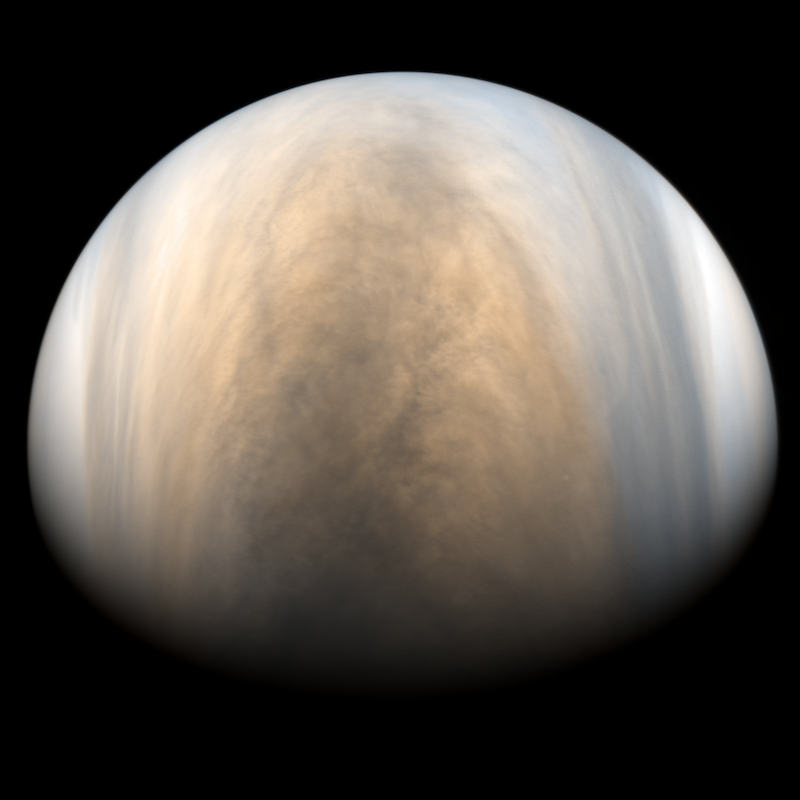
- Venus has no moon. But did it have one in the past?
- A new study from researchers in the U.S. and France suggests that it did.
- The moon likely would have lasted up to nearly 2 billion years before being destroyed by Venus’ gravity.
Venus had a moon billions of years ago
Venus is one of only two planets in our solar system that doesn’t have a moon. But that doesn’t mean it couldn’t have had one in the past.
In a new study, researchers have found that Venus probably did have a moon, and for nearly 2 billion years. The team, from the University of California, Riverside, and the University of Bordeaux, CNRS, in France, said on September 2, 2026, that Venus likely eventually consumed its moon. Venus’ gravity would likely have ripped the moon apart, forming a temporary ring around the planet.
Our solar system is about 4.5 billion years old. Venus’ moon would have formed in the early stages of the formation process. So if it lasted almost 2 billion years, then that means Venus lost its moon about 2.5 billion years ago.
The researchers submitted their not-yet peer-reviewed paper to the arXiv preprint server on September 2, 2026.
Moon suffers cataclysmic fate
If Venus had a moon, why did it get destroyed? It likely had to do with how Venus spins on its axis. It rotates slower than Earth, completing a rotation every 243 days with respect to the sun. Its orbit, by comparison, is 225 days.
The slower rotation means that the moon would have transferred angular momentum to Venus. That would have caused the moon to gradually move closer to Venus. That’s the opposite of Earth’s moon, which is slowly moving farther away.
Lead author Stephen Kane at University of California, Riverside, said:
The moon is transferring angular momentum inward instead of outward. It causes the moon’s orbit to catastrophically collapse.
But when did the moon actually begin to disintegrate? That would happen when it reached the Roche limit, at about 9,321 miles (15,000 km) above Venus. Kane said:
That’s where Venus’ gravity rips the moon apart and consumption occurs.
Millions to billions of years
How long the moon survived will have depended on its mass. If it was about half the mass of our own moon, it would have survived about 1.7 billion years. But if it was twice that mass, it would have only lasted about 30 million years.

Difficult to prove that Venus had a moon
Although the models strongly suggest an ancient moon, proving it is difficult. That’s because there’s nothing left of it. The debris, the researchers say, fell into the atmosphere and was destroyed. As Paul Byrne at Washington University in St Louis, Missouri, explained:
It’s exceedingly hard to test this idea because there is basically nothing left behind.
What about debris on the surface? That’s also unlikely, since the surface is so extremely hot and corrosive. And erupting volcanoes have resurfaced the surface many times over.
There could still be some evidence underground though. Scientists could find it by studying seismic waves moving through Venus’ interior. Kane noted:
That would tell us a lot.
Habitability of Venus
We know that Earth’s moon has played a role in helping to keep our planet habitable. What about Venus? Some studies have suggested that Venus was once more earthlike, perhaps even with oceans. But then something happened that caused a global greenhouse effect. The surface temperatures on Venus soared until the planet was uninhabitable. Could the destruction of a moon have been responsible for that? It’s possible, as Kane surmised:
If there was an early habitable period of Venus, then the big question is what brought that to an end. It could definitely be connected to Venus’ runaway greenhouse state.
It’s fascinating to think that Venus might have once had a moon. What did it look like? How big was it? What was it made of? Hopefully those questions will be answered in the future.
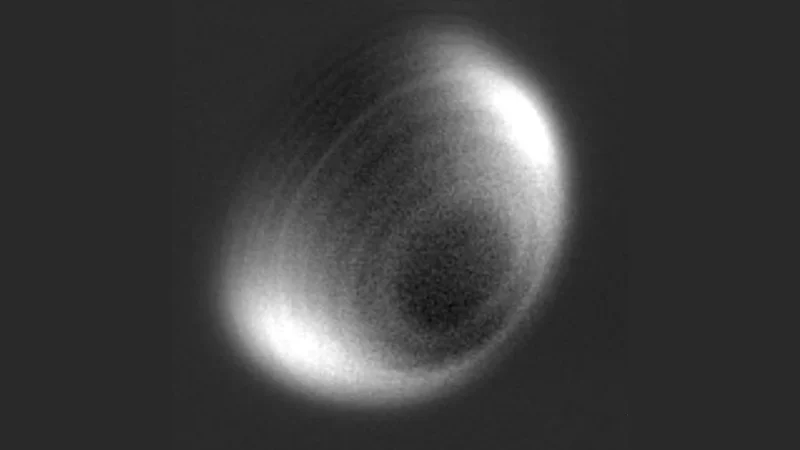
And while Venus might not have a moon anymore, it does have rings … in its clouds!
Bottom line: Venus had a moon a long time ago, scientists in the US and France say. It likely survived for nearly two billion years until Venus’ gravity tore it apart.
Source: Tidal Demise: The Evolution and Fate of a Hypothetical Venus Moon
Read more: Peptides in Venus’ clouds could form life-giving shapes
Like what you read?
Subscribe and receive daily news delivered to your inbox.
More from
Paul Scott Anderson


Alien tech on the moon? Scientists propose search for microscopic debris

Peptides in Venus’ clouds could form life-giving shapes
These microbes in Antarctica don’t live anywhere else
Mars’ southern hemisphere is unusually hot deep underground


