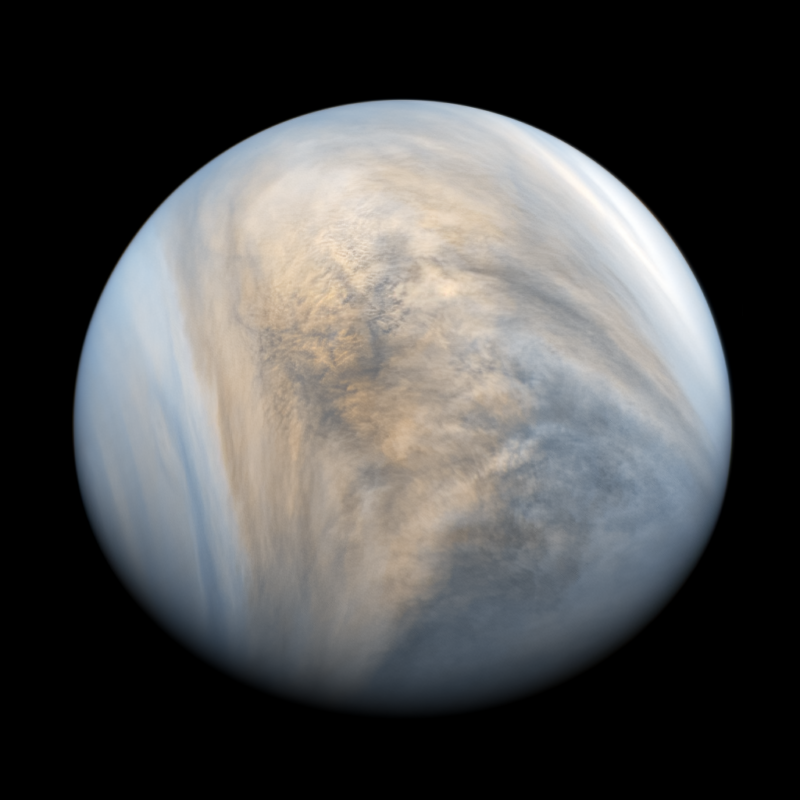
- Venus’ clouds are extremely acidic. But that doesn’t necessarily mean microbes couldn’t exist there.
- Peptides – short chains of amino acids – could survive in those clouds, researchers at MIT say.
- They might also be able to form the shapes needed for biological functions, adding to suspicions that life might be present in Venus’ clouds.
Peptides in Venus’ clouds could form life-giving shapes
Venus’ atmosphere is, for the most part, very unfriendly for life. Its clouds are full of droplets of sulfuric acid, toxic for life as we know it. But, as some other studies have hinted at, perhaps it’s not too toxic for life. Now, a new study from researchers at Massachusetts Institute of Technology (MIT) has added a new twist to the possibility of life on Venus.
The paper centers on peptides: short chains of amino acids that act as the building blocks of proteins. The researchers said on August 31, 2026, that any peptides in Venus’ clouds might not only remain stable, but could form shapes suitable for biological functions.
The researchers published their intriguing peer-reviewed results in Proceedings of the National Academy of Sciences (PNAS) on September 4, 2026.
Peptides preserved in Venus’ cloud droplets
Although Venus’ clouds are highly acidic, the temperatures at those latitudes are much more earthlike than at Venus’ scorching hot surface. And there is a bit of water in the droplets as well. So could microbes live there?
One of the lead authors of the new study, Mei Hong at MIT, said:
If peptides find their way to that cloud layer of concentrated sulfuric acid, they will stay and be stably preserved in that cloud of droplets. And once these macromolecules have a defined three-dimensional structure, they can potentially have a function.
Can biological molecules survive in sulfuric acid?
Meteorites that contain the building blocks of peptides do enter Venus’ atmosphere on a regular basis. So it’s conceivable that they could survive and become the building blocks of simple bacteria-like organisms.
In 2020, co-author Sara Seager at MIT began a series of experiments. Seager and her colleagues tested how well a variety of biological molecules could survive when immersed in a liquid solution of nearly pure sulfuric acid. This simulated the droplets in Venus’ clouds. They used nuclear magnetic resonance (NMR) spectroscopy – which measures the magnetic properties of atomic nuclei within molecules – to analyze the structures of the molecules.
It might be expected that the molecules would all be destroyed. But instead, nucleic acids – the building blocks of DNA – lipids and amino acids all survived. So what about peptides?
The peptides remained stable for many weeks. This was due to the very small amount of water in the solution. The solution was 98% sulfuric acid. This meant there wasn’t enough water for hydrolysis, which is the chemical reaction that breaks the bonds of peptides. Hong said:
Without water, an acid that you would consider a harsh solvent suddenly is not as menacing as one might think.
Shapes of the peptides
The peptides not only survived, but they changed their shapes. One peptide, called HHQ, contains seven amino acids. In ordinary water, its form is flat beta sheets. But in the sulfuric acid solution, it looked more like the Greek letter omega. These three-dimensional shapes – called omega loops – can actually be found in some proteins. Two other peptides, HHQ13 and K7, also formed omega loops.
So why does that happen in sulfuric acid? The researchers say that the molecules of sulfuric acid act as a scaffold. They slide into the center of each loop, thereby supporting them. Hong said:
What hadn’t been known is that peptides can survive so well and have specific three-dimensional shapes in an acidic environment.
Biological functions?
Why are omega loops significant? In earthly life, they play a role in protein folding and molecular recognition. So the fact that peptides can seemingly form these structures even in sulfuric acid is tantalizing. Does it mean life – at least microbes – could exist in such environments?
We don’t know yet, but as co-author Sara Seager at MIT said:
Life needs to have specially shaped proteins so that they have a specific target they can latch onto and perform their function. Before this, people thought that peptides couldn’t survive in sulfuric acid, so showing peptides are not only stable, but also fold, is a really big deal.
Adriaan Bax, chief of the Section on Biophysical NMR at the Laboratory of Chemical Physics at the National Institute of Diabetes and Digestive and Kidney Diseases, added:
The observation that these peptides retain a substantial degree of conformational order in concentrated sulfuric acid raises the prospect that folded oligopeptide/protein structures can exist in such environments, potentially supporting the possibility of life in atmospheric conditions that are very different from Earth.

DNA with peptide backbones
The implications could even extend to life that has different kinds of DNA to life forms on Earth. One possible example is a molecule called peptide nucleic acid (PNA), an artificially synthesized molecule that is similar to DNA but with the sugar-phosphate backbone replaced by a peptide backbone.
In 2024, another international team of scientists also found that amino acids could survive in Venus’ clouds. Amino acids are the building blocks of proteins.
And another study, from California State Polytechnic University, Pomona in 2025, suggested that the droplets in Venus’ clouds actually have less sulfuric acid – and more water – in them than previously thought. How might that affect the peptides, if they were present?
Bottom line: A new study from MIT shows that peptides in Venus’ clouds could survive in the sulfuric acid droplets and fold into the shapes need for biological life.
Source: Peptides adopt stable omega-loop structures in concentrated sulfuric acid
Read more: Amino acids on Venus? New study says it’s possible
Read more: Life on Venus? Exciting new VERVE mission could find it
Like what you read?
Subscribe and receive daily news delivered to your inbox.
More from
Paul Scott Anderson


Surprising colors of white dwarf stars revealed for 1st time

Caves on the moon are target of new NASA mission
2nd-generation planet: Was this world born around a dead star?
Weirdest cloud on Mars formed via ‘exotic physics’