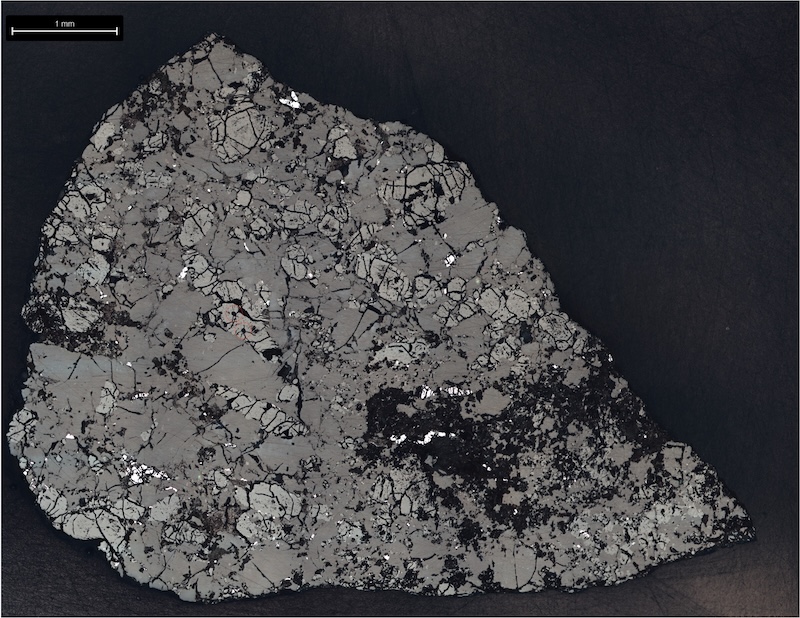
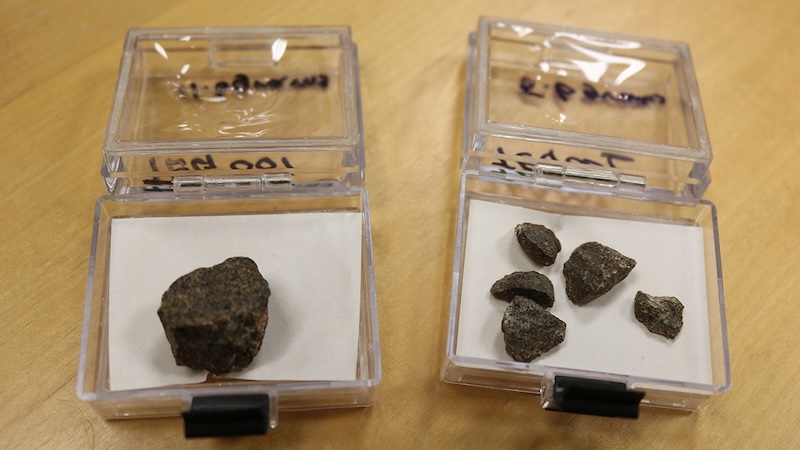
- Teghaza 001 is a rare Martian meteorite that is 4.1 billion years old. It was discovered in the Sahara Desert in Mali in 2022.
- The meteorite contains large amounts of manganese oxide, a common byproduct of microbes on Earth.
- The rare piece of Martian crust also provides more clues about water and habitable conditions on ancient Mars.
Does this rare Martian meteorite hold clues to ancient life on Mars?
A rare 4.1-billion-year-old Martian meteorite has given us new clues about ancient Mars. And some of this new information hints at the possibility of ancient microbial Martian life, back when conditions on the red planet were very different.
The meteorite, called Teghaza 001, was found in the Sahara Desert in Mali in 2022. It’s one of the oldest Martian meteorites ever found.
The researchers said on October 29, 2026, that when they examined the meteorite more closely in the lab, they found something interesting. It contains large amounts of manganese oxide. Why’s that interesting? Because on Earth, manganese oxide is a common byproduct of microbial life.
This isn’t proof of ancient life on Mars, but it’s certainly tantalizing. The meteorite also provides more clues about how wet and how potentially habitable Mars was billions of years ago.
Lead author Yang Liu at NASA’s Jet Propulsion Laboratory in Southern California said:
It was only after we started looking closely that we realized this meteorite is really unique. One of the paper’s reviewers called it a Rosetta Stone for Mars.
The researchers published their peer-reviewed results in Science on October 29, 2026.
Large amounts of manganese oxide
One of the things that makes Teghaza 001 unique is the high levels of manganese oxide within it. On Earth, manganese oxide is a common byproduct of microbial life.
Although this finding does not prove the existence of ancient life on Mars, it remains intriguing.
Carl Agee, director and curator at UNM’s Institute of Meteoritics, and colleague Karen Ziegler, a scientist and research professor in the Department of Earth and Planetary Sciences at the University of New Mexico, examined the meteorite more closely. Agee said:
I realized that this one was a little bit like Black Beauty, not exactly, but it resembled it in the oxygen isotope values. I looked at it microscopically and found domains within it that had high levels of manganese oxide, a compound being looked for on Mars by the rovers as an indicator of environments conducive to life.
Rare Martian meteorite is one of the oldest
Teghaza 001 is one of the oldest Martian meteorites ever found so far. The researchers discovered tiny zircon crystals in the meteorite. They allow age-dating of igneous rocks that form from the cooling of molten magma. The team used uranium-lead age analyses to date the tiny crystals, and Teghaza 001 turned out to be 4.1 billion years old. That makes it one of the oldest known Martian meteorites. Agee said:
There are a few parts to Black Beauty that are around that age, but that whole meteorite itself is a conglomeration of many different rock types. Teghaza 001 is just one unadulterated rock type, and it’s 4.1 billion years or older, so that was a big surprise. It’s the oldest Martian igneous rock ever found by a huge margin, but in addition to that, it seemed to have these clues in its composition that suggested it had been in an environment that had fluids and water coursing through it.
More evidence for ancient water
The meteorite also provided yet more evidence for liquid water billions of years ago on Mars. The clues come from unusual oxygen isotope compositions and altered minerals. Like other previous studies, they point to a warmer and much wetter ancient Mars. As Agee explained:
We also had these anomalous oxygen isotopes, and these domains that had high manganese levels. All of that was consistent with it being from a time on Mars, from the very, very beginning when the Martian environment was different from the time in which most of the Martian meteorites that we see were formed and erupted a few 100 million years ago when Mars was a dry desert, just like it is now. This sample probably came from an environment on Mars that was more Earth-like.
This period of time on Mars is called the Pre-Noachian period. It’s the oldest geological epoch, approximately 4.5 to 4.1 billion years ago.
Going back in time
Being able to study this meteorite is like going back in time, Agee said:
This is just one single meteorite. It’s like going out, going back in time and chipping off a hunk of an outcrop, 4 billion years ago on Mars, and then we have this example of what was actually happening. That is why it’s such a valuable sample. We’ve never found one like this before.
The most exciting part about this find is its age, plus the alteration in the meteorite that indicates it has been in what I would call an Earth-like environment, with fluids coursing over the surface and volcanoes creating hydrothermal systems.
There are surface waters and so on. And that’s all reflected in the way that the meteorite has been sort of altered from its original state.
It’s not like this is very common so not only is it ancient and samples a different type of environment in a different time on Mars, but we don’t have any other samples like it. Chances are very slim or next to impossible, that we’ll get another one, like this anytime soon.

Life on the surface of Mars?
This is also the time when life on Mars’ surface would have been the most possible, as Agee noted:
If there was ever abundant life on Mars, on the surface, not sequestered away in some subsurface, that would be the time that you would be looking at the Pre-Noachian period. It’s the very earliest time, and that was when maybe Mars still had a magnetic field, and it was shielded from radiation, and there were surface waters.
There was a denser atmosphere. If primitive life was abundant in Mars. That is the time that is most likely for it to have down happened.
Origin of rare Martian meteorite Teghaza 001
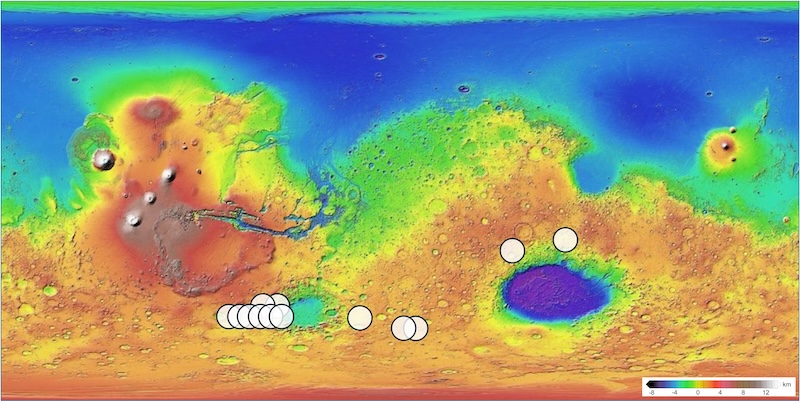
We know that Teghaza 001 came from Mars. But where exactly on Mars? The researchers don’t know for sure yet, but they narrowed it down to 13 primary possible locations. Several are in the Southern Highlands region.
If scientists can identify the exact location, it could help in the planning of future rovers and where to send them.
Bottom line: A rare 4.1-billion-year-old Martian meteorite, Teghaza 001, provides new clues about Mars’ ancient and more habitable past.
Source: A Martian meteorite that formed 4.1 billion years ago samples Mars’ early crust and mantle
Read more: Oldest Mars meteorite reveals Mars lost its water early
Like what you read?
Subscribe and receive daily news delivered to your inbox.
More from
Paul Scott Anderson


Atmosphere of lava planet: ‘A cloudy, reflective sunscreen’

Active volcanoes on Mars? Noxious gas discovery says — maybe
Did comets seed life on Earth? A new study says — probably not
Do black holes split into smaller black holes?